

Exciton quantum superlattices: redefining carrier dynamics in photocatalytic water splitting
 0


 Download PDF
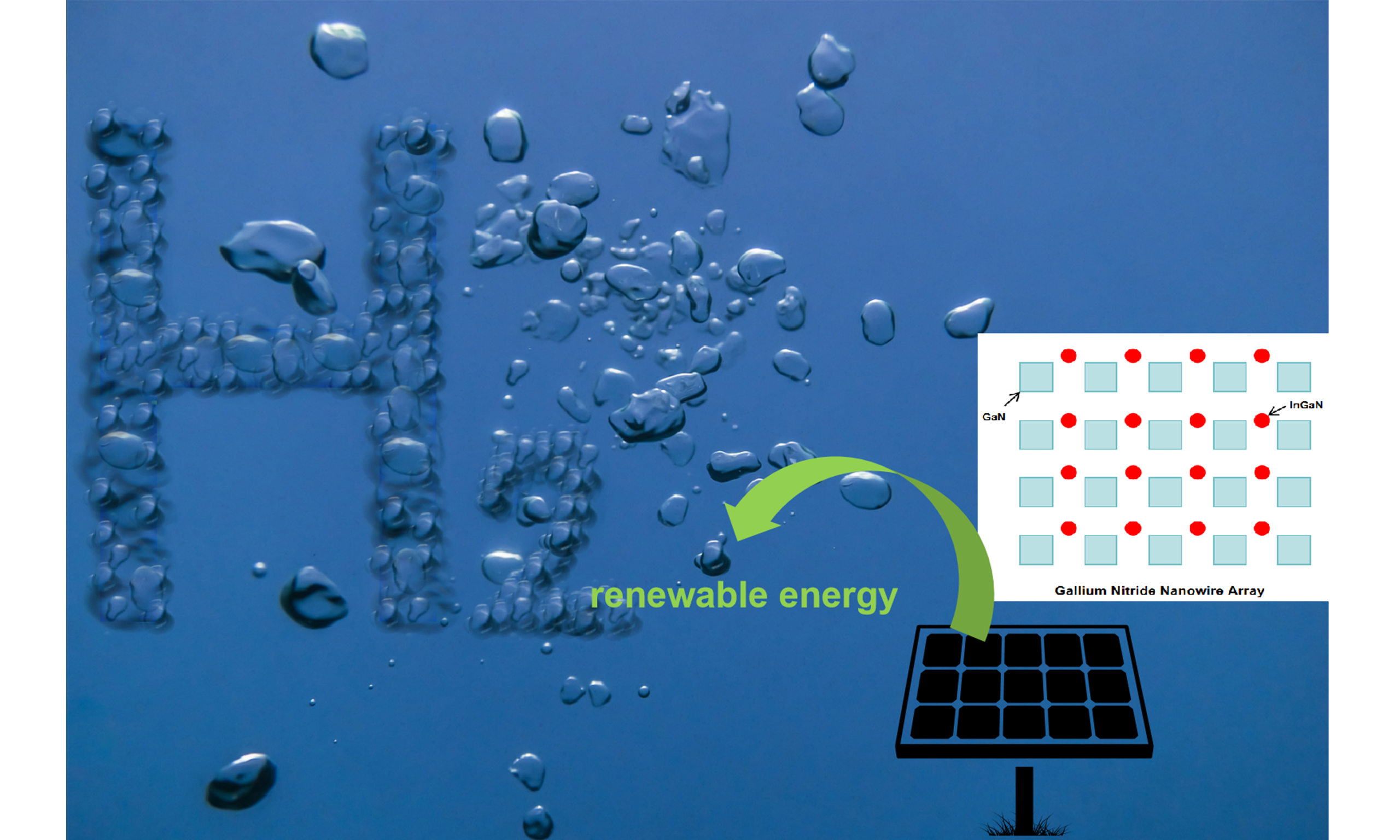
Solar-driven photocatalytic overall water splitting (OWS) uses semiconductor photogenerated carriers to drive redox half-reactions, converting solar energy into storable hydrogen fuel - a crucial step toward carbon neutrality[1,2]. However, a core bottleneck has long hindered progress in this field: the extremely low utilization rate of photogenerated carriers[3]. Particularly under natural conditions at room temperature and atmospheric pressure, reverse reactions intensify and carrier recombination is severe, making it difficult for the solar-to-hydrogen (STH) efficiency of the system to exceed the threshold required for practical application. For decades, researchers have primarily pursued two research paths: first, optimizing the charge separation process through strategies such as crystal plane engineering and heterostructure engineering[4]; second, developing novel light-absorbing materials to broaden the spectral response range. Nevertheless, in most systems that use pure water and operate at room temperature and atmospheric pressure, STH efficiency remains well below 1%[5]. The fundamental reason lies in the fact that photogenerated electrons and holes must travel a considerable distance to reach the reaction sites; during this process, ohmic losses and carrier recombination occur, resulting in low carrier utilization. This critical issue has long plagued researchers worldwide. Recently, Pan et al.[6] published an innovative study in which they utilized an exciton quantum superlattice structure. By localizing excitons with an artificial periodic potential, the researchers created a tunable quantum exciton array, thereby enabling photocatalytic water splitting with high efficiency at room temperature and ambient pressure.
Pan et al.[6] employed plasma-assisted molecular beam epitaxy (MBE) to embed Indium Gallium Nitride (InGaN) quantum-well layers into an array of Gallium Nitride (GaN) nanowires, thereby fabricating an InGaN/GaN superlattice structure on a silicon substrate, as shown in Figure 1. High-angle annular dark-field scanning transmission electron microscopy (HAADF-STEM) imaging clearly revealed the uniform stacking structure of this superlattice, with the two layers arranged in an alternating pattern[6]. The core innovation of this work lies in the reverse application of the quantum-confined Stark effect (QCSE). In the study by Pan et al.[6], the authors systematically investigated the coupling between quantum effects and polarization fields by varying the superlattice period N (N = 10, 20, 40, 80). By leveraging the strong polarization of the wurtzite structure along the c-axis and the lattice-mismatch strain at the InGaN/GaN interface, the researchers established a polarization-induced electric field of up to approximately 0.9 MV/cm within the superlattice[6]. Driven by the polarization electric field, photogenerated electrons and holes relax toward opposite sides of the potential well, forming electron-hole pairs that are spatially separated but bound by Coulomb forces, thereby significantly suppressing bulk recombination. Superlattice tuning showed that 10-layer wells yield weak QCSE, 80-layer wells induce radiative recombination via overlap, and 40-layer (4.3/8 nm) wells optimally balance QCSE and overlap[6]. Experimentally, photoluminescence (PL) measurements showed that the emission peak of the 40-layer (4.3/8 nm) wells was blue-shifted by 20 nm with increasing excitation power, directly confirming strong QCSE[6]. By comparison, the team led by Zetian Mi at the University of Michigan reported a 9.2% STH efficiency in its 2023 study of InGaN/GaN nanowires using a temperature-dependent strategy[7]. That system, however, relied on high-temperature conditions to suppress the reverse reaction. In contrast, the present study improves carrier utilization by extending the exciton lifetime through QCSE at room temperature and atmospheric pressure, offering an approach to exciton engineering that does not require elevated temperatures.
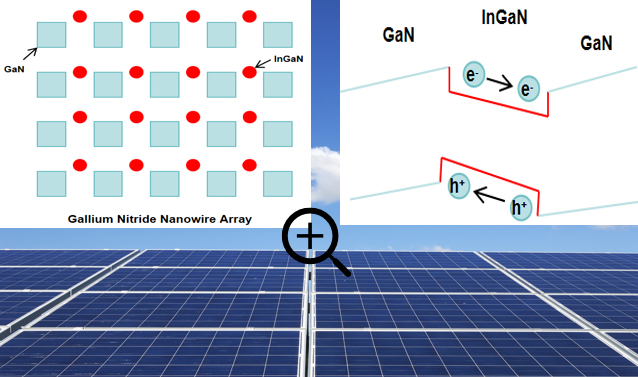
Figure 1. Schematic diagram of an InGaN quantum-well layer embedded in a GaN nanowire array, and illustration of the QCSE in InGaN/GaN superlattices. QCSE: Quantum-confined Stark effect; InGaN: indium gallium nitride; GaN: gallium nitride.
Building on the successful realization of long-lived indirect excitons, Pan et al.[6] addressed the key challenge of how to efficiently use excitons to drive surface chemical reactions by integrating cocatalysts at the nanoscale and designing interfacial electric fields. Using photodeposition, they built “micro-reaction zones” on InGaN/GaN nanowires by coupling Rh/Cr2O3 core-shell structures with CoOOH. HAADF-STEM imaging and elemental mapping showed that Cr2O3-encapsulated Rh suppressed the reverse oxygen reduction reaction (ORR), while CoOOH was positioned nearby, separated from the Rh/Cr2O3 structure at the nanoscale. For comparison, in 2025, a University of Michigan team optimized carrier dynamics through Mg doping in deep nanostructures of an InGaN micro-network, achieving an STH efficiency of approximately 2.6% under concentrated light at about 50 °C[8]. In the same year, the same team further constructed an integrated Rh-MoRhOx cluster heterostructure on InGaN/GaN nanowires[9], enhancing the hydrogen production efficiency of the artificial leaf system by approximately 40-fold through the tight coupling of redox clusters. Building on this integrated-cluster approach, the study combines QCSE-based exciton modulation with interfacial electric-field rectification at the Rh/Cr2O3/CoOOH interface[6], achieving an STH efficiency of 3.16% at room temperature and atmospheric pressure. In comparison, this work not only significantly outperforms previous studies in terms of efficiency but also, more importantly, overcomes the limitations of conventional systems that rely on long-distance carrier migration or externally applied redox shuttles. It does so by precisely controlling the nanoscale distribution of redox sites and the local electric-field environment through exciton regulation within a single nanowire and rectification at the cocatalyst interface.
Another key feature of this study is the application of exciton quantum superlattices in real-world environments[6], where their practical potential was demonstrated through outdoor tests under concentrated sunlight and tests conducted in seawater. A 40-layer InGaN/GaN superlattice achieved an STH efficiency of 3.16% under concentrated illumination (2,000 mW/cm2) at room temperature and standard atmospheric pressure, and 3.05% under one-sun illumination[6]. In outdoor testing at the University of Michigan North Campus, the average STH efficiency was 1.64% (with a peak of 1.94%) under 204-fold solar concentration using a 16 cm2 wafer[6]. For comparison, Zhou et al.[7] (2023) achieved an STH efficiency of 9.2% in an InGaN/GaN system but relied on high-temperature concentration. By contrast, the present study operated at room temperature and atmospheric pressure without an external circuit. Although the STH efficiency of 3.16% is lower than that achieved by the aforementioned high-temperature or externally biased approaches, it demonstrates the effectiveness of QCSE-based exciton regulation. Furthermore, the system achieved an STH efficiency of 2.28% during the first hour of operation in natural North Atlantic seawater and demonstrated corrosion resistance. However, challenges remain, including the limited stability of the CoOOH cocatalyst under high solar concentration (approximately 49% Co loss), limited turnover of active sites under 204-fold solar concentration, the high cost of MBE epitaxy, and interfacial mixing in ultrathin samples.
In summary, this innovative study by Pan et al.[6] redefines the paradigm for controlling carrier dynamics in photocatalytic water splitting through the ingenious combination of quantum confinement and polarization engineering. This research not only provides an innovative solution to the long-standing challenge of low carrier utilization in the field but also opens up a new research direction based on exciton quantum superlattices. The implications of this work extend beyond photocatalysis. The study establishes a generalizable paradigm for modulating charge-carrier dynamics through quantum effects, which is poised to play a pivotal role in other solar-driven reactions, such as CO2 reduction and nitrogen fixation. Nevertheless, practical application of the system faces several constraints. Surface cocatalysts are prone to leaching under highly concentrated illumination and in seawater, and their instability is a major bottleneck that can lead to system failure. In addition, the system depends on solar concentration and tracking; thermal management during continuous operation and high-pressure gas separation remain unresolved.
DECLARATIONS
Authors’ contributions
Writing - original draft, investigation, formal analysis, validation: Zhang, L.; Yang, L.
Investigation, formal analysis, resources, methodology: Zhu, H.; Wang, S.
Writing - review & editing, project administration, funding acquisition, conceptualization: Liu, T.
Availability of data and materials
Not applicable.
AI and AI-assisted tools statement
Not applicable.
Financial support and sponsorship
This work was supported by the Guangxi Science and Technology Major Program (grant no. AA24206037), the Special Fund for Science and Technology Development of Guangxi (grant no. AD25069078), the “Guangxi Bagui Scholars” Fund, the Training Project of High-level Professional and Technical Talents of Guangxi University, and the Natural Science and Technology Innovation Development Multiplication Program of Guangxi University (grant no. 2022BZRC006).
Conflicts of interest
All authors declare that there are no conflicts of interest.
Ethical approval and consent to participate
Not applicable.
Consent for publication
Not applicable.
Copyright
© The Author(s) 2026.
REFERENCES
1. Hisatomi, T.; Yamada, T.; Nishiyama, H.; Takata, T.; Domen, K. Materials and systems for large-scale photocatalytic water splitting. Nat. Rev. Mater. 2025, 10, 769-82.
2. Alotabi, A. S.; Adnan, R. H.; Almutairi, A. M.; et al. A comprehensive review of the role of overlayers in photocatalytic overall water splitting and related reactions. Chem. Rev. 2026, 126, 2801-45.
3. Song, K.; Liu, H.; Chen, B.; et al. Toward efficient utilization of photogenerated charge carriers in photoelectrochemical systems: engineering strategies from the atomic level to configuration. Chem. Rev. 2024, 124, 13660-80.
4. Guo, C.; Guo, J.; Song, W.; et al. Atomic heterointerface engineering and nonequilibrium carrier dynamics for enhanced photocatalysis in halide perovskite/MoS2 systems. Angew. Chem. Int. Ed. 2025, 64, e202506436.
5. Teh, I. J.; Putri, L. K.; Yaw, C. S.; Ng, W. C.; Chong, M. N.; Chai, S. Engineering high-performance BiVO4 homo- and heterojunction Photoanodes for solar-driven Photoelectrochemical water splitting applications. Coord. Chem. Rev. 2025, 541, 216773.
6. Pan, Y.; Zhang, B.; Ye, Z.; et al. Excitonic quantum superlattices for efficient photocatalytic water splitting. Nat. Energy. 2026, 11, 571-80.
7. Zhou, P.; Navid, I. A.; Ma, Y.; et al. Solar-to-hydrogen efficiency of more than 9% in photocatalytic water splitting. Nature 2023, 613, 66-70.
8. Navid, I. A.; Shen, Y.; Zhou, P.; et al. Molecular beam epitaxy, photocatalytic solar water splitting, and carrier dynamics of InGaN micro-network deep-nano structures. AIP. Adv. 2025, 15, 015024.
Cite This Article
 Open Access
How to Cite
Zhang, L.; Yang, L.; Zhu, H.; Liu, T.; Wang, S. Exciton quantum superlattices: redefining carrier dynamics in photocatalytic water splitting. Energy Mater. 2026, 6, 600162. https://dx.doi.org/10.20517/energymater.2026.310
Download Citation
If you have the appropriate software installed, you can download article citation data to the citation manager of your choice. Simply select your manager software from the list below and click on download.
Export Citation File
Type of Import
Tips on Downloading Citation
Citation Manager File Format
Type of Import
Direct Import: When the Direct Import option is selected (the default state), a dialogue box will give you the option to Save or Open the downloaded citation data. Choosing Open will either launch your citation manager or give you a choice of applications with which to use the metadata. The Save option saves the file locally for later use.
Indirect Import: When the Indirect Import option is selected, the metadata is displayed and may be copied and pasted as needed.
About This Article
Copyright

Data & Comments
Data
0











Comments
Comments must be written in English. Spam, offensive content, impersonation, and private information will not be permitted. If any comment is reported and identified as inappropriate content by OAE staff, the comment will be removed without notice. If you have any queries or need any help, please contact us at [email protected].