

Precursor aging homogenizes PbI2 sol-clusters for humidity-tolerant fabrication of perovskite solar cells
 0

Graphical Abstract
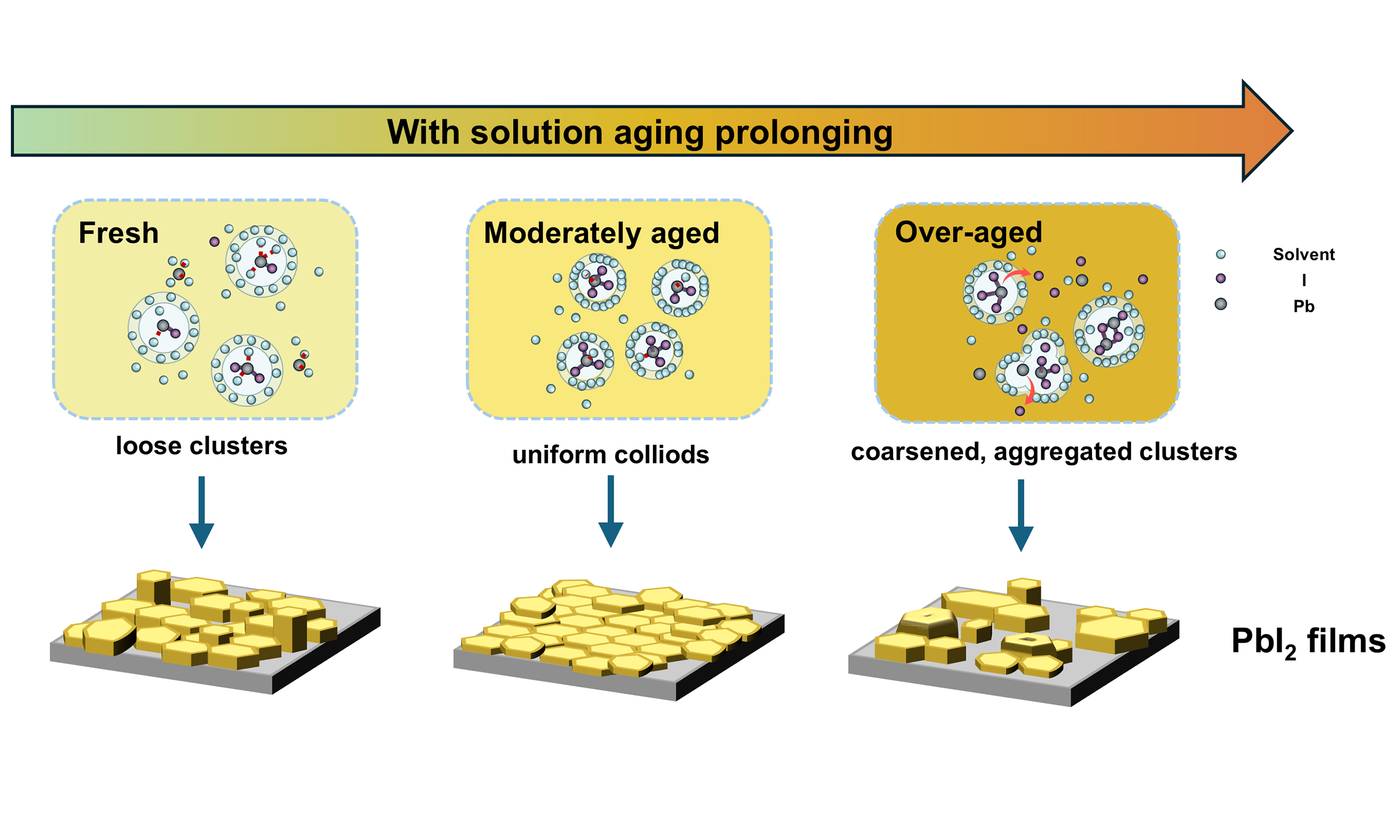
Abstract
Hybrid organic-inorganic metal halide perovskite solar cells (PSCs) represent a promising next-generation photovoltaic technology. Two-step sequential deposition is widely used for the scalable ambient-condition fabrication of perovskite films because of its high processing tolerance and reproducibility, with the predeposited lead iodide (PbI2) layer acting as a vital scaffold for perovskite crystallization and largely determining the final device performance. Despite extensive progress in PbI2 layer regulation through additive and solvent engineering, the physicochemical evolution of precursor systems during the early stages of aging (prior to apparent deterioration) is insufficiently understood. Herein, we investigate the effects of early-stage PbI2 precursor aging on the growth of perovskite films and device performance via ambient two-step deposition. We identify a moderate-aging processing window, in which the spontaneous evolution of the PbI2 solution yields a desirable physicochemical state for the subsequent thin-film deposition. The PSCs fabricated using an additive-free precursor solution at a relative humidity of 40%-50% exhibit a power conversion efficiency (PCE) of 24.52%. This work elucidates the positive role of controlled precursor aging, enriches existing PbI2 modulation strategies, and provides a facile, low-cost approach to high-efficiency all-air-processed PSCs.
Keywords


 Download PDF
INTRODUCTION
Hybrid organic-inorganic metal halide perovskite solar cells (PSCs) have garnered considerable attention due to their exceptional optoelectronic properties[1-4]. Over the past decade, PSCs have achieved a power conversion efficiency (PCE) exceeding 27%, positioning them as promising candidates for next-generation photovoltaic technology[5]. Air-processed PSCs are highly desirable for scalable, cost-effective manufacturing. Compared with one-step methods, two-step sequential deposition methods offer the benefits of a broader processing window and higher reproducibility and are therefore more widely used[6-8]. The lead iodide (PbI2) layer serves as a structural scaffold for subsequent perovskite crystallization, which is initiated by the infiltration of organic ammonium salts into the predeposited lead halide framework. However, incomplete phase transformation and moisture-induced erosion result in excess residual PbI2, which accelerates charge recombination and structural degradation[9-12]. Therefore, PbI2 film optimization is crucial for methods involving two-step sequential deposition in ambient air.
Considerable effort has been devoted to regulating PbI2 film formation via additive and solvent engineering[13-16]. These strategies can modulate crystallization kinetics during deposition, coordination environments, and intermediate-phase formation, thereby dictating the morphology and reactivity of the resulting PbI2 layers[10,17-19], but rely on externally introduced molecular species. Beyond external regulation, the intrinsic evolution of precursor solution chemistry can also play an important role in subsequent film formation, as even slight changes in precursor chemistry can be amplified during the formation of the PbI2 template and its conversion into perovskite in two-step deposition. Solution aging is a spontaneous evolution process continuously influencing the physicochemical state of precursor systems. Prolonged aging can induce changes in solute coordination[20-23], colloidal aggregation[21,24,25], and halide speciation[26-29] and is therefore often associated with deteriorated film morphology and degraded device performance. In particular, colloidal aggregation and the oxidation of iodide ions (I-) have been regarded as major contributors to precursor degradation during long-term storage. To mitigate these effects, stabilizers have been widely employed to extend the shelf life of precursor solutions. Although the above-mentioned studies provide important insights into the detrimental consequences of prolonged aging, the physicochemical evolution of precursor systems in the early stages of aging, prior to apparent deterioration, remains insufficiently understood.
In this work, a sequential deposition approach was used to systematically investigate the effects of the early-stage aging of PbI2 precursor solutions on the formation of perovskite films and the photovoltaic performance of devices. Our findings reveal a moderate-aging processing window wherein the intrinsic evolution of the PbI2 solution leads to a physicochemical state favoring subsequent film deposition, whereas over-aging disrupts this equilibrium. Specifically, moderate aging (5 days) improved the uniformity of PbI2 films and enhanced perovskite crystallization quality. Devices fabricated from the moderately aged PbI2 solution exhibited enhanced PCE of 24.52% under 40%-50% relative humidity (RH) without any additives. This study clarifies the role of controlled precursor aging during sequential deposition in the regulation of PbI2-based systems, showing that controlled early-stage aging offers a simple and practical way to enhance all air-processed perovskite solar cells without using extra chemical additives or complicated processing methods.
EXPERIMENTAL
Materials
All chemicals and reagents used in this study were used without further purification. SnO2 colloidal solution (15 wt% in water) was purchased from Alfa Aesar. N,N-Dimethylformamide (DMF, 99.8%), Dimethyl sulfoxide (DMSO, 99.9%), isopropanol (IPA), chlorobenzene (CB), acetonitrile (ACN), 4-tert-butylpyridine (t-BP), and lithium bis(trifluoromethanesulfonyl)imide (Li-TFSI) were purchased from Sigma-Aldrich. Lead iodide (PbI2, 99.99%) was purchased from Zhejiang Yitai Technology (China). NiOx nanoparticle powder (99.999%, particle size around 10 nm) was purchased from Advanced Election Technology Company. Formamidinium iodide (FAI), methylammonium iodide (MAI), methylammonium chloride (MACl), phenylethylamine iodide (PEAI), phenyl-C61-butyric acid methyl ester (PC61BM), and 2,2’,7,7’-Tetrakis[N,N-di(4-methoxyphenyl)amino]-9,9’-spirobifluorene (Spiro-OMeTAD) (99.8%) were all purchased from Xi’an Yuri Solar (China).
Device fabrication
n-i-p perovskite solar cell fabrication
Indium tin oxide (ITO) glass substrates were cleaned via sequential ultrasonication in detergent, deionized water, acetone, and IPA for 15 min each, followed by a 20-min ultraviolet (UV)-ozone treatment. An electron transport layer was then deposited by spin-coating a diluted SnO2 nanoparticle dispersion (3 wt% in deionized water) at 5,000 rpm for 30 s, and the films were annealed at 150 °C for 30 min in ambient air. Prior to perovskite deposition, the SnO2‑coated substrates underwent an additional 10-min UV-ozone activation. The perovskite films were prepared using a two-step sequential deposition method under ambient conditions with a RH of 40-50%. A 1.5 M PbI2 precursor solution in DMF:DMSO (9:1 v/v) was prepared and stored in a sealed vial at 25 ± 2 °C under ambient light for the specified aging period, with aging time counted from preparation completion. PbI2 solution was then spin-coated at 2,000 rpm for 30 s, annealed at 70 °C for 20 s, and then cooled to room temperature. Subsequently, an organic salt solution containing 90 mg FAI, 6.39 mg MAI, and 9 mg MACl in 1 mL IPA was deposited at 2,000 rpm for 30 s, and the film was annealed at 150 °C for 15 min to achieve full crystallization. For surface modification, a PEAI solution (5 mg mL-1 in IPA) was spin-coated onto the perovskite layer at 5,000 rpm for 20 s without further annealing. The hole transport layer was then deposited at 4,000 rpm for 20 s using a Spiro-OMeTAD solution, which was prepared by mixing 72.3 mg Spiro-OMeTAD, 28.8 µL 4-tert-butylpyridine, and 17.5 µL Li-TFSI solution (520 mg mL-1 in acetonitrile) in 1 mL chlorobenzene. Both PEAI and Spiro-OMeTAD layers were processed in ambient air at 40%-50% RH. Finally, a 70-nm-thick Ag electrode was deposited by thermal evaporation in high vacuum.
Single-carrier device fabrication
Electron-only and hole-only devices were fabricated with the structures of ITO/SnO2/perovskite/PC61BM/Ag and ITO/NiOx/perovskite/Spiro-OMeTAD/Ag, respectively. For the electron-only devices, a PC61BM layer was deposited onto the perovskite film by spin-coating at 2,000 rpm for 30 s, followed by thermal evaporation of the Ag electrode. For the hole-only devices, a NiOx nanoparticle dispersion was spin-coated onto the ITO at 3,000 rpm for 20 s. The NiOx layer was annealed at 150 °C for 10 min in ambient air before perovskite deposition. The other layers were deposited following the same procedures used in n-i-p perovskite solar cell fabrication.
Characterization
The chromaticity coordinates of PbI2 precursor solutions were acquired using a Hach LICO 690 high-performance spectral colorimeter. Dynamic light scattering (DLS) measurements on a Malvern Zetasizer Nano ZS90 provided the size distribution of colloids in the PbI2 solutions. Ultraviolet-visible (UV-vis) absorption spectra of both solutions and thin films were collected on a Shimadzu UV-3600i Plus spectrophotometer in absorbance mode (without integrating sphere), operating at a scan rate of 600 nm/min over 200-450 nm with a step bandwidth of 1 nm. Fourier transform infrared (FTIR) spectra of the PbI2 precursor solutions were recorded with a Thermo Scientific NICOLET iS20 system. 1H nuclear magnetic resonance (1H NMR) spectra of the same solutions were measured in DMSO-d6 containing 1% TMS on a Bruker Avance NEO spectrometer running at 600 MHz at room temperature. Free iodide ions (I-) in the PbI2 precursor solutions were quantified via ion chromatography (IC) using a Thermo Scientific ICS-5000+ system. Raman spectra were obtained on a Thermo Scientific DXR3xi Raman spectrometer under 532 nm excitation. Contact angle measurements were performed with a Dataphysics OCA20 system to evaluate the wettability of PbI2 precursor solutions on SnO2 substrates, as well as the hydrophobicity of thin films against water. X-ray diffraction (XRD) patterns were obtained on a PANalytical Empyrean 2 diffractometer with Cu Kα radiation (λ = 1.5405 Å, 40 kV, 100 mA). Top-view and cross-sectional morphologies were examined using a JSM-7610F (JEOL) field-emission scanning electron microscope (SEM) operated at 5 kV. Atomic force microscopy (AFM) was performed on a Bruker Dimension Icon to determine the surface roughness of the thin films. The chemical environment of the perovskite films was analyzed by X-ray photoelectron spectroscopy (XPS) on a ULVAC-PHI VersaProbe 4 system. Photoluminescence (PL) spectra were recorded using an Edinburgh FLS1000 spectrometer. Current density-Voltage (J-V) characteristics were measured at 25 °C with a Keithley 2400 source meter under standard Air Mass 1.5 Global (AM 1.5G) illumination
RESULTS AND DISCUSSION
To evaluate the effect of early aging on the PbI2 precursor solutions, we first monitored the macroscopic evolution of the solutions over 14 days. We categorized the samples as fresh (1 day), moderately aged (5 days), and over-aged (14 days) for the following study. The yellow PbI2 solutions exhibited progressive color deepening during aging [Figure 1A and B]. The color coordinates shifted near-linearly from (0.42, 0.52) for the fresh sample to (0.44, 0.50) for the over-aged sample, while luminance (Y) concomitantly declined [Supplementary Table 1]. This result indicates that, as aging time increases, the solution gradually changes from light yellow to dark yellow, while its clarity progressively decreases. This progressive color evolution may be associated with changes in the concentration and speciation of iodine-containing species in the precursor solution[28].
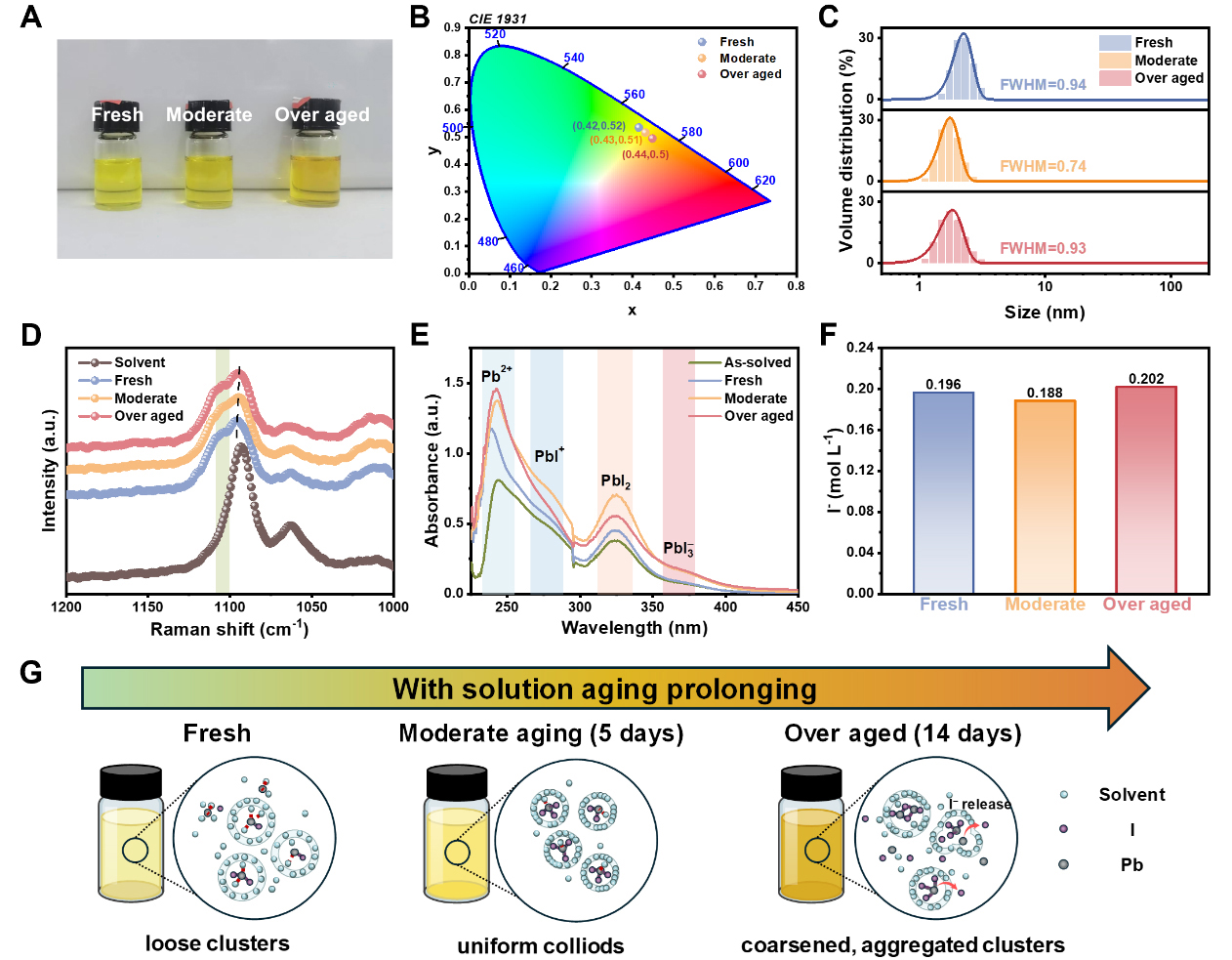
Figure 1. Evolution of PbI2 precursor solutions during early aging. (A) The appearance of PbI2 precursor solutions at different aging periods (photographed by the authors); (B) the CIE chromaticity coordinates of PbI2 precursor solutions; (C) the colloid size distribution of PbI2 precursor solutions; (D) Raman spectra; (E) UV-vis absorption; (F) content of free iodide ions in the precursor solutions; (G) Schematic diagram of physical and chemical changes within the solution during early aging. FWHM: Full width at half-maximum; UV-vis: ultraviolet-visible; CIE: Commission Internationale de l'Éclairage.
Given that perovskite precursor solutions form colloidal dispersion systems rather than fully solvated ions[30-32], we used DLS to characterize the particle size distributions of PbI2 precursor solutions. All PbI2 solutions exhibit a predominantly monodisperse distribution with particle sizes of 1-5 nm [Figure 1C] and negligible contributions from larger aggregates (< 0.0005% in volume fraction, Supplementary Figure 1)[32]. The average particle size decreased from ~2.25 nm in the fresh solution to ~1.76 nm after moderate aging, suggesting a more uniform colloidal size distribution. Upon prolonged aging, slight coarsening occurred, with the average size increasing to ~1.85 nm. The predominance of nanoscale colloids in the PbI2 solutions makes light scattering from micrometer-scale aggregates an unlikely explanation for the observed color evolution. To better understand the precursor chemistry, we evaluated the Pb2+-solvent interactions by using Raman spectroscopy [Figure 1D]. Upon the dissolution of PbI2, a peak assigned to the rocking vibration of the N-CH3 bond in DMF shifted from 1,093 to 1,096 cm-1, with the appearance of a distinct shoulder peak around 1,102 cm-1 [Supplementary Figure 2]. This shoulder peak, associated with a more constrained solvent environment, gradually weakened upon aging, which indicated a progressive relaxation of Pb-DMF interactions. This coordination weakening was further confirmed by FTIR spectroscopic analysis [Supplementary Figure 3]. The C=O vibration peak of DMF shifted from 1,667 to 1,635 cm-1 upon PbI2 addition and returned to 1,658 cm-1 after aging, which suggests the gradual displacement of DMF molecules from the Pb2+ coordination sphere.
UV-vis absorption spectroscopy [Figure 1E] provided further insights into the evolution of iodoplumbate species. The characteristic absorption peaks of Pb2+ (~250 nm), PbI+ (~270 nm), PbI2 (~325 nm), and PbI3- (~370 nm) were identified, consistent with previous reports[33,34]. Upon initial dissolution, the solution exhibited relatively weak absorption, indicating that the coordination equilibrium of Pb-I had not yet been fully established, with low-valent iodoplumbates (Pb2+, PbI+ and PbI2) constituting the primary species. The raw spectra showed increased absorption features associated with PbI2 and PbI3- during moderate aging, followed by a decrease in PbI+ and PbI2 and a slight further increase in Pb2+ upon over-aging. To further assess these changes, spectral fitting was performed, and the relative contribution of each characteristic absorption feature was calculated from its integrated peak area normalized to the total integrated area of all fitted features. The results are summarized in Supplementary Table 2, with the fitted spectra and relative contribution distributions presented in Supplementary Figure 4. During moderate aging, the proportion of Pb2+ contracts from 34.78% to 27.32%, while those of PbI2 and PbI3- increase concurrently, rising from 22.25% to 26.71% and from 5.59% to 6.39%, respectively. These changes suggest a redistribution of the iodoplumbates, with an increased relative contribution from the more highly iodinated species (PbI2 and PbI3-). This trend may be associated with competition between iodide ions and coordinated solvent molecules for Pb2+ coordination sites, as discussed in previous studies[33,35]. As aging extends to the over-aged stage, a non-monotonic trajectory emerged: while PbI3- showed a slight increase to reach 8.02%, PbI+ and PbI2 decreased to 30.83% and 23.64%, respectively. Notably, the Pb2+ fraction rebounds to 37.51%, exceeding its level in the moderately aged state, indicating that extended aging induces a secondary reorganization of iodoplumbate species, rather than a continuous shift toward higher iodide coordination. 1H NMR spectra show no pronounced chemical shift or new resonances upon aging [Supplementary Figure 5], suggesting that no major changes in the detectable solution-phase chemical species occur during aging. IC measurements captured the dynamic evolution of free I- concentration during precursor aging [Figure 1F and Supplementary Figure 6]. The I- concentration declined to 0.188 mol L-1 after moderate aging, and then increased to 0.202 mol L-1 upon over-aging. The gradual release of I- during the over-aging stage, accompanied by weakened Pb-solvent interactions, implies a coordination imbalance and partial decomposition within the Pb-I framework.
Figure 1G presents a schematic of the physical and chemical changes in the solution during early aging based on the above results. The early-stage aging of PbI2 precursor solutions can be regarded as a coordination-driven structural refinement process. In the fresh precursor solution, dissolved PbI2 was coordinated by solvent molecules, forming loose agglomerates of colloidal particles. During moderate aging, iodide ions gradually replaced solvent molecules in the Pb2+ coordination shell, thereby driving the transformation from low-valent species to high-valent iodoplumbates such as PbI3-. This chemical rebalancing may be associated with changes in the size distribution and homogeneity of nanoscale colloids, potentially establishing a favorable chemical window for film formation. As shown in Supplementary Figure 7, the contact angle of the precursor on the SnO2 substrate reaches a minimum after moderate aging. This enhanced wettability promoted more uniform precursor spreading, which may have contributed to the uniform nucleation and subsequent growth of high-quality perovskite films. In contrast, over-aging induced the redistribution of Pb-I coordination and I- release, accompanied by the colloidal coarsening and a shift away from the favorable state. These findings highlight the critical role of controlled early aging in regulating precursor chemistry prior to perovskite film formation. It should be noted that the favorable aging time of 5 days identified in this study is specific to the experimental conditions employed and should not be regarded as universally applicable. Several external factors may alter precursor evolution and shift the favorable aging window. For example, elevated temperature can accelerate iodoplumbate evolution and shorten the time required to reach an optimal precursor state[36], while light exposure can promote the conversion of low-valent to high-valent iodoplumbate species and induce colloidal aggregation[37,38]. Storage conditions, including sealing and temperature control, may further affect solution composition and colloidal evolution. The key preparation and storage conditions should be controlled to ensure reproducibility.
To further understand the impact of solution aging on film deposition, XRD measurements were performed to analyze the crystallinity of PbI2 films deposited under atmospheric conditions at a RH of 40%-50%. As presented in Figure 2A, the diffraction peaks at 12.69°, 25.55°, and 38.71° correspond to the (001), (002), and (003) lattice planes of PbI2, respectively. Figure 2B provides magnified views of these reflections. The PbI2 film derived from the moderately aged solution displays the most prominent (00n) layered orientation, thus featuring the highest degree of crystallinity, as shown in Supplementary Figure 8. Specifically, while the fresh sample showed a discernible (110) reflection near the (003) peak, this competing orientation was effectively suppressed in the moderately aged film. Over-aging, however, induced a resurgence of the (110) peak intensity and the emergence of the (111) peak. This preferential orientation is quantitatively supported by the diffraction-peak intensity ratios. As depicted in Figure 2C, the (001)/(110) ratio increases from 30.45 for the fresh film to 63.56 for the moderately aged PbI2 film, and sharply decreases to 13.35 upon over-aging. A similar trend was observed for the (003)/(110) ratio [Figure 2D], which was 4.85, 7.95, and 2.31 for the fresh, moderately aged, and over-aged samples, respectively, with the highest ratio observed in the moderately aged sample. Given that the PbI2 (110) plane is oriented perpendicular to the layered (00n) planes, the enhanced (001) peak intensity, together with the decreased (110) peak intensity, suggests a preferential orientation that favors the in-plane growth of the layered PbI2 structure[9,39].
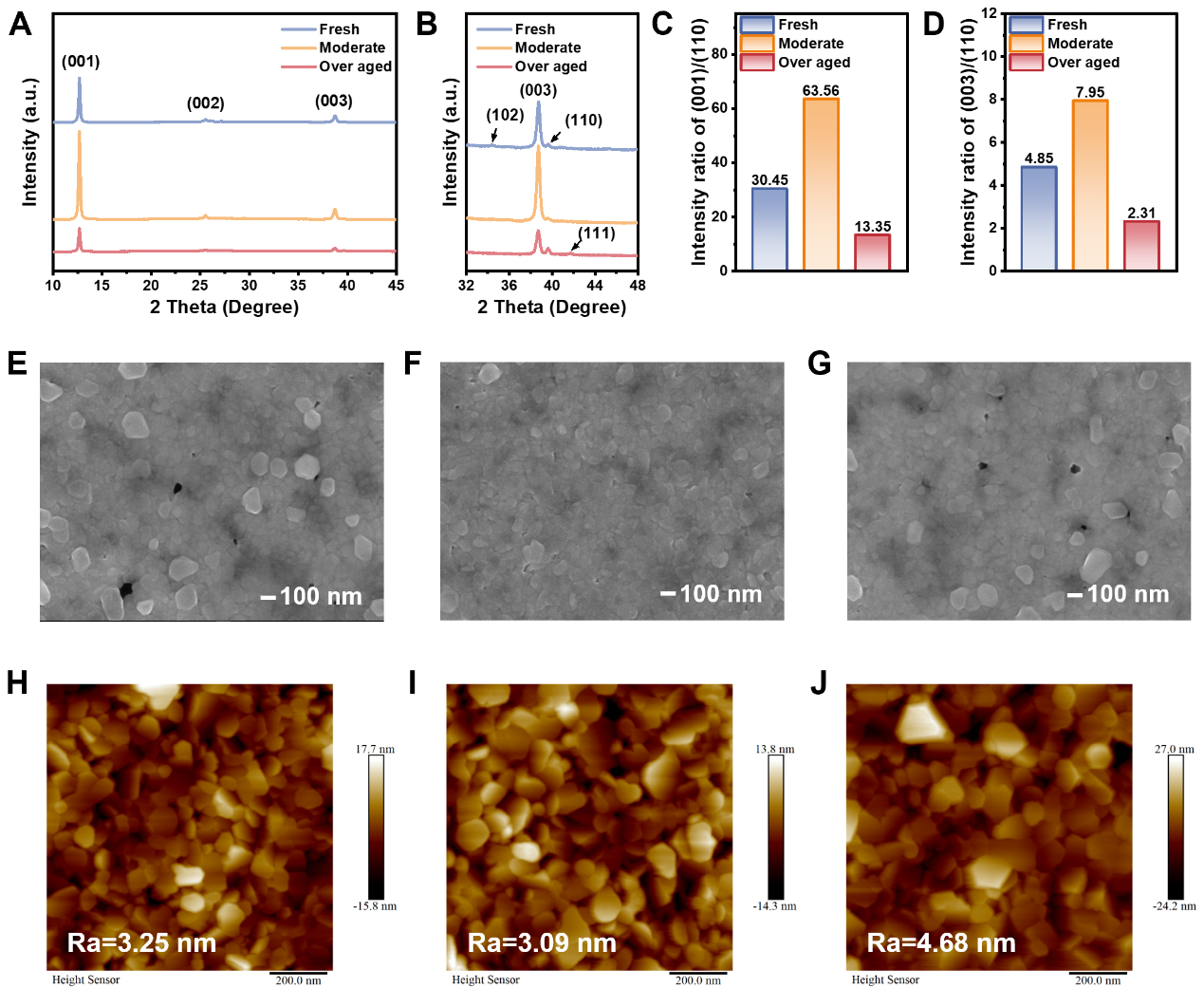
Figure 2. Evolution of PbI2 films induced by precursor aging. (A) The XRD patterns of PbI2 films; (B) Magnified XRD patterns in the vicinity of the PbI2 (003) reflection, highlighting the diffraction peaks associated with the (102), (003), (110), and (111) planes; intensity ratios of PbI2 (C) (001)/(110) peak and (D) (003)/(110) peak; surface SEM images of (E) the fresh PbI2, (F) the moderate PbI2 and (G) the over-aged PbI2 films; AFM images of (H) the fresh PbI2, (I) the moderate PbI2 and (J) the over-aged PbI2 films. XRD: X-ray diffraction; AFM: atomic force microscopy; SEM: scanning electron microscope.
To investigate the impact of solution aging on the morphological characteristics of PbI2, we employed SEM to analyze the surface morphology of PbI2 films [Figure 2E-G]. The fresh film exhibited a relatively uneven surface with discernible hexagonal grain aggregates and sporadic pinholes, whereas the moderately aged PbI2 film presented a compact, homogeneous surface. This morphological refinement is intrinsically linked to the high degree of preferential (00n) orientation revealed by XRD, which facilitates the formation of a dense and continuous precursor template[40]. From a kinetic perspective, a loosely stacked lamellar structure with fewer but larger voids, as observed in the fresh PbI2 film, may partially facilitate the penetration of FAI and MAI solutions[13,41]. However, this morphology often leads to nonuniform reaction kinetics, resulting in incomplete conversion and residual PbI2. In addition, porous PbI2 templates are vulnerable to degradation in ambient air. Moderately aged PbI2 films exhibited grain packing with a high density of smaller and more uniformly distributed voids, which probably served as pathways for solution infiltration and facilitated the subsequent solid-liquid reaction, as reported in previous studies[9,19]. The enhanced wettability of the moderately aged PbI2 film promotes more uniform solution spreading and better interfacial contact compared to the fresh film, which favors the penetration and diffusion of organic cations throughout the compact film. These features enabled a more complete and homogeneous intercalation reaction by improving the diffusion of organic cations into the PbI2 lattice, thus promoting controlled perovskite formation and subsequent crystal growth.
Moreover, the compact PbI2 film obtained after moderate aging exhibited a larger water contact angle, as displayed in Supplementary Figure 9. The reduced surface wettability toward water may help improve its tolerance to ambient moisture under air-processing conditions. By providing a smooth surface with a root mean square (RMS) roughness of 3.09 nm and a highly ordered PbI2 substrate, the moderately aged template could help guide perovskite crystallization and promote structural inheritance in the final film, as supported by XRD data. In contrast, over-aging may lead to a less uniform surface morphology, as reflected by the increased RMS roughness of 4.68 nm compared with 3.25 nm for the fresh sample [Figure 2H-J]. Ultimately, the highly oriented PbI2 crystals in the moderately aged film acted as a structural scaffold that favored uniform nucleation and the controlled growth of subsequent perovskite grains, whereas over-aging may drive the system away from the favorable structural window.
Perovskite layers were subsequently fabricated through the intercalation of organic ammonium salts into the PbI2 templates; the crystallinity of the resulting films was further examined by XRD to comprehend the impact of PbI2 solution aging. As depicted in Figure 3A, the marked decrease in the intensity of residual PbI2 peaks upon moderate aging indicates a more complete conversion of the PbI2 precursor. This trend is further supported by the semi-quantitative analysis in Supplementary Figure 10, where the PbI2/(100) intensity ratio decreases from approximately 0.16 for the fresh sample to 0.05 for the moderately aged sample. This decrease corresponds to a substantial reduction in the amount of residual PbI2. Moreover, the perovskite film prepared by the moderately aged solution exhibited stronger (100) and (200) peaks than the fresh film. Compared with the fresh film, the moderately aged sample featured sharper diffraction peaks, with the full width at half-maximum (FWHM) of the (100) and (200) crystal planes reduced from 0.12 and 0.18 to 0.09 and 0.15, respectively, as summarized in Supplementary Table 3. These narrower peaks suggest improved crystalline order, while the enhanced (n00) reflections indicate a more pronounced preferential orientation. Such structural improvements in perovskite films may contribute to more favorable charge transport and reduced charge carrier recombination losses.
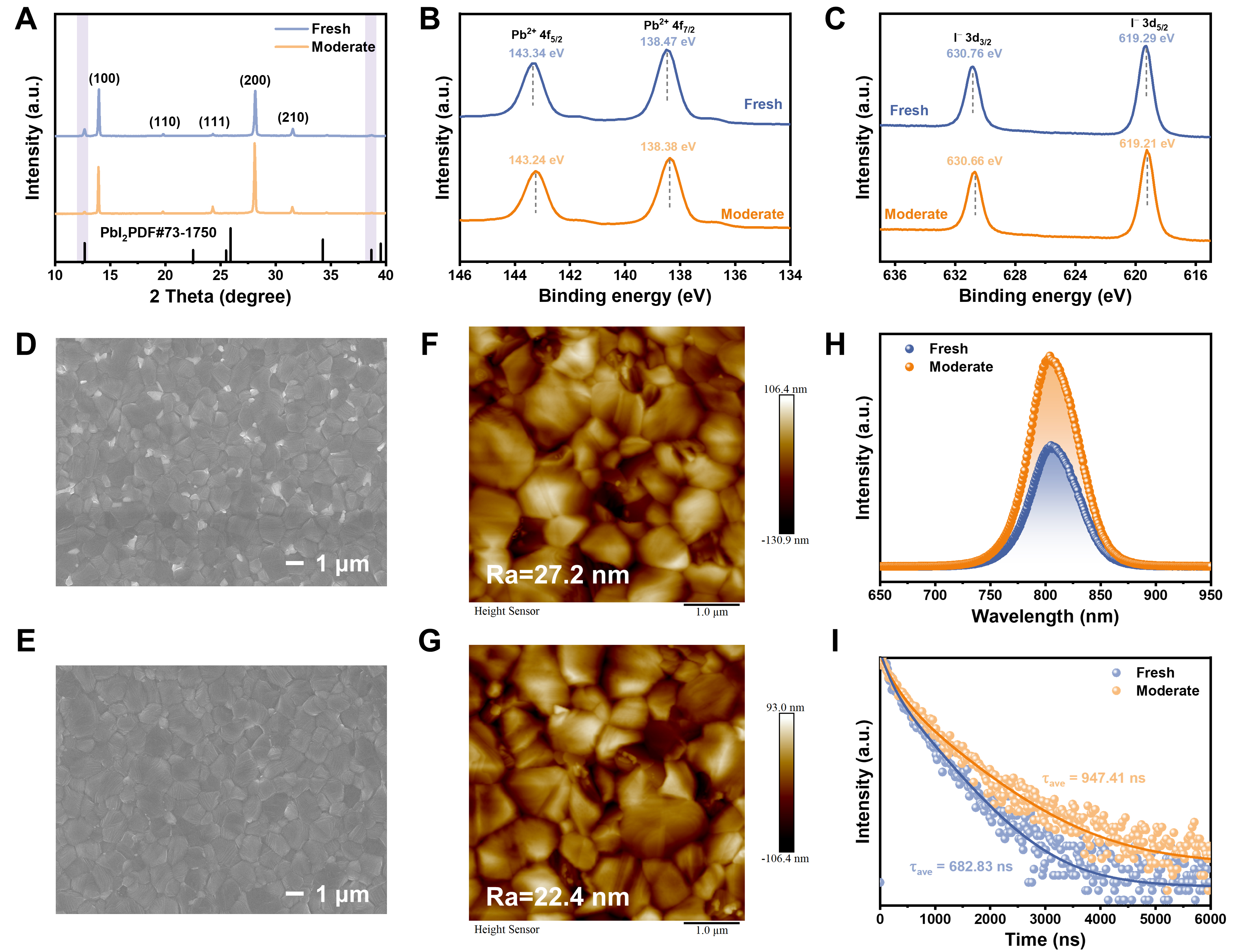
Figure 3. Effect of moderate aging on perovskite thin films. (A) The XRD patterns for the fresh and moderately aged perovskite films; the XPS spectra of (B) Pb 4f and (C) I 3d for the fresh and moderately aged perovskite films; surface SEM images of (D) the fresh and (E) the moderately aged perovskite films; AFM images of (F) the fresh and (G) the moderately aged perovskite films; (H) the PL spectra of the fresh and moderately aged perovskite films; (I) the TRPL spectra of the fresh and moderately aged perovskite films. XRD: X-ray diffraction; XPS: X-ray photoelectron spectroscopy; AFM: atomic force microscopy; PL: photoluminescence; TRPL: time-resolved photoluminescence; SEM: scanning electron microscope.
Chemical interactions on perovskite film surfaces were probed by XPS analysis, with the corresponding Pb 4f core-level spectra shown in Figure 3B. The peaks at ~143.34 eV and ~138.47 eV were assigned to the Pb 4f5/2 and Pb 4f7/2 components of divalent Pb2+ in the fresh sample, respectively, while the perovskite film derived from the moderately aged precursor exhibited a shift of both Pb2+-related peaks toward lower
Then, top-view and cross-sectional SEM were employed to further elucidate the influence of precursor aging duration on the morphological evolution of the resulting perovskite films [Figure 3D and E, Supplementary Figure 11]. The fresh perovskite film exhibited relatively small and irregularly packed grains, accompanied by noticeable grain boundaries and localized residual PbI2 domains. By contrast, the moderately aged film displayed considerably enlarged grains with improved lateral connectivity and a compact microstructure. Cross-sectional SEM images revealed that the moderately aged sample comprised vertically continuous grains spanning the entire film thickness, whereas the fresh sample showed a stacked grain structure with frequent grain boundaries [Supplementary Figure 11C and D]. This evolution of perovskite grains indicates that moderate aging promoted the crystal growth throughout the film thickness rather than merely affecting surface morphology. The reduced residual PbI2 in the moderately aged sample suggests more complete perovskite conversion and uniform grain growth.
The morphological differences were further corroborated by atomic force microscopy [Figure 3F and G]. The RMS roughness of the perovskite film decreased from 27.2 nm for the fresh sample to 22.4 nm for the moderately aged sample, indicating a smoother and more uniform surface. This reduced surface roughness reflects suppressed heterogeneous nucleation and more homogeneous crystal growth, which is consistent with the enhanced crystallinity revealed by XRD analysis.
The improvement in the film structural quality was reflected in its photophysical properties. As depicted in Figure 3H, the steady-state PL spectrum of the moderately aged sample exhibited a markedly enhanced emission intensity compared to that of the fresh sample. The photoluminescence quantum yield (PLQY) increased from 0.14% for the fresh sample to 1.04% for the moderately aged sample, while the corresponding quasi-Fermi level splitting (QFLS) increased from 1.129 to 1.184 eV [Supplementary Figure 12]. These improvements indicate enhanced radiative recombination efficiency and reduced nonradiative recombination losses. This trend was further confirmed by time-resolved photoluminescence (TRPL) measurements [Figure 3I], with the carrier lifetime increasing from 682.83 ns for the fresh sample to
The PSCs featuring an ITO/SnO2/perovskite/PEAI/Spiro-OMeTAD/Ag architecture were fabricated to assess the influence of moderate aging on the photovoltaic performance. All layers were deposited in ambient air, except the Ag electrode, which was deposited by high-vacuum evaporation. Figure 4A shows the J-V curves and corresponding champion photovoltaic parameters of fresh and moderately aged devices. The fresh device achieved a PCE of 23.05% with an open-circuit voltage (VOC) of 1.128 V, short-circuit current density (JSC) of 25.65 mA cm-2, and fill factor (FF) of 79.5%. In contrast, the champion device derived from the moderately aged solution yielded a higher PCE of 24.52%, with a VOC of 1.145 V, JSC of 26.12 mA cm-2, and FF of 81.94%. As shown in Supplementary Table 4, the HI of fresh and moderately aged PSCs are calculated as 2.91% and 1.84%, respectively. To evaluate the reproducibility and consistency of device performance, we examined the statistical distributions of key photovoltaic parameters [Supplementary Figure 13]. The corresponding means and standard deviations are summarized in Supplementary Table 5. PSCs prepared from the moderately aged precursor exhibited higher and more concentrated photovoltaic parameter distributions than their fresh counterparts, which reflected the robust reproducibility of the enhanced performance. The improved JSC and FF were primarily attributed to the enhanced crystallinity and reduced defect density within the perovskite bulk, while the improvement in VOC was mainly linked to the suppressed nonradiative recombination, as evidenced by the prolonged carrier lifetimes revealed by PL spectroscopy. The elevation in JSC is further corroborated by the EQE spectra shown in Figure 4B, which reveal that the moderately aged device displayed superior photon-to-electron conversion efficiencies across the measured range. The most pronounced enhancement occurred in the short-wavelength region (300-400 nm), suggesting more efficient charge-carrier collection and reduced recombination losses near the illuminated side of the device. Consequently, the integrated JSC increased from 23.04 mA cm-2 for the fresh device to 23.98 mA cm-2 for the moderately aged one. This spectral improvement is consistent with the through-out grain structure observed in the SEM images, which effectively facilitates efficient longitudinal charge collection.
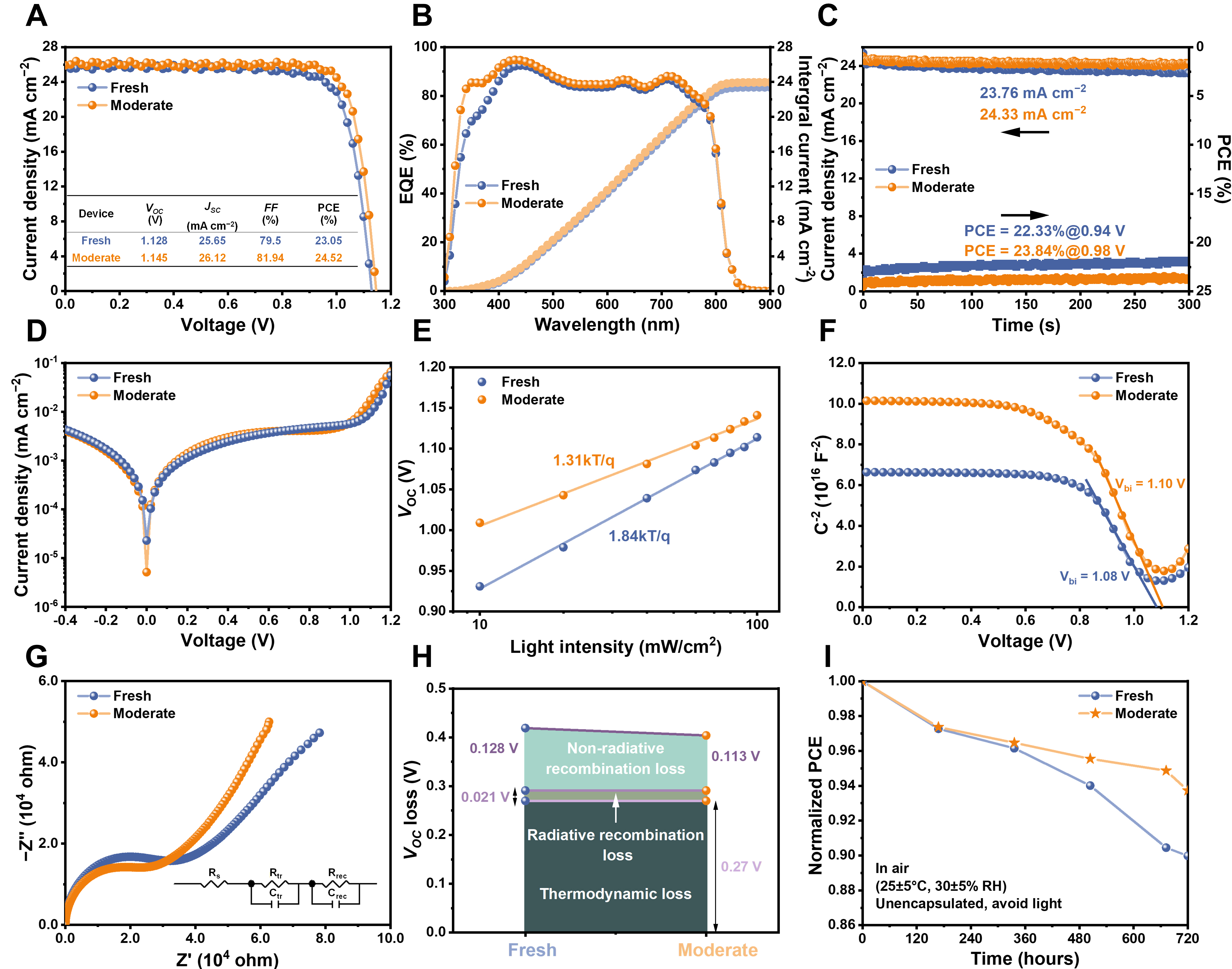
Figure 4. Photovoltaic performance and characteristics of PSCs. (A) The J-V curves of the champion devices based on the fresh and moderate solutions; (B) the EQE spectra and the integrated current density of the fresh and moderately aged devices; (C) steady-state output of the devices at maximum power point; (D) the dark J-V curves of the fresh and moderately aged devices; (E) dependence of VOC on light intensity for the fresh and moderately aged devices; (F) Mott-Schottky curves for the fresh and moderately aged devices; (G) EIS curves for the fresh and moderately aged devices; (H) analysis of the VOC loss for the fresh and moderately aged devices; (I) PCE decay of the best-performing fresh and moderately aged devices stored in ambient conditions (RH = 25%-35%) without encapsulation. PSCs: Perovskite solar cells; EQE: external quantum efficiency; EIS: electrochemical impedance spectroscopy; PCE: power conversion efficiency; RH: relative humidity; FF: fill factor; Rs: series resistance; Rtr: transport resistance; Rrec: recombination resistance; Ctr: transport capacitance; Crec: recombination capacitance; J-V: current density-voltage; VOC: open-circuit voltage; JSC: short-circuit current density.
Figure 4C shows the SPO of the devices monitored under the bias at the maximum power point, with operating voltages of 0.94 and 0.98 V used for the fresh and moderately aged devices, respectively. During 300 s of continuous SPO measurement, the moderately aged device exhibited a higher and more stable steady-state current density of 24.33 mA cm-2, compared with 23.76 mA cm-2 for the fresh device. Correspondingly, the moderately aged device delivers an improved steady-state PCE of 23.84%, exceeding that of the fresh device at 22.33%. The improved short-term steady-state power output of the moderately aged device may be associated with the reduced amount of residual PbI2 at grain boundaries, leading to more efficient and stable charge extraction. Figure 4D presents the dark J-V curves of the moderately aged and fresh PSCs, with the corresponding dark saturation current densities (J0) equaling 5.15 × 10⁻⁶ mA cm-2 and 2.29 × 10⁻⁵ mA cm-2, respectively. This pronounced reduction in J0 indicates suppressed leakage current and nonradiative recombination in the moderately aged device, consistent with the enhanced crystallinity and more complete PbI2 conversion achieved through moderate precursor aging.
The dependence of VOC and JSC on incident light intensity was further examined to elucidate the charge separation and recombination kinetics in the PSCs. Measurements were carried out under illumination intensities ranging from 100 mW cm-2 (1 Sun) to 10 mW cm-2 (0.1 Sun). The VOC can be described by the following Equation (1):
where n is the ideality factor, k is the Boltzmann constant, T is the temperature, q is the elementary charge, and J0 denotes the dark saturation current density. Under illumination, JSC is much larger than J0 and increases with light intensity (I) following a power-law relationship
where εr is the relative dielectric constant of the perovskite (46.9, as reported previously[42]), ε0 is the vacuum permittivity, q is the elementary charge, and L is the thickness of the perovskite layers (644 nm for the fresh and 682 nm for the moderately aged perovskite films). Accordingly, the electron-related Ntrap values of the fresh and moderately aged perovskite films were determined as 4.00 × 1015 cm-3 and 2.01 × 1015 cm-3, respectively, whereas the corresponding hole-related trap-state densities were calculated to be 1.05 × 1016 cm-3 for the fresh sample and 7.91 × 1015 cm-3 for the moderately aged sample. These results indicate that moderate precursor aging reduced both electron- and hole-related trap-state densities in the perovskite films. The reduced trap-state densities may have facilitated carrier transport and suppressed trap-related nonradiative recombination, consistent with the lower dark saturation current observed in the moderately aged devices.
Mott-Schottky analysis [Figure 4F] revealed an increase in the built-in potential (Vbi) from 1.08 V in the fresh device to 1.10 V in the moderately aged device, suggesting a strengthened internal electric field favoring efficient charge separation and transport after moderate aging. To gain further insights into interfacial processes and impedance responses under operating conditions, EIS measurements were conducted. As shown in Figure 4G, the moderately aged device exhibited a smaller semicircle in the high-frequency region, which suggests reduced resistive losses associated with charge transfer. In the low-frequency region, a more pronounced linear tail is observed for the moderately aged device, corresponding to an increased boundary impedance (ZB), which implies restrained ion accumulation at the interfaces. These impedance characteristics collectively account for the improved FF and enhanced operational stability. Additionally, we quantitatively analyzed VOC loss, distinguishing contributions from thermal radiation, radiative recombination, and nonradiative recombination. As shown in Figure 4H, non-radiative recombination accounted for 0.128 V in the fresh device and 0.113 V in the moderately aged device, which explains the decreased VOC loss.
Finally, the long-term storage stability of unencapsulated PSCs was tested under 25 ± 5 °C and 30% ± 5% RH [Figure 4I]. The moderately aged device demonstrated improved storage stability, retaining over 93% of its initial PCE after 720 h, whereas the PCE of the fresh device degraded to < 90% under the same conditions.
CONCLUSIONS
The early-stage aging of PbI2 precursor solutions plays a pivotal role in their coordination chemistry and the structural evolution of two-step perovskite solar cells fabricated under ambient conditions. In the identified moderate-aging window, progressive iodide incorporation into the Pb2+ coordination shell refines nanoscale iodoplumbate species, enabling the formation of compact and highly oriented (00n)-dominated PbI2 templates. This optimized precursor state facilitates the complete conversion of PbI2 to perovskite, formation of enlarged and continuous perovskite grains, defect density reduction, and nonradiative recombination suppression, ultimately enhancing device performance. These findings establish precursor aging as an effective chemical strategy linking solution-state coordination equilibrium with device performance and provide a simple and scalable approach to achieving high-efficiency, reproducible perovskite solar cells via ambient processing.
DECLARATIONS
Authors’ contributions
Methodology, formal analysis, and writing of the manuscript: Zhang, M.
Assisted with experiments and characterization: Liao, X.; Mi, K.; Li, L.; Yang, W.
Supervision, project administration, and funding acquisition: Zeng, Q.; Liu, F.
Availability of data and materials
Some data are presented in the “Supplementary Materials” section. Other raw data that support the findings of this study are available from the corresponding author upon reasonable request.
AI and AI-assisted tools statement
Not applicable.
Financial support and sponsorship
This work was supported by the National Natural Science Foundation of China (52525405, 52604562) and the Major Scientific and Technological Project of Changsha (kq2501002).
Conflicts of interest
All authors declared that there are no conflicts of interest.
Ethical approval and consent to participate
Not applicable.
Consent for publication
Not applicable.
Copyright
© The Author(s) 2026.
Supplementary Materials
REFERENCES
1. Chen, P.; Xiao, Y.; Li, S.; et al. The promise and challenges of inverted perovskite solar cells. Chem. Rev. 2024, 124, 10623-700.
2. Jiang, Q.; Zhu, K. Rapid advances enabling high-performance inverted perovskite solar cells. Nat. Rev. Mater. 2024, 9, 399-419.
3. Tian, Y.; Zhang, X.; Zhao, K.; et al. High-entropy hybrid perovskites with disordered organic moieties for perovskite solar cells. Nat. Photon. 2024, 18, 960-6.
4. Liu, Z.; Lin, R.; Wei, M.; et al. All-perovskite tandem solar cells achieving >29% efficiency with improved (100) orientation in wide-bandgap perovskites. Nat. Mater. 2025, 24, 252-9.
5. Xiong, Z.; Zhang, Q.; Cai, K.; et al. Homogenized chlorine distribution for >27% power conversion efficiency in perovskite solar cells. Science 2025, 390, 638-42.
6. Luo, S.; Liu, D.; Deng, X.; et al. Boron-halide interactions for crystallization regulation of a 1.68 eV wide-bandgap perovskite prepared via a two-step method. Energy. Environ. Sci. 2025, 18, 10364-79.
7. Yu, Z.; Ma, J.; Yang, X.; et al. Levetiracetam-assisted perovskite crystallization and tripartite lead iodide reduction in perovskite solar cells. Adv. Mater. 2026, 38, e12171.
8. Chen, M.; Qin, Z.; Zhang, Z.; et al. Low-temperature sequential deposition for efficient inverted perovskite solar cells. Nat. Commun. 2025, 16, 5746.
9. Zeng, Q.; Xiao, H.; Ma, Q.; et al. Highly layer-oriented PbI2 films enabling all-air processed perovskite solar cells. Adv. Energy. Mater. 2024, 14, 2401279.
10. He, J.; Sheng, W.; Liu, K.; et al. Unraveling the reaction dynamics mechanism and thermodynamic pathway of lead iodide and organic cations in the two-step sequential deposition process. Energy. Environ. Sci. 2025, 18, 6983-7004.
11. Wang, J.; Yuan, L.; Luo, H.; et al. Ambient air processed highly oriented perovskite solar cells with efficiency exceeding 23% via amorphous intermediate. Chem. Eng. J. 2022, 446, 136968.
12. Zhang, J.; Wu, J.; Barabash, A.; et al. Precise control of process parameters for >23% efficiency perovskite solar cells in ambient air using an automated device acceleration platform. Energy. Environ. Sci. 2024, 17, 5490-9.
13. He, J.; Sheng, W.; Yang, J.; et al. Omnidirectional diffusion of organic amine salts assisted by ordered arrays in porous lead iodide for two-step deposited large-area perovskite solar cells. Energy. Environ. Sci. 2023, 16, 629-40.
14. Xia, Y.; Zhu, M.; Qin, L. Organic-inorganic hybrid quasi-2D perovskites incorporated with fluorinated additives for efficient and stable four-terminal tandem solar cells. Energy. Mater. 2023, 3, 300004.
15. Duan, H.; Jin, J.; Liu, X.; et al. Electron-donor/-acceptor ratio-guided molecular engineering for buried interface optimization in n-i-p perovskite solar cells. Energy. Mater. 2026, 6, 600031.
16. Zhou, B.; Zhao, P.; Guo, J.; et al. Solvent-additive cascade engineering enables single-oriented perovskite films with facet-driven performance and stability. Energy. Environ. Sci. 2025, 18, 9865-76.
17. Zhang, Y.; Yang, T.; Lee, S.; Liu, S.; Zhao, K.; Park, N. Stabilizing α-phase FAPbI3 perovskite induced by an ordered solvated quasi-crystalline PbI2. ACS. Energy. Lett. 2024, 9, 159-67.
18. Yu, X.; Fang, Z.; Lin, S.; et al. Polyvinyl pyrrolidone induced “confinement effect” on PbI2 and the improvement on crystallization and thermal stability of perovskite. Small 2024, 20, 2306101.
19. Du, Z.; Ma, Z.; Yu, T.; et al. PbI2 intercalation and residual elimination strategy for sequential inverted perovskite solar cells. Chem. Eng. J. 2025, 503, 158587.
20. McMeekin, D. P.; Wang, Z.; Rehman, W.; et al. Crystallization kinetics and morphology control of formamidinium-cesium mixed-cation lead mixed-halide perovskite via tunability of the colloidal precursor solution. Adv. Mater. 2017, 29, 1607039.
21. Xie, Y.; Xu, X.; Cui, Y.; et al. Colloidal chemistry of MAPbI3 perovskite ink using 2-methoxyethanol as the solvent. Colloids. Surf. A. Physicochem. Eng. Asp. 2023, 677, 132406.
22. Wang, K.; Duan, Z.; Liu, H.; et al. Stabilizing precursor solutions by proton-rich additive for high-performance air-processed solar cells. Small 2025, 21, e2501184.
23. Liu, Y.; Wang, J.; Liu, T.; et al. Stabilized perovskite ink for scalable coating enables high-efficiency perovskite modules. Sci. Adv. 2026, 12, eaec0915.
24. Zhang, Y.; Xing, Z.; Fan, B.; et al. Uncovering aging chemistry of perovskite precursor solutions and anti-aging mechanism of additives. Angew. Chem. Int. Ed. 2023, 62, e202215799.
25. Hu, S.; Hou, P.; Dou, Y.; et al. Precursor stabilization strategies via vapor-solid reaction for reproducible and high-efficiency vapor-deposited perovskite solar cells. ACS. Nano. 2026, 20, 5007-20.
26. Wu, N.; Yang, T.; Wang, Z.; et al. Stabilizing precursor solution and controlling crystallization kinetics simultaneously for high-performance perovskite solar cells. Adv. Mater. 2023, 35, e2304809.
27. Hu, W.; Yang, J.; Yang, C.; et al. Stabilizing perovskite precursors with the reductive natural amino acid for printable mesoscopic perovskite solar cells. J. Energy. Chem. 2024, 90, 32-9.
28. Li, L.; Zeng, Q.; Liao, X.; et al. D-isoascorbic acid endows formamidinium iodide with robust storage stability and wide-bandgap perovskite with reduced phase segregation. Adv. Funct. Mater. 2026, 36, e75247.
29. Ye, J.; Sheng, W.; He, J.; et al. Extending shelf-life of two-step method precursor solutions through targeted regulation for highly efficient and reproducible perovskite solar cells. Angew. Chem. Int. Ed. 2024, 63, e202411708.
30. Yan, K.; Long, M.; Zhang, T.; et al. Hybrid halide perovskite solar cell precursors: colloidal chemistry and coordination engineering behind device processing for high efficiency. J. Am. Chem. Soc. 2015, 137, 4460-8.
31. Flatken, M. A.; Hoell, A.; Wendt, R.; et al. Small-angle scattering to reveal the colloidal nature of halide perovskite precursor solutions. J. Mater. Chem. A. 2021, 9, 13477-82.
32. O’Kane, M. E.; Smith, J. A.; Kilbride, R. C.; et al. Exploring nanoscale structure in perovskite precursor solutions using neutron and light scattering. Chem. Mater. 2022, 34, 7232-41.
33. Radicchi, E.; Mosconi, E.; Elisei, F.; Nunzi, F.; De Angelis, F. Understanding the solution chemistry of lead halide perovskites precursors. ACS. Appl. Energy. Mater. 2019, 2, 3400-9.
34. Shargaieva, O.; Kuske, L.; Rappich, J.; Unger, E.; Nickel, N. H. Building blocks of hybrid perovskites: a photoluminescence study of lead-iodide solution species. ChemPhysChem 2020, 21, 2327-33.
35. Intan, N. N.; Sorenson, B. A.; Choi, Y. K.; et al. Smaller is better: the case for lower-order iodoplumbate species dominating MAPbI3/dimethylformamide solutions. Chem. Mater. 2024, 36, 8424-36.
36. Shin, G. S.; Kim, S.; Zhang, Y.; Park, N. A correlation between iodoplumbate and photovoltaic performance of perovskite solar cells observed by precursor solution aging. Small. Methods. 2020, 4, 1900398.
37. Lee, S.; Lim, S. Y.; Kim, T.; et al. High-valent iodoplumbate-rich perovskite precursor solution via solar illumination for reproducible power conversion efficiency. J. Phys. Chem. Lett. 2021, 12, 1676-82.
38. Naikaew, A.; Krajangsang, T.; Srathongsian, L.; et al. Photoexcitation of perovskite precursor solution to induce high-valent iodoplumbate species for wide bandgap perovskite solar cells with enhanced photocurrent. Sci. Rep. 2023, 13, 6125.
39. Popov, G.; Mattinen, M.; Hatanpää, T.; et al. Atomic layer deposition of PbI2 thin films. Chem. Mater. 2019, 31, 1101-9.
40. Wang, F.; Wang, T.; Sun, Y.; et al. Two-step perovskite solar cells with > 25% efficiency: unveiling the hidden bottom surface of perovskite layer. Adv. Mater. 2024, 36, e2401476.
41. Shao, W.; Wang, H.; Ye, F.; et al. Modulation of nucleation and crystallization in PbI2 films promoting preferential perovskite orientation growth for efficient solar cells. Energy. Environ. Sci. 2023, 16, 252-64.
Cite This Article
 Open Access
How to Cite
Zhang, M.; Zeng, Q.; Liao, X.; Mi, K.; Li, L.; Yang, W.; Liu, F. Precursor aging homogenizes PbI2 sol-clusters for humidity-tolerant fabrication of perovskite solar cells. Energy Mater. 2026, 6, 600161. https://dx.doi.org/10.20517/energymater.2026.295
Download Citation
If you have the appropriate software installed, you can download article citation data to the citation manager of your choice. Simply select your manager software from the list below and click on download.
Export Citation File
Type of Import
Tips on Downloading Citation
Citation Manager File Format
Type of Import
Direct Import: When the Direct Import option is selected (the default state), a dialogue box will give you the option to Save or Open the downloaded citation data. Choosing Open will either launch your citation manager or give you a choice of applications with which to use the metadata. The Save option saves the file locally for later use.
Indirect Import: When the Indirect Import option is selected, the metadata is displayed and may be copied and pasted as needed.
About This Article
Copyright

Data & Comments
Data
0












Comments
Comments must be written in English. Spam, offensive content, impersonation, and private information will not be permitted. If any comment is reported and identified as inappropriate content by OAE staff, the comment will be removed without notice. If you have any queries or need any help, please contact us at [email protected].