

Solvation-driven charge redistribution in high-voltage polyether electrolytes
 0
Graphical Abstract
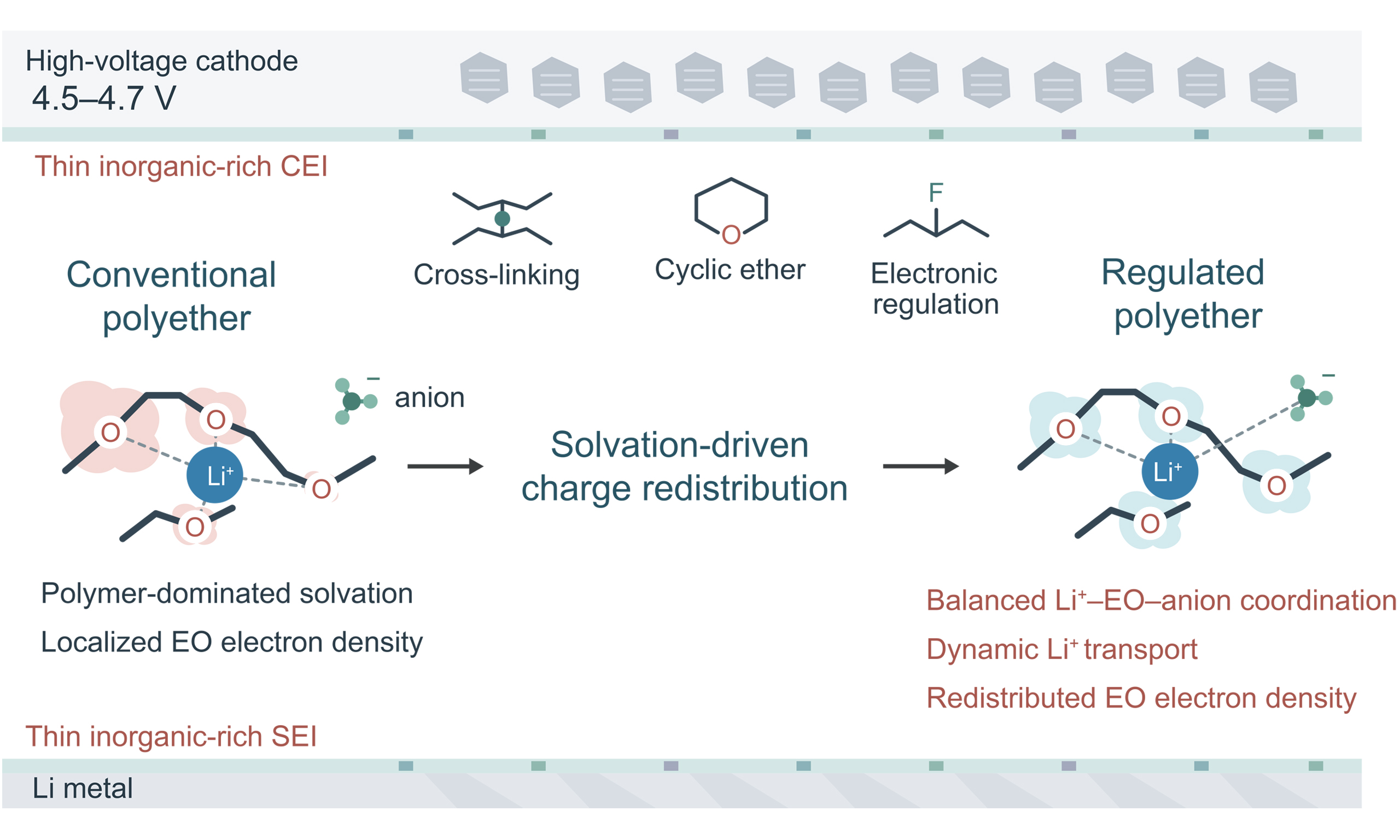
Abstract
Polyether electrolytes (PPEs) are promising for high-voltage lithium-metal batteries (LMBs) because of their good electrode wettability, continuous Li+ transport pathways, and favorable compatibility with lithium metal. However, their application above 4.3 V is limited by electron-rich ether oxygen (EO) sites, oxidation-prone terminal groups, and unfavorable Li+-EO coordination. Increasing evidence indicates that high-voltage instability cannot be attributed solely to terminal-group oxidation, but is closely related to the coupling between Li+ solvation and the local electronic structure of EO. In this review, we introduce solvation-driven charge redistribution as a unifying framework for understanding and designing high-voltage PPEs. We discuss how regulation of Li+-EO-anion coordination can redistribute or homogenize electron density around EO sites, reduce excessive Li+-polyether interactions, lower the oxidative activity of the polyether backbone, and simultaneously influence Li+ transport and interphase chemistry. Recent molecular strategies, including solvation-regulating cross-linkers, weakly solvating cyclic-ether monomers, electron-withdrawing functional units, and optimization of the Li+/EO coordination environment, are systematically analyzed within this framework. Particular attention is given to the connection between bulk solvation/electronic structure and the formation of inorganic-rich electrode-electrolyte interphases. Finally, we discuss the mechanistic evidence, current limitations, and practical design requirements for translating these concepts into high-voltage LMBs.
Keywords


 Download PDF
INTRODUCTION
Pairing lithium-metal anodes with high-voltage cathodes offers a direct route toward lithium-metal batteries (LMBs) with higher energy density, but also imposes stringent requirements on the electrolyte[1,2]. An ideal electrolyte must withstand highly oxidative cathode surfaces and the strongly reducing lithium-metal interface, while maintaining efficient Li+ transport and enabling stable solid-electrolyte interphase (SEI) and cathode-electrolyte interphase (CEI) formation during prolonged cycling[3,4].
Polyether electrolytes (PPEs) are attractive in this context because their flexible chains and abundant ether oxygen (EO) sites facilitate lithium-salt dissociation and Li+ transport, while polyether chemistry generally exhibits favorable compatibility with lithium metal[5-9]. In situ polymerizable PPEs provide an additional advantage: low-viscosity precursors can infiltrate porous electrodes before polymerization, improving interfacial contact and constructing continuous ion-transport pathways in solid-state or quasi-solid-state cells[10-13]. Nevertheless, their limited oxidative stability becomes increasingly problematic as cathode cutoff voltages extend beyond approximately 4.3 V, which is taken here as the onset of the high-voltage regime, with particular emphasis on practical cell operation at 4.5-4.7 V. Conventional explanations have mainly focused on oxidation of reactive terminal groups, particularly hydroxyl termini[14]. Although end-capping, cross-linking termination, and removal of residual reactive species can alleviate such reactions, these approaches alone are often insufficient to stabilize PPEs at higher voltages[15]. Increasing evidence indicates that the intrinsic electronic activity of EO sites within the polyether backbone also represents an important source of oxidative instability[16-18].
EO sites play a dual role in PPEs: they coordinate Li+ to support salt dissociation and ion transport, but also constitute electron-rich units susceptible to oxidation at high cathode potentials. Moreover, excessively strong Li+-EO coordination may hinder Li+ decoordination and migration[19,20]. Changes in the coordination environment can also alter the relative participation of polymer segments and anions in the local solvation environment and subsequent interfacial reactions[21,22]. High-voltage instability should therefore be considered as a coupled problem involving Li+ solvation, EO electronic structure, and interphase chemistry[21]. From this perspective, Li+ coordination is not merely an ion-transport motif, but also a regulator of local electronic structure. Appropriate modulation of the Li+-EO coordination environment can redistribute and homogenize electron density around EO sites, which has been associated with reduced backbone oxidation activity and improved high-voltage tolerance[23].
This emerging picture motivates a shift in PPE design from simple terminal-group passivation toward coordinated regulation of solvation structure, backbone electronic stability, and interfacial chemistry. In this review, we introduce solvation-driven charge redistribution as a unifying framework for understanding recent advances in high-voltage PPEs. We focus primarily on polyethers and in situ polymerized cyclic-ether systems in which EO sites dominate Li+ coordination. Within this framework, Li+ coordination, local electronic response, ion transport, and interphase chemistry are considered as interconnected levels of electrolyte behavior, with different studies providing complementary insight into these molecular-to-interfacial relationships. Non-PPE or chemically distinct electrolyte systems are discussed only when they provide relevant mechanistic or interfacial analogies for solvation-interphase relationships; conclusions drawn from these systems are restricted to the specific transferable principle being illustrated rather than treated as direct evidence for EO-dominated PPE chemistry. Consistent with this mechanism-oriented scope, representative studies were selected according to their relevance to Li+ coordination, ion transport, electronic structure, oxidative stability, and interphase chemistry rather than by a strict publication-year cutoff. Earlier studies are included where they establish the physicochemical basis of these processes, whereas recent studies are emphasized when discussing high-voltage molecular design and cell-level performance. We first examine how Li+ coordination regulates EO charge distribution, then discuss molecular design strategies involving cross-linkers, cyclic-ether monomers, and electron-withdrawing units, and finally connect these bulk molecular effects with SEI and CEI formation. Through this framework, we aim to establish molecular design principles for PPEs capable of stable operation in 4.5-4.7 V LMBs [Figure 1].
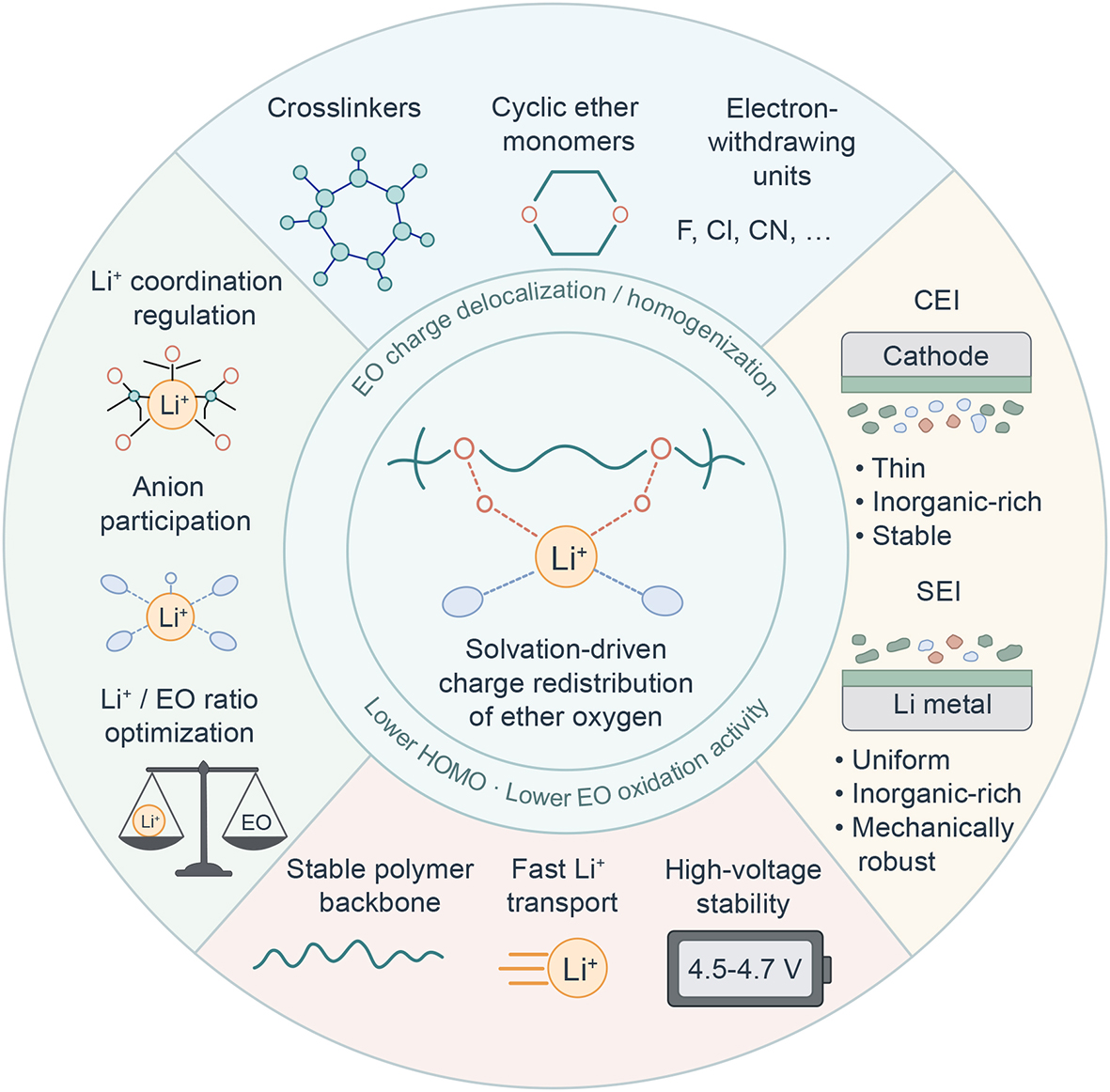
Figure 1. Schematic framework of solvation-driven charge redistribution in high-voltage PPEs. Regulation of Li+-EO-anion coordination couples EO electronic stabilization with Li+ transport and SEI/CEI formation. CEI: Cathode-electrolyte interphase; SEI: solid-electrolyte interphase; EO: ether oxygen; HOMO: highest occupied molecular orbital.
SOLVATION-CONTROLLED CHARGE REDISTRIBUTION OF EO
The high-voltage stability of PPEs cannot be fully described by a single electrochemical-window value, because oxidation is governed by the coupled evolution of local solvation, electronic structure, and interfacial reactions[24-27]. EO sites are central to this coupling. Their lone-pair electrons facilitate lithium-salt dissociation and provide coordination sites for Li+ transport, yet the same electron-rich character makes the polyether backbone susceptible to oxidative activation at high cathode potentials[14,19,20,28,29]. Consequently, the key design objective is not to eliminate Li+-EO coordination, which is essential for ion conduction, but to regulate its strength, spatial distribution, and competition with anions or other coordinating species[21,30].
From this perspective, the solvation structure determines more than the mobility of Li+. It also defines the local electronic environment experienced by EO sites and influences which electrolyte components are preferentially involved in interfacial decomposition. An optimized coordination environment should therefore simultaneously avoid excessive localization of electron density at EO, preserve sufficiently rapid Li+ coordination/decoordination, and promote favorable participation of anions or functional groups in interphase formation[31]. This coupled regulation forms the basis of the solvation-driven charge-redistribution framework discussed below.
Here, solvation-driven charge redistribution describes changes in the local electronic distribution of EO sites arising from reorganization of the Li+-EO-anion coordination environment. Variations in Li+-EO coordination and anion participation can redistribute electron density among neighboring EO sites, which can be reflected in their local charge distribution and highest occupied molecular orbital (HOMO) characteristics. Considered together with Li+ coordination information, these electronic descriptors provide a molecular picture of how solvation perturbs the oxidative activity of the polyether backbone.
Li+ coordination regulates EO electronic structure
In conventional PPEs, Li+-EO coordination is generally regarded as the molecular basis of ion conduction. Coordination between Li+ and EOs promotes lithium-salt dissociation, while long-range Li+ transport involves coupled processes including coordination-site exchange, motion with polymer segments, and transfer between coordination environments[19,20,32,33]. Moderate Li+-EO interactions are therefore beneficial for maintaining a connected ion-transport environment. However, when Li+ binding becomes excessively strong, ion motion becomes increasingly dependent on slow segmental relaxation and local decoordination events, which can reduce Li+ transport kinetics and increase polarization[34,35].
The consequences of Li+-EO coordination are not limited to transport. Changes in coordination strength also modify the relative participation of polymer segments and anions in the Li+ solvation shell. In polymer-dominated coordination environments, strong Li+-EO interactions may increase the involvement of polyether-derived species in interfacial reactions[23]. In some reported systems, this behavior has been associated with more organic-rich interphases, which can exhibit lower mechanical robustness, greater chemical heterogeneity, and less uniform Li+ flux[21,30]. By contrast, weakening excessive Li+-EO coordination can increase anion participation and thereby alter interfacial decomposition pathways[21,30]. More importantly, Li+ coordination directly influences the electronic state of EO[23]. EO contains localized lone-pair electron density that can be involved in oxidative electron-transfer processes at highly delithiated cathode surfaces. When the local electronic density remains strongly concentrated around particular EO sites, these sites may exhibit greater oxidative susceptibility, facilitating dehydrogenation, C-O bond cleavage, chain scission, and subsequent interfacial side reactions[14,17,28]. Thus, the electronic instability of the polyether backbone is intrinsically linked to its coordination environment.
Appropriate Li+ coordination can partially redistribute this local electron density. Rather than treating the Li+-EO interaction only as an electrostatic binding event, it can be viewed as a perturbation of the local electronic structure of the polymer. In selected systems, more spatially balanced Li+ coordination produces a more homogeneous charge distribution among neighboring EO sites and reduces the degree of local electron enrichment[23]. Computational and experimental studies have associated such charge redistribution with lower EO oxidation activity and improved resistance of the polyether backbone toward high-voltage oxidation. Reported local charge-homogenization studies provide a representative example. By adjusting the local coordination environment of Li+, including the nominal Li+/EO ratio and the spatial arrangement of Li+ around EOs, these studies shifted EO charge from a locally concentrated state toward a more uniform distribution. For the modeled configurations, this redistribution was accompanied by a decrease in the calculated HOMO energy of the Li+-polyether complex, indicating reduced electronic susceptibility toward oxidation[23].
Li+ coordination in high-voltage PPEs should therefore be considered as both a transport motif and an electronic-structure regulator. Calculated HOMO energy and Li+-EO binding strength provide useful static descriptors of electronic susceptibility and coordination thermodynamics, respectively, but they do not directly quantify Li+ transport kinetics. Practical Li+ transport additionally depends on the kinetics of coordination/decoordination, Li+ residence and exchange behavior, and polymer segmental relaxation[36]. Accordingly, the desirable coordination state is not necessarily the one with the lowest Li+-EO binding strength, but rather one that balances sufficient salt dissociation with sufficiently rapid coordination exchange and segmental motion for continuous Li+ migration[37]. The desirable coordination state is not necessarily the weakest or strongest Li+-EO interaction. Instead, it should balance three requirements: sufficient coordination for salt dissociation, sufficiently dynamic decoordination for Li+ migration, and sufficiently uniform electronic redistribution to suppress excessive EO oxidation activity[23,35,38]. This view expands conventional PPE design from segmental-motion control toward the coupled regulation of solvation dynamics and electronic stability.
Local charge homogenization lowers oxidative activity
Local charge homogenization provides a more specific molecular interpretation of how solvation regulation can stabilize EO sites without sacrificing their role in Li+ coordination. The central concept is that high-voltage instability is associated not only with the absolute electron density of the polyether backbone, but also with how unevenly that density is distributed among local EO environments. EO sites with strongly localized electron density can become preferential centers for oxidative electron loss, whereas a more delocalized electronic distribution can reduce the presence of highly reactive local sites[23].
Charge homogenization, weak solvation, and electronic stabilization are closely coupled in some PPEs but describe different molecular characteristics. Charge homogenization refers to a redistribution of local electron density within the Li+-polyether coordination environment that reduces excessive electron localization at individual EO sites. Weak solvation instead concerns the relative strength of Li+-polymer coordination or the affinity of polymer coordinating units toward Li+, whereas electronic stabilization describes a state in which the polymer backbone is less susceptible to oxidative electron removal. These characteristics need not vary in parallel. Charge homogenization can be associated with electronic stabilization without requiring the weakest Li+-EO interaction[23,39,40], while weak solvation does not by itself specify how charge is distributed among EO environments. Likewise, electronic stabilization can arise from intrinsic molecular electronic effects without necessarily weakening Li+ coordination. These concepts should therefore be considered as complementary dimensions of molecular regulation rather than interchangeable descriptions of the same mechanism.
Within this framework, the Li+ coordination environment acts as a local charge-regulation field. Altering the number and spatial arrangement of EO groups coordinated to Li+ changes how electronic density is distributed across the Li+-polyether complex[23]. A suitable coordination geometry can reduce local electron enrichment at individual EO sites and distribute charge more evenly over multiple coordinating units. This effect is distinct from simply weakening Li+-EO binding: the relevant parameter is the overall coordination balance and resulting electronic distribution rather than a monotonic decrease in binding strength[39,40]. The reported local charge-homogenization strategy illustrates this distinction. Changes in the Li+/EO coordination ratio and the local distribution of Li+ around EO sites led to less localized EO charge. For selected configurations, theoretical calculations showed a corresponding decrease in the HOMO energy of the polyether-containing complex, consistent with reduced susceptibility toward oxidative electron removal[23]. Taken together, these results support a molecular link between Li+ coordination and the electronic response of EO sites. In PTIDOL, the same solvation-regulating chemistry also influences salt dissociation, network structure, and monomer conversion, indicating that the resulting high-voltage behavior arises from coupled solvation-electronic regulation in which EO charge redistribution represents an important contribution rather than an isolated controlling factor[23].
Charge homogenization also provides a possible bridge between bulk electronic stabilization and interfacial chemistry[21,23,30]. At a high-voltage cathode surface, continuous oxidation of electron-rich polymer segments can generate polyether-derived decomposition products that contribute to a thick and compositionally heterogeneous CEI, increasing impedance and exposing fresh electrolyte to further oxidation. Across several reported systems, electronically stabilized EO environments have been associated with reduced polymer-derived decomposition and a greater relative contribution of anions or deliberately introduced functional groups to early-stage interphase formation[21,23]. Correspondingly, these systems frequently exhibit interphases with a higher proportion of inorganic decomposition products. Importantly, this relationship should not be interpreted as a universal linear sequence in which charge homogenization alone determines CEI composition. Interphase formation remains dependent on salt chemistry, cathode surface state, functional groups, cutoff voltage, and cycling conditions[41,42]. Nevertheless, the available studies support a recurring association between reduced polymer oxidation, increased participation of non-polymer species, and more stable inorganic-rich interphases.
The available evidence nevertheless suggests that charge homogenization should be considered within the broader context of coupled solvation and structural regulation. In representative systems such as PTIDOL, spectroscopic characterization, molecular-dynamics analysis, and electronic-structure calculations consistently link reconstructed Li+-EO coordination with a more delocalized EO electronic distribution and lower oxidative susceptibility. At the same time, the solvation-regulating cross-linker also influences salt dissociation, polymer-network structure, and monomer conversion. The improved high-voltage behavior is therefore more reasonably understood as arising from coupled solvation-electronic regulation, in which EO charge redistribution represents an important molecular contribution rather than an isolated controlling factor[23].
Local charge homogenization should therefore be regarded as a balanced solvation state rather than a simple change in Li+-EO binding strength. An effective design must retain sufficient salt dissociation and Li+ mobility while suppressing localized EO electronic activity. This balance connects molecular solvation regulation with backbone oxidation resistance and provides a mechanistic basis for understanding how bulk electrolyte chemistry can influence cathode-side interphase formation[43].
Li+/EO ratio as a formulation-level descriptor
The nominal Li+/EO ratio is one of the most intuitive formulation-level parameters for describing PPEs and can provide useful information when comparing high-voltage PPE systems[44,45]. It defines the stoichiometric relationship between Li+ and the available EO sites and therefore provides a first approximation of how strongly the coordination environment may be perturbed by lithium salt concentration. For complex cross-linked, copolymerized, or in situ formed systems, the nominal EO count is taken from the stoichiometric number of ether oxygen atoms contributed by the ether-containing polymer, monomer, and cross-linker structures in the reported formulation; oxygen atoms in non-ether functionalities are not included in the EO denominator. Changes in this ratio can be associated with variations in Li+ coordination, EO charge distribution, ion aggregation, and polymer dynamics. However, the nominal Li+/EO ratio does not directly specify the actual local solvation structure[44,45]. Experimentally, wide-composition studies of PEO-LiTFSI have demonstrated that ionic conductivity and Li+ transference behavior vary substantially with the EO:Li ratio[44].
This distinction is important because macroscopic electrochemical behavior emerges from local coordination rather than nominal stoichiometry alone. Compared with descriptors such as ionic conductivity, glass-transition temperature, or the anodic onset obtained from linear sweep voltammetry (LSV), Li+/EO provides complementary molecular-level formulation information[44-46]. It can help rationalize differences between compositions, but it should not be treated as an intrinsic predictor of high-voltage stability. A complete mechanistic description requires consideration of several additional parameters, including the Li+ coordination number, Li+-EO residence or decoordination behavior, anion participation, polymer architecture, salt identity, chain mobility, temperature, and interphase composition[19,20,46,47]. These variables determine whether an increase in nominal Li+ content produces isolated solvated Li+ species, contact ion pairs, larger ionic aggregates, or heterogeneous coordination environments[45]. They also influence the extent to which Li+ transport remains coupled to polymer segmental motion[19,45,48].
Within this broader framework, several apparently distinct molecular strategies can be compared using the same cation-EO-anion coordination picture. Local charge homogenization modifies Li+-EO coordination to redistribute EO electron density. Fluorinated cross-linking can weaken excessive Li+-EO interactions while increasing anion participation. Cyclic-ether monomer reconstruction changes the intrinsic Li+ binding ability and electronic structure of the polyether backbone before interfacial reactions occur[10,49]. Electron-withdrawing functional groups can further perturb both EO electronic activity and the competitive coordination environment. Although these approaches are commonly classified as cross-linking, fluorination, monomer engineering, or functional-group modification, their common molecular consequence is a redistribution of interactions among Li+, EO, anions, and additional coordinating functionalities[50]. A higher nominal Li+/EO ratio is therefore not inherently advantageous. In some formulations, increasing Li+ content can reduce the number of uncoordinated EO sites and alter local electronic distribution, but excessive salt loading may promote contact ion pairs or aggregates, restrict polymer segmental motion, and increase interfacial resistance[45,46]. Conversely, an excessively low Li+/EO ratio may produce only limited perturbation of the EO electronic environment and retain strongly polymer-dominated solvation. More importantly, the nominal Li+/EO ratio does not uniquely determine the local coordination structure[44-46]. Systems with the same nominal composition may differ substantially in salt dissociation, free-anion/contact-ion-pair/aggregate populations, polymer-chain conformation, degree of polymerization, temperature response, and residual monomer or solvent content. Li+/EO should therefore be regarded as a formulation-level descriptor rather than a stand-alone predictor of high-voltage stability, and should be interpreted together with spectroscopic, computational, transport, and interfacial information[44-47].
Taken together, solvation-regulated EO charge redistribution provides a molecular framework linking Li+ coordination, backbone electronic structure, ion transport, and interphase chemistry. In conventional PPEs, strongly localized EO electron density and unfavorable Li+-EO coordination can promote backbone oxidation, sluggish ion transport, and continuous interfacial decomposition[19,20,23,28]. By contrast, optimized coordination environments can redistribute EO electron density, moderate Li+-polyether interactions, enhance anion participation, and favor the formation of more stable inorganic-rich SEI and CEI. These contrasting molecular and interfacial behaviors are schematically summarized in Figure 2. This framework provides the mechanistic basis for the molecular design strategies discussed in the following section, including solvation-regulating cross-linkers, weakly solvating cyclic-ether monomers, and electron-withdrawing units[49,50].
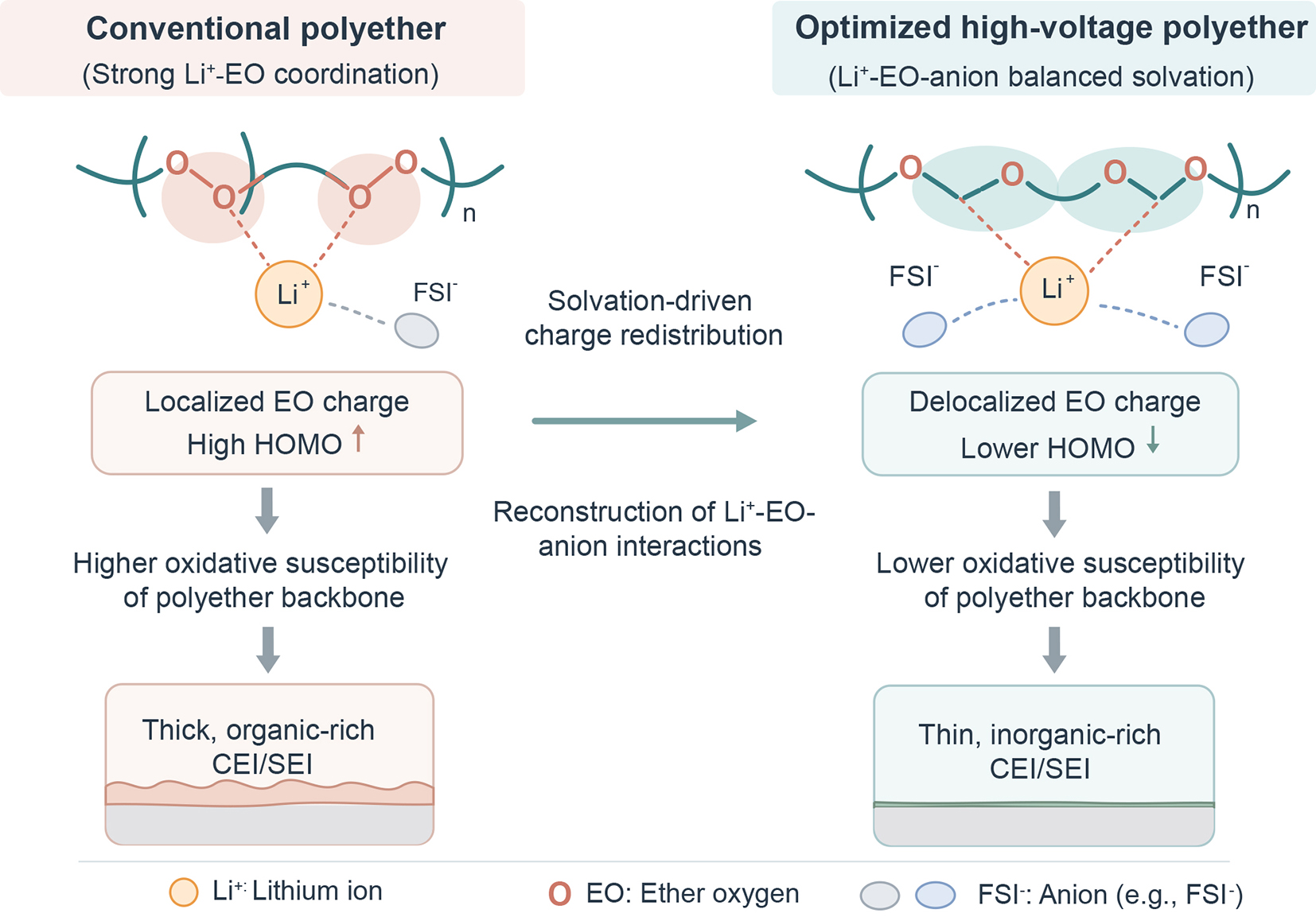
Figure 2. Schematic comparison of solvation, charge distribution, and interphase evolution in conventional and optimized high-voltage polyether electrolytes. Polymer-dominated Li+ coordination and localized EO charge are contrasted with a more balanced Li+-EO-anion coordination environment. The diagrams illustrate the associated differences in HOMO level, susceptibility to backbone oxidation, and CEI/SEI morphology and composition. These relationships are conceptual and depend on the specific electrolyte chemistry and operating conditions. HOMO: highest occupied molecular orbital; CEI: cathode-electrolyte interphase; SEI: solid-electrolyte interphase.
MOLECULAR HANDLES FOR HIGH-VOLTAGE POLYETHER DESIGN
The molecular design of high-voltage PPEs can be rationalized through three complementary structural handles: cross-linkers that regulate local solvation, cyclic-ether monomers that tune intrinsic Li+ binding, and electron-withdrawing or electronic-structure-regulating units that reduce the oxidative activity of polyether segments. These strategies operate at different structural levels, but they are not independent. Each modifies, to varying degrees, the balance among Li+, EO, anions, and additional functional groups, thereby influencing backbone electronic stability, Li+ transport, and interphase formation simultaneously[51,52]. Viewed within the solvation-driven charge-redistribution framework, their common objective is therefore not simply to maximize oxidation resistance, but to establish a coordination environment in which electronic stabilization and ion-transport kinetics remain compatible.
Solvation-regulating cross-linkers
Cross-linkers are widely used in PPEs to construct three-dimensional polymer networks and improve mechanical strength, dimensional stability, and electrode/electrolyte contact. For high-voltage applications, however, their function can extend well beyond structural reinforcement. A cross-linking center that perturbs the local Li+ coordination environment can also act as a solvation-regulating node, modifying the spatial distribution of EO sites, Li+-EO interaction strength, anion participation, and ultimately the electronic state of the polyether backbone[30,47]. Cross-linker design can therefore couple mechanical stabilization with molecular-scale regulation of solvation and oxidation chemistry.
The local charge-homogenization strategy provides a representative example. In a cross-linked polyether system using 1,3-dioxolane (DOL) as the monomer and triglycidyl isocyanurate (TGIC) as the cross-linker, TGIC connects multiple polyether chains while reconstructing the local coordination environment around Li+. The resulting change in the nominal Li+/EO ratio and EO electron-density distribution was associated with a lower calculated HOMO level of the coordinated polyether structure and improved resistance to high-voltage oxidation. The reported electrolyte enabled cycling at a cutoff voltage of 4.7 V, illustrating how a cross-linking unit can function simultaneously as a network former and a local electronic-structure
These examples indicate that cross-linker selection for high-voltage PPEs should consider at least three functions simultaneously: network reinforcement, regulation of Li+-EO-anion coordination, and control of interfacial decomposition. Excessive cross-linking may improve mechanical rigidity but suppress segmental mobility, whereas insufficient cross-linking may fail to stabilize either the network or the local coordination environment[54]. The most effective cross-linkers should therefore serve as multifunctional regulation centers that balance mechanical integrity, solvation structure, electronic stabilization, and interphase chemistry[55]. These complementary functions are illustrated sequentially in Figure 3A-C: local coordination regulation [Figure 3A], functional cross-linking with mixed coordination [Figure 3B], and hybrid-network formation
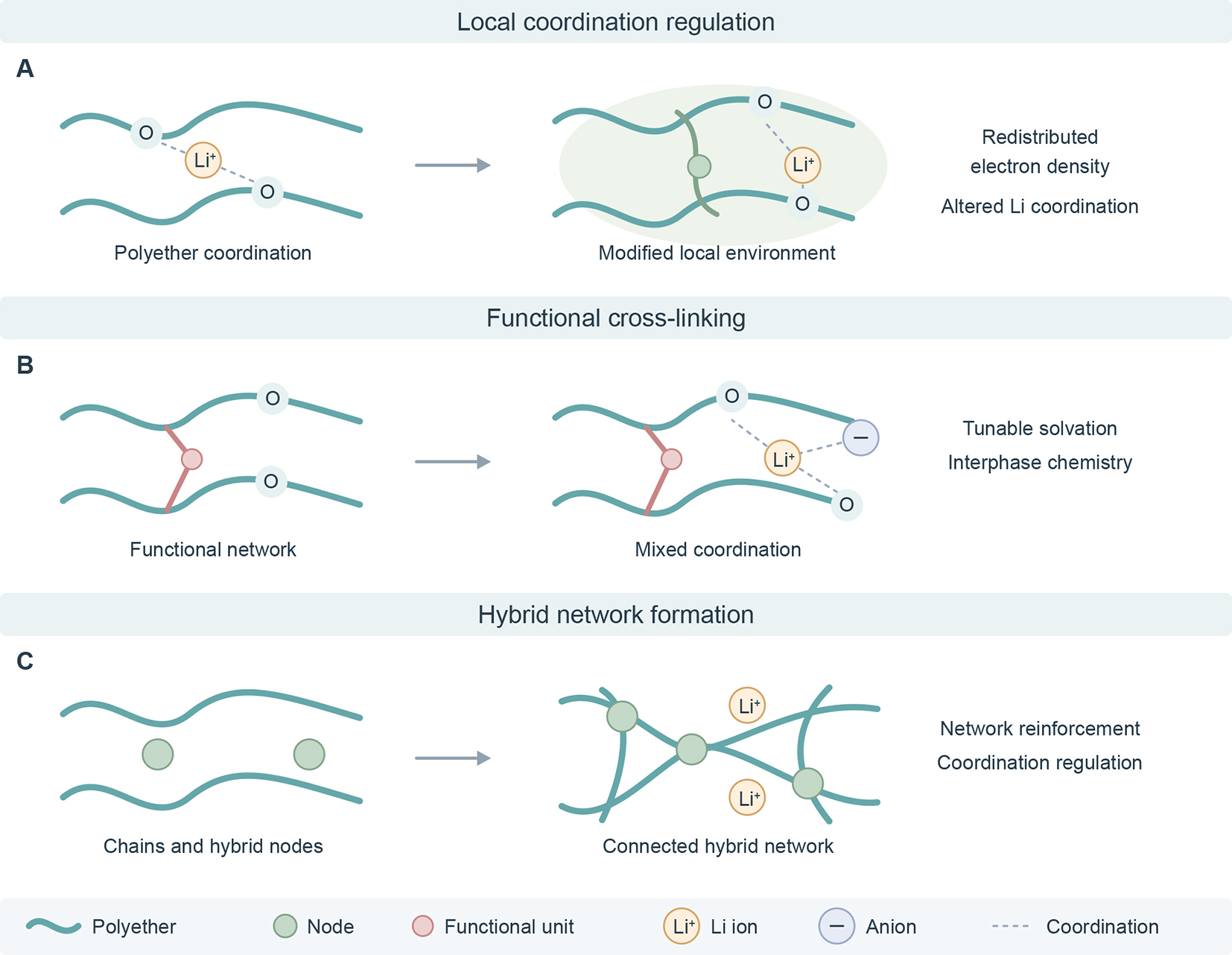
Figure 3. Cross-linking strategies for solvation regulation in high-voltage polyether electrolytes. (A) Local coordination regulation through modification of the polymer environment, leading to redistributed electron density and altered Li⁺ coordination. (B) Functional cross-linking that couples polymer-network formation with mixed Li⁺ coordination and tunable interphase chemistry. (C) Hybrid-network formation that reinforces the polymer framework while regulating the local coordination and ion-transport environment.
Weak-solvating cyclic-ether monomers
Beyond cross-linker engineering, the cyclic-ether monomer itself determines the intrinsic coordination chemistry and electronic character of the resulting polyether backbone. This makes monomer selection a more fundamental design variable than post-polymerization modification[11,49]. Conventional DOL-derived PPEs offer favorable polymerization behavior and continuous EO-based Li+ transport pathways, but their relatively strong Li+-EO interaction and electron-rich backbone can become unfavorable under high-voltage conditions. Modifying the ring structure and EO arrangement of the monomer therefore provides a direct route to regulate Li+ binding, polymer electronic structure, and interfacial reaction pathways from the molecular origin of the electrolyte[49].
The use of 1,3-dioxane (DOX) instead of conventional DOL provides a representative example. Compared with the five-membered DOL-derived structure, the six-membered DOX-derived polyether exhibits a different backbone conformation and a lower calculated HOMO level[49]. In the reported system, weaker Li+-EO interaction was accompanied by increased anion participation in the local coordination environment, thereby shifting the solvation structure away from strongly polymer-dominated coordination. This change was further associated with preferential formation of an anion-derived, inorganic-rich SEI. The DOL/DOX comparison therefore illustrates a continuous structure-solvation-interphase relationship in which monomer architecture affects backbone electronic state, Li+ coordination strength, and interfacial decomposition behavior[49]. The incorporation of POSS hybrid cross-linking nodes into the DOX-derived system further demonstrates how monomer chemistry and network architecture can work cooperatively. The reported PDOX/POSS electrolyte combined a lower calculated HOMO level with weaker Li+-EO coordination and stronger anion participation. It exhibited a Li+ transference number of 0.88, an oxidative-stability response extending to 4.7 V under the stated measurement conditions, and stable lithium plating/stripping at high current densities. The same design was further demonstrated in 4.6 V NCM811 cells and 3 Ah-class pouch cells[10]. These results suggest that weakly solvating backbone chemistry can be further reinforced by a cross-linking environment that preserves favorable coordination while improving structural stability.
Monomer engineering therefore differs conceptually from simply introducing an additive or interfacial modifier[56]. By altering EO spacing, backbone conformation, local polarity, and intrinsic Li+ affinity, the monomer defines the baseline solvation environment before subsequent cross-linking or functionalization is introduced[57]. For high-voltage PPEs, monomer screening should consequently integrate several descriptors rather than focusing on polymerizability alone[58]. Calculated electronic structure, experimentally determined Li+ coordination, anion participation, polymerization kinetics, segmental mobility, and ionic transport should be evaluated together. Excessively weak Li+-EO coordination can compromise salt dissociation, while monomer structures that impede polymerization or segmental motion can offset gains in oxidative stability[58]. The objective is not necessarily to minimize Li+-EO binding, but to establish sufficiently weak and dynamic coordination that reduces excessive polymer participation while maintaining continuous Li+ transport. These design elements are illustrated sequentially in Figure 4A-E: ether-site spacing, backbone conformation, and interfacial contact [Figure 4A], polymer/anion coordination balance [Figure 4B], oxidative backbone response [Figure 4C], hybrid-network formation [Figure 4D], and electronic-level stabilization [Figure 4E].
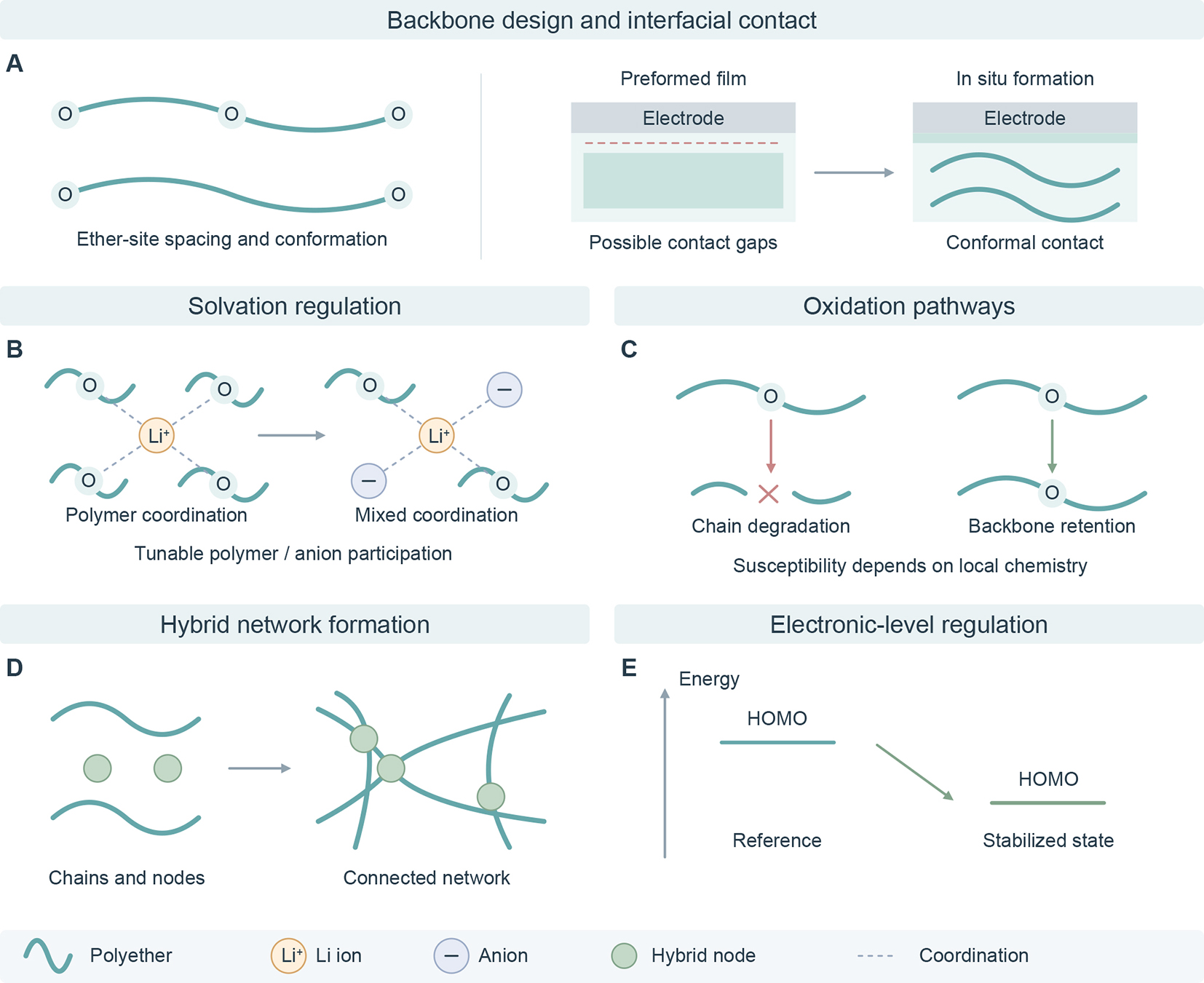
Figure 4. Cyclic-ether monomer engineering and hybrid-network regulation in high-voltage polyether electrolytes. (A) Regulation of ether-site spacing and polymer-backbone conformation, together with improved electrode contact enabled by in situ electrolyte formation. (B) Transition from polymer-dominated coordination toward a more balanced polymer/anion coordination environment. (C) Comparison of polymer-backbone degradation and retention under oxidative conditions. (D) Hybrid-network formation through incorporation of multifunctional nodes into the polymer framework. (E) Electronic stabilization represented by a decrease in the HOMO level following molecular and network regulation. HOMO: highest occupied molecular orbital.
Electron-withdrawing and electronic-structure-regulating units
A third molecular handle is the deliberate regulation of polymer electronic structure through electron-withdrawing groups or coordination-mediated charge redistribution. Functional units containing F, Cl, or cyano (-CN) groups can decrease the electron activity of polymer segments or terminal groups while simultaneously modifying Li+ coordination and interfacial decomposition[59]. Their effect is therefore not purely electronic: changes in polarity, Li+ affinity, segmental dynamics, and decomposition preference can also reshape the local solvation environment[60]. Electron-withdrawing functionalization therefore provides a direct route to electronic stabilization within this broader design space[23].
Halogenation provides a clear example of the balance required between electronic stabilization and ion transport. In the reported comparison of F-, Cl-, and Br-containing polyether systems, Cl provided a favorable compromise between electron-withdrawing ability and preservation of transport kinetics[16]. Chlorination reduced the nucleophilicity of terminal hydroxyl groups and inhibited dehydrogenation reactions initiated by main-chain ether oxygens[16], while also modifying Li+ coordination behavior. As a result, the chlorinated poly(3,3-dimethyloxetane) (PCMO) retained relatively high ionic conductivity while extending its electrochemical stability. Under the reported conditions, PCMO exhibited a stability response reaching approximately 5.0 V and supported relatively stable cycling in 4.5 V LiCoO2 cells and high-voltage pouch cells[16]. This example illustrates that the strongest electron-withdrawing group is not necessarily the most effective; compatibility with polymer dynamics and Li+ coordination remains equally important. Fluorination places greater emphasis on the coupling between bulk electronic stabilization and interphase chemistry[61]. C-F-containing units can decrease the electron activity of polymer segments and, after interfacial decomposition, contribute to LiF-containing SEI or CEI products. In the reported FEOP system, fluorination was associated with an anion-involved solvation environment and an anodic onset extending to approximately 5.6 V, together with full-cell demonstrations using high-voltage NCM811 cathodes[21]. The significance of fluorination therefore lies not only in lowering segment-level oxidative activity, but also in redirecting interfacial chemistry toward fluorine-containing inorganic products[62,63]. As with other LSV-derived values, however, the reported anodic onset reflects the specific measurement configuration rather than a universal intrinsic oxidation limit. Cyano-containing structures provide a complementary example because their strong dipole and electron-withdrawing character can increase salt dissociation while also strengthening interactions with Li+[64]. This illustrates an important distinction between electronic stabilization and weak solvation: an electron-withdrawing unit does not necessarily produce weaker Li+ coordination. In the reported F/CN copolymer series, cyano-containing compositions were classified as more strongly solvating, whereas fluorinated compositions exhibited weaker solvation and favored fluorine-derived interphase formation. The optimized system showed nearly 6,000 h of Li||Li cycling under the reported symmetric-cell conditions and an anodic stability approaching 5.0 V. Full-cell cycling was separately demonstrated with lithium cobalt oxide (LCO) at a 4.45 V cutoff, NCM811 at 4.5 V, and NCM523 at 4.2 V[5]. This comparison highlights that functional-group selection must account for both electronic effects and the resulting position of the polymer within the Li+ solvation hierarchy.
Accordingly, electron-withdrawing regulation should avoid two limiting regimes. If the electronic effect is too weak, oxidation-prone EO or terminal sites may remain insufficiently stabilized. If the interaction is excessively strong or the functional-group content is too high, polymer flexibility can decrease, Li+ coordination/decoordination may become slower, and polymerization behavior may be adversely affected. The appropriate design target is therefore a balanced electronic perturbation that lowers the oxidative activity of susceptible polymer segments while retaining dynamic Li+ transport and promoting favorable interfacial decomposition. These coupled effects are illustrated sequentially in Figure 5A-C: electron-withdrawing functionalization and local electron-density redistribution [Figure 5A], fluorinated-segment incorporation and interphase-precursor chemistry [Figure 5B], and functional-group-dependent coordination balance [Figure 5C].
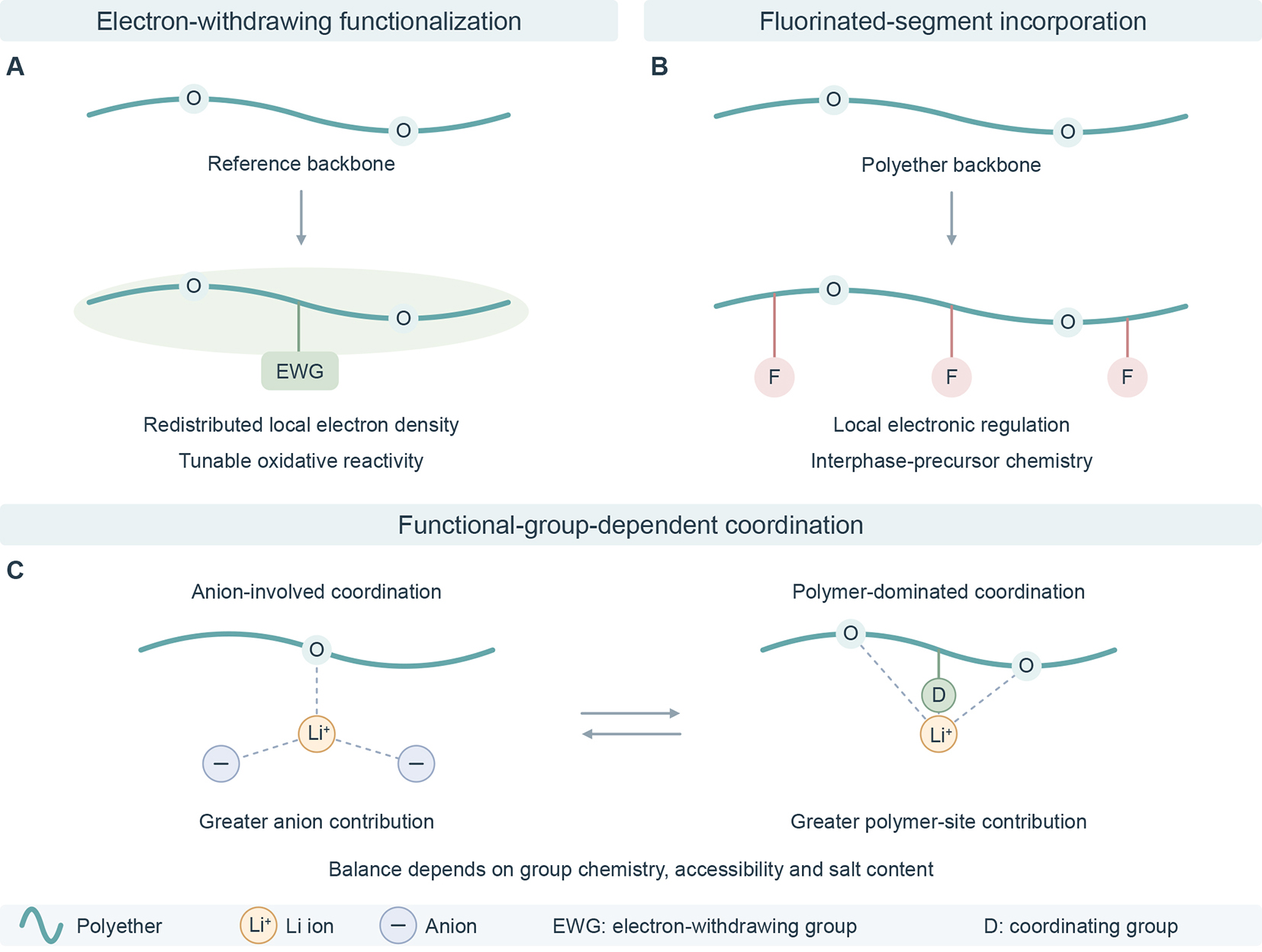
Figure 5. Functional-group-mediated electronic and solvation regulation in polymer electrolytes. (A) Electron-withdrawing functionalization redistributes local electron density and tunes the oxidative reactivity of susceptible polymer segments. (B) Incorporation of fluorinated segments regulates the local electronic environment and interphase-precursor chemistry. (C) Functional-group-dependent coordination shifts the balance between anion-involved and polymer-dominated Li⁺ coordination environments.
Taken together, cross-linkers, cyclic-ether monomers, and electronic-structure-regulating units constitute complementary molecular handles for high-voltage PPEs. Cross-linkers primarily restructure the spatial coordination environment while reinforcing the polymer network; monomer engineering alters the intrinsic electronic structure and Li+ affinity of the backbone; and electron-withdrawing units directly perturb segment-level electron density while also affecting solvation and interphase chemistry. These strategies therefore operate through overlapping but non-identical molecular pathways. Their common feature is the regulation of interactions among Li+, EO, anions, and functional groups, whereas the extent to which local EO charge redistribution is involved depends on the specific chemistry and the available molecular-level evidence. This shared cation-EO-anion framework provides the molecular basis for comparing how different molecular-design strategies balance electronic stability, ion transport, and interfacial regulation before considering their SEI/CEI consequences in Section "INTERPHASE OUTCOMES FROM STABILIZED POLYETHER CHEMISTRY".
To translate these qualitative design principles into a quantitative comparison, Table 1 benchmarks representative high-voltage PPEs using a common set of transport, oxidative-stability, Li-metal, full-cell, and practical-cell metrics. Because the reported systems differ in electrolyte category, test temperature, LSV configuration, current density, electrode loading, lithium inventory, and cell format, the corresponding conditions are retained in the comparison rather than collapsing the data into a single performance ranking.
Standardized quantitative comparison of representative high-voltage polyether electrolytes
| Electrolyte category | Design strategy | σ (mS cm-1)/tLi+ | Anodic responsea | Li||Li benchmarkb | High-voltage cellc | Practical validationd |
| PTIDOL[23]/SPE; in situ | TGIC cross-link; Li+-EO reconstruction; EO homogenization | 0.396 (RT)/0.82 | 5.10 V; SS; 1 mV s-1 | 1,200 h; 0.3/0.3; RT | NCM622; 4.7 V; 1 C; 81.8%/400 | 2 Ah NCM90||SiOx/C; 20.3 mg cm-2; N/P 1.13; 89.4%/150 |
| PDOL-OFHDBO[53]/PE; in situ | Fluorinated cross-link; weak Li+ binding; anion-rich | 1.47 (25 °C)/0.75 | 5.6 V; 0.5 mV s-1 | > 1,100 h; 0.5/1; RT | NCM811; 4.5 V; 0.5 C; 89.1%/100 | 1.1 Ah Li||NCM811; 4.3 mAh cm-2; Li 50 μm; N/P 2.3; E/C 2.2; 401.8 Wh kg-1 |
| PDOX/POSS[10]/hybrid PE; in situ | POSS cross-link; weak Li+-EO; anion-dominant | 0.31 (30 °C)/0.88 | 4.7 V; SS; 1 mV s-1 | ≈4,000 h; 1/1; RT | NCM811; 4.6 V; 1 C; 90.8%/100 | 3 Ah Li||NCM811; 4 mAh cm-2; Li 40 μm; N/P 1.1; E/C 2.0; 74%/100; 383.8 Wh kg-1 |
| P-DOX[49]/PE; in situ | 6-membered ether; weak solvation; FSI--involved | 0.17 (25 °C)/0.75 | > 4.7 V; SS; 1 mV s-1 | > 1,300 h; 1/1; RT | NCM811; 4.5 V; 1 C; > 84%/100 | 2.5-3.0 mg cm-2; Li ≈400 μm; N.R. (Ah-scale) |
| PCMO[16]/QSPE | Cl regulation; balanced Li+ coordination/transport | 1.14 (30 °C)/0.71 | ≈5.0 V; SS/Pt; 0.2 mV s-1 | > 2,500 h; 0.5/0.5; RT | LCO; 4.5 V; 1 C; 85.3%/200 | 33 mAh NCM622||Li; 11.5 mg cm-2; Li 50 μm; 83%/145; 2 Ah Gr pouch ≈70%/1,000 |
| FEOP[21]/PE; in situ | Main-chain F; lower HOMO; anion-involved | 1.00 (25 °C)/0.51 | 5.6 V; SS; 1 mV s-1 | 2,000 h; 0.5/0.5; RT | NCM811; 4.7 V; 1 C; 68.1%/700 | 1.19 Ah LMB: Li 20 μm; 3.34 mAh cm-2; N/P 1.3; E/C 3.0; 77.2%/70; 332.1 Wh kg-1; 5.6 Ah: 405.3 Wh kg-1 |
| DF0.24-20[5]/SPE; in situ | F-copolymer; weak solvation; CIP/AGG-rich | 0.019 (28 °C); 0.11 (60 °C)/N.R. | 5.0 V; C/Al; 1 mV s-1 | 5,967 h; 0.1/0.1; 60 °C | LCO; 4.45 V; 0.5 C; 80%/300; 60 °C | PE ≈ 10 μm; LCO ≈ 2.0 mg cm-2; N.R. (Ah-scale) |
Several trends emerge from this comparison. No single molecular-design strategy is uniformly superior across all metrics. PTIDOL provides particularly direct molecular-level evidence linking Li+ coordination reconstruction with EO charge redistribution, whereas PDOL-OFHDBO combines high near-room-temperature ionic conductivity with high-loading and thin-Li validation. PDOX/POSS couples a high Li+ transference number with high-current Li-metal tolerance and 3 Ah pouch-cell validation, while FEOP provides the broadest demonstration across ultra-high-voltage full cells and practical cell formats. PCMO achieves a favorable balance between ion transport and oxidative stability, whereas P-DOX and DF0.24-20 illustrate representative monomer-engineering and weak-solvation design routes, respectively. Collectively, these comparisons indicate that high-voltage PPE performance should be evaluated through the coordinated optimization of electronic stability, Li+ transport, interfacial regulation, and practical cell constraints rather than by any isolated performance metric.
INTERPHASE OUTCOMES FROM STABILIZED POLYETHER CHEMISTRY
Molecular stabilization of high-voltage PPEs ultimately needs to be translated into stable electrode/electrolyte interfaces. Changes in Li+-EO-anion coordination affect not only the electronic stability and transport properties of the polymer bulk, but also the identity and relative reactivity of species reaching the electrode surface. Changes in bulk solvation and polymer electronic structure can reduce polymer participation in interfacial decomposition, while increased participation of anions or functional groups can redirect competing reaction pathways toward inorganic products. Their coupled effects can favor earlier formation of thinner, denser, and more chemically stable passivation layers[65]. Establishing this connection, however, requires linking the precursor coordination environment with the reactivity of participating electrolyte species and the resulting interphase chemistry, rather than inferring the pathway from post-cycling interphase composition alone[66,67].
This relationship is relevant to both electrodes but operates under distinctly different electrochemical conditions. At the high-voltage cathode, the principal challenge is to suppress oxidative decomposition of the polyether backbone and prevent continuous CEI growth. At the lithium-metal anode, rapid Li+ transfer, homogeneous ion flux, and formation of a mechanically and chemically robust SEI are required to sustain reversible lithium deposition[5,68]. High-voltage PPE design therefore requires coordinated control of both interfaces rather than optimization of either side in isolation.
Cathode interphases with suppressed polymer oxidation
At high states of charge, particularly for highly delithiated Ni-rich cathodes, the electrolyte is exposed to strongly oxidizing surfaces that can accelerate polyether decomposition. Electron-rich EO sites and reactive terminal groups can undergo oxidative reactions that generate C-C-, C-O-, and carbonate-containing products. Repeated decomposition produces a thick and compositionally heterogeneous CEI, increases interfacial impedance, and continuously consumes electrolyte and active lithium[17]. A semisolid nylon electrolyte provides a non-PPE cathode-interphase analog illustrating how preferential formation of inorganic-rich products can improve passivation of high-Ni cathodes[69].
Regulation of the polyether electronic structure can alter this degradation pathway. In fluorinated cross-linked polyethers, for example, electron-withdrawing units decrease the electronic activity of the polymer framework, while modified Li+ coordination increases anion participation in the local solvation environment. In the reported fluorinated cross-linked system, these coupled changes were associated with a lower contribution from continuous polymer decomposition and greater participation of alternative interfacial reaction pathways. In the reported PDOL system, the CEI formed on NCM811 was relatively thick and loose, reaching approximately 13.3 nm and containing pronounced polymer-derived C-C, C-O, and Li2CO3 components[53]. After introduction of the fluorinated OFHDBO cross-linker, the CEI thickness decreased to approximately 2.6 nm and the film became more uniform, with increased contributions from inorganic species including LiF and B-O-containing products[53]. The significance of this change lies not simply in producing an inorganic-rich film, but in achieving effective passivation before extensive polyether oxidation occurs. A relatively thin and compact CEI can limit further electron transfer between the cathode and electrolyte while maintaining Li+ transport across the interface[70]. In this sense, the kinetics and selectivity of initial decomposition are as important as the final interphase composition.
Coordination-mediated charge homogenization provides a second route toward cathode stabilization. In PTIDOL, reconstruction of the Li+ coordination environment was associated with a more homogeneous EO charge distribution and a lower calculated electronic activity of the polyether structure. The same electrolyte exhibited a thinner and more inorganic-rich cathode interphase after cycling and supported high-voltage operation[23]. Together, these observations support an association between bulk electronic stabilization and suppressed CEI growth, while the thinner and more inorganic-rich interphase is more appropriately understood as an integrated outcome of bulk solvation and interfacial reaction pathways rather than a unique fingerprint of the preceding charge-redistribution process. Monomer engineering provides a related example at the backbone level. The DOX-derived polyether exhibits weaker Li+-EO coordination and a lower calculated HOMO level than its DOL-derived analogue, while POSS incorporation further enhances anion participation.[10,49] Calculations of DOX, PDOX, and PDOX/POSS at the NCM811 surface provide a molecular-scale comparison of their interfacial interactions[10]. Together with the reported cycling of PDOX/POSS against 4.6 V Ni-rich cathodes, these results illustrate how backbone chemistry, coordination structure, and cathode-surface interactions can be regulated cooperatively.
Cathode-interface stabilization can therefore be understood as a coupled process involving three linked effects: reduction of intrinsic polyether oxidation activity, increased participation of anions or functional groups in early interfacial reactions, and formation of a sufficiently thin and passivating CEI[50,65]. The relative importance of these contributions varies among electrolyte chemistries and operating conditions, but their combined effect determines whether the cathode interface reaches a stable passivated state or undergoes continuous electrolyte decomposition. These cathode-side pathways are illustrated sequentially in
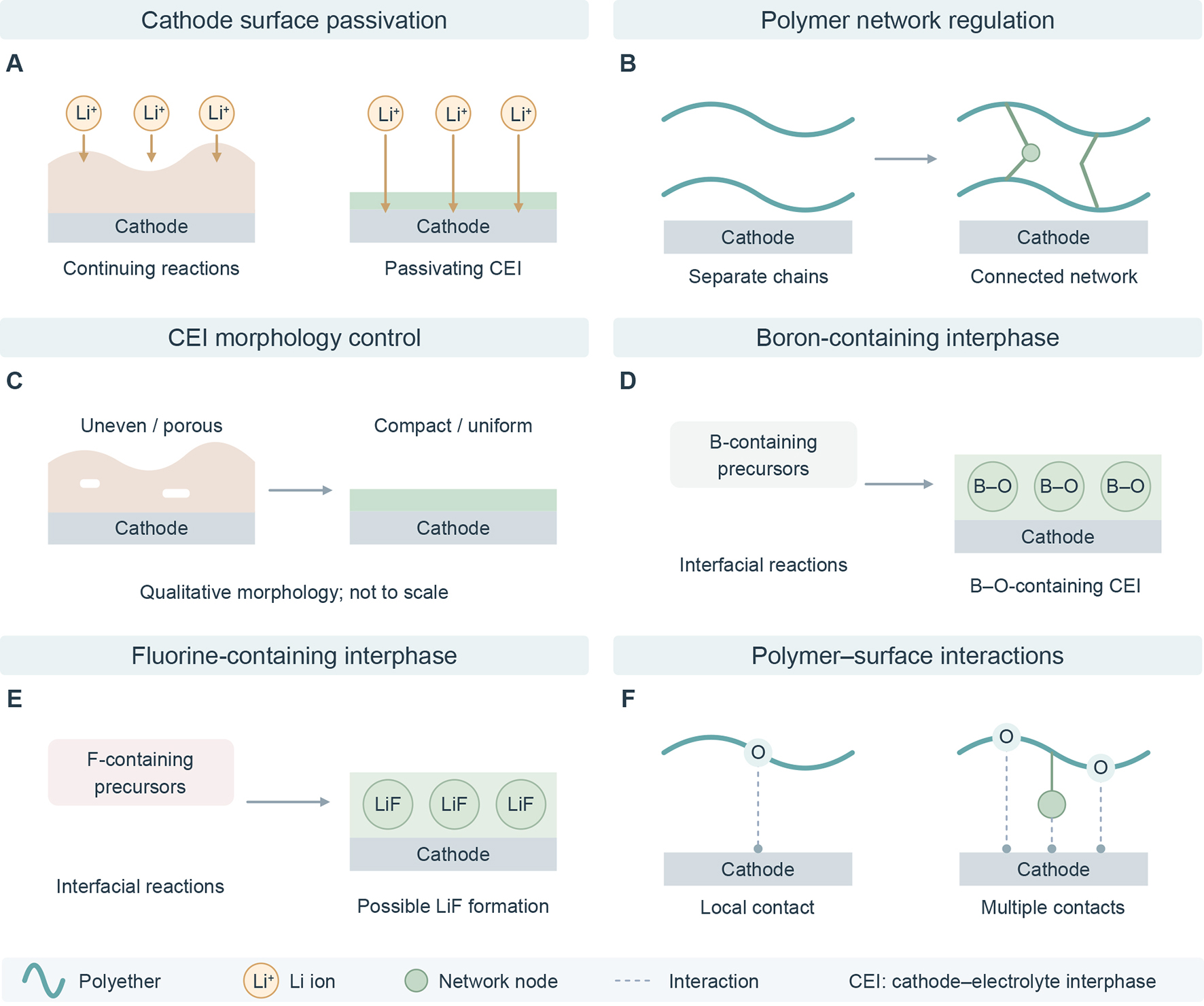
Figure 6. Cathode-interphase regulation and polymer-cathode interactions in high-voltage polymer electrolytes. (A) Comparison between continued interfacial reactions and formation of a passivating CEI. (B) Polymer-network regulation from separated chains toward a connected network structure. (C) Comparison between uneven/porous and compact/uniform CEI morphologies. (D) Formation of B-O-containing interphase components from boron-containing precursors. (E) Formation of LiF-containing interphase components from fluorine-containing precursors. (F) Regulation of polymer-cathode interactions from localized contact toward multiple interfacial contacts.
Lithium interphases with uniform Li+ flux
Bulk solvation regulation is equally important at the lithium-metal interface. Before deposition, Li+ must undergo coordination rearrangement and interfacial decoordination before crossing the SEI and being reduced to metallic lithium. Excessively strong Li+-EO coordination can increase the energetic or kinetic cost of this process, whereas heterogeneous interfacial transport can generate localized current-density hotspots. In combination with a mechanically or chemically unstable SEI, these effects promote rough lithium deposition, dead-lithium formation, and dendritic growth[71,72]. The desirable SEI therefore needs to perform several functions simultaneously[73,74]. It should suppress continuous electrolyte reduction, maintain sufficient mechanical integrity against morphological fluctuations, and provide spatially homogeneous Li+-transport pathways[75-77]. A non-PPE interfacial analog further illustrates the distinction between a sparse, heterogeneous interphase and a more continuous and passivating SEI; its relevance to PPEs is limited to this general interfacial design principle[78].
Solvation regulation provides a route to tune the species preferentially reduced at lithium. When Li+ coordination becomes less strongly dominated by EO and anion participation increases, anions can contribute more strongly to the initial reduction chemistry. Depending on the salt and functional groups involved, this may enrich the SEI in inorganic species such as LiF, Li2S, Li3N, and boron-containing products[10,79]. Such inorganic components are frequently associated with improved chemical stability, mechanical robustness, and more homogeneous Li+ transport, although their effectiveness depends on their spatial distribution and the overall interphase architecture rather than composition alone. The fluorinated cross-linked polyether provides one example of this relationship. The reported electrolyte sustained Li||Li cycling for more than 1,100 h at 0.5 mA cm-2 and more than 550 h at 2 mA cm-2, with a critical current density of 3.7 mA cm-2[53]. These electrochemical characteristics were associated with formation of a fluorine-rich and mechanically robust SEI, suggesting that fluorinated molecular design can couple bulk solvation regulation with interfacial reinforcement. PTIDOL exhibits a related but mechanistically distinct behavior. In this system, local EO charge homogenization and reconstructed Li+ coordination were accompanied by an SEI containing less oxygen, more uniformly distributed LiF, and boron-containing species. A higher measured Young's modulus was also reported[23]. These features are consistent with more reversible lithium plating/stripping and a more mechanically stable interface, although they should be regarded as interfacial outcomes associated with, rather than independent proof of, the proposed charge-redistribution mechanism. The PDOX/POSS system further illustrates how changes in solvation can be connected with interfacial reaction chemistry. Raman spectroscopy and molecular simulations showed weaker Li+-polymer coordination and greater participation of the bis(fluorosulfonyl)imide anion (FSI-) than in PDOX[10]. Calculations of the PDOX/POSS complex with lithium bis(fluorosulfonyl)imide (LiFSI) indicated a lower LUMO and a greater tendency toward anion-involved reduction; depth-resolved X-ray photoelectron spectroscopy (XPS) after cycling revealed a LiF-rich gradient SEI. Together, these precursor-state and post-cycling results connect solvation, reaction tendency, and interphase chemistry, although POSS incorporation also modifies network architecture and ion transport. Li||Li cells reportedly cycled for nearly 4,000 h at 1 mA cm-2 and 1 mAh cm-2 and for more than 1,000 h at 7.5 mA cm-2[10]. A complementary interfacial strategy combines regulation of the bulk coordination environment with a salt-philic, solvent-phobic interfacial layer to enrich anion participation near the lithium surface and promote an anion-derived inorganic SEI[79]. The carbonate electrolyte formulation containing fluoroethylene carbonate (FEC) and pentafluorocyclotriphosphazene (PFPN) (PFE) and its aluminum ethoxide Al(Eto)3-containing counterpart (PAFE) formed a more uniform interphase that promoted homogeneous Li+ transport and reduced local stress at the lithium interface[80]. Taken together, long-term lithium stability is better understood as the combined consequence of bulk transport, solvation structure, interphase chemistry, and interfacial architecture rather than SEI composition alone.
These examples indicate that the often-cited intrinsic affinity of polyethers toward lithium metal is insufficient as a design criterion for high-voltage LMBs. The lithium interface should instead be engineered from the perspective of Li+ solvation and interfacial reaction selectivity. A favorable PPE should enable sufficiently rapid Li+ coordination exchange, promote uniform ionic flux across the SEI, and preferentially generate a chemically stable and mechanically competent interphase. These lithium-interface principles are illustrated sequentially in Figure 7A-E: interphase continuity [Figure 7A], solvation-guided SEI formation [Figure 7B], coordination balance [Figure 7C], selective interfacial partitioning [Figure 7D], and ion-flux distribution with mechanical accommodation [Figure 7E].
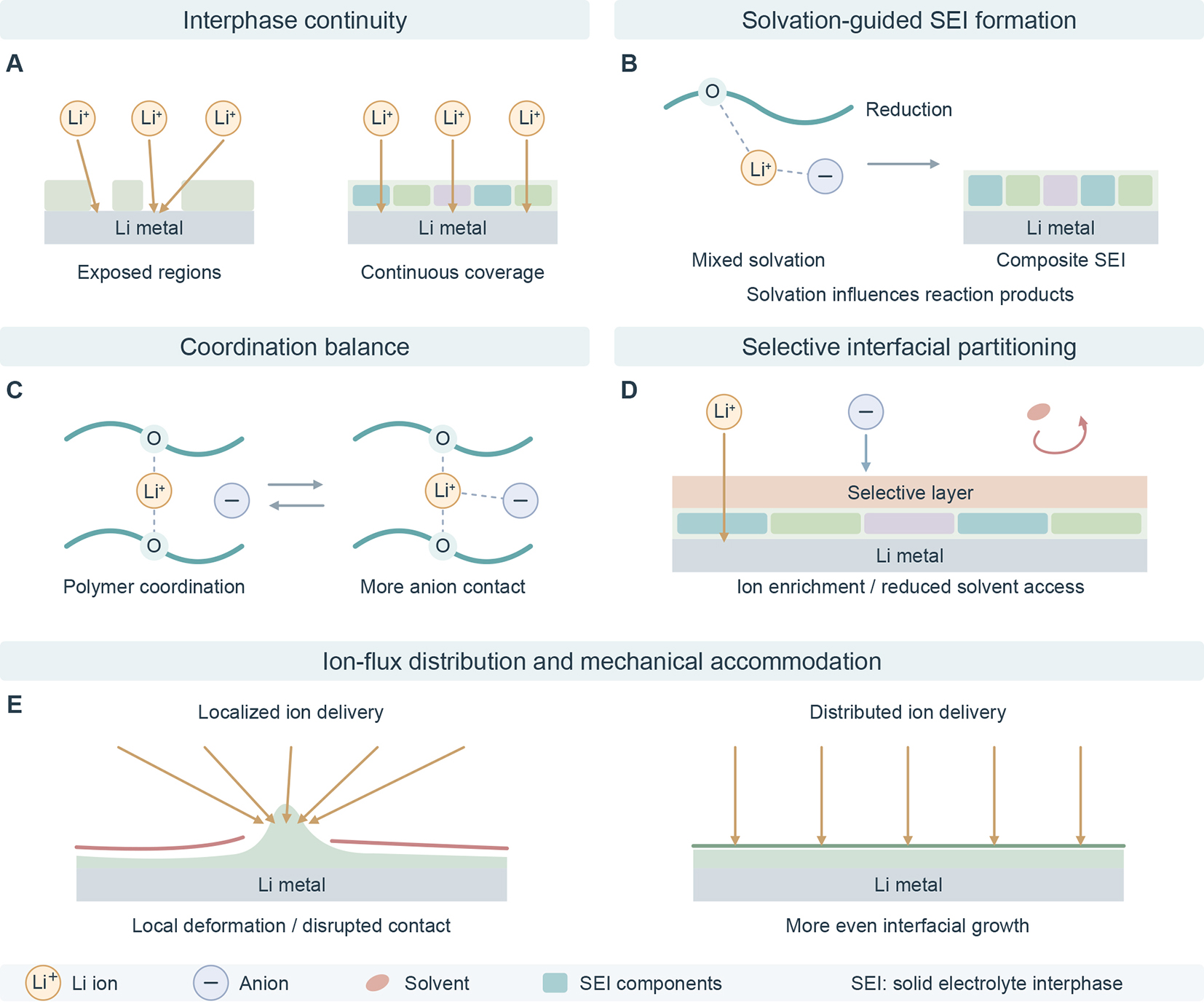
Figure 7. Solvation and interfacial strategies for stabilizing lithium metal. (A) Sparse and continuous interphase coverage illustrating localized and more spatially distributed Li⁺ flux. (B) Solvation-guided interphase formation showing how anion participation influences reduction products and SEI composition. (C) Coordination balance between polymer-dominated and more anion-involved Li⁺ environments. (D) Selective interfacial partitioning that enriches ionic species while restricting solvent access to the lithium surface. (E) Comparison between localized and distributed Li⁺ delivery and the associated differences in interfacial deformation and growth.
Coupled stabilization of SEI and CEI
High-voltage PPEs require simultaneous stabilization of the cathode and lithium-metal interfaces[81]. A highly oxidation-resistant electrolyte cannot sustain long-term full-cell operation if lithium deposition remains nonuniform, while an exceptionally stable lithium interface provides little benefit if continuous polyether oxidation occurs at the cathode[82]. The central challenge is therefore to establish a bulk solvation environment that is compatible with two electrochemically opposite interfaces.
The Li+-EO-anion coordination structure provides the molecular connection between these interfaces. In strongly polymer-dominated solvation environments, polyether segments can participate extensively in both oxidative and reductive decomposition[21,23,30,83]. When excessive Li+-polymer interaction is weakened and anion or functional-group participation increases, the relative contribution of polymer-derived interfacial products can decrease, while anion-derived species contribute more strongly to both SEI and CEI formation[84,85]. The resulting films may become richer in LiF, sulfur- or nitrogen-containing inorganic species, or boron/fluorine-containing products, depending on the electrolyte chemistry and electrode environment.
Anion-regulation strategies further demonstrate how selective coordination can redirect interfacial chemistry. In the AMPE system, a boron-containing anion receptor promoted dissociation and reduction of bis(trifluoromethanesulfonyl)imide (TFSI-), resulting in a layered, anion-derived SEI and stable high-voltage Li||LCO cycling, with the direct interphase evidence pertaining primarily to the lithium-metal interface[22]. AMPE is included here as a mechanistic analog illustrating how anion coordination can control preferential interphase formation rather than as direct evidence for EO-dominated PPE chemistry.
An anion-rich PDMA-Li system provides a complementary polymer-electrolyte example[86]. Weakened Li+-polymer interactions and greater anion participation were accompanied by an inorganic-rich SEI and a thin, uniform CEI on NCM523, enabling Li||NCM523 cycling at 4.5 V[83]. Although chemically distinct from EO-dominated PPEs, this system illustrates how anion-rich solvation can regulate decomposition at both interfaces. Another example is the conjugated topologically confined composite electrolyte (M-FGPE), which incorporates a metal-organic framework (MOF) into a fluorinated polymer matrix and promotes anion-derived interphase formation at lithium and LCO interfaces[87]. Within polyether systems, the TGIC-cross-linked PTIDOL electrolyte combines local EO charge homogenization with stabilization at both the cathode and lithium-metal interfaces. Its reconstructed coordination/electronic environment is accompanied by reduced polymer-derived decomposition and more inorganic-rich interphases, while Li|PTIDOL|NCM622 cells operate at a cutoff voltage of 4.7 V[23]. Similarly, the PDOX/POSS hybrid electrolyte combines weaker Li+-EO interaction, enhanced anion participation, a high Li+ transference number, and an inorganic-rich SEI, providing direct interphase evidence at the lithium-metal interface together with cathode-side support from high-voltage Ni-rich cell operation and calculated cathode-surface interactions[10]. Fluorinated cross-linked polyethers provide a complementary route in which fluorinated segments and anion-rich solvation favor LiF-containing interphases on both electrodes[30,53].
Taken together, these observations suggest that dual-interface stabilization should be assessed as an integrated property rather than inferred from a single electrochemical metric. Anodic LSV onset characterizes only a particular oxidative test condition, Li||Li lifetime probes only the lithium interface under symmetric-cell conditions, and ionic conductivity alone does not determine interphase stability[88,89]. High-voltage PPE evaluation should therefore also consider CEI thickness and composition, SEI morphology and mechanical properties, Li+ transference behavior, interfacial impedance evolution, and full-cell retention under practically relevant cathode loading and lithium inventory[90].
Accordingly, inorganic-rich SEI and CEI should be viewed as interfacial manifestations of a broader molecular design strategy rather than as independent optimization targets. Across the systems discussed above, stabilization of EO electronic structure is associated with reduced polymer-derived oxidation, while rebalanced Li+-EO-anion coordination is frequently accompanied by greater participation of anions or functional groups in early interfacial reactions. When these trends occur cooperatively, they are consistent with the formation of passivating interphases on both electrodes while retaining efficient Li+ transport[21,23,30,43]. Such coupled bulk-interface behavior provides a useful basis for interpreting the sustained operation of PPEs in high-voltage LMBs. These coupled pathways are illustrated sequentially in Figure 8A-C: anion-interaction engineering [Figure 8A], coordination-environment tuning [Figure 8B], and coupled cathode/lithium-metal interphase stabilization [Figure 8C].
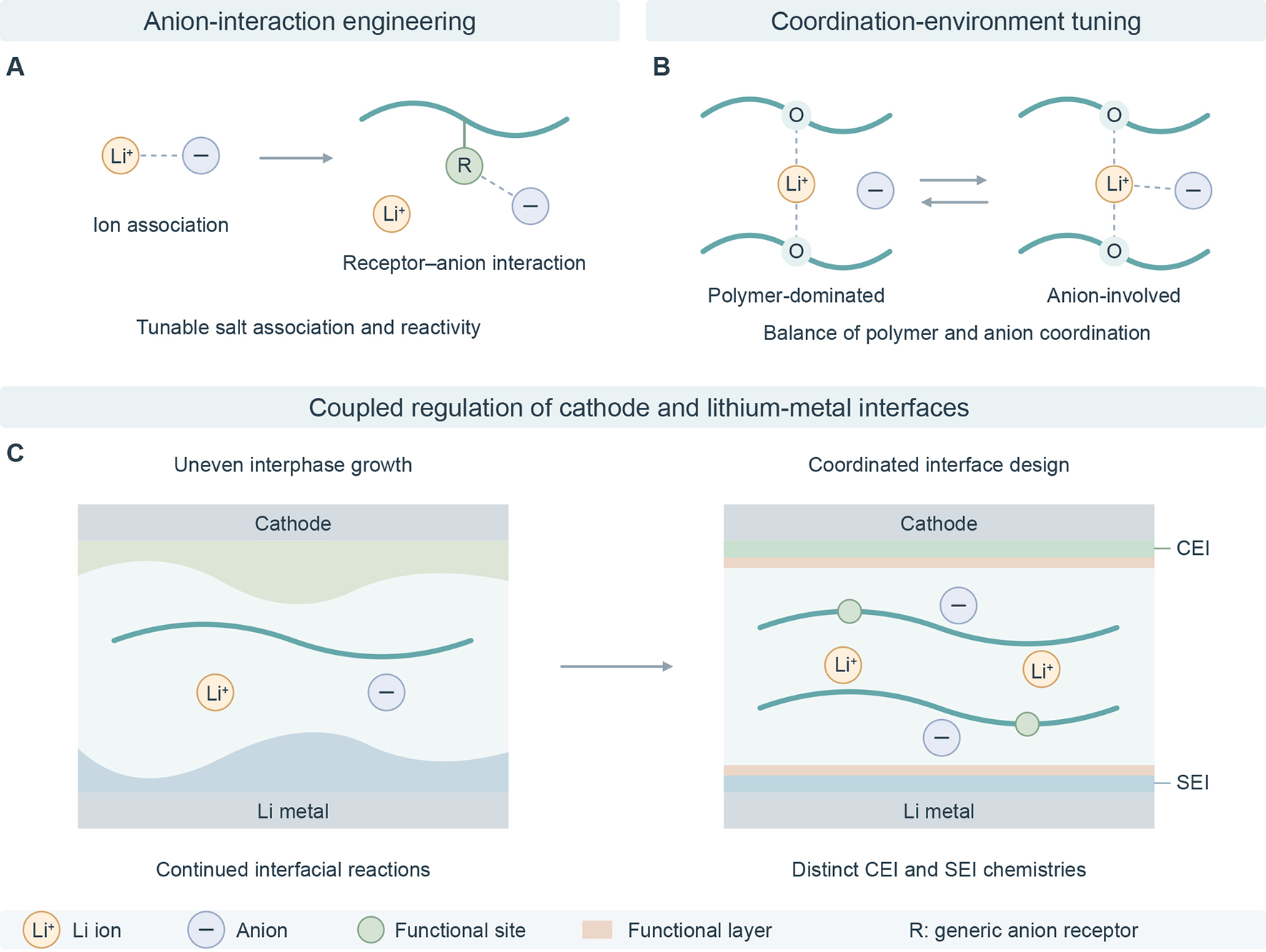
Figure 8. Anion regulation and coupled stabilization of electrode interphases. (A) Anion-interaction engineering through a functional receptor that regulates ion association and anion reactivity. (B) Coordination-environment tuning between polymer-dominated and more anion-involved Li⁺ solvation. (C) Coupled regulation of cathode and lithium-metal interfaces, illustrating the transition from uneven interphase growth and continued interfacial reactions toward coordinated formation of passivating CEI and SEI layers. CEI: cathode-electrolyte interphase; SEI: solid-electrolyte interphase.
CONCLUSION AND OUTLOOK
Solvation-driven EO charge redistribution provides a molecular framework for understanding and designing high-voltage PPEs. Rather than treating oxidative stability, Li+ transport, and interphase formation as independent optimization targets, this framework connects polymer structure with Li+-EO-anion coordination, EO electronic structure, and the resulting SEI/CEI chemistry. The studies discussed in this review suggest that high-voltage PPE design should move beyond simply widening the apparent electrochemical stability window or increasing cross-linking density toward coordinated regulation of bulk solvation and dual-interface stability[91] [Figure 9]. Several directions merit particular attention.
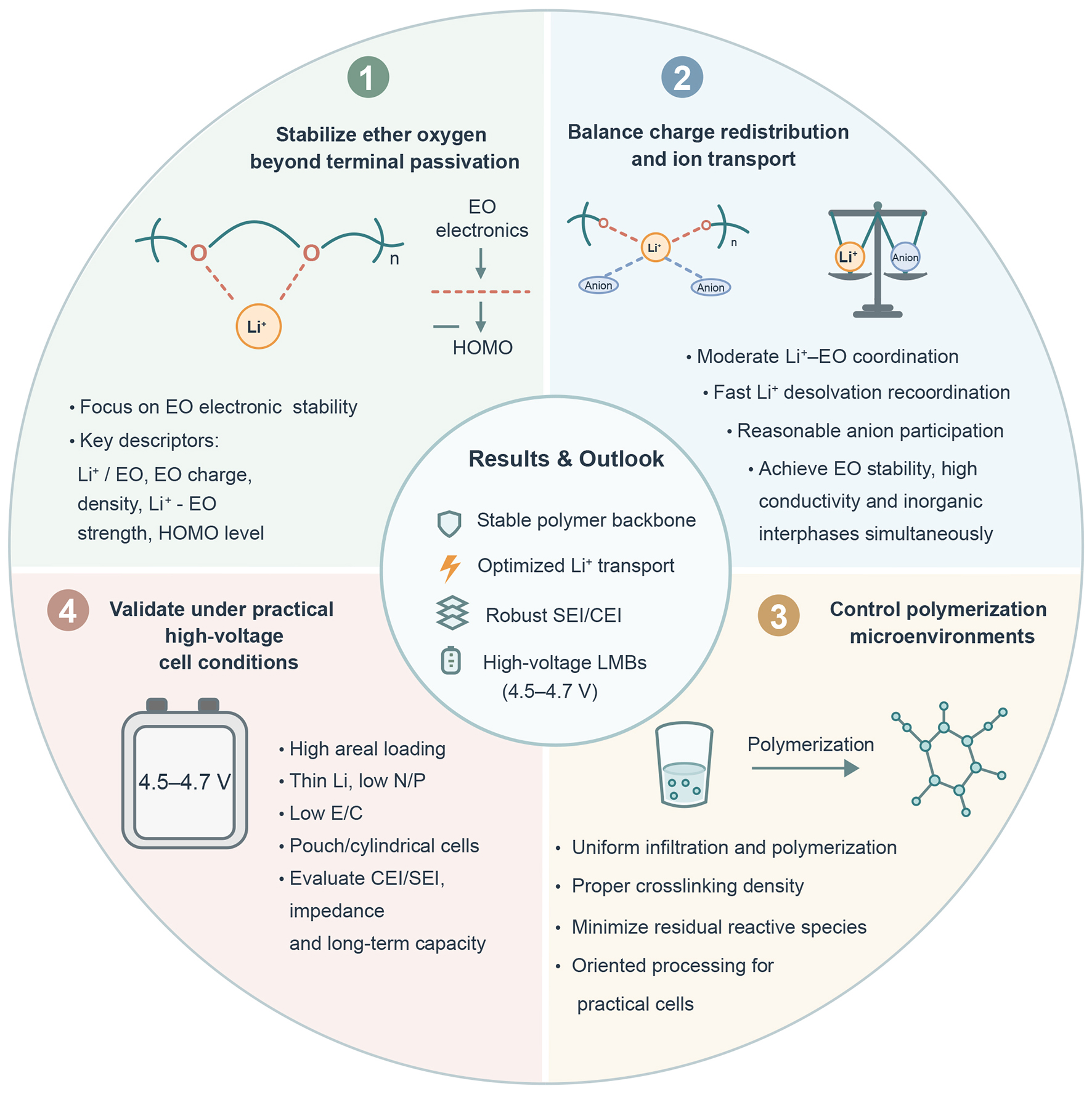
Figure 9. Molecular design targets and practical evaluation criteria for high-voltage PPEs. The proposed framework integrates EO electronic stabilization, Li+ solvation and transport, processing control, dual-interface regulation, and practically relevant cell parameters toward predictable high-voltage LMB operation.
(1) Move from terminal passivation to backbone-level EO stabilization
Reactive terminal groups, particularly hydroxyl groups, remain important sources of high-voltage side reactions, but their elimination alone is insufficient for sustained operation above 4.3 V. The electronic activity of EO sites within the polyether backbone represents an additional and potentially more fundamental limitation. Future molecular design should therefore target the local electronic environment of EO through controlled Li+ coordination, backbone architecture, and functional-group engineering. Parameters such as the nominal Li+/EO ratio, EO charge distribution, Li+-EO binding strength, coordination number, and calculated HOMO level may serve as complementary molecular descriptors. In particular, HOMO energy and Li+-EO binding strength primarily describe electronic or thermodynamic tendencies and should not be interpreted as direct predictors of Li+ transport. Practical ion transport additionally depends on coordination/decoordination kinetics, Li+ residence and exchange behavior, polymer segmental dynamics, and the continuity of ion-transport pathways[92]. These static and dynamic parameters should therefore be evaluated together with spectroscopic, transport, and interfacial measurements[93].
(2) Balance electronic stabilization with Li+ transport
Reducing EO oxidation activity is beneficial only if rapid ion transport is retained. Excessive cross-linking, overly strong electron-withdrawing effects, rigid polymer architectures, or excessively strong Li+ coordination can suppress segmental dynamics and increase the kinetic barrier for Li+ coordination exchange[94]. Conversely, overly weak Li+-EO interactions may compromise salt dissociation or disrupt continuous transport pathways. An optimized high-voltage PPE should therefore maintain a dynamic coordination environment characterized by moderate Li+-EO interaction, sufficiently rapid coordination/decoordination, and appropriate anion participation. Establihing quantitative relationships among charge redistribution, coordination dynamics, and Li+ transport will be essential for moving from empirical formulation toward predictive molecular design. Progress toward this goal will benefit from matched electrolyte systems that minimize concurrent changes in salt speciation, monomer conversion, and network structure, together with operando spectroscopy and quantitative electronic-structure analysis to clarify how EO charge redistribution contributes to high-voltage stability[95].
(3) Control polymerization and processing microenvironments
For in situ polymerized PPEs, the final electrolyte structure is determined not only by molecular composition but also by the polymerization and processing history[11]. Precursor infiltration, local monomer concentration, polymerization kinetics, cross-linking heterogeneity, residual monomers or initiators, and electrolyte thickness can all influence the local Li+ coordination environment and subsequent interfacial reactions[96]. These effects become increasingly important in thick electrodes and large-format cells, where spatial heterogeneity can produce uneven ionic transport and nonuniform interphase formation. Future studies should therefore connect polymerization chemistry with spatially resolved solvation, transport, and interfacial characterization, rather than treating processing conditions as secondary experimental details. Matched electrolyte series that vary the coordination environment while independently quantifying polymer conversion, network structure, residual monomer content, and mechanical properties will be particularly valuable for separating these coupled effects. Combining such controlled comparisons with time- or potential-resolved characterization of interfacial solvation and reaction products would allow the sequence from coordination change to interphase formation to be tested directly rather than inferred from post-cycling correlations[66,67].
(4) Validate high-voltage stability under practically relevant conditions
Apparent anodic stability from LSV or long Li||Li symmetric-cell cycling cannot alone establish practical compatibility with high-voltage LMBs. Future studies should systematically report cathode areal loading and areal capacity, lithium thickness, negative-to-positive capacity ratio (N/P), electrolyte-to-capacity ratio (E/C), cutoff voltage, stack pressure, temperature, formation protocol, average Coulombic efficiency, capacity retention, and cycle number[97-99]. More stringent validation should progressively combine high-loading cathodes, thin lithium, low N/P ratios, lean electrolyte conditions, and realistic pouch or cylindrical cell formats[100-102]. Concurrent tracking of CEI/SEI composition, interfacial impedance, gas evolution, and lithium morphology will also be necessary to distinguish genuine electrolyte stabilization from short-term interfacial passivation. Beyond electrochemical performance, practical polymer-electrolyte development should also consider thermal safety, leakage resistance, and flammability, particularly for gel or quasi-solid systems[103].
Overall, the development of high-voltage PPEs requires a transition from isolated molecular modifications toward integrated control of solvation structure, EO electronic stability, Li+ transport, and dual-interface chemistry[104]. Solvation-driven charge redistribution offers a useful framework for organizing these coupled factors and for identifying experimentally testable relationships between molecular design and cell-level behavior. Progress along this direction may enable PPEs to move from proof-of-concept high-voltage operation toward practical 4.5-4.7 V LMBs.
DECLARATIONS
Authors’ contributions
Conceptualization, literature review, visualization, writing-original draft: Chen, H.
Literature review, writing-review and editing: Chen, J.; Feng, Y.
Literature collection and organization, visualization, writing-review and editing: Jiang, X.; Long, J.
Literature review, writing-review and editing: Zhang, Y.; Su, Z.; Dong, Y.
Conceptualization, supervision, writing-review and editing: Dong, C.
Conceptualization, writing-review and editing: Sun, F.; Li, F.
Conceptualization, funding acquisition, supervision, project administration, writing-review and editing:
Availability of data and materials
Not applicable.
AI and AI-assisted tools statement
During the preparation of this manuscript, the AI tool ChatGPT (GPT-5.6 Sol, released 2026-07-09) was used solely for language polishing and grammar checking. The tool did not influence the study design, data collection, analysis, interpretation, or the scientific content of the work. All authors take full responsibility for the accuracy, integrity, and final content of the manuscript.
Financial support and sponsorship
This work was supported by the National Natural Science Foundation of China (52402226), the Natural Science Foundation of Sichuan Province (2026NSFSC1978), the Key Research and Development Program of Sichuan Province (2026YFTX0122), the Award Fund from the Key Laboratory of Salt Lake Resources Chemistry of Qinghai Province (2026), the Project of Engineering Research Center of Eco-friendly Polymeric Materials, Ministry of Education (EFP-KF2606), the Key Laboratory of Sichuan Province for Lithium Resources Comprehensive Utilization and New Lithium Based Materials for Advanced Battery Technology (LRMKF202405), the Open Project of the Key Laboratory of Material Corrosion and Protection of Sichuan Province (2025CL03), the Yunnan Key Laboratory of Crystalline Porous Organic Functional Materials (202449CE340024), the Academic Degree and Postgraduate Education Reform Project of Sichuan Province (High-Quality Professional Degree Postgraduate Teaching Case of Sichuan Province: Analysis on Structure-Activity Relationship Between Interfacial Structure Design and Safety Performance of Lithium Metal Batteries), and the CHN Energy Investment Group (GJNY-25-104). The funders had no role in the conception, literature analysis, writing, or decision to submit this manuscript.
Conflicts of interest
All authors declared that there are no conflicts of interest.
Ethical approval and consent to participate
Not applicable.
Consent for publication
Not applicable.
Copyright
© The Author(s) 2026.
REFERENCES
1. Wu, L.; Zhang, J.; Li, Y.; et al. Hydrofluorocarbon electrolytes for energy-dense and low-temperature batteries. Nature 2026, 651, 383-9.
2. Kim, M.; Kim, J.; Baek, M.; et al. Electrolyte diluent with large electrostatic potential difference for fast charging and slow discharging lithium metal batteries. Nat. Commun. 2026, 17, 3183.
3. Ji, H.; Xiang, J.; Li, Y.; et al. Liquid-liquid interfacial tension stabilized Li-metal batteries. Nature 2025, 643, 1255-62.
4. Ye, C.; Tu, S.; Zhang, S. J.; Wang, C.; Qiao, S. Z. Harnessing interfacial solvation structure for next-generation secondary batteries. Nat. Energy. 2026, 11, 167-75.
5. Wang, T.; Zhang, Y.; Huang, X.; et al. Designing weakly and strongly solvating polymer electrolytes: systematically boosting high-voltage lithium metal batteries. SusMat 2024, 4, e219.
7. Xue, Z.; He, D.; Xie, X. Poly(ethylene oxide)-based electrolytes for lithium-ion batteries. J. Mater. Chem. A. 2015, 3, 19218-53.
8. Mindemark, J.; Lacey, M. J.; Bowden, T.; Brandell, D. Beyond PEO—alternative host materials for Li+-conducting solid polymer electrolytes. Prog. Polym. Sci. 2018, 81, 114-43.
9. Lopez, J.; Mackanic, D. G.; Cui, Y.; Bao, Z. Designing polymers for advanced battery chemistries. Nat. Rev. Mater. 2019, 4, 312-30.
10. Liu, Q.; Dan, Y.; Niu, Y.; Li, G. Molecular design for in-situ polymerization of hybrid polymer electrolyte enables high-voltage and high-energy-density quasi-solid-state lithium metal batteries. Energy. Storage. Mater. 2025, 78, 104277.
12. Jia, Z.; Liu, Y.; Li, H.; et al. In-situ polymerized peo-based solid electrolytes contribute better Li metal batteries: challenges, strategies, and perspectives. J. Energy. Chem. 2024, 92, 548-71.
13. Utomo, N. W.; Deng, Y.; Zhao, Q.; Liu, X.; Archer, L. A. Structure and evolution of quasi-solid-state hybrid electrolytes formed inside electrochemical cells. Adv. Mater. 2022, 34, 2110333.
14. Yang, X.; Jiang, M.; Gao, X.; et al. Determining the limiting factor of the electrochemical stability window for peo-based solid polymer electrolytes: main chain or terminal -OH group? Energy. Environ. Sci. 2020, 13, 1318-25.
15. Lin, Z.; Liu, S.; Cui, C.; et al. Strategies for achieving fast-charge and high-voltage polymer-based solid-state lithium metal batteries. Sci. China. Chem. 2025, 68, 2845-66.
16. Luo, P.; Song, X.; Wu, Y.; et al. Balancing oxidative stability and ion transport in quasi-solid polymer electrolytes via chlorine-driven halogenation engineering. Angew. Chem. Int. Ed. 2025, 65, e21087.
17. Nie, K.; Wang, X.; Qiu, J.; et al. Increasing poly(ethylene oxide) stability to 4.5 V by surface coating of the cathode. ACS. Energy. Lett. 2020, 5, 826-32.
18. Xiang, J.; Lu, Y. C. Ether-Based high-voltage lithium metal batteries: the road to commercialization. ACS. Nano. 2024, 18, 10726-37.
19. Diddens, D.; Heuer, A.; Borodin, O. Understanding the lithium transport within a rouse-based model for a PEO/LiTFSI polymer electrolyte. Macromolecules 2010, 43, 2028-36.
20. Devaux, D.; Bouchet, R.; Glé, D.; Denoyel, R. Mechanism of ion transport in PEO/LiTFSI complexes: effect of temperature, molecular weight and end groups. Solid. State. Ion. 2012, 227, 119-27.
21. Zhu, J.; Bian, P.; Sun, G.; et al. Practical high-voltage lithium metal batteries enabled by the in-situ fabrication of main-chain fluorinated polymer electrolytes. Angew. Chem. Int. Ed. 2025, 64, e202424685.
22. Zhao, L.; Dong, Q.; Wang, Y.; et al. Anion modulation: enabling highly conductive stable polymer electrolytes for solid-state Li-metal batteries. Angew. Chem. Int. Ed. 2024, 63, e202412280.
23. Wu, Y.; Luo, P.; Su, K.; et al. Local charge homogenization strategy enables ultra-high voltage tolerance of polyether electrolytes for 4.7 V lithium metal batteries. Natl. Sci. Rev. 2024, 12, nwae436.
24. He, F.; Tang, W.; Zhang, X.; Deng, L.; Luo, J. High energy density solid state lithium metal batteries enabled by sub-5 µm solid polymer electrolytes. Adv. Mater. 2021, 33, 2105329.
25. Li, C.; Zhong, Y.; Liao, R.; et al. Robust and antioxidative quasi-solid-state polymer electrolytes for long-cycling 4.6 V lithium metal batteries. Adv. Mater. 2025, 37, 2500142.
26. Li, J.; Hu, H.; Zhu, J.; et al. Solid polymer electrolyte with compatible cathode-electrolyte interfacial design enabling lithium metal batteries operation at 4.8 V with long cycle life. Adv. Mater. 2025, 37, 2501659.
27. Choudhury, S.; Tu, Z.; Nijamudheen, A.; et al. Stabilizing polymer electrolytes in high-voltage lithium batteries. Nat. Commun. 2019, 10, 3091.
28. Faglioni, F.; Merinov, B. V.; Goddard, W. A.; Kozinsky, B. Factors affecting cyclic durability of all-solid-state lithium batteries using poly(ethylene oxide)-based polymer electrolytes and recommendations to achieve improved performance. Phys. Chem. Chem. Phys. 2018, 20, 26098-104.
29. Yusim, Y.; Trevisanello, E.; Ruess, R.; et al. Evaluation and improvement of the stability of poly(ethylene oxide)-based solid-state batteries with high-voltage cathodes. Angew. Chem. Int. Ed. 2023, 62, e202218316.
30. Zhu, J.; Zhao, R.; Zhang, J.; et al. Long-cycling and high-voltage solid state lithium metal batteries enabled by fluorinated and crosslinked polyether electrolytes. Angew. Chem. Int. Ed. 2024, 63, e202400303.
31. Pei, F.; Huang, Y.; Wu, L.; et al. Multisite crosslinked poly(ether-urethane)-based polymer electrolytes for high-voltage solid-state lithium metal batteries. Adv. Mater. 2024, 36, 2409269.
32. Borodin, O.; Smith, G. D. Mechanism of ion transport in amorphous poly(ethylene oxide)/LiTFSI from molecular dynamics simulations. Macromolecules 2006, 39, 1620-9.
33. Wu, N.; Chien, P. H.; Li, Y.; et al. Fast Li+ conduction mechanism and interfacial chemistry of a NASICON/polymer composite electrolyte. J. Am. Chem. Soc. 2020, 142, 2497-505.
34. Li, R.; Hua, H.; Yang, X.; et al. The deconstruction of a polymeric solvation cage: a critical promotion strategy for peo-based all-solid polymer electrolytes. Energy. Environ. Sci. 2024, 17, 5601-12.
35. Rosenwinkel, M. P.; Andersson, R.; Mindemark, J.; Schönhoff, M. Coordination effects in polymer electrolytes: fast Li+ transport by weak ion binding. J. Phys. Chem. C. 2020, 124, 23588-96.
36. Shao, Y.; Gudla, H.; Mindemark, J.; Brandell, D.; Zhang, C. Ion transport in polymer electrolytes: building new bridges between experiment and molecular simulation. Acc. Chem. Res. 2024, 57, 1123-34.
37. France-Lanord, A.; Wang, Y.; Xie, T.; Johnson, J. A.; Shao-Horn, Y.; Grossman, J. C. Effect of chemical variations in the structure of poly(ethylene oxide)-based polymers on lithium transport in concentrated electrolytes. Chem. Mater. 2019, 32, 121-6.
38. Ye, S.; Zhang, Y.; Huang, Y.; et al. Regulating ion transport through direct coordination in composite gel polymer electrolytes toward high-voltage and high-loading quasi-solid-state lithium metal batteries. Angew. Chem. Int. Ed. 2025, 64, e202506662.
39. Song, X.; Zhao, R.; Zhu, J.; et al. Practical 4.7 V solid-state 18650 cylindrical lithium metal batteries with in-situ fabricated localized high-concentration polymer electrolytes. Natl. Sci. Rev. 2025, 12, nwaf016.
40. Huang, X. Y.; Zhao, C. Z.; Kong, W. J.; et al. Tailoring polymer electrolyte solvation for 600 wh kg-1 lithium batteries. Nature 2025, 646, 343-50.
41. Li, W.; He, Z.; Jie, Y.; et al. Understanding and design of cathode-electrolyte interphase in high-voltage lithium-metal batteries. Adv. Funct. Materials. 2024, 34, 2406770.
42. Xiao, J.; Adelstein, N.; Bi, Y.; et al. Assessing cathode-electrolyte interphases in batteries. Nat. Energy. 2024, 9, 1463-73.
43. Dai, Y.; Tan, J.; Hou, Z.; et al. Customized Li-1 solvation sheath at the poly(ethylene oxide)-based electrolyte/ultrahigh-nickel cathode interface toward room-temperature solid-state lithium batteries. ACS. Nano. 2024, 18, 22518-32.
44. Pożyczka, K.; Marzantowicz, M.; Dygas, J. R.; Krok, F. Ionic conductivity and lithium transference number of poly(ethylene oxide):litfsi system. Electrochim. Acta. 2017, 227, 127-35.
45. Molinari, N.; Mailoa, J. P.; Kozinsky, B. Effect of salt concentration on ion clustering and transport in polymer solid electrolytes: a molecular dynamics study of PEO-LiTFSI. Chem. Mater. 2018, 30, 6298-306.
46. Sharon, D.; Bennington, P.; Webb, M. A.; et al. Molecular level differences in ionic solvation and transport behavior in ethylene oxide-based homopolymer and block copolymer electrolytes. J. Am. Chem. Soc. 2021, 143, 3180-90.
47. Jang, S.; Hernandez, Alvarez. E. I.; Chen, C.; et al. Control of lithium salt partitioning, coordination, and solvation in vitrimer electrolytes. Chem. Mater. 2023, 35, 8039-49.
48. Teran, A. A.; Tang, M. H.; Mullin, S. A.; Balsara, N. P. Effect of molecular weight on conductivity of polymer electrolytes. Solid. State. Ion. 2011, 203, 18-21.
49. Liu, Y.; Zou, H.; Huang, Z.; et al. In situ polymerization of 1,3-dioxane as a highly compatible polymer electrolyte to enable the stable operation of 4.5 V li-metal batteries. Energy. Environ. Sci. 2023, 16, 6110-9.
50. Jiang, M.; Ma, Y.; Bao, C.; et al. Opportunities for polymer electrolytes in sustaining high-voltage lithium metal batteries. Adv. Funct. Mater. 2025, 36, e23096.
51. Li, M.; Rakov, D. A.; Fan, Y.; et al. Balancing solvation ability of polymer and solvent in gel polymer electrolytes for efficient lithium metal batteries. Angew. Chem. Int. Ed. 2025, 64, e202513450.
52. Zhou, D.; Shanmukaraj, D.; Tkacheva, A.; Armand, M.; Wang, G. Polymer electrolytes for lithium-based batteries: advances and prospects. Chem 2019, 5, 2326-52.
53. Li, S.; Hong, H.; Yang, X.; et al. In situ polymerized polyfluorinated crosslinked polyether electrolytes for high-voltage lithium metal batteries. Adv. Mater. 2025, 37, 2504333.
54. Fischer, M.; Heuer, A.; Diddens, D. Structure and transport properties of poly(ethylene oxide)-based cross-linked polymer electrolytes─A molecular dynamics simulations study. Macromolecules 2022, 55, 10229-42.
55. Tang, L.; Chen, B.; Zhang, Z.; et al. Polyfluorinated crosslinker-based solid polymer electrolytes for long-cycling 4.5 V lithium metal batteries. Nat. Commun. 2023, 14, 2301.
56. Zhang, H.; Xu, X.; Fan, W.; Zhao, J.; Huo, Y. In-situ polymerized solid/quasi-solid polymer electrolyte for lithium-metal batteries: recent progress and perspectives. Chemistry 2024, 30, e202402798.
57. Chen, Y.; Zhang, Y.; Liang, W.; et al. In situ-prepared poly(ether-ester)-based gel polymer electrolytes for high-performance lithium metal batteries. Chem. Commun. 2022, 58, 11961-4.
58. Peng, H.; Long, T.; Peng, J.; et al. Molecular design for in-situ polymerized solid polymer electrolytes enabling stable cycling of lithium metal batteries. Adv. Energy. Mater. 2024, 14, 2400428.
59. Shen, J.; Liu, S.; Han, X.; et al. Regulating the Li-O coordination in polymer electrolytes via semi-ionic C-F bonds for high-voltage solid lithium metal batteries. Chem. Eng. J. 2024, 484, 149497.
60. Hou, W.; Ou, Y.; Liu, K. Progress on high voltage peo-based polymer solid electrolytes in lithium batteries. Chem. Res. Chin. Univ. 2022, 38, 735-43.
61. Yan, H.; Wang, T.; Liu, L.; et al. High voltage stable cycling of all-solid-state lithium metal batteries enabled by top-down direct fluorinated poly (ethylene oxide)-based electrolytes. J. Power. Sources. 2023, 557, 232559.
62. Chen, Y.; Yang, X.; Wang, T.; et al. Fluoroether design enables high-voltage all-solid-state lithium metal batteries. Adv. Mater. 2025, 37, 2506020.
63. Wei, Z.; Luo, Y.; Yang, Y.; et al. Molecular design of difluorinated polyether electrolyte for ultrastable high-voltage all-solid-state lithium metal batteries. Adv. Sci. 2025, 12, e08721.
64. Liu, Y.; Zhao, Y.; Lu, W.; et al. PEO based polymer in plastic crystal electrolytes for room temperature high-voltage lithium metal batteries. Nano. Energy. 2021, 88, 106205.
65. An, H.; Li, M.; Liu, Q.; et al. Strong lewis-acid coordinated PEO electrolyte achieves 4.8 V-class all-solid-state batteries over
66. Kang, C.; Zhu, J.; Kong, F.; et al. Low-solvent-coordination solvation structure for lithium-metal batteries via electric dipole-dipole interaction. Angew. Chem. Int. Ed. 2024, 63, e202412703.
67. Swallow, J. E. N.; Fraser, M. W.; Kneusels, N. J. H.; et al. Revealing solid electrolyte interphase formation through interface-sensitive operando X-ray absorption spectroscopy. Nat. Commun. 2022, 13, 6070.
68. Shi, P.; Ma, J.; Liu, M.; et al. A dielectric electrolyte composite with high lithium-ion conductivity for high-voltage solid-state lithium metal batteries. Nat. Nanotechnol. 2023, 18, 602-10.
69. Zhao, Z.; Melinte, G.; Guo, D.; et al. Nylon electrolyte chemistry in high-energy Li-metal batteries. Energy. Environ. Sci. 2025, 18, 2826-38.
70. Fu, F.; Zheng, Y.; Jiang, N.; et al. A dual-salt peo-based polymer electrolyte with cross-linked polymer network for high-voltage lithium metal batteries. Chem. Eng. J. 2022, 450, 137776.
71. Lin, D.; Liu, Y.; Cui, Y. Reviving the lithium metal anode for high-energy batteries. Nat. Nanotechnol. 2017, 12, 194-206.
72. Fang, C.; Li, J.; Zhang, M.; et al. Quantifying inactive lithium in lithium metal batteries. Nature 2019, 572, 511-5.
73. Cheng, X. B.; Zhang, R.; Zhao, C. Z.; Zhang, Q. Toward safe lithium metal anode in rechargeable batteries: a review. Chem. Rev. 2017, 117, 10403-73.
74. Peled, E.; Menkin, S. Review—SEI: past, present and future. J. Electrochem. Soc. 2017, 164, A1703-19.
75. Tikekar, M. D.; Choudhury, S.; Tu, Z.; Archer, L. A. Design principles for electrolytes and interfaces for stable lithium-metal batteries. Nat. Energy. 2016, 1, 16114.
76. Hatzell, K. B.; Chen, X. C.; Cobb, C. L.; et al. Challenges in lithium metal anodes for solid-state batteries. ACS. Energy. Lett. 2020, 5, 922-34.
77. Xu, B.; Li, X.; Yang, C.; et al. Interfacial chemistry enables stable cycling of all-solid-state Li metal batteries at high current densities. J. Am. Chem. Soc. 2021, 143, 6542-50.
78. Wang, C.; Zhao, X.; Li, D.; Yan, C.; Zhang, Q.; Fan, L. Z. Anion-modulated ion conductor with chain conformational transformation for stabilizing interfacial phase of high-voltage lithium metal batteries. Angew. Chem. Int. Ed. 2024, 63, e202317856.
79. Duan, S.; Zhang, L.; Zheng, Y.; et al. “Rigid exterior, soft interior” design enables high-voltage polyether electrolytes for quasi-solid-state batteries. Angew. Chem. Int. Ed. 2025, 64, e202502728.
80. Li, X.; Li, Z.; Li, C.; et al. Facilitating uniform lithium-ion transport via polymer-assisted formation of unique interfaces to achieve a stable 4.7 V Li metal battery. Natl. Sci. Rev. 2025, 12, nwaf182.
81. Nair, J. R.; Imholt, L.; Brunklaus, G.; Winter, M. Lithium metal polymer electrolyte batteries: opportunities and challenges. Electrochem. Soc. Interface. 2019, 28, 55-61.
82. Hou, T.; Wang, D.; Jiang, B.; et al. Ion bridging enables high-voltage polyether electrolytes for quasi-solid-state batteries. Nat. Commun. 2025, 16, 962.
83. Liu, Y.; Jin, Z.; Liu, Z.; et al. Regulating the solvation structure in polymer electrolytes for high-voltage lithium metal batteries. Angew. Chem. Int. Ed. 2024, 63, e202405802.
84. Feng, L.; Shen, Z. Z.; Yang, Q.; Zhang, J.; Chen, S. MOF-ionic liquid structured polymer electrolytes with multi-channel ion transport pathways for wide-temperature solid-state lithium batteries. Adv. Mater. 2025, 37, e12360.
85. Chen, L.; Gu, T.; Mi, J.; et al. Homogeneous polymer-ionic solvate electrolyte with weak dipole-dipole interaction enabling long cycling pouch lithium metal battery. Nat. Commun. 2025, 16, 3517.
86. Li, X.; Wang, C.; Nan, W.; Peng, S.; Liu, J.; Yan, S. Polyether-based composite solid-state electrolyte to realize stable high-rate cycling for high-voltage lithium metal batteries at room temperature. Mater. Today. Chem. 2024, 40, 102219.
87. Xu, W.; Mu, Y.; Yin, Y.; et al. Conjugated topologically confined composite electrolytes for robust high-voltage and high-temperature semi-solid-state lithium metal batteries. Energy. Environ. Sci. 2026, 19, 384-96.
88. Randau, S.; Weber, D. A.; Kötz, O.; et al. Benchmarking the performance of all-solid-state lithium batteries. Nat. Energy. 2020, 5, 259-70.
89. Stolz, L.; Röser, S.; Homann, G.; Winter, M.; Kasnatscheew, J. Pragmatic approaches to correlate between the physicochemical properties of a linear poly(ethylene oxide)-based solid polymer electrolyte and the performance in a high-voltage Li-metal battery. J. Phys. Chem. C. 2021, 125, 18089-97.
90. Zhao, Q.; Stalin, S.; Zhao, C. Z.; Archer, L. A. Designing solid-state electrolytes for safe, energy-dense batteries. Nat. Rev. Mater. 2020, 5, 229-52.
91. Song, Z.; Chen, F.; Martinez-Ibañez, M.; et al. A reflection on polymer electrolytes for solid-state lithium metal batteries. Nat. Commun. 2023, 14, 4884.
92. Fu, X.; Liu, Y.; Wang, W.; et al. Probing the fast lithium-ion transport in small-molecule solid polymer electrolytes by solid-state NMR. Macromolecules 2020, 53, 10078-85.
93. Halat, D. M.; Snyder, R. L.; Sundararaman, S.; et al. Modifying Li+ and anion diffusivities in polyacetal electrolytes: a pulsed-field-gradient NMR study of ion self-diffusion. Chem. Mater. 2021, 33, 4915-26.
94. Agapov, A. L.; Sokolov, A. P. Decoupling ionic conductivity from structural relaxation: a way to solid polymer electrolytes? Macromolecules 2011, 44, 4410-4.
95. Vigil, D. L.; Ferko, B. T.; Saumer, A.; et al. Partial solvation of lithium ions enhances conductivity in a nanophase-separated polymer electrolyte. Chem. Mater. 2024, 36, 9970-9.
96. Zhang, S.; Sun, F.; Du, X.; et al. In situ-polymerized lithium salt as a polymer electrolyte for high-safety lithium metal batteries. Energy. Environ. Sci. 2023, 16, 2591-602.
97. Liu, J.; Bao, Z.; Cui, Y.; et al. Pathways for practical high-energy long-cycling lithium metal batteries. Nat. Energy. 2019, 4, 180-6.
98. Xiao, J.; Li, Q.; Bi, Y.; et al. Understanding and applying coulombic efficiency in lithium metal batteries. Nat. Energy. 2020, 5, 561-8.
99. Albertus, P.; Babinec, S.; Litzelman, S.; Newman, A. Status and challenges in enabling the lithium metal electrode for high-energy and low-cost rechargeable batteries. Nat. Energy. 2017, 3, 16-21.
100. Kim, M. S.; Ryu, J. H.; Deepika; et al. Langmuir-blodgett artificial solid-electrolyte interphases for practical lithium metal batteries. Nat. Energy. 2018, 3, 889-98.
101. Lu, Y.; Liu, Y.; Zhang, S.; Wu, Y.; Cheng, H.; Lu, Y. Toward practical lithium metal batteries via a solvation structure regulation strategy in in situ polymerized fluorinated gel polymer electrolytes. Energy. Environ. Sci. 2025, 18, 9512-23.
102. Niu, C.; Lee, H.; Chen, S.; et al. High-energy lithium metal pouch cells with limited anode swelling and long stable cycles. Nat. Energy. 2019, 4, 551-9.
103. Yang, B.; Li, T.; Pan, Y.; et al. Design strategy towards flame-retardant gel polymer electrolytes for safe lithium metal batteries. Energy. Mater. 2024, 4, 400061.
Cite This Article
 Open Access
How to Cite
Chen, H.; Chen, J.; Feng, Y.; Sun, F.; Jiang, X.; Su, Z.; Dong, Y.; Zhang, Y.; Dong, C.; Li, F.; Long, J.; Hu, A. Solvation-driven charge redistribution in high-voltage polyether electrolytes. Energy Mater. 2026, 6, 600156. https://dx.doi.org/10.20517/energymater.2026.270
Download Citation
If you have the appropriate software installed, you can download article citation data to the citation manager of your choice. Simply select your manager software from the list below and click on download.
Export Citation File
Type of Import
Tips on Downloading Citation
Citation Manager File Format
Type of Import
Direct Import: When the Direct Import option is selected (the default state), a dialogue box will give you the option to Save or Open the downloaded citation data. Choosing Open will either launch your citation manager or give you a choice of applications with which to use the metadata. The Save option saves the file locally for later use.
Indirect Import: When the Indirect Import option is selected, the metadata is displayed and may be copied and pasted as needed.
About This Article
Special Topic
Copyright

Data & Comments
Data
0












Comments
Comments must be written in English. Spam, offensive content, impersonation, and private information will not be permitted. If any comment is reported and identified as inappropriate content by OAE staff, the comment will be removed without notice. If you have any queries or need any help, please contact us at [email protected].