

Dry electrode binders: from fluoropolymer fibrillation toward multifunctional architectures for next-generation energy storage
 0


 Download PDF
INTRODUCTION
This Perspective addresses dry-electrode binders for advanced lithium-ion and all-solid-state batteries, focusing on interfaces, ion transport, fabrication, and scale-up. Dry-electrode binders influence solid-solid contact, ion-transport continuity, electrochemical stability, and chemo-mechanical durability[1-6]. Conventional lithium-ion electrodes use slurry coating: active materials, conductive additives, and polyvinylidene fluoride (PVDF) are dispersed in N-methyl-2-pyrrolidone (NMP), coated, and oven-dried[7,8]. The process requires costly solvent recovery and creates environmental burdens[9,10]. Dry processing eliminates solvents through powder mixing, binder fibrillation, and calendering, and has attracted strong interest since Tesla acquired Maxwell Technologies in 2019[8,11].
Dry fabrication depends on a binder that forms a self-supporting three-dimensional network by mechanical deformation, binding active and conductive particles without liquid processing[12,13]. Polytetrafluoroethylene (PTFE) is widely used because shear-induced fibrillation converts crystalline particles into nanoscale fibers[14,15]. However, its low-potential electrochemical instability, weak adhesion to metal collectors, and ionic insulation limit performance[16,17].
This Perspective argues for rational binder architectures that combine mechanical integrity, interfacial adhesion, ionic functionality, and electrochemical stability. We review PTFE fibrillation, its limitations, co-binder strategies, Li+-conducting architectures, and opportunities for conventional and all-solid-state batteries.
Regulatory attention to per- and polyfluoroalkyl substances (PFAS) adds sustainability pressure; future binders must balance performance, scalability, and environmental compatibility.
FIBRILLATION MECHANISM AND THE PTFE PARADIGM
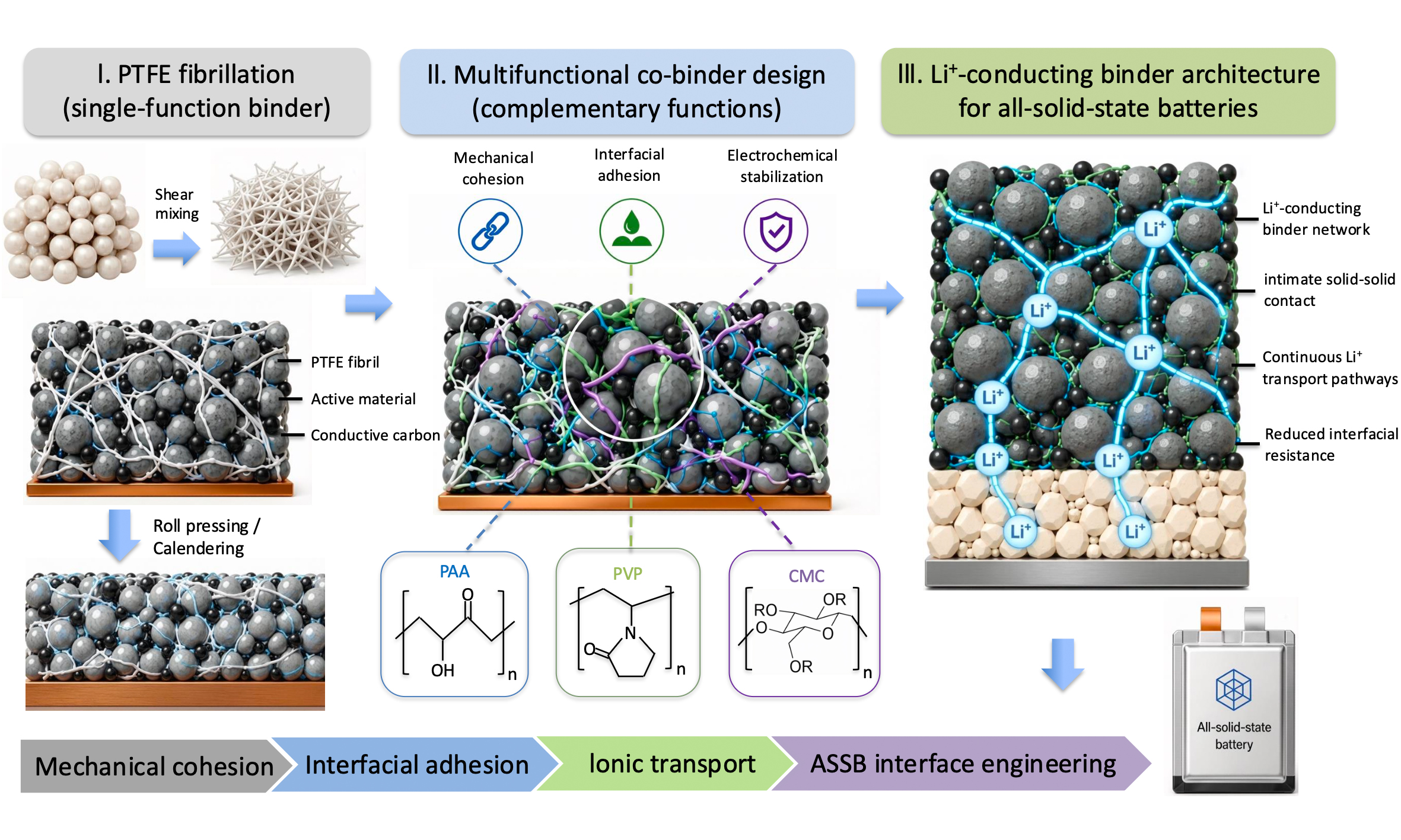
The defining step in dry electrode manufacturing is binder fibrillation, a solid-state mechanical transformation in which PTFE particles undergo crystalline slip and elongation under shear forces generated by jet milling, kneading, or high-shear mixing[12,14]. As illustrated in Figure 1, active material, conductive carbon, and PTFE powder are directly mixed under high shear, inducing the binder to fibrillate and entangle particulate components into a self-supporting composite film that is subsequently roll-pressed or calendered onto the current collector[8,11]. This solvent-free powder-to-film route provides a manufacturing basis for high-loading electrodes.
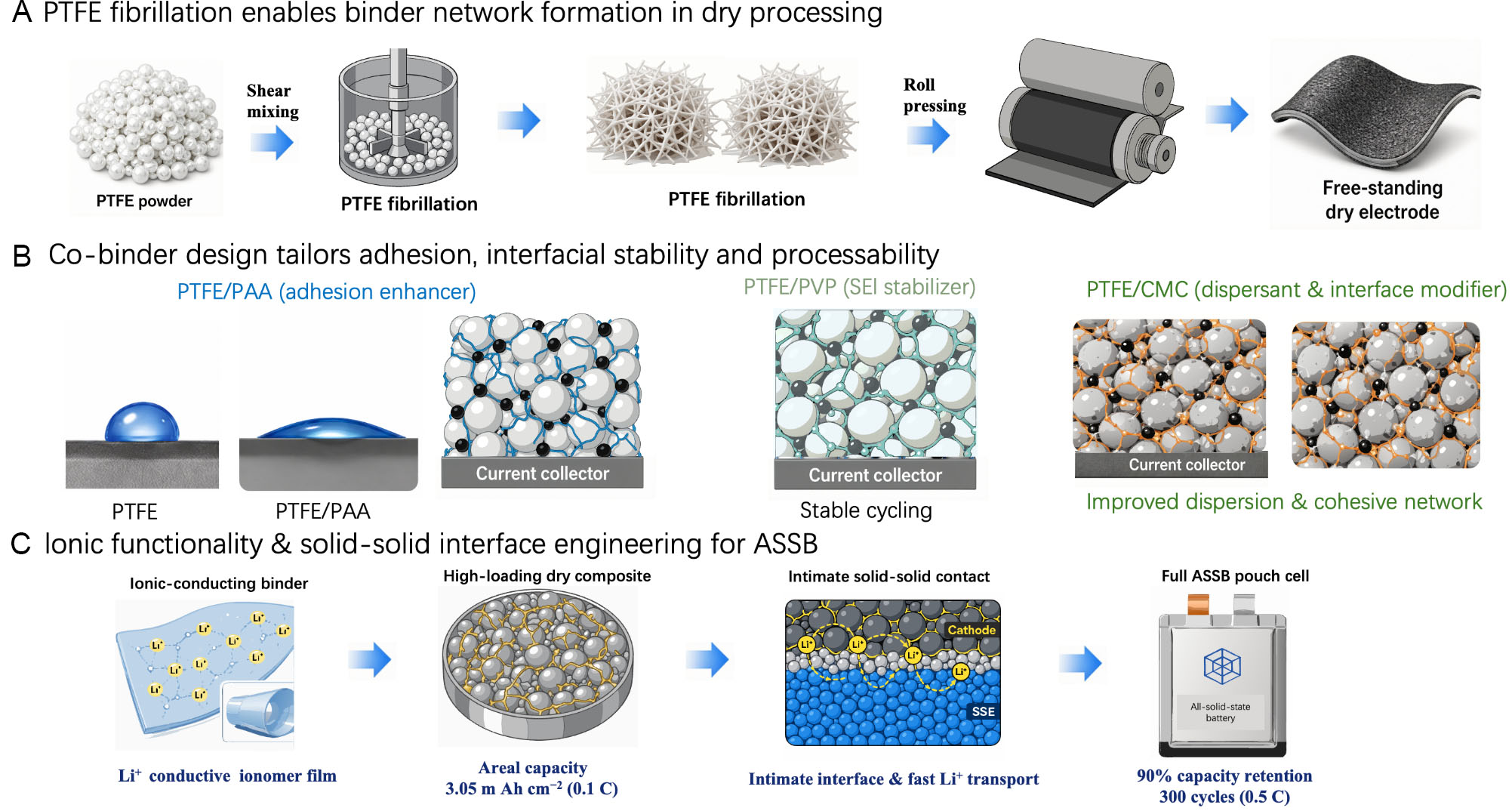
Figure 1. Schematic illustration of the evolution of dry-electrode binder design from PTFE fibrillation to multifunctional and solid-stateelectrolyte-compatible architectures. (A) PTFE powder undergoes shear mixing and fibrillation, followed by roll pressing to form a freestanding dry electrode; (B) PTFE/PAA, PTFE/PVP, and PTFE/CMC co-binder strategies introduce complementary functions associated with interfacial adhesion, SEI stabilization, particle dispersion, and cohesive network formation; (C) Li+-conducting binders enable ionic transport in high-loading composite electrodes and promote intimate cathode-solid-electrolyte contact, thereby reducing interfacial impedance and supporting stable all-solid-state battery operation. The wetting sketches in (B) are schematic; improved wettability with PAA/PTFE is reported in Ref.[18]. In (C), the ionomer cell results are 3.05 mAh cm-2 (0.1 C) and 90% retention after 300 cycles (0.5 C); the pouch cell is a separate demonstration[4]. PTFE: Polytetrafluoroethylene; PAA: polyacrylic acid; PVP: polyvinylpyrrolidone; CMC: sodium carboxymethyl cellulose; SEI: solid electrolyte interphase; ASSB: all-solid-state battery; SSE: solid-state electrolyte.
The molecular basis of PTFE fibrillation is the ability of polymer chains to undergo crystalline slip and plastic elongation under shear rather than brittle fracture[12,19]. Under sufficient shear stress, PTFE particles are transformed into interconnected fibrils that percolate through the composite and mechanically bridge active-material and conductive-particle domains[13,20]. Figure 1 translates this molecular/process concept into a materials-manufacturing sequence and then extends the same design logic toward multifunctional co-binders and Li+-conducting architectures.
The fibrillation process is highly sensitive to processing parameters. PTFE undergoes a crystalline phase transition near 19 °C that renders molecular chains more pliable, facilitating fibril extraction under modest shear[12,14]. The degree of fibrillation depends on molecular weight, crystallinity, applied shear rate, temperature, and the presence of processing aids such as alcohols or terpenes[13,20]. Industrial implementations by Maxwell-Tesla and Fraunhofer IWS have exploited these principles to develop roll-to-roll dry coating processes capable of producing thick electrodes (> 300 μm) with areal loadings exceeding 20 mg cm-2 - values that are challenging to achieve via wet slurry casting owing to cracking and delamination during drying[8,11].
Despite these manufacturing advantages, PTFE should be regarded as the most established fibrillatable fluoropolymer for practical dry-electrode processing rather than the only viable binder route for thick electrodes. Fluorine-free thermoplastic binders have recently demonstrated primer-free dry processing of high-loading electrodes, showing that thermoplastic adhesion can provide an alternative to shear-induced PTFE fibrillation[21]. Thus, the key challenge is not simply to replace PTFE, but to broaden the design space while preserving scalable processing and independently optimizing cohesion, adhesion, electrochemical stability, ionic transport, and sustainability[8,11].
ELECTROCHEMICAL AND MECHANICAL CONSTRAINTS OF PTFE
PTFE’s limitations become particularly apparent when deployed in full-cell configurations and the negative electrode operates at low potentials. PTFE’s intrinsic electronic structure gives it a low-lying lowest unoccupied molecular orbital (LUMO), making reductive side reactions at low-potential anodes thermodynamically favorable[16]. Recent molecular-level work further shows that raising the PTFE LUMO through controlled surface functionalization can increase the initial Coulombic efficiency and suppress long-term degradation, demonstrating that the limitation is chemically addressable but intrinsic to unmodified PTFE[22].
The reductive reaction can generate LiF-containing and carbonaceous products at the low-potential interface, consuming active lithium and altering the local binder network[16]. These reactions matter particularly in thick electrodes because degradation within the binder network can change interfacial resistance and mechanical continuity over long ion-transport pathways. Accordingly, electrochemical stability should be treated as a first-class binder-selection criterion rather than as a secondary processing concern[23].
A second constraint is PTFE’s poor adhesion to current collectors. The low surface energy of fluorinated polymers limits specific interactions with Al and Cu foils, so adhesion can rely mainly on mechanical anchoring[18]. This becomes more important as electrode thickness and areal loading increase, because interfacial delamination can increase contact resistance and produce non-uniform current distribution. Co-binder chemistry therefore provides a complementary route to retain PTFE fibrillation while strengthening the collector interface.
Furthermore, the fibrillated PTFE network is electronically and ionically insulating. Excessive or poorly distributed fibrils can occupy pore space and interrupt continuous Li+ pathways, particularly in dense, high-loading electrodes[19,20]. This mechanical-transport trade-off motivates binder architectures that preserve cohesion while introducing polar or ion-conducting functionality.
BEYOND PTFE: CO-BINDER AND COMPOSITE STRATEGIES
Recent advances have increasingly focused on hybrid binder systems that retain PTFE’s fibrillation capability while compensating for its electrochemical or interfacial deficiencies. Polyacrylic acid (PAA) is a representative adhesion-oriented co-binder. Its carboxyl groups can strengthen hydrogen-bonding interactions with oxide-rich current-collector surfaces and improve interfacial wetting[18]. Importantly, PAA should not be interpreted as eliminating PTFE reduction; rather, it primarily addresses the adhesion and interface side of the PTFE trade-off. Reported PAA/PTFE electrodes showed improved adhesion and cycling relative to PTFE-only controls[18].
PAA does not stabilize the PTFE C-F backbone or fully suppress reduction. Its polar groups improve collector adhesion and regulate local contact. Cellulose derivatives, styrene-butadiene rubber, and polyimide additives provide additional flexibility, adhesion, or thermal stability.
The PTFE/sodium carboxymethyl cellulose (CMC) co-binder system uses carboxylate and hydroxyl groups toimprove particle dispersion, surface affinity, and electrolyte access. PTFE/CMC composites improve graphite-anode stability relative to PTFE-only binders, likely by reducing direct PTFE-graphite contact and creating amore polar environment[24].
The PTFE/polyvinylpyrrolidone (PVP) binary binder system has been reported for ultra-thick anodes withareal capacities approaching 10 mAh cm-2 and stable cycling beyond 200 cycles[[17].
Li+-conducting binders move beyond passive support toward functional charge transport. In liquid cells, Li+ can travel through electrolyte-filled pores around an insulating polymer. In all-solid-state electrodes, an insulating binder can interrupt direct solid-solid pathways; Li+-conducting ionomers add local ionic pathways while maintaining cohesion[4].
DRY ELECTRODE BINDERS IN ALL-SOLID-STATE BATTERIES
The convergence of dry electrode technology with all-solid-state batteries (ASSBs) is a central frontier for this Perspective and directly matches the Special Topic’s emphasis on solid-state electrolytes, electrode/electrolyte interfaces, ion transport, and fabrication. Conventional wet slurry processing can be problematic for sulfide electrolytes such as Li6PS5Cl because polar solvents may cause chemical degradation or loss of ionic conductivity[1,2]. Dry electrode manufacturing eliminates this solvent incompatibility entirely, making it an ideal fabrication platform for ASSB electrodes and composite electrolyte membranes[1,6].
In this context, the fibrillation strategy has migrated beyond electrode manufacturing to the construction offree-standing solid-electrolyte membranes. By mechanically percolating sulfide electrolyte particles such asLi6PS5Cl into a self-supporting composite scaffold, PTFE enables membrane integrity; however, the binderfraction must be minimized to prevent obstruction of Li+ percolation pathway[3]. Furthermore, recentliterature underscores that high-areal-loading dry ASSB electrodes demand concurrent optimization ofparticle packing density, binder spatial distribution, and interfacial intimacy, given that the inorganic solidelectrolyte serves as the sole functional ion-conducting medium[6].
The binder-electrolyte interface in an ASSB differs fundamentally from the binder-electrolyte situation in a liquid cell. In liquid cells, electrolyte-filled pores provide ion-conduction pathways around the polymer binder; in ASSBs, the binder remains a discrete solid phase in direct contact with the solid electrolyte, and even small amounts of poorly conducting polymer can interrupt percolating solid-solid pathways. For sulfide electrolytes, chemical compatibility becomes especially important because the binder is continuously in physical contact with the electrolyte, while electrochemical stability is coupled to the potential of the active electrode[1,2,6]. Chemo-mechanical interfacial degradation can further change the local contact area and interfacial resistance during cycling[23]. Accordingly, future dry binders for ASSBs should be designed simultaneously for chemical compatibility, electrochemical stability, controlled ionic transport, and mechanical stress accommodation.
A Li+-conducting ionomer for solvent-free sulfide composite cathodes added an ionic pathway and improved contact among active material, carbon, and Li6PS5Cl[4]. It delivered 3.05 mAh cm-2 and 90% capacity retention after 300 cycles, with an all-solid-state pouch-cell demonstration[4]. This architecture integrates cohesion and ion transport.
Unlike liquid-electrolyte cells, ASSBs require binders to coexist directly with solid electrolytes. Binder selection must therefore preserve chemical compatibility, solid-solid interfacial stability, and continuous Li+ transport[2].
OUTLOOK
Dry-electrode binders are evolving from PTFE fibrillation toward multifunctional architectures that address mechanical, interfacial, ionic, and electrochemical requirements.
First, molecular design should target electrochemical stability across the full operating window together with controlled Li+ permeability. Molecular electronic-band engineering of PTFE can raise the LUMO and reduce reductive side reactions[22], while fluorine-free thermoplastics provide a complementary replacement pathway[21].
Second, intelligent process control should accompany molecular design as dry coating moves toward scale-up. Real-time control of powder flow, fibrillation, porosity, and binder distribution can improve morphology and reproducibility[6,20].
Third, binder content and architecture must be co-optimized with thickness and porosity. High-loading ASSB electrodes require continuous ion pathways and uniform stress transfer[6,19].
Finally, the binder should be treated as a functional interface-engineering material rather than an electrochemically inert structural additive. PTFE/PAA, PTFE/PVP, PTFE/CMC, and Li+-conducting systems distribute adhesion, interphase regulation, dispersion, and ion transport across the binder architecture. PFAS constraints should be considered with performance[25].
Table 1 compares representative binder architectures discussed in this Perspective. The values are literature examples.
Representative dry-electrode binder systems and their key characteristics
| Binder system | Loading/areal capacity | Capacity retention | Adhesion/interface | Main role | Reference |
| PTFE | High-loading dry electrodes[8,11,14,15] | System dependent[16] | Weak collector affinity; mechanical anchoring[18] | Fibrillation/cohesion | [8,11,14-16,18] |
| PTFE/PAA | Literature-specific[18] | Improved vs PTFE-only[18] | Hydrogen-bonding collector interaction[18] | Adhesion | [18] |
| PTFE/PVP | ~ 10 mAh cm-2[17] | Stable > 200 cycles[17] | Interphase/interface stabilization[17] | Graphite protection / SEI | [17] |
| PTFE/CMC | Literature-specific[24] | Improved graphite stability[24] | Polar interface / dispersion[24] | Dispersion + interface | [24] |
| Li+-conducting ionomer | 3.05 mAh cm-2[4] | 90% after 300 cycles; pouch-cell demonstrated[4] | Improved solid-solid contact[4] | Ionic transport + cohesion | [4] |
| Fluorine-free Parafilm | > 5 mAh cm-2 (NCM811)[21] | > 700 cycles reported[21] | Primer-free thermoplastic adhesion[21] | PTFE-free processing | [21] |
DECLARATIONS
Authors’ contributions
Made substantial contributions to the conception and design of the study and performed data analysis and interpretation: Xiao, F.; Yin, H.
Performed data acquisition and provided administrative, technical, and material support: Yin, H.
Data analysis: Lian, H.
Supervision: Yuan, T.
Availability of data and materials
Not applicable.
AI and AI-assisted tools statement
Not applicable.
Financial support and sponsorship
Not applicable.
Conflicts of interest
All authors declared that there are no conflicts of interest.
Ethical approval and consent to participate
Not applicable.
Consent for publication
Not applicable.
Copyright
© The Author(s) 2026
REFERENCES
1. Liu, Y.; Shao, H.; Guo, J.; et al. Toward scale-up of solid-state battery via dry electrode technology. Next. Energy. 2025, 7, 100221.
2. Chen, Y.; Kong, S. Advances and challenges in dry electrode process for solid-state batteries. J. Solid. State. Electrochem. 2026, 30, 1441-55.
3. Yoon, S.; Kang, S. H.; Choi, J.; et al. Regulating entanglement networks of fibrillatable binders for sub-20-µm thick, robust, dry-processed solid electrolyte membranes in all-solid-state batteries. Small 2025, 21, e2407882.
4. Hong, S.; Lee, Y.; Kim, U.; et al. All-Solid-State Lithium Batteries: Li+ -conducting ionomer binder for dry-processed composite cathodes. ACS. Energy. Lett. 2022, 7, 1092-100.
5. Helmers, L.; Froböse, L.; Friedrich, K.; et al. Sustainable solvent-free production and resulting performance of polymer electrolyte-based all-solid-state battery electrodes. Energy. Tech. 2021, 9, 2000923.
6. Han, S. A.; Suh, J. H.; Park, M.; Kim, J. H. High-loading dry-electrode for all solid-state batteries: nanoarchitectonic strategies and emerging applications. Electrochem. Energy. Rev. 2025, 8, 240.
7. Wood, D. L.; Wood, M.; Li, J.; et al. Perspectives on the relationship between materials chemistry and roll-to-roll electrode manufacturing for high-energy lithium-ion batteries. Energy. Storage. Mater. 2020, 29, 254-65.
8. Schumm, B.; Dupuy, A.; Lux, M.; et al. Dry battery electrode technology: from early concepts to industrial applications. Adv. Energy. Mater. 2025, 15, 2406011.
9. Jin, W.; Song, G.; Yoo, J.; Jung, S.; Kim, T.; Kim, J. Advancements in dry electrode technologies: towards sustainable and efficient battery manufacturing. ChemElectroChem 2024, 11, e202400288.
10. Park, J.; Kim, J.; Kim, J.; Kim, M.; Song, T.; Paik, U. Sustainable and cost-effective electrode manufacturing for advanced lithium batteries: the roll-to-roll dry coating process. Chem. Sci. 2025, 16, 6598-619.
11. Mun, J.; Song, T.; Park, M. S.; Kim, J. H. Paving the way for next-generation all-solid-state batteries: dry electrode technology. Adv. Mater. 2025, 37, e2506123.
12. Zhang, K.; Li, D.; Wang, X.; et al. Dry electrode processing technology and binders. Materials. (Basel). 2024, 17, 2349.
13. Matthews, G.; Meyer, B.; Doerrer, C.; et al. Impact of binder content on particle fracture and microstructure of solvent-free electrodes for Li-ion batteries. J. Mater. Chem. A. 2025, 13, 18283-91.
14. Oh, H.; Kim, G.; Hwang, B. U.; Bang, J.; Kim, J.; Jeong, K. Development of a feasible and scalable manufacturing method for PTFE-based solvent-free lithium-ion battery electrodes. Chem. Eng. J. 2024, 491, 151957.
15. Ryu, M.; Hong, Y. K.; Lee, S. Y.; Park, J. H. Ultrahigh loading dry-process for solvent-free lithium-ion battery electrode fabrication. Nat. Commun. 2023, 14, 1316.
16. Wei, Z.; Kong, D.; Quan, L.; et al. Removing electrochemical constraints on polytetrafluoroethylene as dry-process binder for high-loading graphite anodes. Joule 2024, 8, 1350-63.
17. Lee, J.; Son, C. Y.; Han, S.; et al. Anode interface-stabilizing dry process employing a binary binder system for ultra-thick and durable battery electrode fabrication. Chem. Eng. J. 2025, 503, 158271.
18. Sung, K.; Hwang, I.; Choi, J.; Jung, S.; Yoon, J. Enhanced adhesion in PTFE-based dry electrodes with hydrogen bonding co-binder integration for advanced lithium-ion batteries. Chem. Eng. J. 2025, 511, 161789.
19. Tao, R.; Steinhoff, B.; Uzun, K.; et al. Correlation among porosity, mechanical properties, morphology, electronic conductivity and electrochemical kinetics of dry-processed electrodes. J. Power. Sources. 2023, 581, 233481.
20. Tao, R.; Gu, Y.; Du, Z.; Lyu, X.; Li, J. Advanced electrode processing for lithium-ion battery manufacturing. Nat. Rev. Clean. Technol. 2025, 1, 116-31.
21. Kim, M. K.; Yu, T.; Jang, S.; et al. Fluorine-free binder-based dry thick electrodes with Parafilm(®) M toward sustainable and efficient battery manufacturing. Nat. Commun. 2025, 16, 11174.
22. Kim, M.; Kim, J.; Choi, B.; et al. Electrochemical stabilization of polytetrafluoroethylene (PTFE) via electronic band engineering enables long-life, high-energy-density Li-ion batteries. Adv. Energy. Mater. 2026, 16, e70845.
23. Jung, J.; Park, J.; Lim, J.; et al. Electrochemo-mechanical effects of Co-free layered cathode on interfacial stability in all-solid-state batteries under high-voltage operation. EES. Batteries. 2025, 1, 1720-30.
24. Zheng, J.; Lang, X.; Lv, X.; Shao, J.; Zhang, C. The synergistic effect of sodium carboxymethyl cellulose and polytetrafluoroethylene for highly stable graphite anodes. J. Energy. Storage. 2026, 149, 120249.
25. European Chemicals Agency (ECHA). Per- and Polyfluoroalkyl Substances (PFAS): Restriction Evaluation and Regulatory Updates. ECHA. https://Echa.Europa.Eu/En-GB/Hot-Topics/Perfluoroalkyl-Chemicals-Pfas [accessed on 19 October 2026].
Cite This Article
 Open Access
How to Cite
Xiao, F.; Yin, H.; Yuan, T.; Lian, H. Dry electrode binders: from fluoropolymer fibrillation toward multifunctional architectures for next-generation energy storage. Energy Mater. 2026, 6, 600141. https://dx.doi.org/10.20517/energymater.2026.251
Download Citation
If you have the appropriate software installed, you can download article citation data to the citation manager of your choice. Simply select your manager software from the list below and click on download.
Export Citation File
Type of Import
Tips on Downloading Citation
Citation Manager File Format
Type of Import
Direct Import: When the Direct Import option is selected (the default state), a dialogue box will give you the option to Save or Open the downloaded citation data. Choosing Open will either launch your citation manager or give you a choice of applications with which to use the metadata. The Save option saves the file locally for later use.
Indirect Import: When the Indirect Import option is selected, the metadata is displayed and may be copied and pasted as needed.
About This Article
Special Topic
Copyright

Data & Comments
Data
0











Comments
Comments must be written in English. Spam, offensive content, impersonation, and private information will not be permitted. If any comment is reported and identified as inappropriate content by OAE staff, the comment will be removed without notice. If you have any queries or need any help, please contact us at [email protected].