

Moisture-engineered reed-derived hard carbon for sodium-ion batteries
 0
Graphical Abstract
Abstract
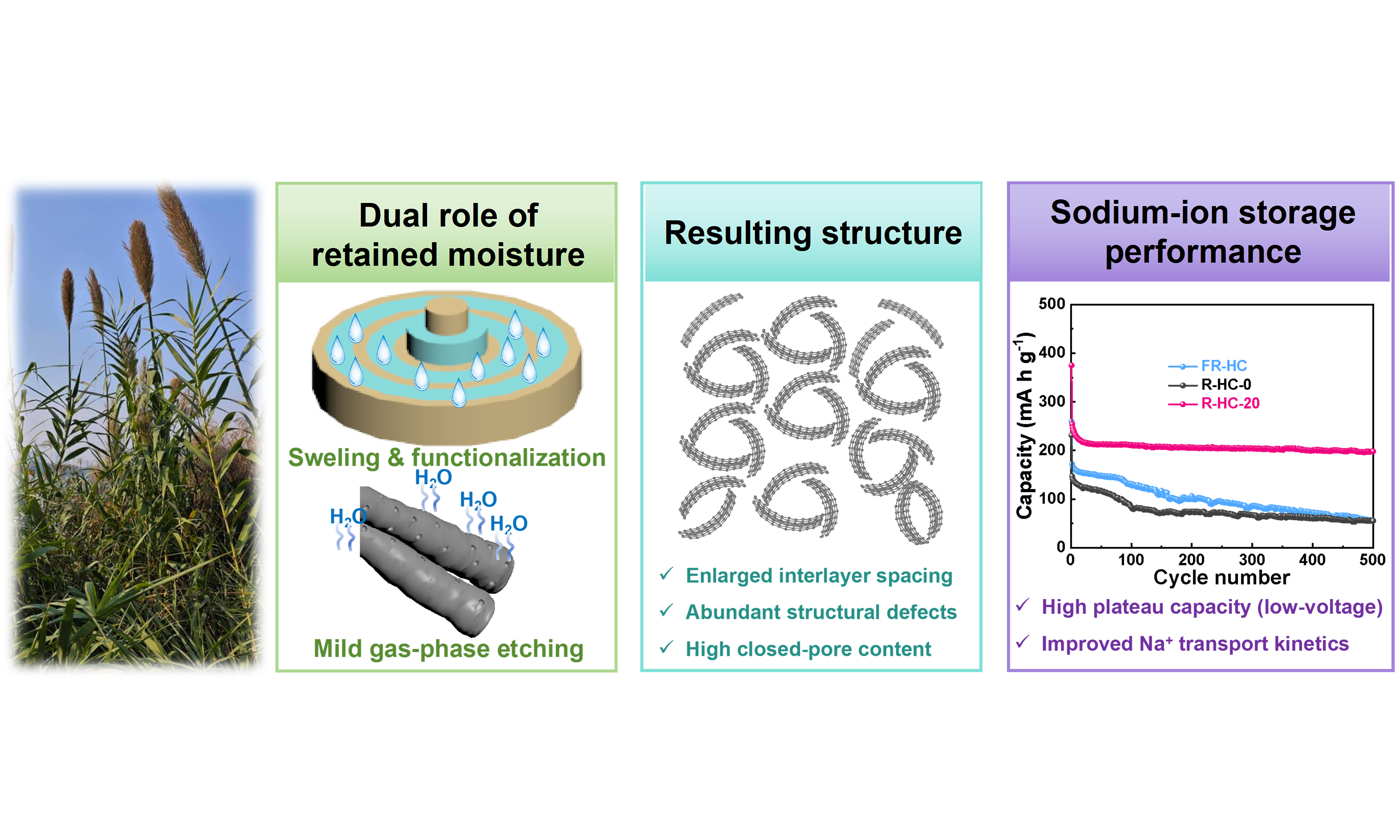
With the advantages of abundant sodium resources and reduced material costs, sodium-ion batteries (SIBs) are regarded as viable candidates for next-generation large-scale energy storage systems. Despite these merits, the development of advanced anode materials with high capacity, long-term stability, and excellent rate capability remains a key bottleneck for their practical application. Hard carbon is regarded as the most viable anode material for SIBs, while its sodium-storage capability is largely determined by precursor-derived microstructures, particularly closed pores associated with the low-voltage plateau capacity. Herein, a precursor moisture-regulation strategy is developed to tailor the microstructure of biomass-derived hard carbon. Using reed as a precursor, we demonstrate that appropriate moisture content promotes the formation of closed pores during carbonization, resulting in enhanced plateau contribution and reversible capacity. The optimized hard carbon combines enlarged interlayer spacing, abundant defects, and hierarchical porosity, affording a reversible capacity of 312.5 mAh g-1 at 0.1 A g-1 with accelerated Na+ transport kinetics. Furthermore, the assembled R-HC-20//NVP full cell delivers an energy density of 334.5 Wh kg-1. Mechanistic analysis reveals that residual water regulates carbon structural evolution through precursor swelling and vapor-mediated mild etching, which facilitate oxygen-functional-group exposure, disordered carbon stacking, and initial pore formation. In contrast, excessive structural ordering in dried precursors suppresses closed-pore development and Na+ storage. This work identifies precursor moisture content as a critical parameter for controlling the microstructure and sodium-storage properties of biomass-derived hard carbon, offering a simple and effective strategy for designing advanced SIB anodes.
Keywords


 Download PDF
INTRODUCTION
The accelerating integration of intermittent renewable energy sources, such as solar and wind power, under global carbon-neutrality initiatives has intensified the demand for large-scale energy-storage technologies that simultaneously offer high safety, economic competitiveness, and long-term sustainability[1-3]. Although lithium-ion batteries have reached technological maturity in electric vehicles and portable electronics, their reliance on scarce and unevenly distributed resources (e.g., lithium and cobalt) raises critical concerns regarding long-term cost and sustainability, particularly for grid-scale applications[4,5]. In this regard, sodium-ion batteries (SIBs) have emerged as promising alternatives, owing to the widespread availability and abundant reserves of sodium, sharing fundamental electrochemical principles with lithium-ion batteries[6-8]. However, the relatively large ionic radius of Na+ (1.02 Å) and its intrinsically slower diffusion kinetics can induce considerable structural strain and sluggish reaction dynamics during repeated cycling, thereby placing increasingly stringent demands on the structural stability and electrochemical properties of SIB anode materials[9].
The narrow interlayer spacing of conventional graphite restricts its ability to accommodate sodium ions, thereby stimulating extensive research into amorphous and turbostratic carbon materials as alternative anodes[10]. Among these candidates, hard carbon has emerged as one of the most promising materials for SIBs, owing to its highly disordered framework, relatively expanded interlayer spacing, and tunable hierarchical pore architecture. The sodium-storage mechanism of hard carbon is commonly characterized by a sloping region at relatively high potentials, generally associated with adsorption at surface sites and structural defects, and a low-potential plateau that is widely related to sodium accommodation within closed nanopores. The latter contribution is particularly important for simultaneously attaining high reversible capacity and a low average operating voltage[11]. Considerable efforts have therefore been devoted to improving the electrochemical performance of hard carbon through rational precursor selection, optimization of carbonization conditions, activation strategies, and regulation of its microstructural characteristics[12]. The physicochemical properties of precursors are widely recognized to determine the “structural genes” of hard carbon, governing carbon stacking, pore evolution, and surface chemistry. Nevertheless, existing studies largely treat precursors as static entities and focus predominantly on compositional tuning, while the role of their initial physical state remains underexplored.
In recent years, biomass has emerged as an attractive class of precursors for hard carbon production, owing to its renewable nature, economic accessibility, and intrinsically complex multiscale architectures[13,14]. A growing body of research has demonstrated that diverse biomass feedstocks, such as wood, agricultural by-products, and fruit shells, can be transformed into hard carbon with competitive sodium-storage properties. In particular, carefully engineered biomass-derived hard carbons have achieved reversible capacities of approximately 300 mAh g-1 or even higher, highlighting the substantial potential of biomass resources for developing high-performance anodes for SIBs[15,16]. For instance, Tang et al.[17] obtained wood-derived hard carbon with a reversible capacity of up to 380 mAh g-1 by tuning the crystallinity of cellulose in wood. Their findings indicated that highly crystalline cellulose promotes the development of cross-linked, disordered graphitic-like carbon domains, which subsequently undergo curling and stacking to construct the walls of closed pores. Furthermore, Fu et al.[18] examined the role of hemicellulose in determining the structure of reed-derived hard carbon and demonstrated that the preferential decomposition of hemicellulose during carbonization suppresses the crosslinking of oxygen-containing functional groups within oxygen-rich carbon domains, thereby limiting closed-pore development. In addition, Wang et al.[19] demonstrated that modulation of lignin content can effectively tailor the structure and sodium-storage behavior of bamboo-derived hard carbon. In particular, lignin removal enhances carbonization reactivity and promotes ordered carbon stacking and closed-pore formation. Despite these advances in compositional regulation, most studies have focused on chemical composition and thermal treatment conditions, while the effects of precursor moisture content on pyrolysis behavior and the resulting structural evolution of hard carbon remain largely unexplored.
Importantly, water is not an inert component in biomass thermochemical conversion. It can modulate intermolecular interactions via hydrogen bonding and participate in gas-phase reactions during pyrolysis, thereby affecting carbon framework etching and reconstruction[20]. Consequently, precursor moisture content should be regarded not merely as a processing parameter, but as a critical, yet overlooked variable governing hard carbon microstructure. Elucidating its role is essential for achieving structural control and advancing the fundamental understanding of biomass-to-carbon conversion.
Reed, a fast-growing, abundant wetland biomass, enables stable closed-pore carbon frameworks, making it a promising sustainable precursor for sodium storage[21]. Herein, this work departs from the conventional paradigm that prioritizes dried precursors and investigates the influence of moisture content in reed on the microstructural evolution and sodium-storage behavior of the resulting hard carbon. Compared with dried reed, the use of moisture-rich fresh reed markedly facilitates the development of closed pores during carbonization. This structural regulation enhances the low-voltage plateau contribution and, consequently, improves the overall reversible specific capacity of the hard carbon anode for SIBs. Mechanistically, water infiltration induces swelling of hemicellulose and lignin, loosening intermolecular packing and exposing oxygen-containing functional groups that act as pinning sites during high-temperature carbonization, thereby directing carbon layer distortion and disordered stacking. Concurrently, water vapor released at low temperatures generates primary porosity via mild gas-phase etching, providing a structural basis for subsequent closed-pore development. In contrast, dried precursors tend to undergo excessive structural ordering, limiting pore formation and sodium storage capability. This work reveals the pivotal role of moisture-mediated interactions and gas-phase environments in governing hard carbon structural evolution and electrochemical behavior. It offers a facile and effective strategy for tailoring biomass-derived hard carbon and highlights the potential of directly utilizing wet biomass, thereby reducing preprocessing energy consumption. It establishes a new paradigm for carbon material design based on precursor physical state regulation.
EXPERIMENTAL
Materials
Ultrapure water was used throughout the experiments, while the natural reeds were collected from Dongting Lake.
Synthesis of reed-derived hard carbon (R-HC-x)
Briefly, 5 g of freshly collected reed powder was first dried and then carbonized in a tubular furnace under a continuous flow of nitrogen. The temperature was increased to 1,400 °C at a heating rate of 2 °C min-1 and maintained for 2 h. The obtained sample was denoted as R-HC-0. To investigate the effect of precursor moisture on the microstructure and electrochemical properties of the derived hard carbon, the dried reed powder was uniformly blended with deionized water at predetermined mass ratios to achieve moisture contents of 10%, 20%, and 30%, denoted as x = 10%, 20%, and 30%, respectively. The resulting precursors were then carbonized using the same procedure, producing a series of reed-derived hard carbons denoted as R-HC-x. As a reference, freshly collected reed powder was directly subjected to carbonization under identical conditions, and the resulting material was designated as FR-HC.
Electrochemical measurements
CR2016 coin cells were assembled in a Mikrouna Ar-filled glovebox, where the H2O and O2 levels were maintained below 1 ppm. The hard-carbon active material, poly(vinylidene fluoride) (PVDF), and acetylene black were blended at a mass ratio of 8:1:1, with N-methyl-2-pyrrolidone (NMP) employed as the solvent. The resulting mixture was magnetically stirred for 10 h to form a homogeneous slurry, which was subsequently coated uniformly onto copper foil using a scraper and vacuum-dried at 80 °C for 12 h. The dried electrodes were punched into 12 mm diameter disks, with an active-material loading of ≥ 1.5 mg cm-2. Glass fiber was used as the separator, while self-prepared sodium foil served as both the counter and reference electrodes. The electrolyte consisted of 1 M NaPF6 dissolved in DME. Galvanostatic charge-discharge measurements, including cycling stability and rate capability tests, were conducted using a CT3002A battery testing system within a voltage window of 0.005-2.3 V at current densities of 0.1-4 A g-1. Cyclic voltammetry (CV) measurements were performed on a CHI 760 electrochemical workstation over a potential range of 0.005-2.3 V at scan rates of 0.2-1.0 mV s-1. The Na+ diffusion coefficients were determined using the galvanostatic intermittent titration technique (GITT) on the CT3002A system. Specifically, a constant current of 50 μA was applied for 0.5 h, followed by a 1 h relaxation period for each titration step. For full-cell assessment, Na3V2(PO4)3 (NVP; Canrd Technology Co., Ltd.) was employed as the cathode and coupled with the R-HC-20 anode. The cathode loading was determined based on the negative-to-positive electrode capacity ratio (N/P ratio). An N/P ratio of 1.06 was selected to minimize the potential for sodium dendrite formation while avoiding unnecessary excess loading of the anode active material.
Characterization
The morphology and microstructural characteristics of the synthesized samples were characterized using scanning electron microscopy (SEM, HITACHI S-4800) and transmission electron microscopy (TEM, JEOL JEM-2100). Crystal structure and carbon structural disorder were investigated by X-ray diffraction (XRD, Rigaku Ultima IV) and Raman spectroscopy (Jobin Yvon LabRAM-010), respectively. The surface chemical composition and functional groups were analyzed using X-ray photoelectron spectroscopy (XPS, Thermo Scientific ESCALAB 250) and Fourier transform infrared spectroscopy (FTIR, BRUKER TENSOR II), respectively. Thermal stability and decomposition behavior were evaluated by thermogravimetric analysis (TGA, PerkinElmer STA6000). The specific surface area and pore-size distribution were determined from N2 adsorption-desorption isotherms recorded using a Micromeritics ASAP 2020 HD surface-area and porosity analyzer. In addition, small-angle X-ray scattering (SAXS, Anton Paar SAXSess MC2) was employed to further elucidate the characteristics of the closed-pore structure. Further information on the instrumentation is provided in Supplementary Table 1.
RESULTS AND DISCUSSION
Inspired by the pronounced differences in the microstructures of hard carbon materials derived from fresh and dried reeds, this work achieved precise regulation of the microcrystalline structure of reed-derived hard carbon by controlling the moisture content of the reed precursor. Optical microscopy images [Supplementary Figure 1] reveal that, compared with fresh reeds (FR), the cellular structure of dried reeds (R-0) undergoes significant shrinkage. The introduction of moisture weakens the interactions between lignin and hemicellulose, thereby exerting a plasticizing effect on the matrix formed by these components. Simultaneously, it induces swelling of the amorphous regions, leading to a reduction in the overall crystallinity of the reeds. The expansion of the amorphous domains promotes the exposure of oxygen-containing functional groups, which serve as effective “anchoring sites” to enlarge the interlayer spacing of carbon sheets. This, in turn, suppresses the ordered rearrangement of graphitic microcrystallites and facilitates the formation of closed-pore structures. Meanwhile, crystalline cellulose, the primary precursor for the development of graphitic microcrystallites, benefits from a moderate reduction in crystallinity, which favors the contraction and entanglement of the microcrystalline structure[20,22]. In addition, water vapor generated during pyrolysis can participate in gas-phase reactions, thereby regulating the etching and reconstruction pathways of the carbon framework and introducing additional structural defects. These effects collectively enhance the sodium-storage kinetics of the hard carbon materials [Figure 1].
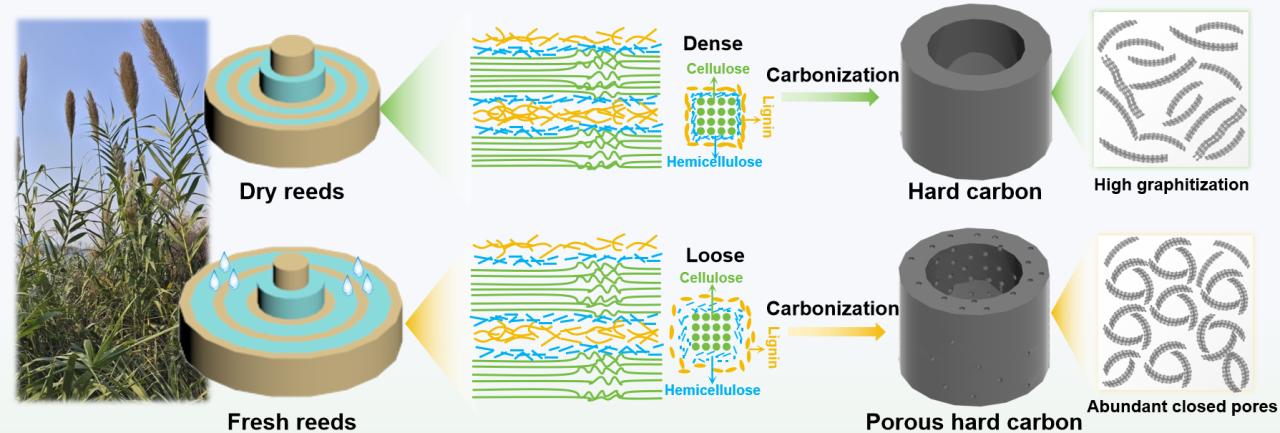
Figure 1. Schematic illustration of the preparation of hard carbon samples derived from dried and fresh reeds. (The photograph on the left was taken by the authors.)
XRD was used to examine how moisture affects the crystallinity of the reed precursors, with patterns for R-x and FR shown in Figure 2A. All samples displayed two characteristic diffraction peaks located at 2θ = 15.5° and 22.5°, which can be assigned to the (110) and (200) crystal planes of cellulose, respectively[23]. Compared with R-0, FR displayed markedly reduced peak intensities. Moreover, upon the introduction of moisture into dried reeds, the characteristic peak intensities of the R-x samples gradually decreased with increasing moisture content. This observation suggests that interactions between water molecules and hydroxyl groups in the amorphous regions induce the swelling of lignin and hemicellulose molecules, thereby hindering the close packing and ordered crystallization of cellulose chains[24]. The calculated crystallinity values of FR, R-0, R-10, R-20, and R-30 were 42.2%, 68.2%, 53.1%, 50.6%, and 47.5%, respectively [Figure 2B]. Figure 2C compares the Fourier-transform infrared (FTIR) spectra of R-0 samples and FR. The spectra indicate that the overall chemical structures of all samples remained essentially unchanged, exhibiting identical characteristic absorption bands. FR nevertheless displays a broader and more intense hydroxyl band centered at 3340 cm-1. This phenomenon is primarily attributed to the moisture-mediated swelling of lignin and hemicellulose molecules, which disrupts the hydrogen-bonding network and exposes a greater number of hydroxyl groups[25]. The FTIR observations therefore support the XRD results and further demonstrate the role of water in modifying reed microstructure.
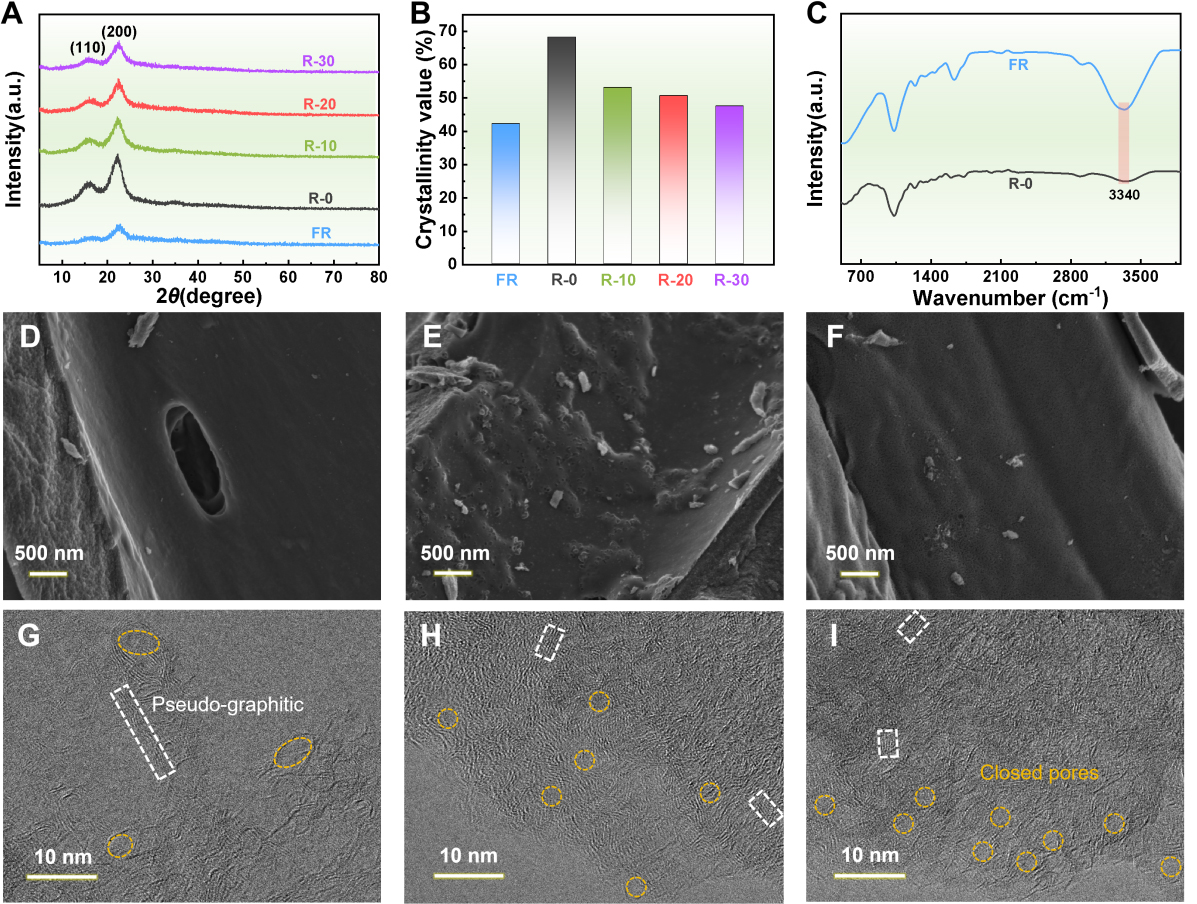
Figure 2. XRD patterns (A) and corresponding cellulose crystallinity values (B) for FR and R-x. FTIR spectra (C) of FR and R-0. SEM images of R-HC-0 (D), FR-HC (E), and R-HC-20 (F). HRTEM images of R-HC-0 (G), FR-HC (H), and R-HC-20 (I). XRD: X-ray diffraction; FTIR: Fourier transform infrared spectroscopy; HRTEM: high-resolution transmission electron microscopy; FR: fresh reeds; SEM: scanning electron microscopy.
The morphological characteristics of reed-derived hard carbon materials prepared with different moisture contents were investigated using SEM. Figure 2D-F and Supplementary Figures 2 and 3 present the SEM images of R-HC-x and FR-HC. All samples exhibit irregular block-like morphologies while largely retaining the intrinsic porous channel structure of the original reed. Compared with R-HC-0, the surface of FR-HC displays a large number of nanoscale pores. Meanwhile, with increasing moisture content, abundant nanopores are progressively generated on the surfaces of R-HC-10, R-HC-20, and R-HC-30, accompanied by a gradual increase in both pore size and pore density. These observations indicate that water vapor released during pyrolysis participates in gas-phase reactions, exerting an etching effect on the carbon framework and thereby promoting pore formation. To further quantify the role of moisture, the water content of fresh reeds was measured and found to be 51.3%. An appropriate moisture level facilitates the construction of a rich porous structure on the surface of hard carbon, thereby accelerating the transport of ions, electrons, and electrolyte, and enhancing overall transport kinetics[26].
High-resolution transmission electron microscopy (HRTEM) was utilized to further analyze the impact of moisture content on the microstructural evolution of carbon layers within reed-derived hard carbon. Figure 2G-I and Supplementary Figure 4A and B show the HRTEM images of FR-HC and R-HC-x. The R-HC-0 sample exhibits relatively long graphitic-like layers (marked by white rectangles) along with a small number of closed pores (indicated by orange circles). In contrast, for FR-HC, the presence of moisture reduces the crystallinity of cellulose, leading to a noticeable shortening of the graphitic-like layers. Simultaneously, the expansion of amorphous components further promotes the bending and entanglement of these layers, thereby favoring the development of a more pronounced closed-pore architecture. When moisture is gradually introduced into the dried reed system, both the abundance and dimensions of the closed pores in R-HC-x increase with rising water content. Because closed pores are widely regarded as important sodium-storage sites associated with the low-potential plateau, promoting their formation represents an effective strategy for enhancing plateau capacity and, consequently, the overall sodium-storage performance of hard carbon[27]. Furthermore, the interlayer spacing of the carbon layers was quantitatively estimated from the HRTEM images [Supplementary Figures 5A-C and 6A and B]. The interlayer distances of FR-HC, R-HC-0, R-HC-10, R-HC-20, and R-HC-30 are 0.408, 0.362, 0.386, 0.420, and 0.411 nm, respectively. Compared with the untreated sample, the increased interlayer spacing after moisture regulation indicates that moderate moisture-induced structural relaxation of reed components promotes the generation of oxygen-containing functionalities. These oxygen species can disrupt the stacking of carbon layers and act as anchoring centers during carbonization, ultimately facilitating the formation of expanded graphitic-like carbon structures.
The crystalline structure and defect evolution of FR-HC and R-HC-x were analyzed by XRD and Raman spectroscopy. As shown in Figure 3A, all samples present a broad (002) diffraction peak centered at around 2θ ≈ 22°, characteristic of turbostratic carbon with randomly oriented graphene-like layers. The reduced intensity of the (002) peak observed for FR-HC compared with R-HC-0 reveals that moisture-assisted treatment inhibits the ordering of carbon layers, leading to a more amorphous carbon structure with abundant defects[28]. With further regulation of the moisture content in the reed precursors, it is observed that the (002) peak intensity of R-HC-10, R-HC-20, and R-HC-30 gradually decreases with increasing water content. This suggests that moisture not only reduces the crystallinity of cellulose but also acts as an etching agent at elevated temperatures, thereby facilitating defect formation. Meanwhile, a noticeable negative shift of the (002) diffraction peak is observed for FR-HC, R-HC-20, and R-HC-30. According to Bragg’s law[29], the interlayer spacing increases from 0.365 nm for R-HC-0 to 0.388 nm (R-HC-10), 0.418 nm (R-HC-20), and 0.413 nm (R-HC-30). Correspondingly, the crystallite stacking height (Lc) decreases from 1.61 nm for R-HC-0 to 1.21 nm for R-HC-20, and further declines to 1.15 nm at an excessively high moisture content (R-HC-30), while FR-HC exhibits an Lc value of 1.08 nm. These results suggest that moderate moisture regulation of the precursor plays an important role in tailoring the carbon-layer arrangement and interlayer characteristics along the c-axis[30]. To further elucidate the evolution of defects and structural disorder during carbonization, Raman spectroscopy analysis was performed [Figure 3B]. Two distinct Raman bands are observed for all samples at around 1,343.3 and 1,595.6 cm-1, corresponding to the defect-induced D band and the graphitic G band, respectively. The calculated ID/IG values of FR-HC, R-HC-0, R-HC-10, R-HC-20, and R-HC-30 are 1.13, 1.62, 1.40, 1.34, and 1.24, respectively. These results reveal that increasing the moisture content of the precursor promotes the generation of structural defects in the derived hard carbon materials. Previous studies have demonstrated that the ID/IG ratio decreases with increasing degrees of amorphization[31]. Meanwhile, the generation of abundant defect structures is generally associated with the formation of a large number of closed pores[32].
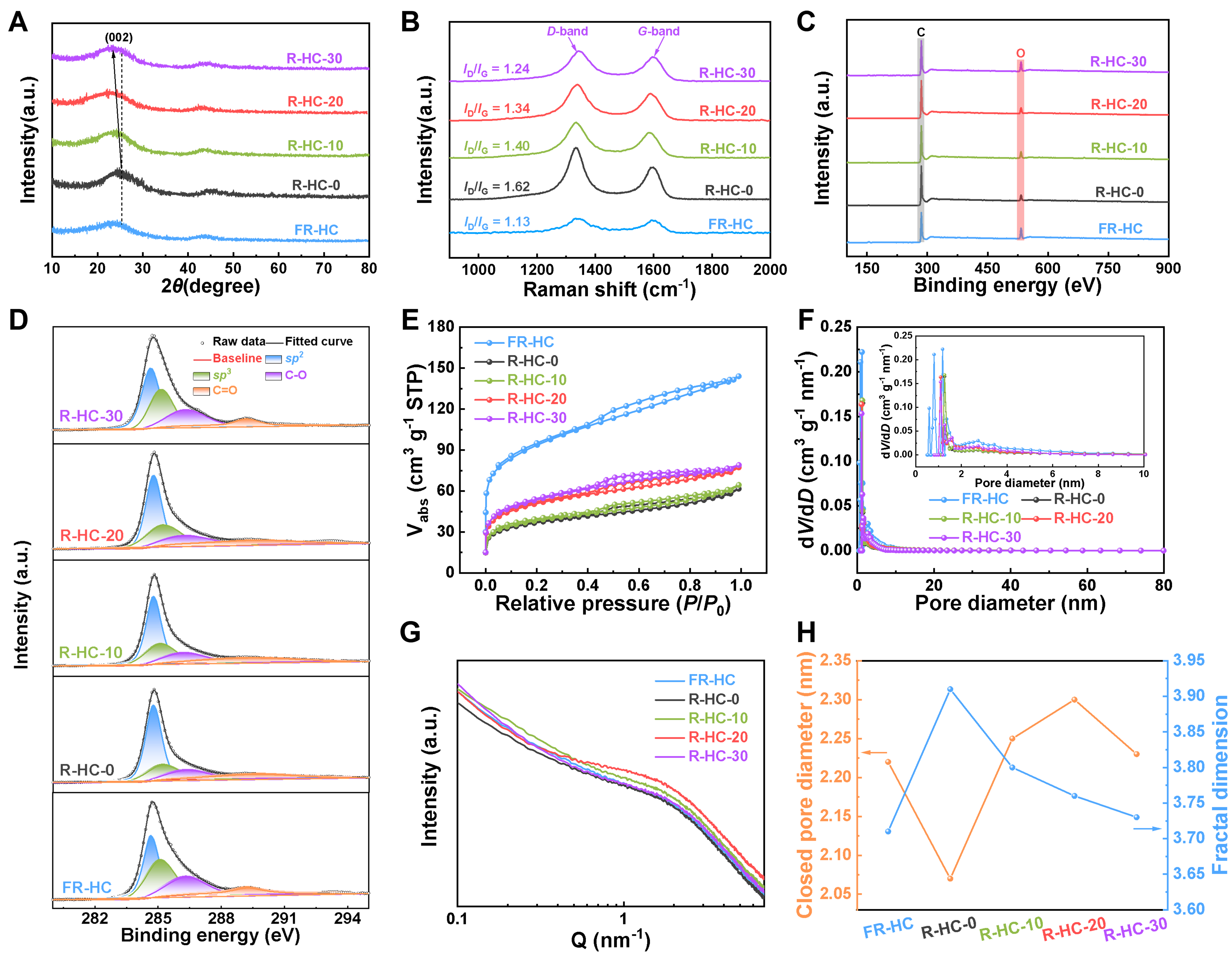
Figure 3. Structural evolution and compositional analysis of FR-HC and R-HC-x samples. XRD patterns (A), Raman spectra (B), and XPS survey spectra (C). High-resolution C 1s XPS spectra (D). N2 adsorption-desorption isotherms (E), pore-size distribution profiles (F), SAXS curves (G), and closed-pore diameters and fractal dimensions obtained from SAXS fitting analysis (H). FR: Fresh reeds; XRD: X-ray diffraction; XPS: X-ray photoelectron spectroscopy; SAXS: small-angle X-ray scattering.
XPS was conducted to analyze the elemental composition and surface chemical states of the as-prepared carbon materials. As presented in Figure 3C, the XPS survey spectra of FR-HC and R-HC-x exhibit only two characteristic signals corresponding to C 1s and O 1s, confirming the presence of both carbon and oxygen species in all samples. The detailed elemental compositions are summarized in Supplementary Table 2. The high-resolution C 1s spectra [Figure 3D] were fitted with four components centered at 284.6, 285.3, 286.5, and 289.3 eV, which are assigned to sp2 carbon, sp3 carbon, C-O, and C=O species, respectively[33]. The relative contribution of sp2 and sp3 carbon provides valuable information regarding the degree of carbon ordering and graphitic evolution[34]. Compared with R-HC-0 (53.83%), the sp2 carbon content in FR-HC, R-HC-10, R-HC-20, and R-HC-30 decreases to 37.50%, 48.20%, 45.19%, and 43.98%, respectively [Supplementary Table 3]. This decline can be attributed to the moisture-induced disruption of cellulose crystallinity, which inhibits the rearrangement and growth of graphitic-like carbon domains during high-temperature pyrolysis. In addition, water vapor acts as an etching agent, further suppressing graphitic ordering within the hard carbon framework. Accordingly, the sp2/sp3 ratios for FR-HC, R-HC-0, R-HC-10, R-HC-20, and R-HC-30 are 1.16, 2.95, 2.09, 1.75, and 1.46, respectively, further confirming that regulating the moisture content of the precursor effectively decreases the graphitization level of the resulting hard carbon.
The pore architectures of FR-HC and R-HC-x samples were evaluated by N2 adsorption-desorption analysis [Figure 3E]. R-HC-0 exhibits a typical Type I isotherm according to the International Union of Pure and Applied Chemistry classification, confirming the dominant contribution of micropores. After moisture regulation, FR-HC, R-HC-10, R-HC-20, and R-HC-30 display H4-type hysteresis loops within the intermediate relative-pressure range, suggesting the formation of hierarchical pore networks comprising both micropores and mesopores[35]. Based on the BET method, the calculated specific surface areas of FR-HC, R-HC-0, R-HC-10, R-HC-20, and R-HC-30 are 334.87, 133.85, 139.45, 185.09, and 191.72 m2 g-1, respectively. The corresponding pore size distribution profiles further indicate that FR-HC and the moisture-modified samples contain abundant mesoporous structures with a broad pore-size distribution [Figure 3F]. In addition, CO2 adsorption measurements were performed to further evaluate the ultramicroporous characteristics of R-HC-0 and FR-HC [Supplementary Figure 7]. Compared with R-HC-0, FR-HC exhibits a more developed hierarchical ultramicroporous architecture, with pore sizes distributed mainly within the range of 0.32-0.86 nm. This distribution is considerably broader and more abundant than that observed for R-HC-0. In general, mesoporous structures facilitate electrolyte infiltration and ion/electron transport, whereas hierarchical ultramicroporous structures are beneficial for enhancing the diffusion kinetics of Na+ ions[36]. Therefore, by regulating the moisture content of the precursor, the specific surface area and pore structure can be synergistically optimized, which is consistent with the SEM observations. However, due to the size limitations of N2 and CO2 molecules, they are unable to effectively access closed pores, resulting in certain limitations of these adsorption-based methods for the characterization of closed-pore structures.
To further analyze the closed-pore structure, SAXS measurements were carried out [Figure 3G]. All samples exhibit a pronounced scattering peak in the range of 1-2 nm-1, and the peak intensities of FR-HC and moisture-containing samples are higher than that of R-HC-0, indicating that moisture regulation increases both the size and abundance of closed pores[37]. Notably, R-HC-20 shows the highest peak intensity, suggesting that an optimal moisture content most effectively promotes the contraction and curling of graphitic-like carbon layers, favoring the generation of closed pores. Meanwhile, water-vapor-induced etching at elevated temperatures promotes the development of additional micropores, which can subsequently undergo structural rearrangement and contribute to further closed-pore formation. The closed-pore parameters obtained by fitting the theoretical model [Figure 3H] reveal an average pore size of approximately 2 nm. With increasing moisture content, the average closed-pore size initially increases from 2.07 nm for R-HC-0 to a maximum of 2.30 nm for R-HC-20. When the moisture content further increases to 30%, the average closed-pore size of R-HC-30 decreases relative to that of R-HC-20. Furthermore, analysis based on Porod fitting in the high-q region of the SAXS profiles reveals that the surface of the closed pores becomes progressively smoother as the moisture content increases, reflecting a gradual optimization of the interfacial structure[38].
To elucidate the effect of moisture content on the structural evolution of reed-derived hard carbon, XRD measurements were performed on dried reeds (R-0) and moisture-treated reeds with a water content of 20% (R-20) after pyrolysis at different temperatures. The corresponding XRD patterns of R-0-T and R-20-T (where T denotes the temperature) are shown in Figure 4A and B, respectively. As observed, the characteristic diffraction peaks associated with the crystalline regions of cellulose remain essentially unchanged in the 250-300 °C range, although their intensities gradually decrease with increasing temperature. When the pyrolysis temperature is elevated above 400 °C, a broad amorphous diffraction peak centered at approximately 2θ = 21.4° appears in both R-0-T and R-20-T samples, suggesting the decomposition of biomass components and the progressive transformation from ordered cellulose structures into disordered carbon frameworks. Notably, the amorphous carbon peak of R-0-400 is more intense than that of R-20-400, suggesting that a larger number of carbon microcrystallites are generated in R-0-400 under identical pyrolysis conditions, corresponding to a faster carbonization process. When the pyrolysis temperature reaches 500 °C, the characteristic carbon (002) diffraction peaks of both R-0-500 and R-20-500 become narrower. With a further increase in the pyrolysis temperature to 600 °C, a distinct diffraction peak corresponding to the carbon (100) plane emerges at 2θ = 44.7° in the R-0-600 sample, suggesting the initiation of in-plane carbon layer ordering and the gradual formation of a more developed carbonized structure. In contrast, no corresponding (100) reflection is observed for R-20-600, which is likely attributable to the etching effect of water vapor generated during pyrolysis, thereby suppressing the ordered growth of carbon microcrystallites. Moreover, with increasing pyrolysis temperature, the (002) diffraction peaks of both R-0-T and R-20-T gradually move toward higher 2θ values, reflecting the continuous reduction of interlayer spacing and the progressive enhancement of carbon-layer ordering. However, when the pyrolysis temperature is increased to 700 °C, the displacement of the (002) peak becomes much less pronounced for both samples, suggesting that carbon-layer rearrangement and structural contraction have approached a stable state. Based on the above results, Figure 4C further illustrates the role of moisture in the structural evolution and carbon microcrystallite formation of reed-derived hard carbon. Reed biomass is primarily composed of cellulose, hemicellulose, and lignin, whose intrinsically complex and disordered architecture undergoes bond cleavage, condensation, and aromatization during pyrolysis, accompanied by the generation of abundant reactive radical intermediates. The cross-linking and recombination of these radicals not only facilitate the construction of the carbon framework but also play a critical role in the formation of carbon microcrystallites and closed-pore structures. Under anhydrous conditions, the biomass components remain tightly packed, preserving a relatively intact native structure. During pyrolysis, the carbon layers are therefore able to undergo rearrangement and ordered stacking, resulting in the formation of relatively large carbon microcrystallites. Consequently, the final R-HC-0 sample exhibits a lower content of sp3-hybridized carbon and a higher degree of carbon-layer ordering. In contrast, the introduction of an appropriate amount of moisture induces the swelling of hemicellulose and lignin, thereby reducing the overall crystallinity of the biomass and weakening the compact packing among its constituents. This pretreatment facilitates bond cleavage and the generation of reactive radicals during pyrolysis while increasing the randomness of radical cross-linking reactions. Consequently, the ordered stacking and growth of carbon layers are suppressed, while the development of structurally disordered carbon domains is favored, resulting in a higher proportion of sp3-hybridized carbon and a reduced degree of graphitic ordering. Furthermore, the enclosed spaces generated during radical condensation and local structural reconstruction are more readily retained during subsequent carbonization, thereby promoting the formation of closed pores. Accordingly, compared with the anhydrous sample, the R-20 sample develops a greater abundance of closed pores during carbonization and exhibits a higher degree of structural disorder together with distinctly different microstructural characteristics.
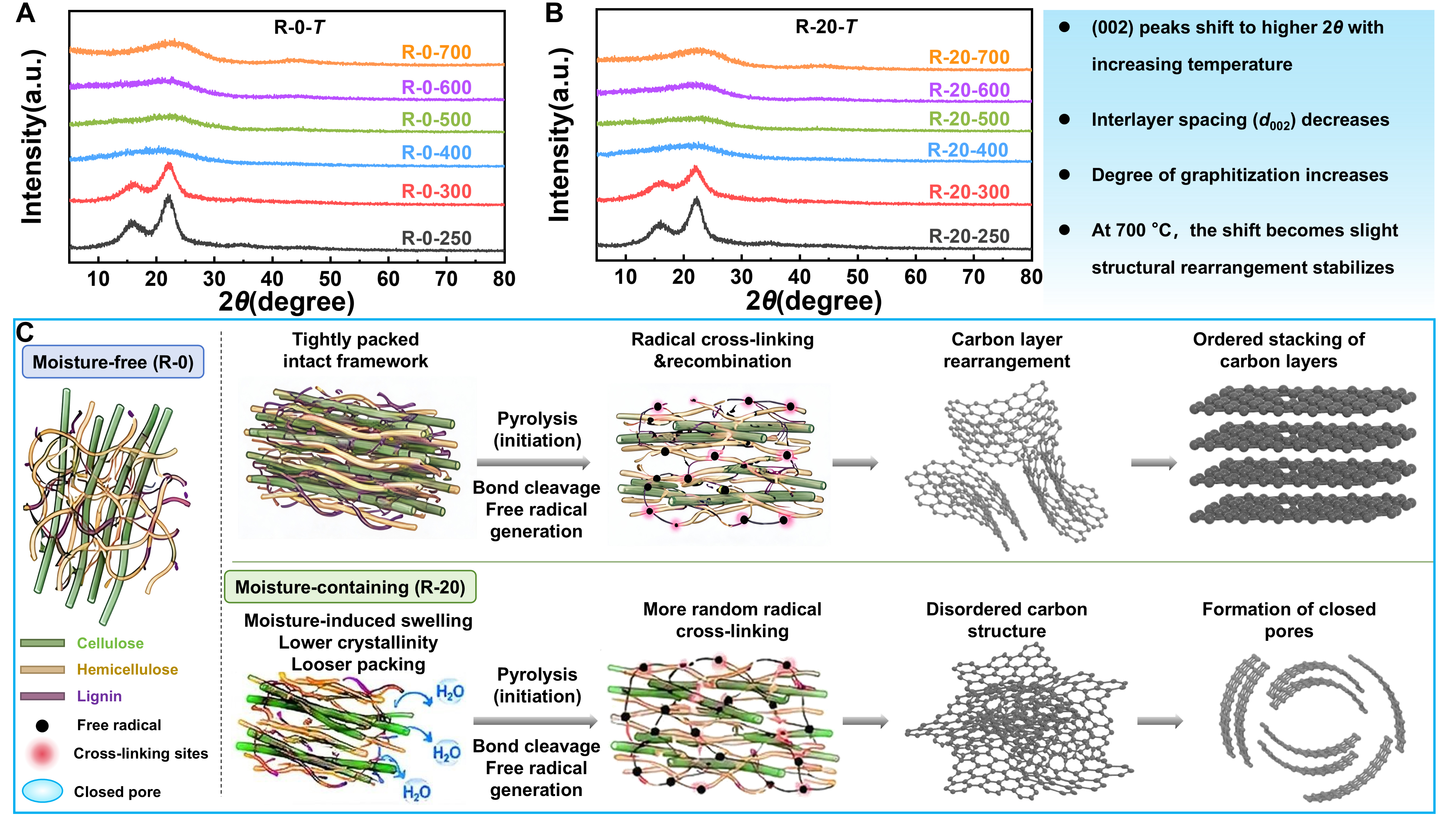
Figure 4. Pore structure formation mechanism of R-HC-20. XRD patterns (A) of R-0-T and R-20-T (B) at different calcination temperatures. The role of moisture in the structural evolution and carbon microcrystallite formation of reed-derived hard carbon (C). XRD: X-ray diffraction.
The sodium-storage properties of FR-HC and R-HC-x were systematically assessed by assembling sodium-ion half-cells using these materials as anode electrodes in an Ar-filled glovebox. Figure 5A compares the CV responses of the different electrodes. All samples display characteristic redox features near 0.1 V, which can be associated with Na+ insertion/extraction within closed pores and the corresponding low-potential plateau region characteristic of hard carbon. In addition, the broad capacitive current around 0.5 V originates from sodium adsorption on disordered carbon domains and defect sites, representing the sloping region of the charge-discharge profiles. With moderate moisture regulation, the intensified redox peaks at ~ 0.1 V reveal an increased contribution from plateau storage, which is closely related to the optimized development of closed pores in the carbon matrix. These enclosed nanoscale cavities provide favorable sites for sodium-ion accommodation and are therefore crucial for improving plateau capacity[39]. Given that closed pores are widely regarded as important storage reservoirs responsible for the low-voltage plateau, the CV characteristics are consistent with the GCD profiles presented in Figure 5B. Among all electrodes, R-HC-20 presents the largest integrated CV area [Supplementary Figures 8 and 9], demonstrating its superior sodium-storage capability and rate performance. Furthermore, the first CV curve of R-HC-20 closely overlaps with those of subsequent cycles, suggesting the formation of a relatively stable and compact solid electrolyte interphase (SEI) layer and excellent electrochemical reversibility.
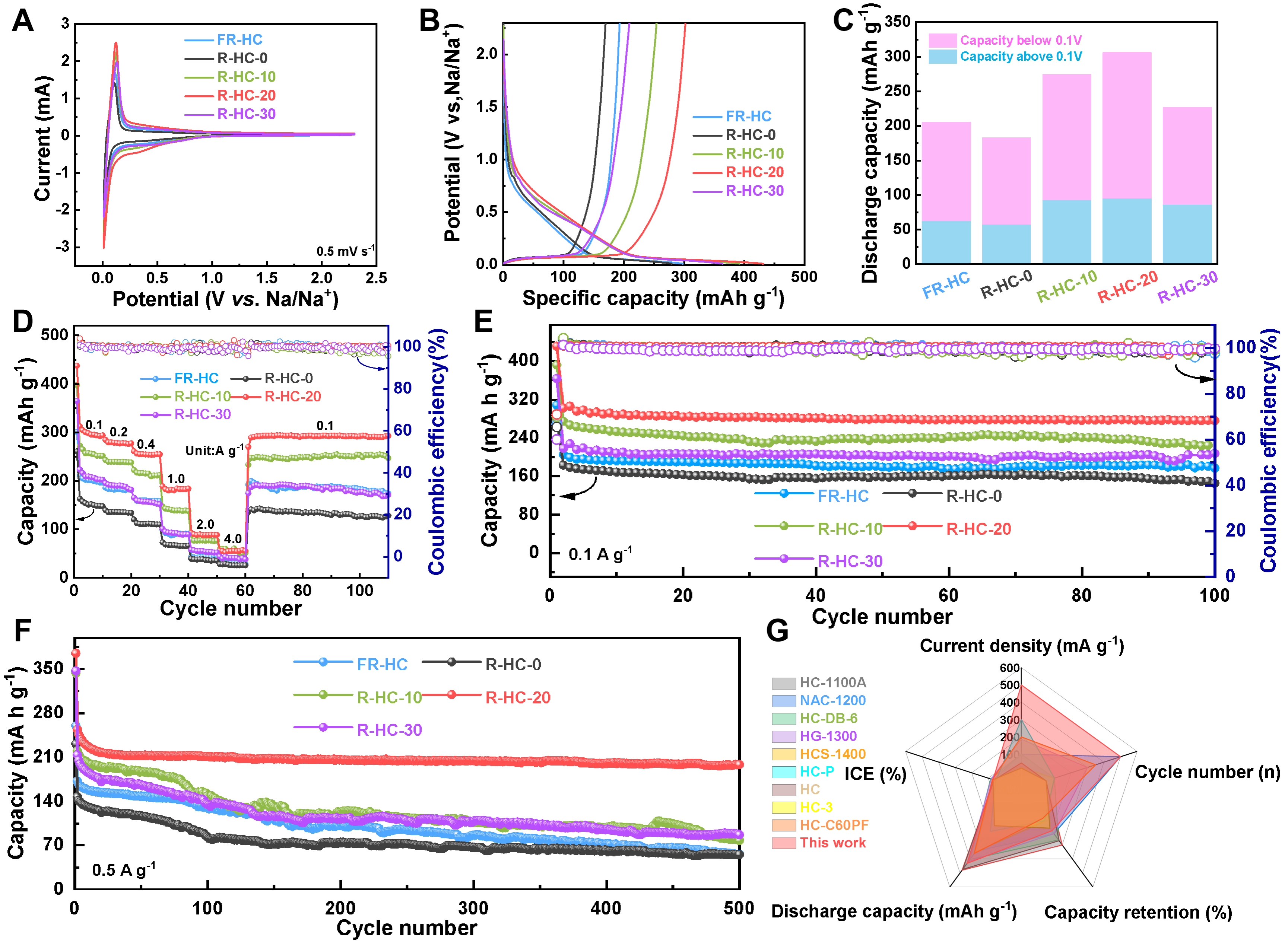
Figure 5. Electrochemical sodium-storage characteristics of FR-HC and R-HC-x electrodes. CV curves at a scan rate of 0.5 mV s-1 (A); Initial galvanostatic charge-discharge profiles at 0.1 A g-1 (B); Contributions of the slope and plateau regions to the second-discharge capacity (C); Rate performance (D); Cycling stability at 0.1 A g-1 (E); Long-term cycling performance at 0.5 A g-1 (F); Comparison of reversible capacity and cycling durability of the present hard carbon anode with previously reported biomass-derived hard carbon materials (G). FR: Fresh reeds; CV: cyclic voltammetry; ICE: Initial coulombic efficiency.
Figure 5B presents the initial GCD profiles of the FR-HC and R-HC-x electrodes. All electrodes exhibit the characteristic sodium-storage behavior of hard carbon, featuring a sloping region at relatively high potentials followed by an extended low-potential plateau, reflecting the distinct contributions of slope and plateau storage mechanisms. The initial discharge capacities of FR-HC, R-HC-0, R-HC-10, R-HC-20, and R-HC-30 are 308.0, 279.3, 391.8, 431.4, and 363.8 mAh g-1, respectively, with R-HC-20 delivering the highest initial discharge capacity. Correspondingly, the initial coulombic efficiencies of these electrodes are 66.6%, 65.5%, 70.0%, 71.4%, and 60.0%, respectively, demonstrating the superior capacity utilization and reduced irreversible capacity loss of R-HC-20. Figure 5C summarizes the respective contributions of plateau and slope regions to the second discharge capacity of different electrodes. Notably, R-HC-20 achieves the largest capacities in both regions, indicating the simultaneous enhancement of low-voltage plateau storage and high-voltage slope storage. The superior plateau capacity is closely associated with the well-developed closed-pore architecture induced by moderate moisture regulation, which provides abundant nanoscale reservoirs for sodium-ion accommodation. Meanwhile, the optimized microstructure also contributes to the improvement of the sloping capacity. The rate performance comparison of FR-HC and R-HC-x electrodes is displayed in Figure 5D. The R-HC-20 exhibits the most favorable rate performance, delivering reversible capacities of 312.5, 284.5, 260.9, 188.6, 92.7, and 55.3 mAh g-1 as the current density increases stepwise from 0.1 to 4.0 A g-1, surpassing all other electrodes. When the current density is subsequently reduced to 0.1 A g-1, a reversible capacity of 290.9 mAh g-1 is recovered, highlighting its excellent structural adaptability and electrochemical reversibility of the electrode. The long-term cycling stability was further examined to evaluate the durability of the sodium-storage structure. R-HC-20 maintains the highest reversible capacity among the investigated samples over 100 cycles at 0.1 A g-1, retaining 275.7 mAh g-1 with nearly 100% coulombic efficiency [Figure 5E]. Even at the higher current density of 0.5 A g-1, the electrode preserves 80.1% of its initial capacity after 500 cycles [Figure 5F], confirming the robustness of the moisture-regulated carbon framework. Compared with previously reported biomass-derived hard carbon anodes [Figure 5G], R-HC-20 demonstrates a favorable balance among reversible capacity, rate capability, and cycling durability, highlighting its potential as a competitive anode material for practical SIB applications[19,40-47].
To verify the applicability of the moisture-assisted structural regulation approach beyond reed-derived precursors, wood and bamboo were employed as representative biomass models. The sodium-storage properties of hard carbons obtained from dry precursors and precursors with a controlled moisture content of 20% were comparatively investigated. Supplementary Figure 10 presents the cycling performance of these electrodes at 0.1 A g-1. Both W-HC-20 and B-HC-20 exhibit enhanced reversible capacities and superior capacity retention compared with their moisture-free counterparts (W-HC and B-HC), indicating that moderate moisture regulation induces favorable structural evolution during carbonization. This improvement is attributed to the moisture-mediated modulation of carbon-layer disorder, pore architecture, and defect configuration, which collectively contribute to enhanced sodium-ion accommodation and transport. The reproducible performance enhancement across multiple biomass feedstocks confirms the robustness and general applicability of the moisture-assisted strategy for constructing high-performance hard carbon anodes.
To clarify the potential-dependent sodium-storage mechanism and interfacial evolution of the R-HC-20 electrode, ex situ XRD and XPS measurements were conducted at selected charge and discharge states. The ex situ XRD results [Figure 6A] reveal that the (002) diffraction peak exhibits negligible variation during the initial discharge process down to 0.1 V, suggesting that sodium storage at relatively high potentials is dominated by adsorption processes involving defects, surface functional groups, and micropores. Upon deep discharge to 0.01 V, the discernible shift of the (002) reflection indicates Na+ accommodation within the disordered graphitic domains, accompanied by an increase in the interlayer spacing. These results collectively indicate a multistep sodium-storage mechanism involving initial adsorption at defect and surface sites, subsequent Na+ insertion between carbon layers, and ultimately sodium filling within closed pores. During charging, the restoration of the (002) peak position demonstrates the reversible contraction of carbon layers and confirms the structural resilience of the moisture-regulated hard carbon framework. Ex situ XPS analysis further reveals the reversible interfacial chemistry of the R-HC-20 electrode. The emergence of the CO32- component after cycling indicates the participation of electrolyte decomposition reactions in SEI formation [Supplementary Figure 11A]. The reduced binding energy and decreased sp3-C contribution in the charged state suggest that disordered carbon domains actively participate in Na+ storage[48]. Meanwhile, the appearance of Na KLL signals and oxygen-containing species during discharge confirms the interaction between Na+, surface oxygen functionalities, and electrolyte-derived products, promoting the formation of a stable SEI film [Supplementary Figure 11B]. These results collectively demonstrate that the optimized closed-pore architecture and defect-rich carbon framework of R-HC-20 enable reversible Na+ storage through synergistic adsorption-intercalation-pore-filling mechanisms[49].
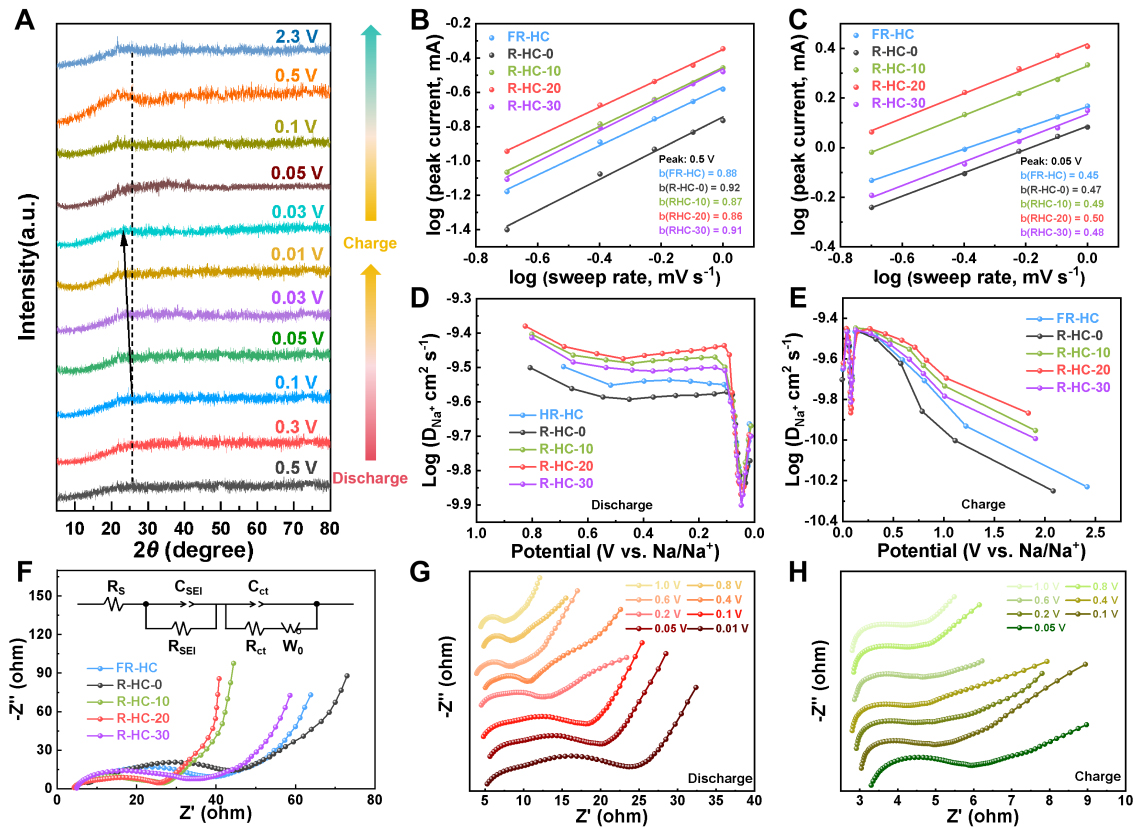
Figure 6. Sodium-storage mechanism and structure-performance correlation of hard carbon electrodes. Ex situ XRD patterns of the R-HC-20 electrode collected at different electrochemical states (A); b-values of FR-HC and R-HC-x electrodes at 0.5 and 0.05 V, respectively (B and C); GITT voltage profiles and corresponding Na+ diffusion behavior of FR-HC and R-HC-x electrodes during sodiation/desodiation processes (D and E). EIS Nyquist plots of FR-HC and R-HC-x electrodes (F). In situ EIS spectra of the R-HC-20 electrode recorded at different discharge and charge states during the initial cycle (G and H). FR: Fresh reeds; XRD: X-ray diffraction; GITT: galvanostatic intermittent titration technique; EIS: electrochemical impedance spectroscopy.
The sodium-storage kinetics of FR-HC and R-HC-x electrodes were examined using CV, GITT, and electrochemical impedance spectroscopy (EIS) techniques. The similar CV profiles observed at different scan rates [Supplementary Figures 12 and 13] indicate that all electrodes undergo analogous sodium-storage pathways, while their kinetic behaviors are strongly influenced by structural regulation. The dependence of the peak current on the scan rate was evaluated according to the power-law relationship, i = avb. At 0.5 V, the derived b values for FR-HC, R-HC-0, R-HC-10, R-HC-20, and R-HC-30 are 0.88, 0.92, 0.87, 0.86, and 0.91, respectively, revealing a dominant surface-controlled storage contribution in the slope region [Figure 6B]. This behavior can be attributed to the rapid adsorption of Na+ on defect-rich carbon surfaces and exposed edge sites. Conversely, the b values near 0.05 V approach 0.5, demonstrating a diffusion-dominated process associated with Na+ migration into closed pores and subsequent pore filling [Figure 6C]. Therefore, the sodium-storage mechanism of the R-HC-20 electrodes can be understood as a synergistic “surface adsorption-interlayer diffusion-closed-pore filling” process. Further quantitative analysis reveals that the capacitive contribution progressively increases with increasing scan rate. At 1.0 mV s-1, R-HC-20 achieves the highest capacitive contribution (67.39%), exceeding those of FR-HC (60.66%), R-HC-0 (53.60%), R-HC-10 (65.15%), and R-HC-30 (61.01%) [Supplementary Figures 14 and 15]. The enhanced capacitive behavior demonstrates accelerated reaction kinetics enabled by the moisture-regulated carbon framework. Specifically, the optimized closed-pore structure provides additional sodium-storage reservoirs, while the interconnected hierarchical pores shorten ion diffusion distances and facilitate electrolyte penetration. These synergistic structural advantages effectively accelerate sodium-ion transport and interfacial charge transfer, accounting for the outstanding rate capability of R-HC-20.
GITT measurements were employed to investigate the Na+ diffusion behavior of FR-HC and R-HC-x electrodes during the sodiation/desodiation process. As shown in Figure 6D and E, all electrodes exhibit comparable variation trends in Na+ diffusion coefficients, suggesting similar fundamental storage mechanisms. During discharge, the diffusion coefficient decreases gradually at first, followed by an increase and a subsequent recovery at the end of the sodiation process. The minimum diffusion coefficients appear mainly in the low-voltage plateau region, reflecting the kinetic limitation associated with closed-pore filling. In the slope region, Na+ ions are rapidly adsorbed by defect-rich carbon surfaces and edge sites of graphitic domains, enabling fast reaction kinetics. Upon entering the plateau region, Na+ ions are stored within confined closed pores, where stronger electrostatic interactions and restricted spatial environments hinder ion migration, resulting in slower diffusion kinetics. EIS analysis further confirms the enhanced transport kinetics of R-HC-20. The significantly reduced Rct value (19.2 Ω) compared with FR-HC, R-HC-0, R-HC-10, and R-HC-30 demonstrates accelerated interfacial electron-transfer processes [Figure 6F]. Meanwhile, the steep low-frequency Warburg region indicates enhanced Na+ diffusion capability. In situ EIS analysis reveals that although Rct increases slightly during deep sodiation due to Na+ insertion-induced interfacial evolution, the electrode maintains excellent charge-transfer kinetics throughout cycling [Figure 6G and H][50]. These results demonstrate that the moisture-regulated hard carbon framework effectively balances closed-pore sodium storage and rapid ion transport.
To demonstrate the practical viability of the moisture-regulated R-HC-20 anode, a sodium-ion full cell was assembled using Na3V2(PO4)3 (NVP) as the cathode and pre-sodiated R-HC-20 as the anode [Figure 7A]. Several N/P ratios (1.02, 1.04, 1.06, and 1.08) were analyzed, with the optimized N/P ratio being 1.06. As shown in Figure 7B, the resulting full cell delivers a reversible capacity of 239.3 mAh g-1 (based on the mass of anode) at a current density of 0.03 A g-1, together with an average operating voltage of 3.28 V, demonstrating its promising energy-storage capability. The remarkable full-cell performance is closely associated with the unique structural features of R-HC-20, where moisture-induced closed-pore formation, optimized interlayer spacing, and abundant active sites synergistically promote Na+ accommodation, ion transport, and interfacial charge-transfer processes. The rate performance of the R-HC-20//NVP full cell is presented in Figure 7C. Reversible capacities of 239.3, 168.4, 157.7, 137.5, and 126.0 mAh g-1 are achieved as the current density is successively increased from 0.03 to 0.4 A g-1. When the current density is subsequently restored to 0.03 A g-1, the cell recovers a capacity of 147.0 mAh g-1, confirming the rapid kinetic response and robust structural stability under varying charge/discharge conditions. During extended cycling at 0.1 A g-1 [Figure 7D], the cell maintains a reversible capacity of 102.0 mAh g-1 after 100 cycles, demonstrating stable sodium-ion storage behavior and the sustained integrity of the electrode/electrolyte interfaces. Moreover, the R-HC-20//NVP full cell achieves an energy density of 334.5 Wh kg-1 when calculated on the basis of the anode active mass. The excellent full-cell performance validates the effectiveness of moisture-assisted structural regulation in constructing high-performance hard carbon anodes and highlights its potential for practical sodium-ion energy-storage applications. Post-cycling SEM images of both the cathode and anode are provided in Supplementary Figure 16. The R-HC-20 anode largely preserves its original morphology after prolonged cycling, with no apparent sodium dendrite growth or irregular sodium deposition observed on the electrode surface. These findings suggest that the optimized N/P ratio of 1.06 provides sufficient anode capacity to accommodate the Na+ ions extracted from the cathode during the charging process, thereby mitigating localized sodium plating and ensuring stable operation of the full cell.
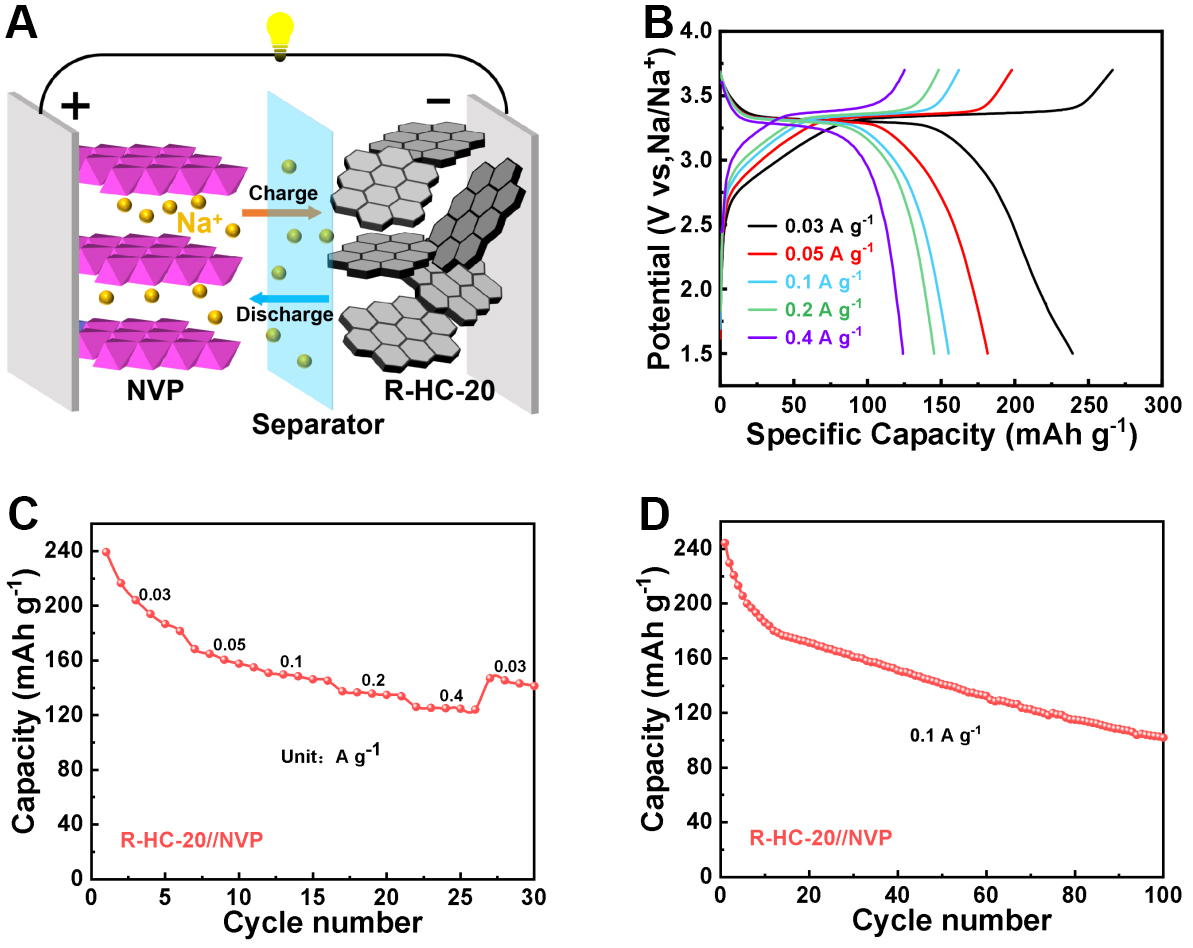
Figure 7. Electrochemical performance of the R-HC-20//NVP full cell. Schematic illustration of the R-HC-20//NVP full-cell configuration (A); Galvanostatic charge-discharge profiles at different current densities (B); Rate capability (C) and cycling performance of the R-HC-20//NVP full cell at 0.1 A g-1 (D). NVP: Na3V2(PO4)3.
CONCLUSIONS
Herein, a moisture-assisted structural regulation strategy was developed to optimize the microstructure and sodium-storage performance of reed-derived hard carbon. Introducing an appropriate amount of moisture prior to carbonization effectively tailored the carbon framework reconstruction and pore evolution, resulting in increased closed-pore content, enlarged interlayer spacing, and enhanced structural disorder. The moisture-induced swelling of hemicellulose and lignin weakened the compact packing of biomass components, while water-vapor etching facilitated the formation of initial pores, collectively constructing a favorable sodium-storage architecture. Owing to these optimized structural characteristics, R-HC-20 delivered a high initial discharge capacity of 431.4 mAh g-1, an initial Coulombic efficiency of 71.4%, and excellent long-term cycling stability, retaining 80.1% of its capacity after 500 cycles at 0.5 A g-1. The corresponding R-HC-20//NVP full cell achieved an energy density of 334.5 Wh kg-1 together with robust cycling performance. This work establishes a facile, effective, and scalable pathway for the structure of biomass-derived hard carbon and offers useful guidance for the rational development of advanced anode materials for high-performance SIBs.
DECLARATIONS
Authors’ contributions
Writing-original draft, data analysis: Zeng, W.; Jiang, M.; Chen, Y.
Investigation: Teng, Y.; Zhou, M.
Formal analysis: Zhong, C.; Chen, X.
Funding acquisition: Li, Z.; Xu, C.; Xu, W.
Discussion: Chen, X.
Writing-review & editing: Chen, Y.; Chen, L.; Zhou, M.
Availability of data and materials
The original data in this study are included in the article/Supplementary Materials. Further inquiries can be directed to the corresponding author(s).
AI and AI-assisted tools statement
During the preparation of this manuscript, the authors used ChatGPT (OpenAI, released 2026-07-09) to assist with processing certain presentation elements in Figure 4C. The AI tool was used solely to facilitate figure preparation and did not generate, analyze, or interpret the underlying experimental data or scientific conclusions. All outputs were carefully reviewed and verified by the authors, who take full responsibility for the accuracy, integrity, and content of the manuscript.
Financial support and sponsorship
This work was supported by the National Natural Science Foundation of China (52504333), Hunan Provincial Natural Science Foundation of China (2026JJ80238), and Scientific Research Fund of Hunan Provincial Education Department (25B0588 and 24B0606).
Conflicts of interest
The authors declared that there are no conflicts of interest.
Ethical approval and consent to participate
Not applicable.
Consent for publication
Not applicable.
Copyright
© The Author(s) 2026.
Supplementary Materials
REFERENCES
1. Li, J.; Li, J.; Qiao, Y.; et al. In-situ construction of artificial interface layer using sodiophilic Bi2S3 nanowires for dendritic-free sodium-metal batteries. Energy. Mater. 2026, 6, 600070.
2. Yin, H.; Cao, Y.; Wang, Y.; Huang, J.; Thalluri, S. M.; Yu, Z. Toward interface-adaptive silicon anodes: from 3D SEI to dynamic coupled interphases. Innovation. (Camb). 2026, 7, 101360.
3. Hemmelder, A.; Panda, A.; Peiseler, L.; Lux, S.; Leker, J.; Schmidt, T. S. Knowledge interdependencies between lithium- and sodium-ion battery chemistries. Nat. Energy. 2026, 11, 313-23.
4. Chen, S.; Wu, G.; Jiang, H.; et al. External Li supply reshapes Li deficiency and lifetime limit of batteries. Nature 2025, 638, 676-83.
5. Nieto, N.; Mancini, M.; Lopez-urionabarrenechea, A.; et al. Cathode performance in sustainable Na-ion full-cells: layered oxides versus polyanionic chemistry. J. Power. Sources. 2026, 666, 239089.
6. Zhao, Y.; Kang, Y.; Wozny, J.; et al. Recycling of sodium-ion batteries. Nat. Rev. Mater. 2023, 8, 623-34.
7. Zeng, Y.; Yang, J.; Yang, H.; Yang, Y.; Zhao, J. Bridging microstructure and sodium-ion storage mechanism in hard carbon for sodium ion batteries. ACS. Energy. Lett. 2024, 9, 1184-91.
8. Yao, A.; Benson, S. M.; Chueh, W. C. Critically assessing sodium-ion technology roadmaps and scenarios for techno-economic competitiveness against lithium-ion batteries. Nat. Energy. 2025, 10, 404-16.
9. Kalder, L.; Olgo, A.; Lührs, J.; et al. Empirical correlation of quantified hard carbon structural parameters with electrochemical properties for sodium-ion batteries using a combined WAXS and SANS analysis. Energy. Storage. Mater. 2024, 67, 103272.
10. Zeng, Y.; Zhong, H.; Luo, Y.; Huang, Q.; Lin, X.; Liu, J. Interfacial engineering principles for hard carbon anodes in sodium-ion batteries: from mechanisms to synergistic strategies. Energy. Environ. Sci. 2026, 19, 1775-836.
11. Dey, S. C.; Worfolk, B.; Lower, L.; et al. Phenolic resin derived hard carbon anode for sodium-ion batteries: a review. ACS. Energy. Lett. 2024, 9, 2590-614.
12. Wu, C.; Yang, Y.; Zhang, Y.; et al. Hard carbon for sodium-ion batteries: progress, strategies and future perspective. Chem. Sci. 2024, 15, 6244-68.
13. Hyun, J. C.; Jin, H. M.; Kwak, J. H.; et al. Design guidelines for a high-performance hard carbon anode in sodium ion batteries. Energy. Environ. Sci. 2024, 17, 2856-63.
14. Dayarathne, N. K.; Shi, C.; Song, X.; et al. Unlocking the potential of lignin for sodium-ion battery anodes: from biorefining to hard carbon engineering. Energy. Storage. Mater. 2025, 83, 104705.
15. Huang, W.; Wu, C.; Zhong, L.; et al. Unlocking kinetic limitations in hard-carbon anodes to enable practical fast-charging sodium-ion batteries. Adv. Energy. Mater. 2026, 16, e05568.
16. Huo, J.; Li, C.; Xia, P.; Fan, N.; Mao, W.; Bao, K. Preparation of hard carbon from acid-treated locust wood as anode material for sodium-ion batteries. J. Appl. Electrochem. 2025, 55, 1099-110.
17. Tang, Z.; Zhang, R.; Wang, H.; et al. Revealing the closed pore formation of waste wood-derived hard carbon for advanced sodium-ion battery. Nat. Commun. 2023, 14, 6024.
18. Fu, Z.; Jiang, D.; Tang, Z.; et al. Revealing the blocking effect of hemicellulose on the formation of closed pores in reed-derived hard carbon for sodium-ion batteries. Chem. Eng. J. 2025, 505, 159431.
19. Wang, Y.; Yi, Z.; Xie, L.; et al. Releasing free radicals in precursor triggers the formation of closed pores in hard carbon for sodium-ion batteries. Adv. Mater. 2024, 36, e2401249.
20. Lu, Q.; Yang, C.; Xu, Y.; et al. Cellulose fast pyrolysis activated by intramolecular hydrogen bonds. J. Phys. Chem. A. 2022, 126, 7806-19.
21. Wang, F.; Chen, L.; Li, F.; et al. Lattice reconstruction strategy for fast-charging plateau-type hard carbon anodes in ultra-long-life sodium-ion batteries. Energy. Environ. Sci. 2026, 19, 3640-52.
22. Albornoz-palma, G.; Ching, D.; Valerio, O.; Mendonça, R. T.; Pereira, M. Effect of lignin and hemicellulose on the properties of lignocellulose nanofibril suspensions. Cellulose 2020, 27, 10631-47.
23. Gundupalli, M. P.; Cheenkachorn, K.; Chuetor, S.; et al. Assessment of pure, mixed and diluted deep eutectic solvents on Napier grass (Cenchrus purpureus): compositional and characterization studies of cellulose, hemicellulose and lignin. Carbohydr. Polym. 2023, 306, 120599.
24. Liu, L.; Cui, B.; Tan, L.; Wang, W. Improving the combination of cellulose and lignin using xylan as a compatibilizer. Cellulose 2021, 28, 5335-49.
25. Zhu, X.; Liu, M.; Sun, Q.; et al. Elucidation of the interaction effects of cellulose, hemicellulose and lignin during degradative solvent extraction of lignocellulosic biomass. Fuel 2022, 327, 125141.
26. Zhu, G.; Luo, D.; Chen, X.; Yang, J.; Zhang, H. Emerging multiscale porous anodes toward fast charging lithium-ion batteries. ACS. Nano. 2023, 17, 20850-74.
27. Xiao, S.; Guo, Y. J.; Chen, H. X.; et al. Insight into the role of closed-pore size on rate capability of hard carbon for fast-charging sodium-ion batteries. Adv. Mater. 2025, 37, e2501434.
28. Wang, Z.; Feng, X.; Bai, Y.; et al. Probing the energy storage mechanism of quasi-metallic Na in hard carbon for sodium-ion batteries. Adv. Energy. Mater. 2021, 11, 2003854.
29. Alvin, S.; Cahyadi, H. S.; Hwang, J.; Chang, W.; Kwak, S. K.; Kim, J. Revealing the intercalation mechanisms of lithium, sodium, and potassium in hard carbon. Adv. Energy. Mater. 2020, 10, 2000283.
30. Fu, W.; Zhao, G.; He, S.; et al. Constructing accessible closed nanopores in coal-derived hard carbon for sodium-ion batteries. Small 2025, 21, e2411376.
31. Ferrari, A. C.; Robertson, J. Interpretation of Raman spectra of disordered and amorphous carbon. Phys. Rev. B. 2000, 61, 14095-107.
32. Chen, Y.; Liao, Y.; Ding, Y.; et al. Synchronously reconfiguring closed pore and interlayer spacing of wood-derived hard carbon via hot-pressing for advanced sodium-ion batteries. Green. Chem. 2025, 27, 8143-53.
33. Chen, Y.; Liao, Y.; Li, L.; et al. Solvothermal-assisted defect engineering in hierarchically porous carbonized wood fibers for high-performance lithium-sulfur batteries. Green. Chem. 2025, 27, 4235-43.
34. Matar, S. F. Original mechanism of transformation from soft metallic (sp2/sp3) C12 to ultra-dense and ultra-hard (sp3) semi-conducting C12: Crystal chemistry and DFT characterizations. Prog. Solid. State. Chem. 2025, 78, 100521.
35. Chen, X.; Tian, J.; Li, P.; et al. An overall understanding of sodium storage behaviors in hard carbons by an “adsorption-intercalation/filling” hybrid mechanism. Adv. Energy. Mater. 2022, 12, 2200886.
36. Duan, J.; Xu, Z.; Li, M.; et al. Structure regulation of hard carbon with enriched semi-closed ultramicropores for enhanced rapid sodium storage. Adv. Funct. Mater. 2025, 35, 2508822.
37. Zhang, Y.; Li, G.; Zhang, X.; Xia, Y. Modulating closed pore structure to enhance rate capability of corncob-derived hard carbon anode for fast-charging sodium ion battery. Adv. Funct. Mater. 2026, 36, e75450.
38. Zhang, L.; Deng, Z.; Sun, M.; et al. Characterization of closed pores in Longmaxi shale by synchrotron small-angle X-ray scattering. Energy. Fuels. 2021, 35, 6738-54.
39. Zhong, B.; Liu, C.; Xiong, D.; et al. Biomass-derived hard carbon for sodium-ion batteries: basic research and industrial application. ACS. Nano. 2024, 18, 16468-88.
40. Li, R.; Yang, B.; Hu, A.; et al. Heteroatom screening and microcrystal regulation of coal-derived hard carbon promises high-performance sodium-ion batteries. Carbon 2023, 215, 118489.
41. Wang, L.; Xu, Z.; Lin, P.; et al. Oxygen-crosslinker effect on the electrochemical characteristics of asphalt‐based hard carbon anodes for sodium-ion batteries. Adv. Energy. Mater. 2025, 15, 2403084.
42. Xu, Z.; Wang, J.; Guo, Z.; et al. The role of hydrothermal carbonization in sustainable sodium-ion battery anodes. Adv. Energy. Mater. 2022, 12, 2200208.
43. Yan, B.; Han, C.; Dai, Y.; Li, M.; Wu, Z.; Gao, X. Biomass derived hard carbon materials for sodium ion battery anodes: exploring the influence of carbon source on structure and sodium storage performance. Fuel 2024, 371, 132141.
44. Yu, C.; Li, Y.; Ren, H.; et al. Engineering homotype heterojunctions in hard carbon to induce stable solid electrolyte interfaces for sodium‐ion batteries. Carbon. Energy. 2023, 5, e220.
45. Li, Y.; Shi, J.; Wu, F.; et al. Dual-functionalized ca enables high sodiation kinetics for hard carbon in sodium-ion batteries. ACS. Appl. Mater. Interfaces. 2024, 16, 2397-407.
46. Xue, Y.; Chen, Y.; Liang, Y.; et al. Substitution index-prediction rules for low-potential plateau of hard carbon anodes in sodium-ion batteries. Adv. Mater. 2025, 37, e2417886.
47. Li, X.; Zhang, J.; Zhang, J.; et al. C60 to modulate the closed pore structures of hard carbon for high-performance sodium-ion batteries. ACS. Nano. 2025, 19, 14829-38.
48. Song, Z.; Di, M.; Zhang, X.; et al. Nanoconfined strategy optimizing hard carbon for robust sodium storage. Adv. Energy. Mater. 2024, 14, 2401763.
49. Yin, X.; Lu, Z.; Wang, J.; et al. Enabling fast Na+ transfer kinetics in the whole-voltage-region of hard-carbon anodes for ultrahigh-rate sodium storage. Adv. Mater. 2022, 34, e2109282.
Cite This Article
 Open Access
How to Cite
Zeng, W.; Jiang, M.; Teng, Y.; Chen, Y.; Zhong, C.; Li, Z.; Xu, C.; Xu, W.; Chen, X.; Chen, L.; Zhou, M. Moisture-engineered reed-derived hard carbon for sodium-ion batteries. Energy Mater. 2026, 6, 600139. https://dx.doi.org/10.20517/energymater.2026.222
Download Citation
If you have the appropriate software installed, you can download article citation data to the citation manager of your choice. Simply select your manager software from the list below and click on download.
Export Citation File
Type of Import
Tips on Downloading Citation
Citation Manager File Format
Type of Import
Direct Import: When the Direct Import option is selected (the default state), a dialogue box will give you the option to Save or Open the downloaded citation data. Choosing Open will either launch your citation manager or give you a choice of applications with which to use the metadata. The Save option saves the file locally for later use.
Indirect Import: When the Indirect Import option is selected, the metadata is displayed and may be copied and pasted as needed.
About This Article
Special Topic
Copyright

Data & Comments
Data
0











Comments
Comments must be written in English. Spam, offensive content, impersonation, and private information will not be permitted. If any comment is reported and identified as inappropriate content by OAE staff, the comment will be removed without notice. If you have any queries or need any help, please contact us at [email protected].