


Design, preparation, and application of two-dimensional topological materials in electrocatalytic water splitting
 0
0 Abstract
The increasing demand for sustainable energy and carbon emission reduction has prompted the development of efficient hydrogen production technologies. Electrocatalytic water splitting is a promising technique for generating clean hydrogen. However, sluggish hydrogen evolution reaction and oxygen evolution reaction kinetics and the high cost of conventional catalysts remain major challenges. Two-dimensional (2D) topological materials have attracted considerable attention owing to their unique electronic structures, topologically protected edge states, and excellent charge transport properties. This review summarizes recent advances in the electronic structures, preparation methods, and electrocatalytic water splitting applications of 2D topological materials (including topological insulators, Dirac semimetals, Weyl semimetals, and nodal line semimetals). In addition, the catalytic mechanisms and performance regulation strategies are discussed. The reviewed studies reveal that topological electronic states can enhance catalytic activity by increasing active sites, modulating intermediate adsorption, and accelerating charge transfer. Furthermore, several techniques, including heterostructure construction, doping, and strain engineering, can further improve the performance of 2D topological materials. The remaining challenges and future perspectives for practical applications are highlighted, providing insights for the further development of this field.
Keywords
INTRODUCTION
The continuous increase in global energy demand, fossil fuel consumption, and greenhouse gas emissions poses significant environmental threats[1]. As a result, researchers have directed considerable efforts toward developing clean and renewable energy sources. Hydrogen (H2) has emerged as a promising clean energy carrier owing to its abundant availability, high energy density, zero carbon emissions, and high calorific value of approximately 142 kJ/g[2,3]. H2 is mainly produced through electrocatalytic water splitting. This method generates H2 at the cathode and O2 at the anode[4,5]. However, the high activation energy barriers and resulting slow reaction kinetics of the hydrogen evolution reaction (HER) and oxygen evolution reaction (OER) remain major limitations to efficient electrocatalytic water splitting[6,7]. Therefore, developing high-performance electrocatalysts with stable catalytic activity is crucial for advancing this process.
In recent years, noble metal-based catalysts have been widely used for water electrolysis owing to their highly efficient electrocatalytic activity. Platinum (Pt) exhibits excellent catalytic activity toward the HER, whereas iridium (Ir) and ruthenium (Ru) exhibit excellent performance toward the OER. However, their high cost and limited availability hinder widespread applications[8]. To address these limitations, various metal composite materials, including transition metal nitrides[9,10], carbides[11,12], and sulfides[13,14] have been explored as alternative electrocatalysts to precious metals. Although these composite materials are cost-effective, they are still limited by poor catalytic activity and stability compared with noble metal-based catalysts. Therefore, developing cost-effective novel materials with excellent catalytic performance is urgently required.
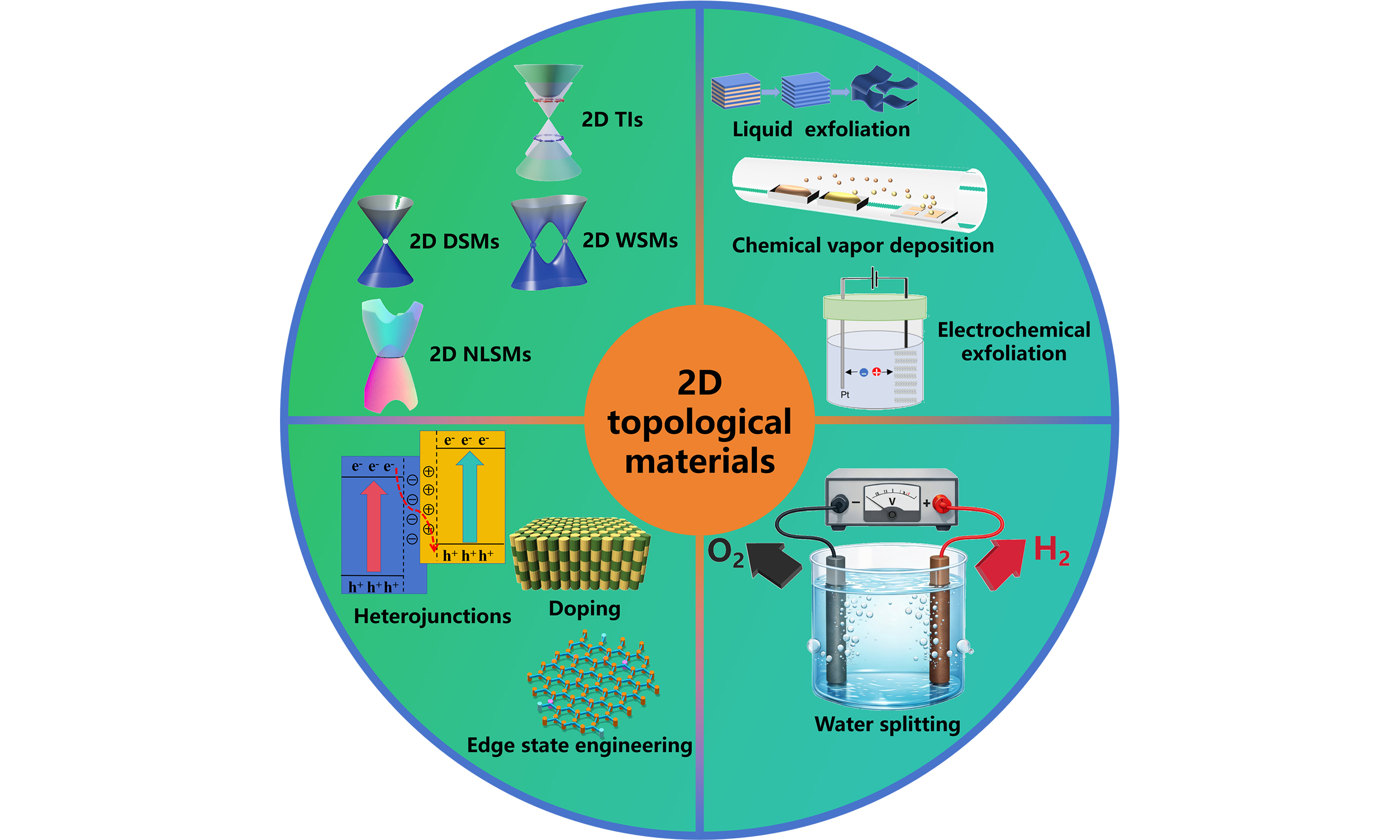
2D topological materials are an advanced class of materials characterized by a 2D structure, in which the bulk electronic states exhibit topologically non-trivial properties. In 2D topological materials, nontrivial band topology can give rise to topologically protected boundary states localized at the material edges, commonly referred to as topological edge states (TESs). The unique structure of TESs enhances the catalytic activity and stability of composite catalysts[15,16]. The high surface carrier concentration of TESs provides abundant active sites, effectively promoting catalytic reactions. The symmetry and topological structure of TESs enable them to be topologically protected, thereby exhibiting strong resistance to disturbances, such as doping, defects, and external perturbations. The stability of TESs ensures that their active sites remain intact and continue to function even under conditions that could otherwise compromise catalyst performance, thus maintaining stable catalytic activity[17].
The adsorption and desorption strengths of catalytic active sites and reaction intermediates mainly influence catalytic reaction efficiency. From a thermodynamic perspective, the magnitude of the Gibbs free energy of adsorption (ΔGH*) influences the strength of adsorption and desorption. An extremely small ΔGH* value indicates that reaction intermediates are strongly bound to active sites, thereby hindering product desorption and blocking catalytic activity. Conversely, an excessively large ΔGH* results in weak adsorption, leading to insufficient binding strength between reactants and active sites, thereby impeding effective catalytic reactions. Therefore, high-performance electrocatalysts exhibit ΔGH* values approaching zero. The tunable electronic structures of 2D topological materials facilitate the regulation of ΔGH* toward the ideal state[18].
Carrier mobility is an important factor affecting electrocatalytic performance. Electrons moving on TESs exhibit high mobility and conductivity. The inherent topological protection of the edge states can help preserve their conductive properties[19]. Among the diverse range of 2D topological materials, 2D topological insulators (TIs) and 2D topological semimetals (TSMs) have attracted considerable attention from researchers. Among 2D TSMs, Dirac semimetals (DSMs), Weyl semimetals (WSMs), and nodal-line semimetals (NLSMs) have exhibited high catalytic performance, thereby attracting significant research attention.
Several review articles have summarized the research progress of 2D topological materials from different perspectives. For example, Li et al.[20] reviewed the applications of 2D TSMs in terahertz detectors and chip integration. Que et al.[21] provided an overview of the quantum spin Hall effect and TESs in 2D TIs. The intrinsic properties of 2D TSMs and their applications in electronic and optoelectronic devices were discussed by Yu et al.[22]. Yin et al.[23] summarized the recent advances in 2D organic TIs, including lattice models, theoretical predictions, and experimental realizations of various materials. However, a comprehensive review integrating recent advances in the fabrication, modification, and application of 2D topological materials for electrocatalytic water splitting remains lacking. Therefore, this review aims to provide an overview of the latest advances in the fabrication, modification, and electrocatalytic water-splitting applications of 2D topological materials, offering valuable insights and references for future development and practical applications.
2D TOPOLOGICAL MATERIALS
In recent years, inspired by graphene, various novel 2D topological materials have been discovered and extensively studied. The unique nontrivial topological electronic states of the materials make their theoretical and experimental investigation an active research direction in condensed matter physics[24]. In addition to the search for novel 2D topological materials, another research focus involves examining the quantum effects and changes in electronic properties that occur when three-dimensional (3D) bulk topological materials are reduced to 2D structures[25]. For instance, the use of thickness-dependent bandgap reconstruction to reduce the three-dimensional block-like WTe2 to an atomic-scale thin layer can generate a 2D quantum spin Hall state[26]. Reducing the thickness of Bi2Se3-family TIs induces hybridization between top and bottom surface states, leading to the opening of a Dirac gap and the evolution from 3D topological surface states toward 2D topological phases[27]. Furthermore, another study revealed that dimensional reduction of 3D DSM Cd3As2 produced a 2D topological insulating phase with robust quantum spin Hall edge states[28]. Studies on 2D topological materials have focused on TIs, DSMs, WSMs, and NLSMs, each possessing unique topological phases. Their unique transport properties and tunable edge states make them promising platforms for next-generation electronic devices, efficient catalysts, and topological quantum computing.
2D TIs
The discovery of 2D TIs represents a significant development in condensed matter physics. These materials possess an insulating bulk interior and conducting topological surface states (TESs). In many 2D TIs, strong spin-orbit coupling (SOC) modifies the electronic band structure, leading to band inversion between the valence and conduction bands and the formation of TESs. This inversion transforms the topological invariant of the entire band structure from "trivial" to non-trivial [Figure 1A and B][29,30]. The Z2 invariant (ν) represents the topological invariant, where ν = 1 indicates topological nontriviality (TI), and ν = 0 denotes topological triviality (ordinary insulator, vacuum, and air). When a material with ν = 1 forms an interface with a topologically trivial material with ν = 0, a conductive metallic edge state inevitably emerges at their interface. This state connects two distinct electronic states with different Z2 invariants[2,24]. Additionally, spin-momentum locking occurs at the metallic edge state, where the direction of electron motion and its intrinsic spin are forced to be perpendicular [Figure 1C]. Ordinary non-magnetic impurities cannot alter the spin direction of the electrons. As a result, electrons are prevented from bypassing non-magnetic impurities through backscattering, leading to direct migration without backscattering or energy loss, thereby facilitating electron transport. Moreover, the backscatter-free migration is protected by time-reversal symmetry, ensuring consistently high electron mobility[31].
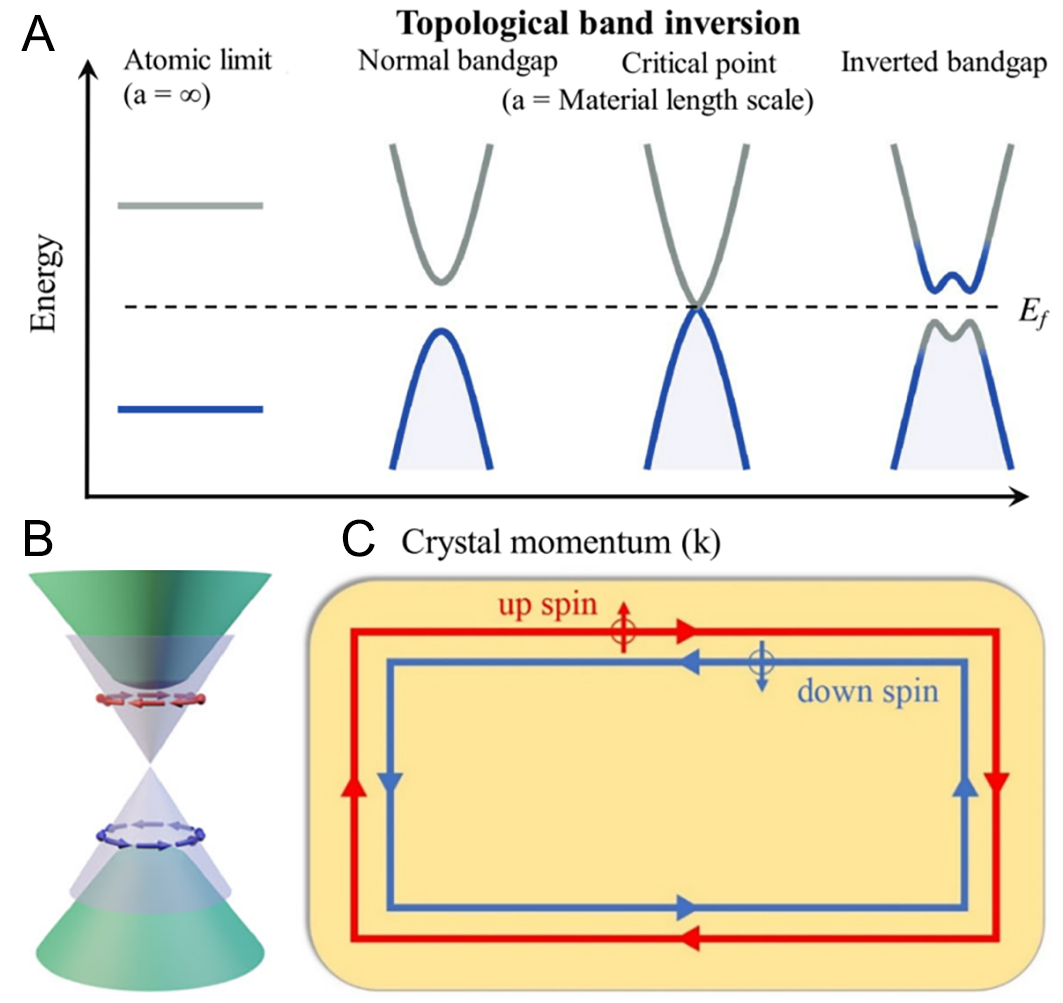
Figure 1. (A) Schematic diagram illustrating the generation of topologically non-trivial states through band inversion, adapted with permission[29], Copyright © 2023 Wiley-Blackwell. (B) Band structure diagram of 2D topological insulators, adapted with permission[30], Copyright © 2021 Springer Nature. (C) Schematic illustration of helical metallic edge states in a 2D topological insulator, where spin-up and spin-down electrons propagate in opposite directions along the edge, adapted with permission[19], Copyright © 2022 Wiley-VCH.
A recent study[32] has shown that a novel 2D magnetic higher-order TI, CrOCl, exhibits fully spin-polarized corner states that remain stable in the presence of SOC, symmetry breaking, and even magnetic disruption. Under the influence of an electric field, CrOCl undergoes a phase transition where the corner states merge with the edge or bulk states. Xu et al.[33] reported a single-layer 2D TI, ZrTe5, and discovered a new structural phase distinct from its bulk structure. In the study, a topologically nontrivial band gap was observed at approximately 254 meV, along with metallic edge states. Meanwhile, Yalameha et al.[34] applied first-principles calculations to predict that monolayer K2Be2P2 could transition from a conventional semiconductor to a TI under strain control. Its symmetrical lattice, strain-driven topological phase transition, and TES make it a promising candidate for novel 2D TIs.
2D DSMs
TSM phases can arise through two primary mechanisms: band inversion and crystal symmetry protection [Figure 2]. Most DSMs originate from band inversion. The key distinction between 2D DSMs and 2D TIs lies in their bulk electronic structures. In DSMs, band inversion in the bulk causes the conduction and valence bands to directly touch at the Dirac point, resulting in a vanishing bandgap. Near this point, the energy bands exhibit symmetric conical dispersions, forming a Dirac cone [Figure 3A] with fourfold degeneracy.
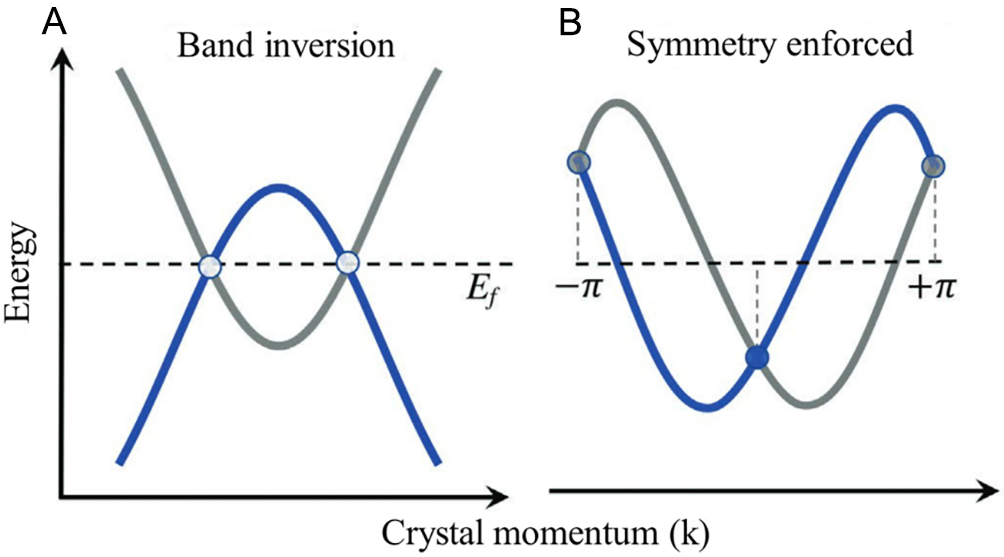
Figure 2. (A and B) Schematic diagram illustrating the generation of a topological semimetal phase through (A) band inversion and (B) crystal symmetry, This figure is adapted with permission[29], Copyright © 2023 Wiley-Blackwell.
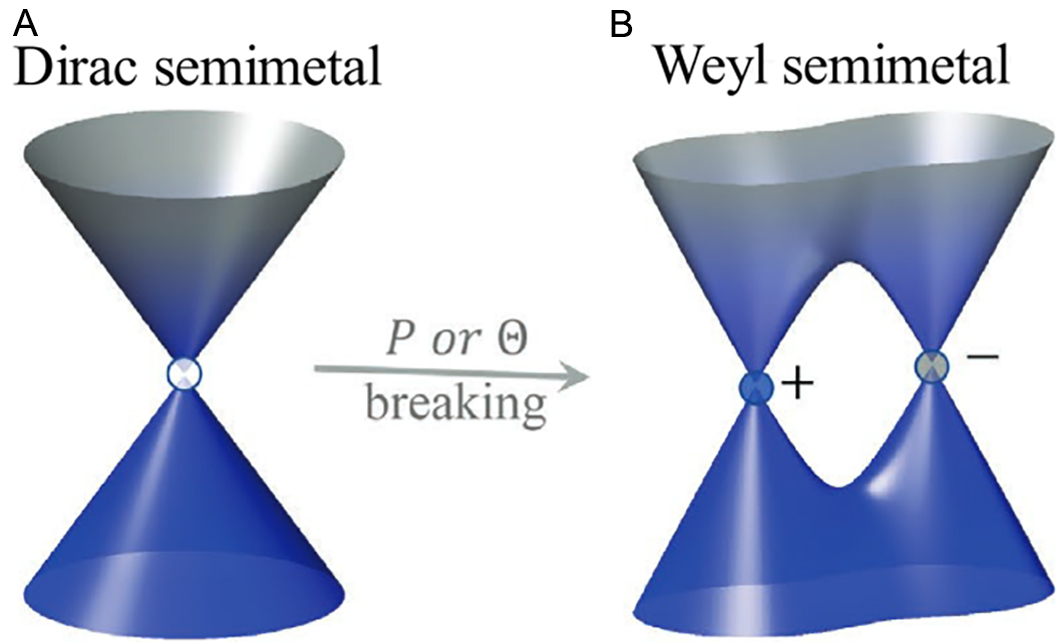
Figure 3. (A) Dirac cone. (B) Splitting from a Dirac point into two Weyl points, This figure is adapted with permission[29], Copyright © 2023 Wiley-Blackwell.
Near the Dirac point, the electron energy varies linearly with momentum, resulting in massless Dirac fermions with an effective mass approaching zero. These quasiparticles can experience reduced scattering rates, consequently exhibiting exceptionally high carrier mobility. Moreover, Dirac points protected by time-reversal symmetry and spatial-inversion symmetry contribute to the stability of the electronic structure. Based on the degree of band tilting, 2D DSMs can be classified as type I and type II. Type I DSMs exhibit nearly vertical band dispersions near the Dirac point, whereas type II DSMs exhibit strongly tilted bands, leading to pronounced anisotropy in properties, including electrical conductivity and magnetoresistance. These characteristics make type II DSMs particularly promising for developing superconducting materials[35].
Zhao et al.[36] theoretically predicted that the 2D antiferromagnetic DSM, r-MnN4 monolayer, exhibited ideal 2D Dirac properties. At atomic-layer thickness, the monolayer simultaneously exhibited magnetic properties and a Dirac-crossed band structure, making the integration of magnetic and Dirac states possible. A theoretical study[37] has shown that combining a single-layer BaCu with appropriate distortion and heterostructures can exhibit 2D Weyl and type-III Dirac point properties, indicating that stable, tunable DSMs can be realized in 2D systems through geometric control. Wang et al.[38] identified the TCH-SSH-2D, a pure carbon 2D allotrope whose calculated band structure exhibits Dirac nodal lines, providing new insights into 2D carbon-based TSMs.
2D WSMs
2D WSMs are derived from 2D DSMs. As shown in Figure 3B, when time-reversal symmetry or crystal-symmetry-protected Dirac point is broken, the fourfold-degenerate Dirac point splits into two doubly degenerate Weyl points with opposite chirality. At the Weyl points, the valence and conduction bands meet, resulting in linear dispersion and the emergence of Weyl fermions. Compared with the solitary Dirac points found in the bulk of 2D DSMs, the two Weyl points split from a single Dirac point are discretely distributed within the bulk[39]. This characteristic enables Fermi arcs to form at the edges of 2D WSMs. The Fermi arcs connect the projections of the discrete pair of Weyl points at the edge of the material. As Fermi arcs provide conductive channels along the edges of 2D WSMs and the bulk states contribute to conduction, these materials exhibit transport properties that combine both edge and bulk effects[40].
A study[41] examining the spin-polarized Weyl points and corresponding edge states using spin-angle-resolved photoemission spectroscopy (spin-ARPES) and scanning tunneling spectroscopy (STS) revealed 2D bismuthene monolayers grown on SnS or SnSe substrates. Another study[42] revealed that applying an appropriate in-plane Zeeman field and modulating the Fermi level with an electric field in Cd3As2 films with controlled thickness induced a 2D WSM phase. This approach provides a theoretical pathway for reducing 3D TEMs to 2D. Xu et al.[43] theoretically proposed the TiTe monolayer as a novel 2D topological phase. This material integrates magnetic and Weyl semimetallic properties, enabling switching between the Weyl semimetallic phase and the quantum Hall phase by controlling the magnetization direction.
2D NLSMs
Compared with the discrete Dirac or Weyl points in the bulk electronic structures of 2D DSMs and 2D WSMs, respectively, the crossing of the conduction and valence bands in 2D NLSMs does not occur at a discrete point but rather forms a continuous line or loop[44]. Although electronic states at Dirac and Weyl points are zero-dimensional and localized, those at nodal lines are one-dimensional and extended. This difference can result in anisotropic electron dispersion near the nodal lines, characterized by approximately linear band dispersion perpendicular to the nodal line and parabolic dispersion along the tangential direction, with the latter corresponding to a large effective mass. Moreover, due to the bulk-edge correspondence principle, topologically protected edge states exist along the boundaries. Based on the dispersion characteristics of the nodal lines, they are classified into three types: I, II, and hybrid nodal lines. Type I nodal lines are formed through the intersection of one electron-type band and one hole-type band and are the most common in 2D NLSMs. Type II nodal lines are formed through the intersection of two electron-type bands or two hole-type bands. Hybrid nodal lines simultaneously exhibit both type I and type II characteristics[45-48].
He et al.[49] reported the existence of mixed nodal lines in CrN monolayers [Figure 4], where two types of nodal lines coexist. Chen et al.[50] achieved an ideal type II NLSM in bilayer AlN through a van der Waals interlayer intercalation strategy, in which the nodal lines were stabilized near the Fermi level by regulating interlayer hybridization. A recent study[51] identified C-Me-graphene as an ideal 2D NLSM. Its nodal lines lie at the Fermi level without interference from extraneous bands, resulting in a well-defined band structure, while also exhibiting excellent mechanical properties.
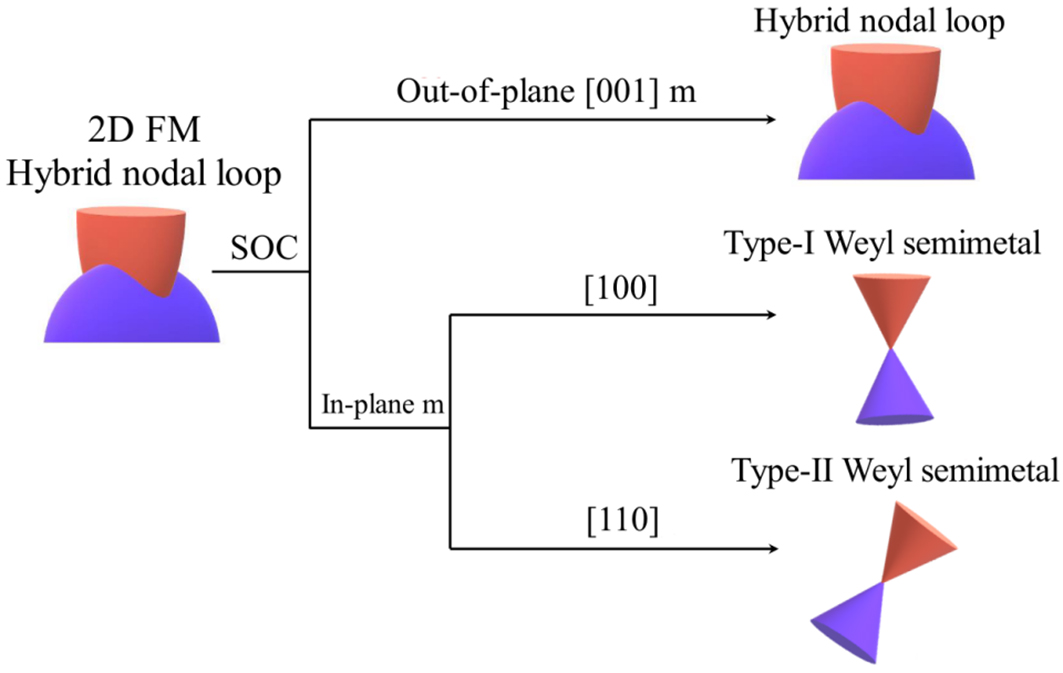
Figure 4. Topological phase transition of a 2D nodal line semimetal CrN monolayer, This figure is adapted with permission[49], Copyright © 2020 American Physical Society.
2D topological materials have attracted considerable attention from researchers owing to their diverse electronic structures. Additionally, the combination of different topological materials or topological materials and other functional materials with unique properties provides new opportunities for discovering and designing novel topological phases. For example, combining materials with topological properties and those with superconductivity results in topological superconductors—novel materials with the zero-resistance characteristics of superconductivity. Examples of 2D topological superconductors include Ag4H[52], monolayer h-V2N3[53], and 2D MXC3 materials (InAsC3, SeAsC3, and InTeC3)[54]. Similarly, integrating topological materials with magnetic materials results in magnetic TIs, topological axion insulators, and antiferromagnetic TIs. Common examples in this category include the MnBi2Te4 family[55], V2WS4[56], and Eu3In2As4[57], which exhibit remarkable magnetoelectric effects. In addition to these categories, numerous novel materials with coupled properties exhibit multiple functional properties within a single crystal. These materials provide numerous research opportunities and have considerable potential for technological applications. However, in the context of electrocatalytic water splitting—particularly the HER—the catalytic performance of the coupled-property materials is yet to be fully explored. This presents vast opportunities for developing electrocatalysts with enhanced activity and improved stability.
PREPARATION OF 2D TOPOLOGICAL MATERIALS
Developing controllable, efficient, and reliable preparation strategies for high-quality 2D topological materials is critical for advancing their fundamental studies and practical applications. The most widely used and effective techniques include molecular beam epitaxy (MBE), chemical vapor deposition (CVD), mechanical exfoliation, liquid-phase exfoliation, and electrochemical exfoliation.
Molecular beam epitaxy
MBE is an epitaxial growth technique for growing high-quality thin films layer by layer on a substrate by directing molecular beams onto the substrate in a vacuum environment. The main factors influencing MBE include substrate selection, temperature, surface passivation, and beam current ratio. Substrate selection significantly influences film quality, with Si, SiO2/Si, SrTiO3, and GaAs substrates being suitable for growing various 2D topological materials[25]. Liu et al.[58] successfully fabricated MnBi2Te4 films on Si(111) substrates. He et al.[59] successfully grew monolayer 2H-MoTe2 films on SiO2/Si substrates. Figure 5A and B illustrate the schematic apparatus and process control for MoTe2 preparation through MBE. Ip et al.[60] fabricated Bi2Se3 films on SrTiO3 substrates, and the process flow is shown in Figure 5C-H. A further study[61] successfully grew NbAs films on both GaAs(100) and GaAs(111) substrates.
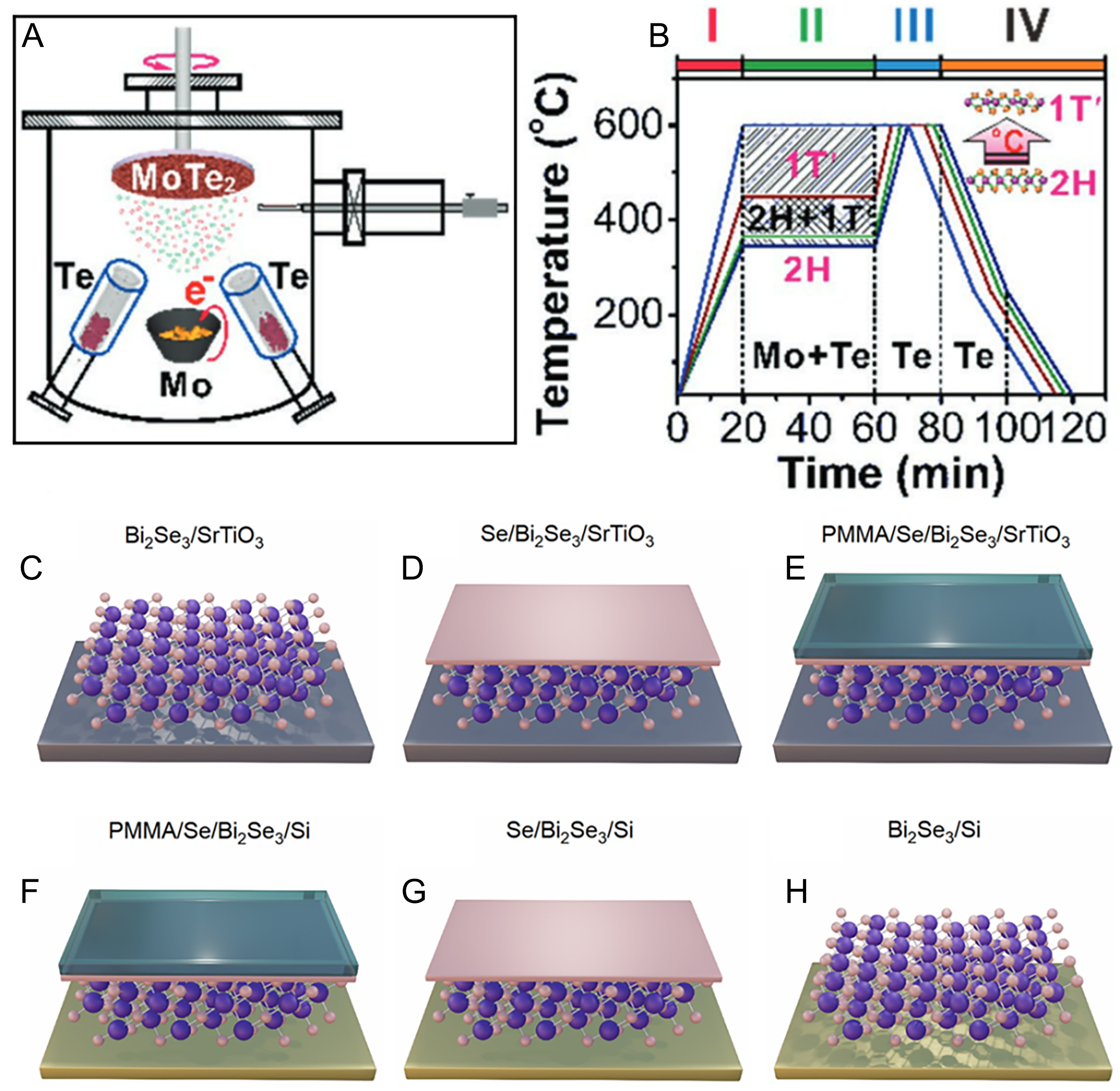
Figure 5. (A) Schematic diagram of the MBE growth setup. (B) Temperature distribution and process control of the substrate during the MBE growth of MoTe2: I: Heating; II: Nucleation/Growth; III: Annealing; IV: Cooling, (A and B) are adapted with permission[59], Copyright © 2019 Wiley-Blackwell. (C-H) The preparation process of Bi2Se3 thin films, (C-H) are adapted with permission[60], Copyright © 2024 American Chemical Society.
Substrate temperature influences growth kinetics, film quality, and surface morphology. Different substrate temperatures have different effects on film growth. Liu et al.[62] grew BiSbTe3 films on Al2O3 (0001) substrates and compared the surface morphologies of the films prepared at different temperatures [Figure 6A-C]. The images reveal triangular terraced step surfaces at all temperatures, which are closely related to the symmetry of the trigonal (hexagonal) crystal structure of the substrate. As the temperature increases, the step dimensions progressively enlarge, indicating improved crystal quality. Furthermore, all five terraced layers of BiSbTe3 exhibit excellent epitaxial relationships with the substrate.
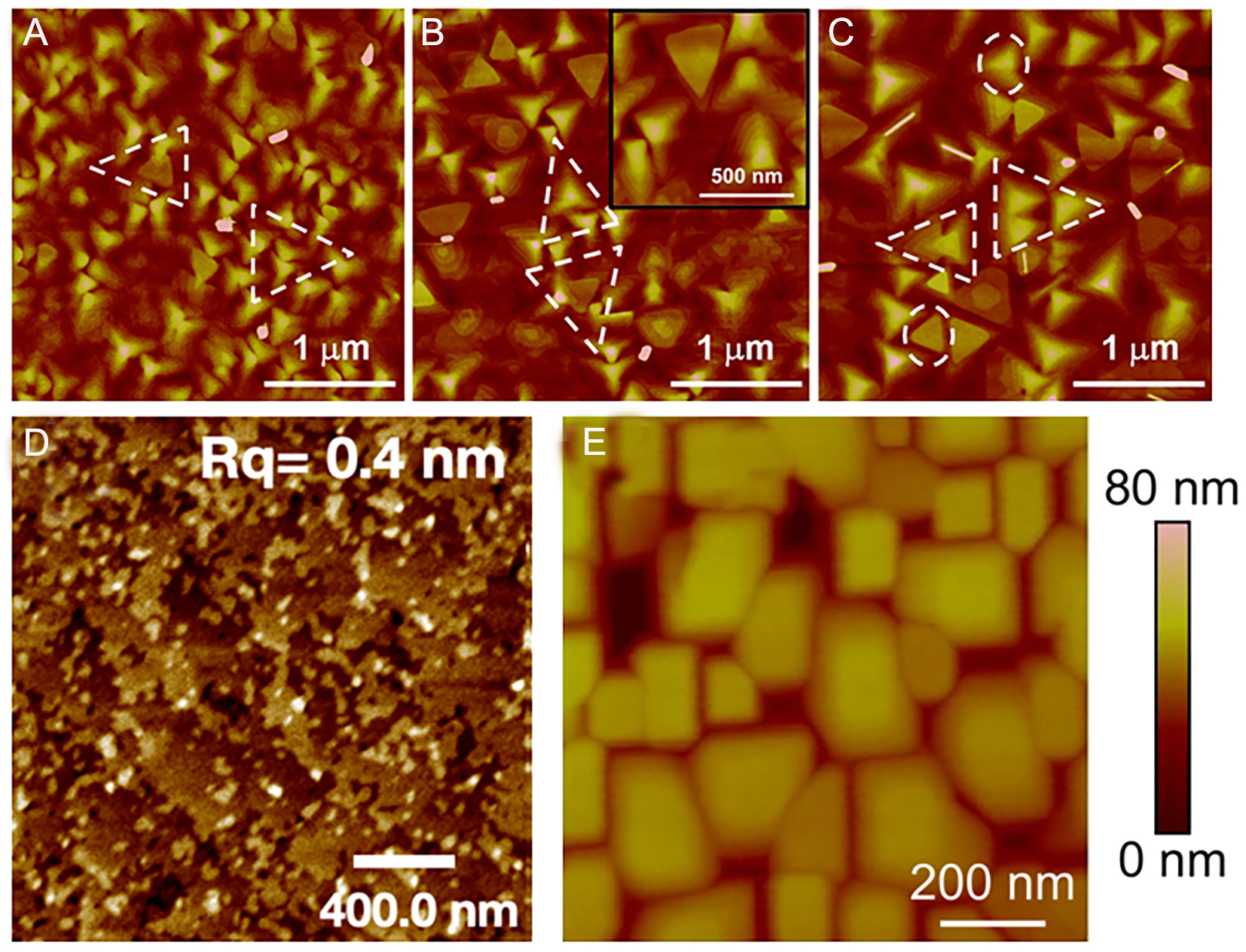
Figure 6. (A-C) Atomic force microscope (AFM) images of 2D BiSbTe3 films grown at substrate temperatures of (A) 485 K, (B) 500 K, and (C) 515 K, (A-C) are adapted with permission[62], Copyright © 2015 Elsevier. (D and E) AFM images of the (D) virtual substrate In2Se3, adapted with permission[63], Copyright © 2023 MDPI, and (E) TaAs film, adapted with permission[64], Copyright © 2023 Elsevier.
Crystal defects significantly affect thin-film growth quality. Therefore, effectively controlling and eliminating defects are essential for producing high-quality films. Common defects include anti-site atoms, vacancies, and twin domains. Surface passivation of the substrate is a widely used method for suppressing these defects. Wickramasinghe et al.[63] introduced a novel selenium (Se) passivation technique in which Se passivation of the surface of an InP(111)B substrate forms a virtual In2Se3 substrate layer, as shown in Figure 6D. This virtual substrate provides an atomically flat and highly smooth surface. Bi2Se3 and Sb2Te3 films grown on this substrate completely suppress crystal defects, particularly twin domains.
The beam ratio is another critical factor influencing film quality. Nelson et al.[64] grew TaAs films on GaAs (001) substrates [Figure 6E] by varying the substrate temperature from 400 to 650 °C while adjusting the As/Ta ratio from 1 to 60. Their results revealed that below 590 °C, both excessively high and low As/Ta ratios adversely affected the phase composition of the film. However, between 640 and 650 °C, the As/Ta ratio minimally impacted the phase composition, demonstrating a close correlation between the beam ratio and substrate temperature.
Chemical vapor deposition
The CVD technique is used to generate high-quality thin films through chemical reactions between gaseous precursors and substrate surfaces[65,66]. Depending on the number of precursors involved in the reaction, CVD can be categorized into two methods: single-precursor and multi-precursor methods. Due to the complex multi-component chemical compositions and strict atomic ratios of 2D topological materials, achieving precise elemental ratios with a single precursor is challenging. Consequently, the multi-precursor method is generally used for preparing 2D topological materials.
The selection and ratio of precursors mainly influence film quality. Li et al.[67] successfully grew few-layer 1T'-WTe2 films on SiO2/Si substrates using CVD. In their experiment, a mixed precursor with a molar ratio of Te:WCl6 ≈ 4.15:1 was used, significantly exceeding the stoichiometric 2:1 ratio of WTe2. This difference indicates that an excess of Te was used experimentally. As shown in Figure 7A, additional Te powder was placed upstream to maintain a Te-rich atmosphere within the reaction tube, ensuring that the reaction consistently progressed toward WTe2 formation. The morphological structure of the 1T'-WTe2 films was further analyzed using AFM and a high-resolution transmission electron microscope (HRTEM) in
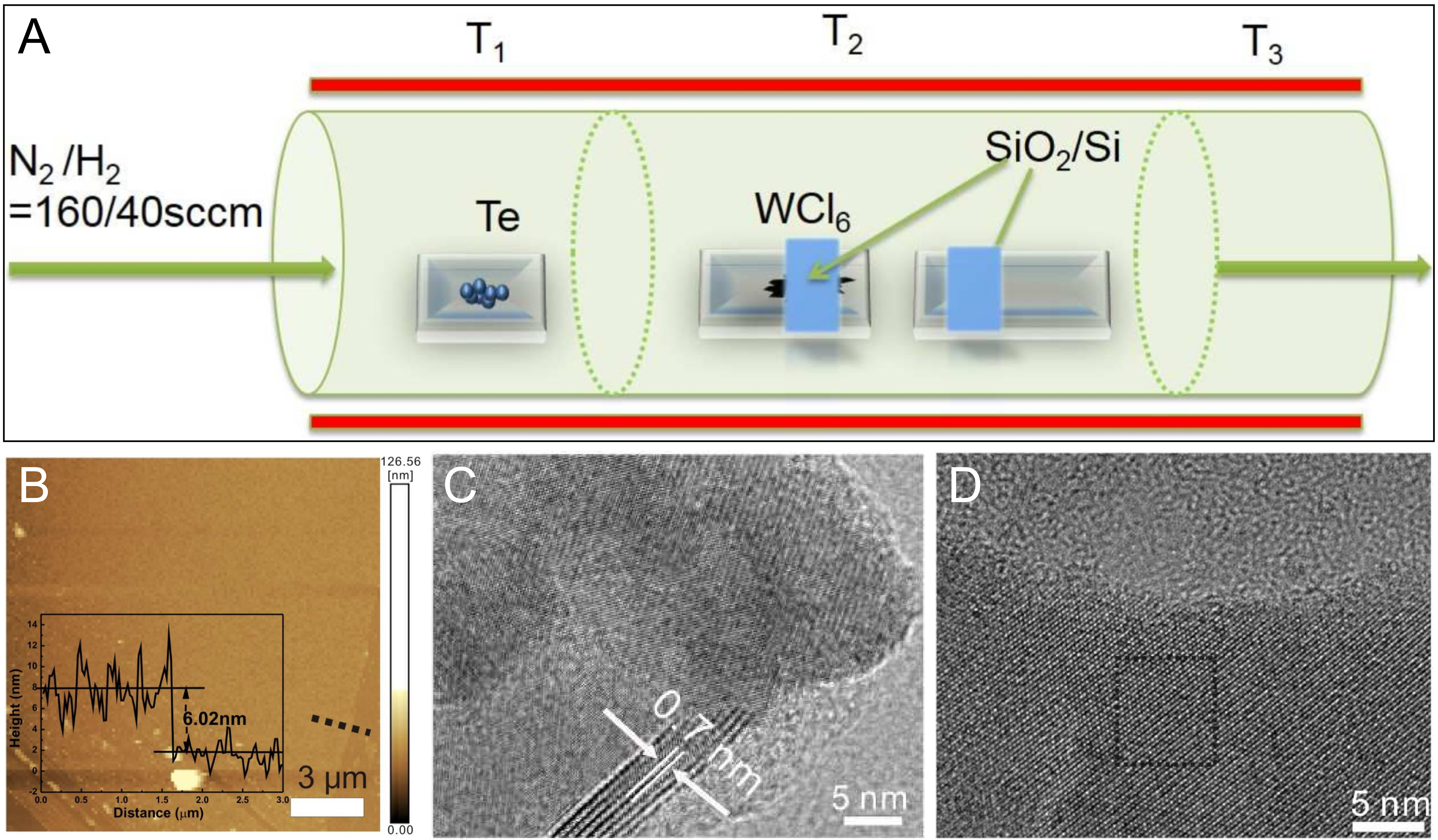
Figure 7. (A) Schematic diagram for the growth of 1T'-WTe2 by chemical vapor deposition. (B) AFM and (C and D) HRTEM images of 1T'-WTe2, This figure is adapted with permission[67], Copyright © 2018 American Chemical Society.
Different substrates, substrate temperatures, and growth durations significantly influence the quality of the resulting films. Poplinger et al.[68] grew Bi2Se3-xSx films on three substrates: Si/SiO2, sapphire, and Si/SiO2 covered with a monolayer of graphene. They compared the growth morphologies and properties of these films [Figure 8]. When the films were grown at 570 °C for 10 min on a Si/SiO2 substrate, the crystals grew vertically and formed isolated structures. When the films were grown on the sapphire substrate at 580 °C for 180 min, crystals grew both laterally and vertically, resulting in aggregation. When the films were separately grown on the Si/SiO2 substrate covered with a monolayer of graphene at 580 °C for 60, 120, and 180 min, the crystals gradually transformed from isolated hexagonal crystals into continuous films.
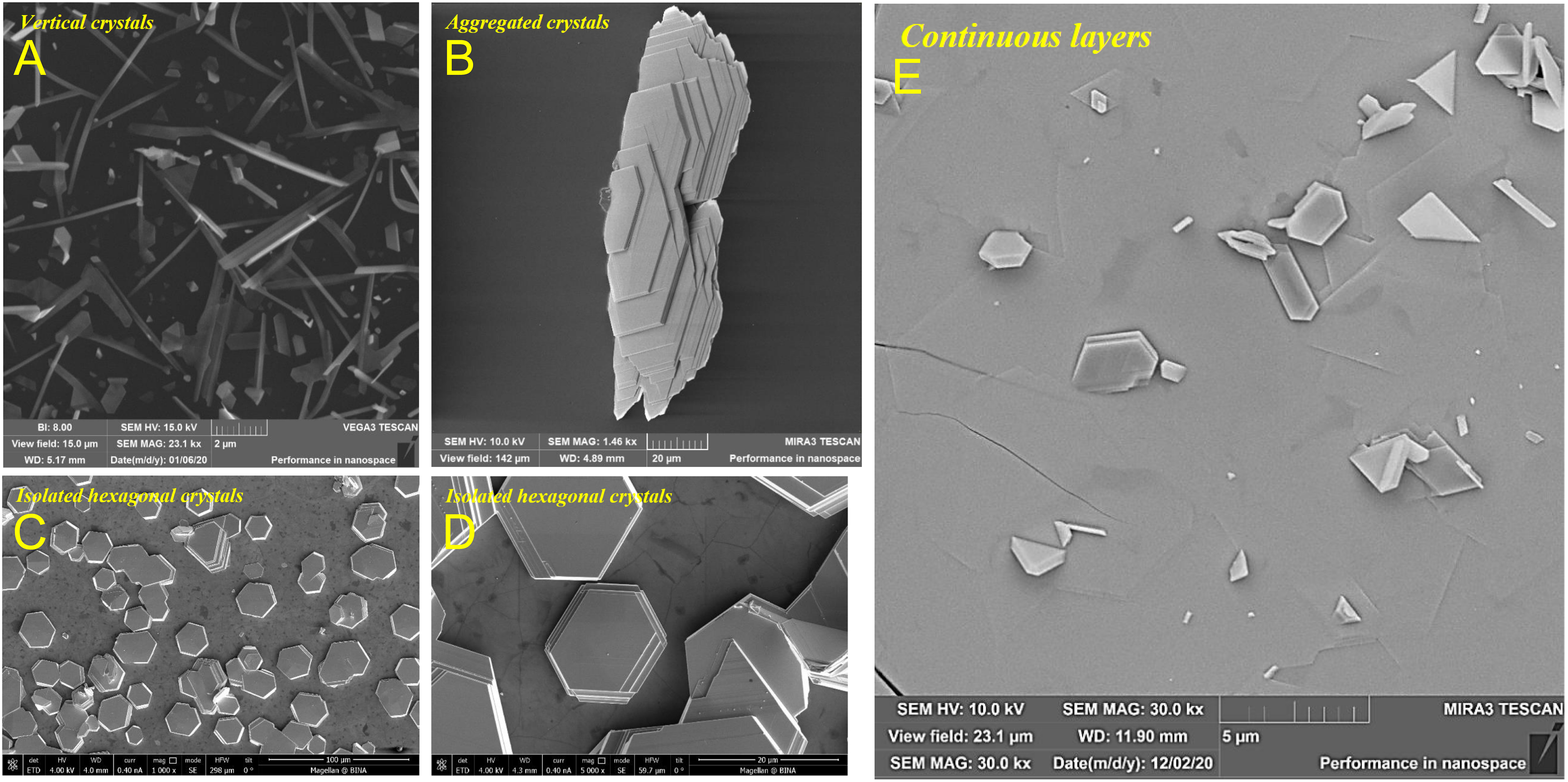
Figure 8. (A-E) SEM images of Bi2Se(3-x)Sx grown on different substrates. (A) Si/SiO2. (B) Sapphire. (C-E) Si/SiO2 covered with single-layer graphene after growth for (C) 60 min, (D) 120 min, and (E) 180 min, This figure is adapted with permission[68], Copyright © 2024 Royal Society of Chemistry.
Owing to its excellent film coverage, high uniformity, and relatively rapid growth rate, multi-precursor CVD has emerged as an important synthesis method for high-quality 2D topological materials. Other common examples include PtTe2[69], MoxW1-xTe2[70], Bi2-xSbxTe3-ySey[71], and (BixSb1-x)2Te3[72]. Furthermore, with improved control over film composition and structure, the CVD technique holds significant potential for future breakthroughs.
Mechanical exfoliation
The mechanical exfoliation method applies physical force to peel atomic layers from crystalline materials, thereby producing high-quality 2D materials. Common mechanical exfoliation techniques include dry grinding, dry ball milling, and tape exfoliation. Dry grinding and dry ball milling are generally unsuitable for producing high-quality 2D topological materials because the intense mechanical stresses can damage the crystal structure and provide limited control over the exfoliation process, often yielding small-sized and defective nanosheets. In recent years, more efficient tape exfoliation techniques, such as polymer-assisted exfoliation[73], metal-assisted exfoliation[74], and oxide-assisted exfoliation have been developed[75].
A study[73] prepared graphene using polyethyleneimine-assisted exfoliation, as shown in Figure 9A. The bonding energy between polyethyleneimine and graphene exceeded the interlayer exfoliation energy of graphite, enabling efficient exfoliation of layered graphite into graphene films. As shown in Figure 9B and C, analysis of the morphology and film dimensions revealed that the product exhibits good performance in terms of size, morphology, quality, and yield.
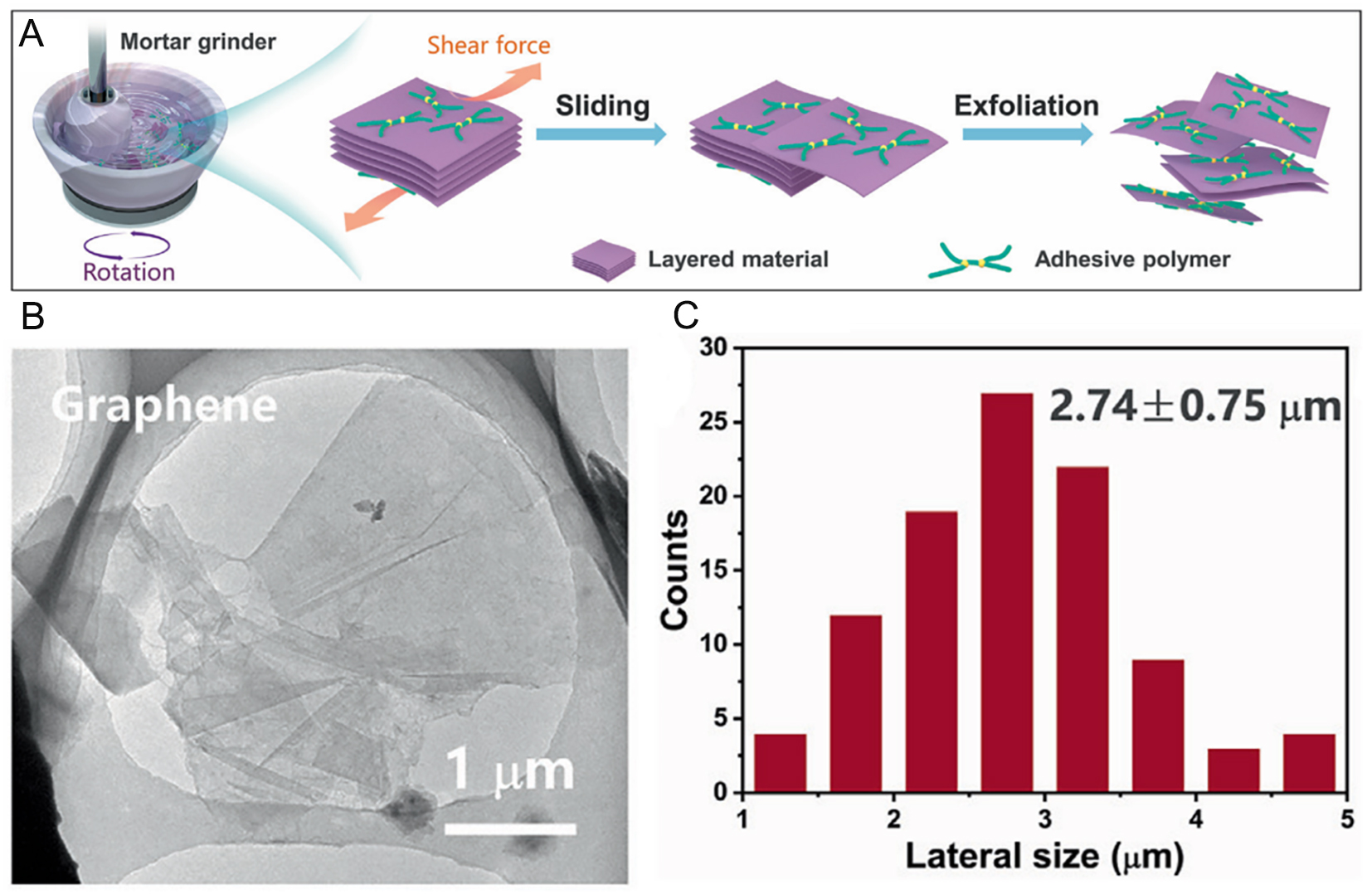
Figure 9. (A) Schematic process for producing graphene films. (B) TEM image of graphene. (C) Distribution of the detached graphene in the lateral dimension, This figure is adapted with permission[73], Copyright © 2021 Elsevier.
Another study[76] has revealed a method for preparing monolayer and few-layer MoTe2 and WTe2 films by introducing an Au film as an adhesion layer to assist in exfoliation. The morphology and structure of films were further analyzed. As shown in Figure 10A and B, the lighter-colored large areas were identified as monolayers, whereas slightly darker smaller areas were identified as bilayers. The effectiveness of an Au film in assisted exfoliation is attributed to the stronger Au-Te bond, which exceeds the interlayer van der Waals forces, enabling more efficient separation. Additionally, the Au film facilitates selective exfoliation, improving process controllability.
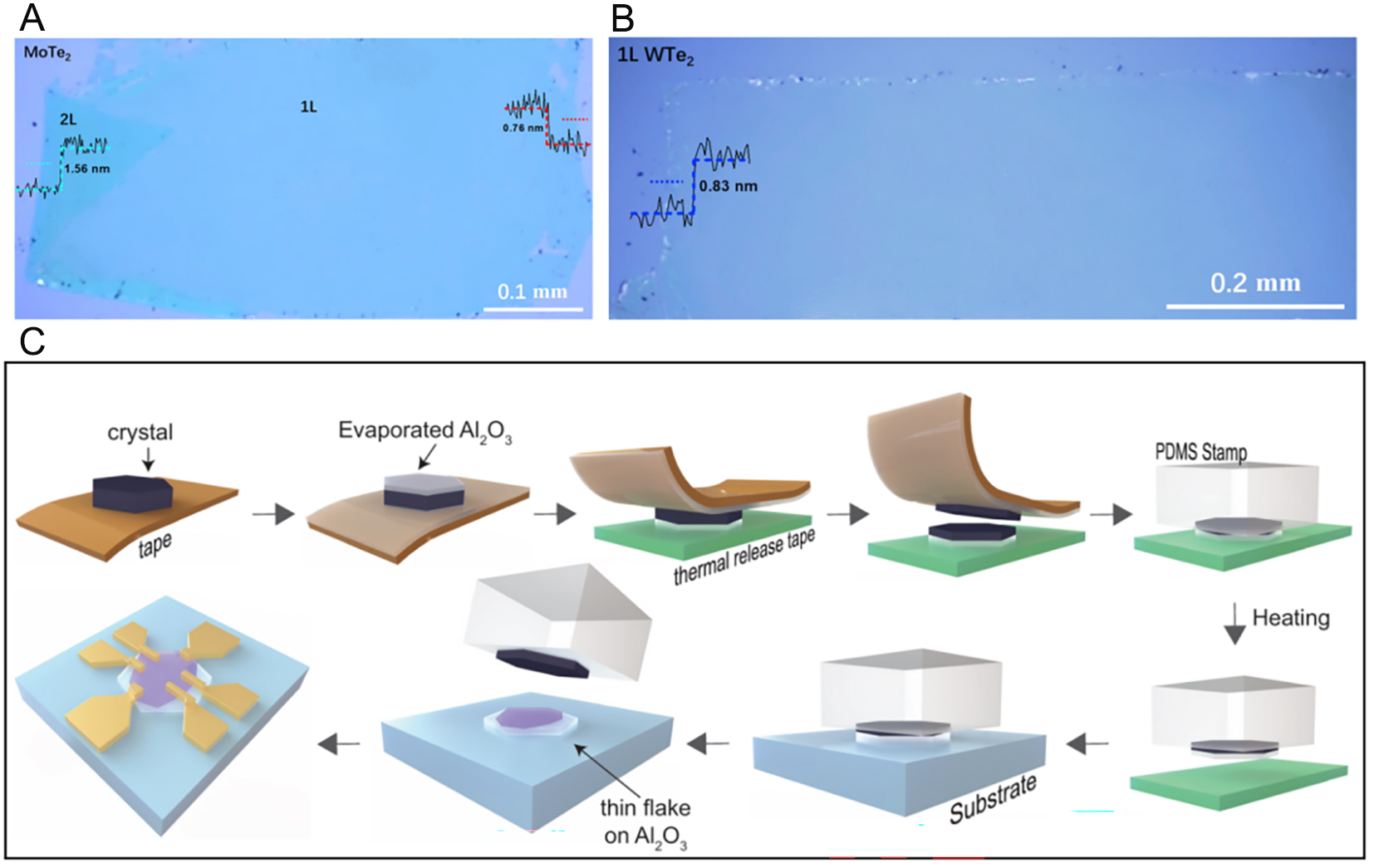
The oxide-assisted exfoliation method is similar to the aforementioned approaches, with the key difference being the use of an oxide layer as the stripping aid. Deng et al.[77] fabricated Fe3GeTe2 films using an Al2O3-assisted exfoliation method, as shown in Figure 10C. Similarly, Deng et al.[78] prepared MnBi2Te4 films through the Al2O3-assisted exfoliation technique.
Liquid-phase exfoliation method
Liquid-phase exfoliation involves dispersing layered bulk materials in suitable solvents and applying external energy, typically through ultrasonication, to overcome interlayer interactions and obtain single- or few-layer nanosheets. Surface energy matching is crucial during exfoliation, making solvent selection critical. Common solvents include N-methylpyrrolidone (NMP), isopropyl alcohol (IPA), and ethanol.
Sun et al.[79] successfully synthesized few-layer Bi2Se3 using NMP as the solvent through liquid-phase ultrasonic exfoliation, as shown in Figure 11A. In organic solvents, NMP has appropriate surface tension and plays a crucial role in detaching and stably dispersing bulk Bi2Se3 into nanosheets while preventing their reaggregation.
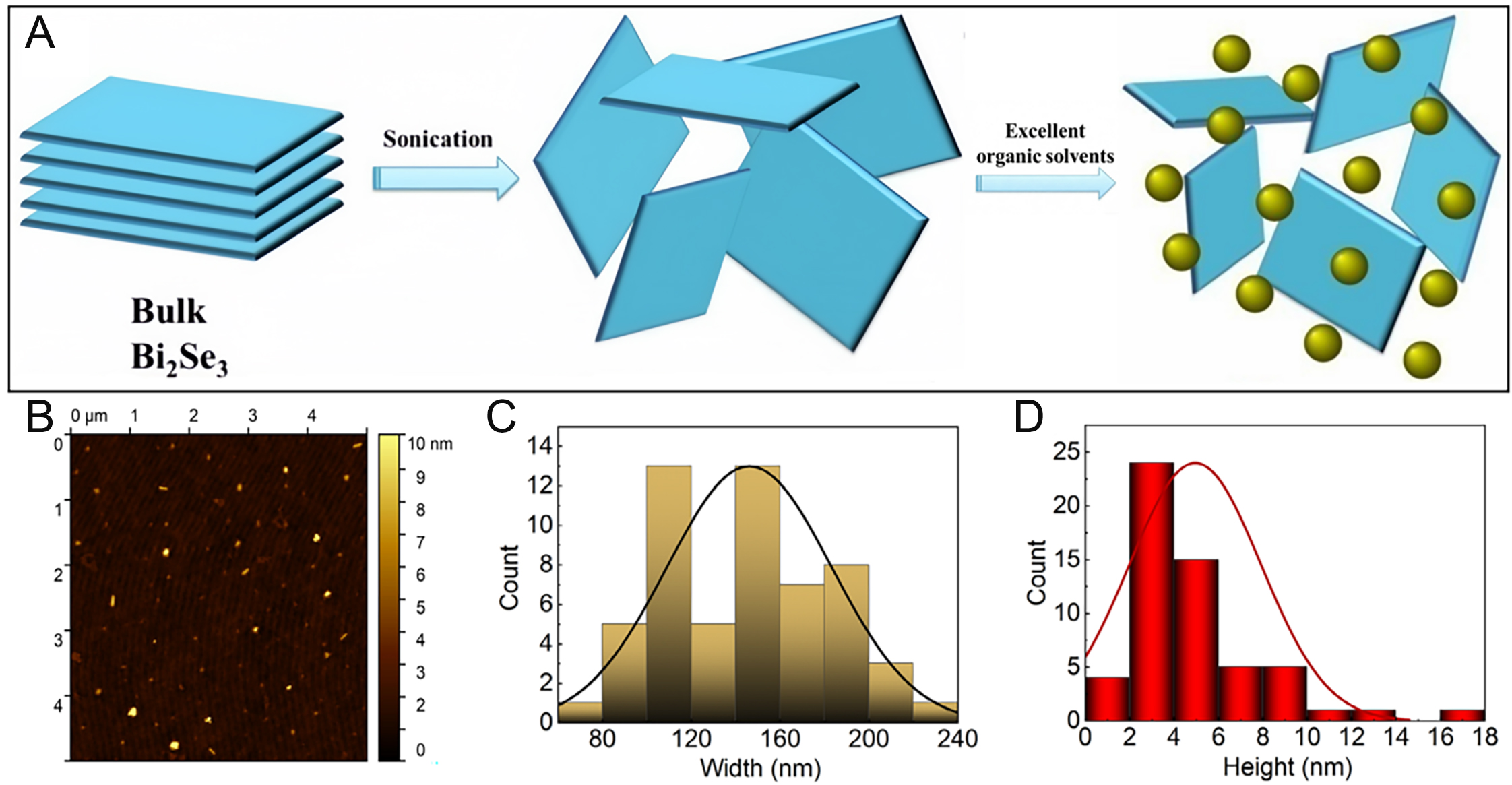
Figure 11. (A) Schematic diagram of preparing few-layer Bi2Se3 through liquid-phase ultrasonic exfoliation, adapted with permission[79], Copyright © 2014 Springer Nature. (B) AFM image and (C and D) statistical width and height of few-layer NiTe2, (B-D) are adapted with permission[80], Copyright © 2025 Wiley-VCH Verlag.
Isopropanol is a suitable solvent for preparing 2D topological materials through the liquid-phase exfoliation method. Goswami et al.[80] used isopropanol to synthesize few-layer NiTe2. As shown in Figure 11B-D, the dimensional statistics conducted on the width and thickness of flakes demonstrate the successful exfoliation of 2D NiTe2 flakes.
Yeon et al.[81] reported a liquid-phase ultrasonic exfoliation method for synthesizing graphene using sodium dodecyl sulfate (SDS) as a surfactant and a mixed ethanol-methanol solvent as the co-solvent. This approach enabled the production of high-quality graphene under mild and environmentally friendly conditions.
Electrochemical exfoliation method
Electrochemical exfoliation applies an external electric field to drive ions into layered bulk materials, weakening the interlayer forces and enabling efficient exfoliation. This method is mainly categorized into anodic and cathodic exfoliation. Anodic exfoliation generally promotes oxidation and introduces oxygen-containing functional groups, whereas cathodic exfoliation may induce defects. Due to the inherent stability of 2D topological materials, they exhibit low sensitivity to defects. However, surface oxidation and the introduction of oxygen-containing functional groups during anodic exfoliation can affect the quality of the exfoliated film, making cathodic exfoliation the preferred method.
WTe2 films have been successfully prepared through cathodic electrochemical exfoliation using a mixed cation system of diammonium salts (TPA+ and TMA+)[82]. As shown in Figure 12A, the mixed cations intercalate between the WTe2 layers, increasing the interlayer spacing and weakening the van der Waals forces between the layers. Subsequent ultrasonic treatment accelerates the exfoliation of WTe2 films. Similarly, Ma et al.[83] successfully prepared bilayer PtSe2 and PtTe2 films by intercalating tetraalkylammonium (TAA) cations into the interlayer space using organic electrolytes [Figure 12B and C].
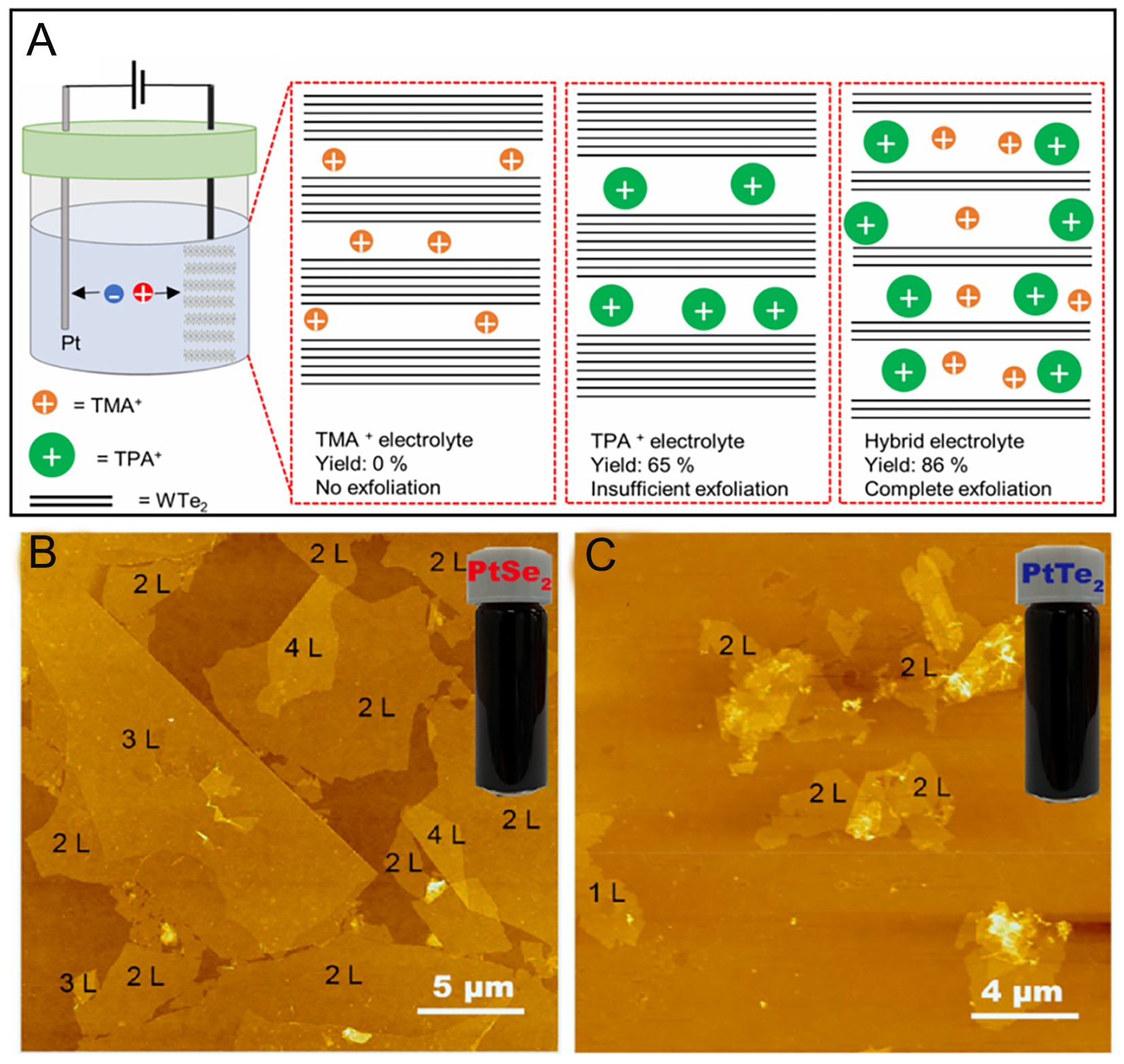
Figure 12. (A) Schematic diagram of the electrochemical exfoliation setup and WTe2 exfoliation with different electrolytes (TMA+, TPA+, and mixed type (TPA+-TMA+)), adapted with permission[82], Copyright © 2025 American Chemical Society. (B and C) AFM images of the exfoliated bilayer (B) PtSe2 and (C) PtTe2, (B and C) are adapted with permission[83], Copyright © 2021 American Chemical Society.
Cathodic electrochemical exfoliation can also be used to prepare other 2D topological materials, including Bi2Se3[84], Bi2Te3[85], and graphene[86]. Due to its efficient and gentle exfoliation mechanism, this method is widely used for preparing 2D topological materials. It offers excellent controllability and holds significant potential for functionalization and large-scale production.
As shown in Table 1, we summarize and compare the five methods discussed above. Each method has its advantages and limitations, and the most appropriate approach is selected based on the specific requirements of the 2D topological materials being prepared. Although numerous thin-film preparation techniques have been developed, new methods should be developed, and existing techniques should be improved. These advancements will improve product efficiency and quality and reduce costs.
Summary and comparison of five methods for the preparation of 2D topological materials
| Methods | Applicable materials | Key parameters | Advantages | Limitations |
| MBE | Bi2Se3, Sb2Te3[63] BiSbTe3[62] MnBi2Te4[58] and TaAs[64] | Substrate, temperature, and beam current ratio | High precision, high purity, strong, and controllable | High cost, slow growth rate, and small size |
| CVD | WTe2[67] PtTe2[69] and MoxW1-xTe2[70] | Precursors, temperature control, and growth time | High quality, large-area growth, and wide applicability | High temperature, and low purity, |
| Mechanical exfoliation | Graphene[75] MoTe2, WTe2[76] and Fe3GeTe2[77] | Number of peelings, peeling force, and speed | Simple operation, low cost, and high quality | Low yield and poor controllability |
| Liquid phase exfoliation | Bi2Se3[79] NiTe2[80] and graphene[81] | Solvent, ultrasonic power, and duration | Large-scale production and low cost | Low uniformity and defects |
| Electrochemical exfoliation | Bi2Se3[84] Bi2Te3[85] WTe2[82] PtSe2, and PtTe2[83] | Electrolytes, applied voltage, and current | High efficiency, good controllability, and low cost | Low purity, defects, and limited applicability |
2D TOPOLOGICAL MATERIALS AS ELECTROCATALYSTS
Electrocatalytic water splitting involves the HER and OER, both of which proceed through multiple elementary steps involving the adsorption, electrochemical transformation, and desorption of intermediates on the electrocatalyst surface. In this context, we outline the specific mechanism of water splitting, using the reaction under acidic conditions as an example.
Hydrogen evolution reaction:
Oxygen evolution reaction:
In the HER, adsorbed hydrogen atoms (H*) represent reaction intermediates. The first step involves the adsorption of hydrogen ions (H+) onto the active sites of the electrocatalyst through electrochemical adsorption, forming H*. Then, these H atoms combine with each other or with H+ and electrons (e-) to generate hydrogen gas. In the OER, hydroxyl (*OH), adsorbed oxygen atoms (*O), and peroxyhydroxyl
The topological electronic structures of 2D topological materials exhibit unique regulatory mechanisms in charge transfer, active site formation, adsorption behavior, and reaction pathways during HER and OER.
The topologically protected electronic states, including edge states, Dirac cones, Weyl nodes, and Fermi arc states, provide highly conductive channels for electron transport. These states can facilitate rapid charge migration between the electrode and catalytic surface and reduce interfacial charge-transfer resistance, thereby improving catalytic efficiency.
The unique electronic distributions near the Fermi level in 2D topological materials contribute to the formation of highly active catalytic sites. TESs usually exhibit localized electronic states and enhanced density of states (DOS), providing favorable sites for the adsorption and activation of reactants.
The catalytic activity of electrocatalysts is mainly influenced by the adsorption strength of reaction intermediates, such as H*, *OH, *O, and *OOH[89-92]. Topological electronic structures can regulate surface charge distribution and electronic states, thereby improving the interactions between active sites and intermediates. For HER, the electronic states near the Fermi level can effectively regulate the Gibbs free energy of hydrogen adsorption toward the optimal value, achieving a balance between hydrogen adsorption and desorption. For OER, the modified electronic structures provide appropriate adsorption energies for oxygen-containing intermediates, lowering reaction barriers and improving catalytic activity.
In addition to improving electron transport and intermediate adsorption, 2D topological materials can influence the reaction pathways of HER and OER by modifying surface electronic configurations. During HER, efficient electron transfer and optimized H* adsorption facilitate the Volmer step and the subsequent Heyrovsky or Tafel steps, thereby accelerating hydrogen generation. During OER, the regulated electronic structures facilitate the sequential transformation of *OH, *O, and *OOH intermediates, lowering kinetic barriers associated with oxygen evolution[93,94].
The enhanced electrocatalytic performance of 2D topological materials cannot be solely attributed to their topological electronic states. During exposure to air or electrochemical environments, surface oxidation, hydroxylation, structural defects, and edge dangling bonds can occur, which can generate additional catalytic active sites and regulate surface adsorption behavior. For example, defect-rich regions and undercoordinated edge atoms can provide favorable sites for the adsorption and activation of reaction intermediates, whereas surface oxygen-containing species may participate directly in catalytic processes or modify the local electronic structure. Therefore, the experimentally observed catalytic enhancement may be attributed to the synergistic contribution of intrinsic topological states and surface chemical effects. Distinguishing the specific contribution of topological properties from conventional catalytic factors remains challenging and requires advanced in situ characterization and theoretical calculations.
As discussed in the introduction, electrocatalytic performance is mainly influenced by several factors, including the characteristics of active sites, the adsorption and desorption energetics of reaction intermediates, and charge-transport properties. These factors are closely related to fundamental catalytic descriptors, such as Gibbs free energy[95,96], overpotential[97,98], Tafel slope[99,100], and exchange current density[101,102]. 2D topological materials with unique electronic structures, such as TESs, high-mobility charge carriers, and symmetry-protected Fermi arc states, provide new opportunities for developing advanced electrocatalysts. Meanwhile, their catalytic performance is affected by surface chemical environments, structural defects, and interface configurations. Therefore, understanding the synergistic contributions of intrinsic topological properties and extrinsic structural factors is crucial for the rational design of high-performance electrocatalysts based on 2D topological materials.
2D TIs as electrocatalysts
2D TIs have attracted considerable attention in electrocatalysis owing to their distinctive combination of bulk insulating properties and edge-conducting states. In recent years, researchers have focused on developing a range of 2D TIs as electrocatalysts for water splitting[103,104].
Doping 2D TIs with other 2D materials can enhance the catalytic performance of the resulting catalyst[105,106]. For pure 2D TIs, active sites are mainly confined to the edges. Doping with additional materials exposes more active sites, thereby increasing catalytic activity. Furthermore, this approach regulates the hydrogen adsorption free energy. Moreover, heterostructures formed by integrating 2D topological materials and other functional materials induce interfacial electronic reconstruction and charge redistribution, resulting in modified electronic structures with unique properties. This reconfigured electronic structure optimizes the adsorption and desorption energies of H* on the material surface, bringing the Gibbs free energy closer to zero.
Sujita et al.[105] investigated the enhanced performance of Bi2Te3 composites doped with bismuthene in the HER. They prepared Bi2Te3/bismuthene composites through liquid-phase exfoliation and solvothermal synthesis. As shown in Figure 13A and B, the microstructures reveal that the layered structure and high surface area of bismuthene facilitate the enhanced adsorption of hydrogen intermediates, while Bi2Te3 ensures excellent conductivity. Figure 13C presents the polarization curves of different materials at a scan rate of 5 mV/s. The calculated overpotentials revealed that the composite containing 10% bismuthene exhibited the lowest overpotential of 119 mV vs. SHE. This result confirms that the addition of bismuthene effectively enhances the catalytic active sites in Bi2Te3.
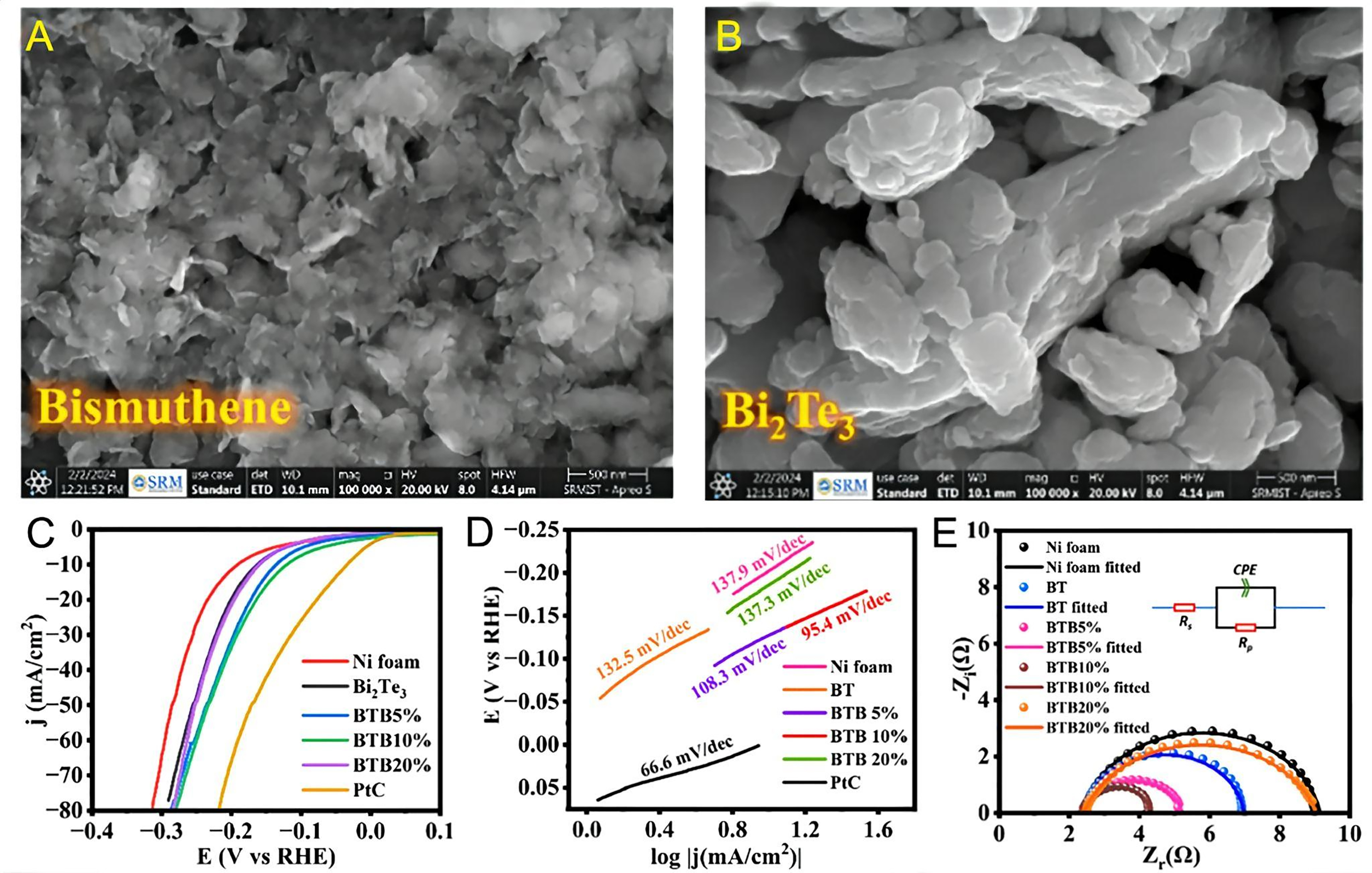
Figure 13. (A and B) FE-SEM images of bismuthene and Bi2Te3. (C) Polarization curves, (D) Tafel plots, and (E) Nyquist plots of different materials, This figure is adapted with permission[105], Copyright © 2024 Elsevier.
The kinetic process of water splitting can be characterized using the Tafel slope. Figure 13D shows the Tafel curves for different materials, along with the corresponding Tafel slopes. The curves reveal that the composite material containing 10% bismuthene exhibits the lowest Tafel slope of 95.4 mV/dec. As shown in Figure 13E, the 10% bismuthene composite exhibits the lowest charge transfer resistance (Rct)[105]. Doping bismuthene into Bi2Te3 increases active sites at the material edges while optimizing the adsorption and desorption of H* at the surface. The synergistic effect of these two factors improves the catalytic performance.
2D TIs can also serve as additives or substrates for other electrocatalysts. For example, Yang et al.[106] reported that Bi2Se3, acting as a conductive substrate, exhibited exceptional electronic dynamics and stability by uniformly growing MoSe2 nanosheets onto monolayer Bi2Se3 hexagonal flakes[107,108]. They further analyzed the morphology and electrochemical performance of the composite material. The results showed that Bi2Se3 doping significantly enhanced the conductivity and charge transfer capacity of the material, promoting synergistic interactions between the two components. These interactions increased the catalytic activity of the relatively inactive MoSe2 surface, improving the adsorption and desorption of H* and water-splitting efficiency. Furthermore, MoSe2 grew vertically in an ultrathin and small-sized form on the Bi2Se3 substrate, exposing more active sites on the MoSe2 surface. The topological stability of Bi2Se3 prevents the collapse of the structure, thereby significantly extending its lifetime.
The development of novel 2D TIs for electrocatalytic water splitting has received considerable attention. 2D metal-organic frameworks (MOFs) have emerged as a new class of hybrid organic materials. Studies have shown that 2D MOFs exhibit characteristics similar to TIs, including strong spin coupling, TESs, and a substantial topological energy gap[109-111]. Owing to their high porosity, tunable metallic nodes, and multifunctional organic ligands, 2D MOFs have gained widespread application in electrocatalytic water splitting. Their catalytic performance can be further enhanced through various modification strategies, including 2D MOF nanosheet fabrication[112,113], defect engineering[114,115], heteroatom doping[116,117], and ligand engineering[118,119].
Sattigeri et al.[120] converted 2D LiMgAs from an ordinary insulator into a TI through biaxial compressive stress. As shown in Figure 14A and B, they constructed structures with zig-zag and planar edges to investigate their edge states and catalytic properties. The most active sites on the zig-zag edge were identified as the atomic As top site and Li-As bridge site, while the active sites on the planar edge were identified as the Li top site and As top site. The Gibbs free energies of these sites under SOC were analyzed. The results revealed ΔGH* values of -0.024 and -0.02 eV for the zig-zag As and Li-As sites, respectively, which are very close to the ideal value of 0 eV. Similarly, the planar Li and As sites exhibited ΔGH* values of 0.026 and
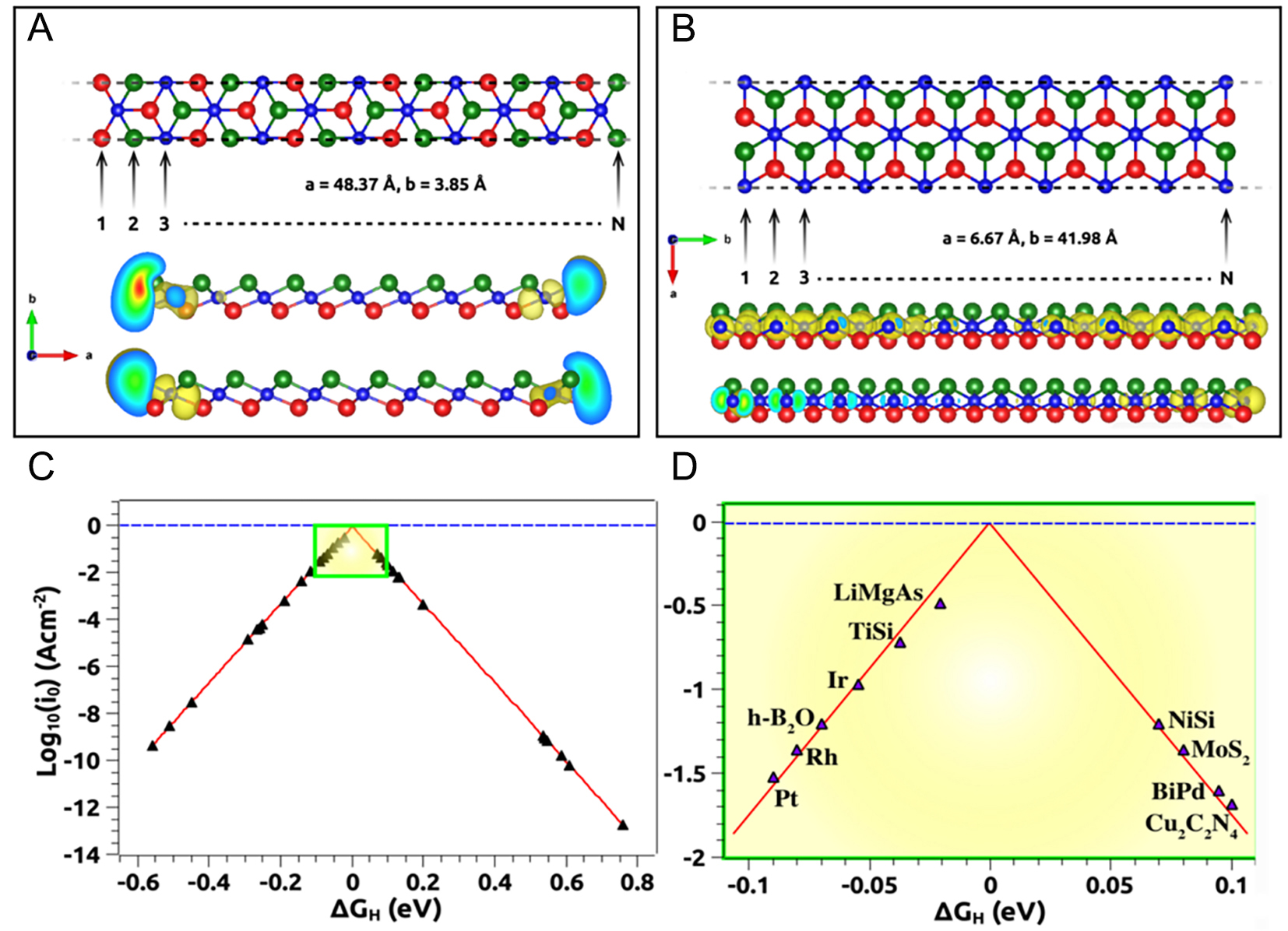
Figure 14. (A and B) 2D LiMgAs nanoribbons with (A) zig-zag edges and (B) planar edges. (C and D) Comparison of volcano plots of the exchange current and Gibbs free energy, This figure is adapted with permission[120], Copyright © 2022 American Institute of Physics.
Wang et al.[121] reported a novel 2D organometallic material, Ni3(CNH)12, which exhibited both TI properties and highly efficient bifunctional electrocatalytic performance. This material features four potential adsorption sites at its edges: Ni-top, N-top, C-top, and hole-top. As shown in Figure 15A-C, the C-top site is optimal for OER with an overpotential of 0.95 V, whereas the N-top site is optimal for HER with an overpotential of 0.31 V. Furthermore, the effect of hydrogen coverage on hydrogen evolution efficiency was investigated. By varying hydrogen coverage on the N-top sites within the range of α = 1/12 to α = 1, it was found that the hydrogen adsorption free energy reached 0.1 eV at α = 1/3 [Figure 15D], indicating performance comparable to Pt catalysts.
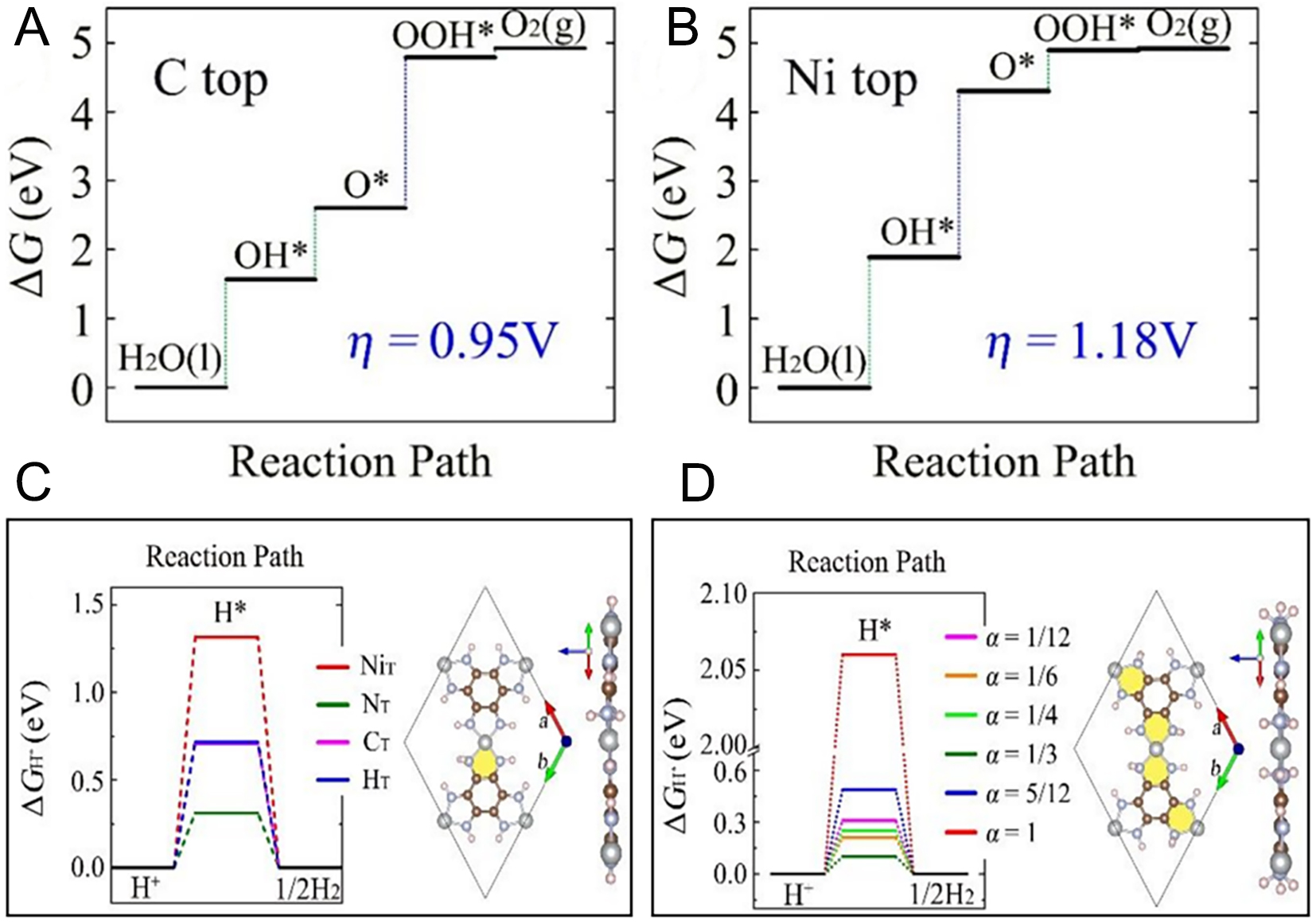
Figure 15. (A and B) OER free energy diagrams of Ni3(CNH)12 for (A) the C-top and (B) the Ni-top positions. (C and D) HER free energy steps of (C) different top positions and (D) various hydrogen coverages, This figure is adapted with permission[121], Copyright © 2020 American Chemical Society.
Although 2D TIs have demonstrated considerable potential for electrocatalytic water splitting, current studies mainly focus on improving catalytic performance through structural engineering rather than developing intrinsic catalytic systems. Studies have shown that heterostructure construction and exfoliation methods can effectively increase exposed active sites and promote charge transfer, as demonstrated in Bi2Te3-based and Bi2Se3-based materials[105,106]. However, the catalytic performance of 2D TIs remains highly dependent on surface modification and interface regulation. Future research should focus on precise control of surface structures, optimization of interfacial interactions, and development of scalable preparation methods to further improve their practical applicability.
2D DSMs as electrocatalysts
In electrocatalytic water splitting, catalytically active sites are crucial because they strongly influence the adsorption of water molecules and the formation and binding of H* intermediates. 2D TIs, with their conductive edges, exclusively confine active sites to these edges. Although incorporating other materials[122,123] and optimizing edge structures[120,124] to expose additional sites have been explored, these methods still significantly limit catalytic activity. In contrast, 2D TSMs exhibit excellent conductivity both in the bulk and along the edges, thus maximizing the availability of active sites[125]. Additionally, the massless, dissipation-free fermions in 2D TSMs provide exceptional mobility, thereby attracting significant attention to 2D TSMs.
2D DSMs, as prototypical examples of 2D TSMs, have been extensively used in electrocatalytic water splitting. In recent years, researchers have enhanced catalytic performance by optimizing the electronic structure of these materials[126,127] and developing novel material compositions[128,129].
Wang et al.[130] proposed a 2D WB4 lattice material exhibiting multiple Dirac cones near the Fermi level [Figure 16A and B]. These Dirac cones were generated from d-p-π and d-p-σ hybridization between the d orbitals of tungsten (W) and the p orbitals of boron (B). Electrons near the Dirac cones exhibited high Fermi velocities (0.72 × 10⁶ m/s). Experiments revealed the B-B bridging site as the most stable hydrogen adsorption site [Figure 16C]. Additionally, the study revealed that stretching the material increased the number of active sites. The catalytic activity of WB4 is closely related to the position of the d-band center of W. Consequently, the tensile strain modulated the d-band center by altering the orbital coupling between B and W, shifting the d-band center downward, and weakening the adsorption strength between the active site and H*. As shown in Figure 16D, at 3% tensile strain, the Gibbs free energy approached the ideal value (0 eV). The effect of hydrogen coverage on Gibbs free energy was also investigated [Figure 16E]. The results showed that the optimal Gibbs free energy (0.02 eV) occurred at a coverage of 1/3.
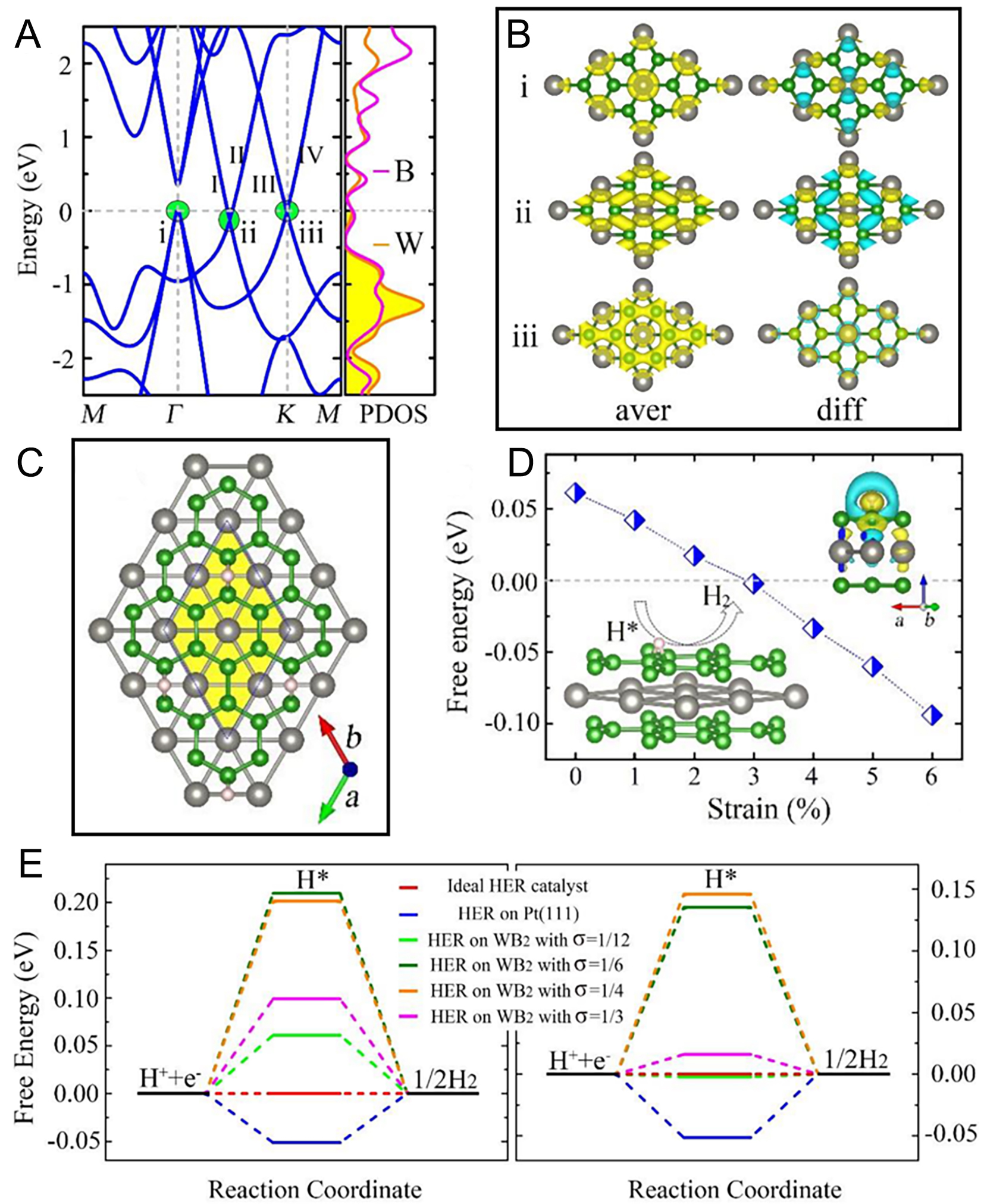
Figure 16. (A) Electronic band structure and corresponding electron state density of WB4. (B) The Kohn-Sham wave function isosurfaces of the Dirac points listed in (A). (C) Schematic diagram of hydrogen atom adsorption. (D) Gibbs free energy of HER under different strain conditions. (E) Gibbs free energy of WB4 with 3% tensile strain under different hydrogen coverage, This figure is adapted with permission[130], Copyright © 2019 Royal Society of Chemistry.
The growth mode of materials can significantly influence the exposure of catalytic active sites. Catalysts grown on planar substrates mainly confine most active sites to their edges. In contrast, catalysts grown in a 3D mode can provide numerous exposed active sites[131,132]. Fu et al.[133] reported the 3D growth of PtTe2 nanosheets on conductive carbon cloth through atmospheric pressure CVD. The PtTe2 nanosheets increased the surface area, improved active site utilization, optimized the electron transport pathways, and significantly enhanced the electron mobility. In addition, they revealed the thickness-dependent effects on catalytic activity. By adjusting the loading of the PtCl2 precursor, the thickness of PtTe2 nanosheets was controllably varied from 3 nm to bulk-like (> 12 nm) [Figure 17A-C]. When the thickness of PtTe2 nanosheets increased from 3.0 to 7.5 nm, the overpotential decreased from 65.6 to 38.8 mV, and the Tafel slope decreased from 95.8 to 59.2 mV/dec [Figure 17D and E]. Beyond a thickness of 7.5 nm, further increases in thickness slightly affected catalytic activity, indicating a slight increase in active sites.
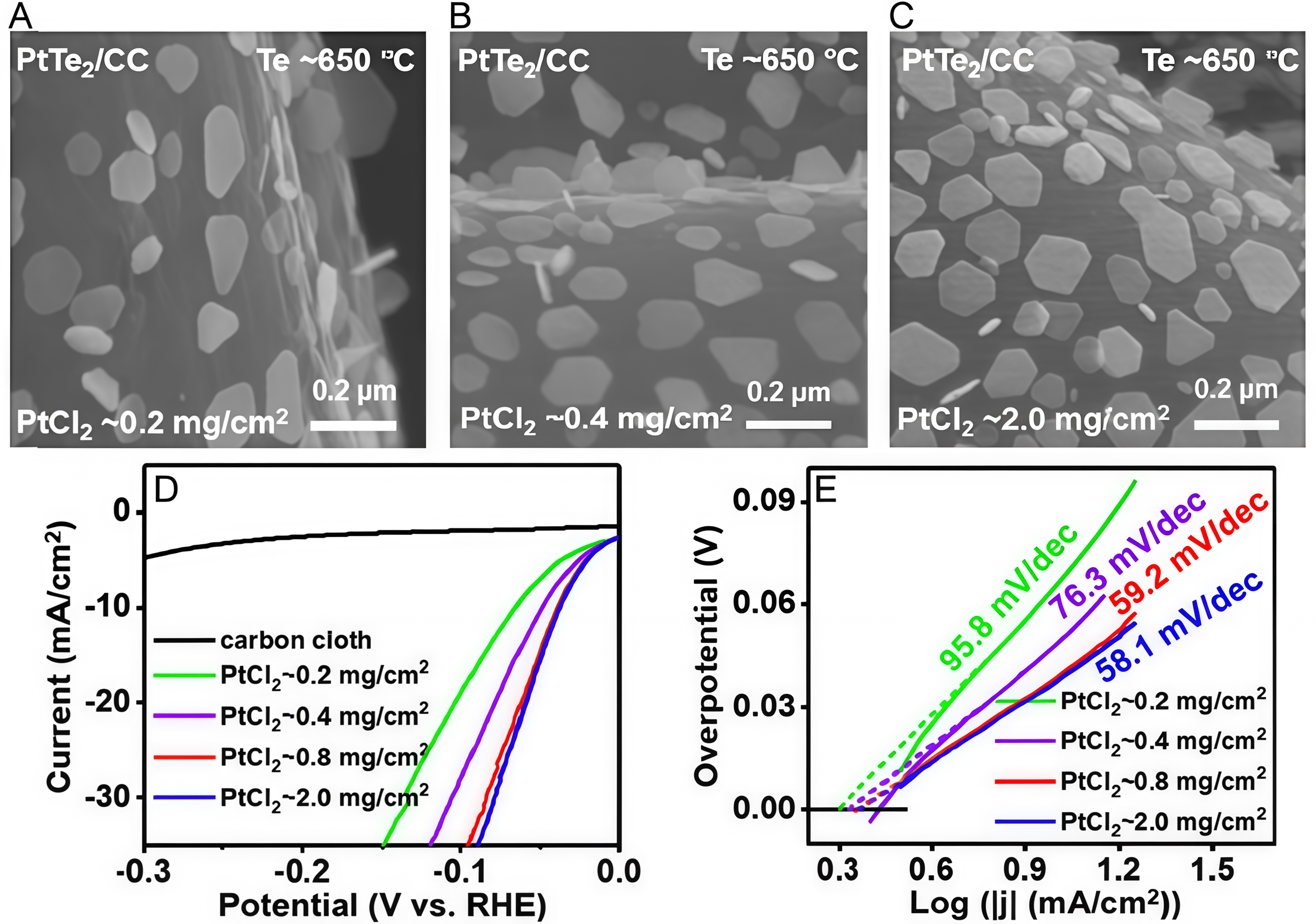
Figure 17. (A-C) PtTe2 nanosheets with a thickness of (A) 3.0 nm, (B) 5.0 nm, and (C) greater than 12 nm. (D) Polarization curves and (E) Tafel curves of PtTe2 nanosheets with different thicknesses, This figure is adapted with permission[133], Copyright © 2025 Royal Society of Chemistry.
The pH value influences catalytic performance, and reaction processes vary under acidic, alkaline, and neutral conditions[134,135]. The adsorption and desorption behaviors of catalysts toward different ions or molecules vary with the solution pH due to changes in the surface charge state and interfacial interactions. Therefore, achieving efficient catalysis across the entire pH range is challenging. Shi et al.[134] synthesized 1T-NiTe2 through CVD and evaluated its catalytic performance in the HER. The results showed that 1T-NiTe2 exhibited high activity under both acidic and alkaline conditions. Under acidic conditions (0.5 M H2SO4), the catalyst achieved a minimum overpotential of 353 mV and Tafel slopes of approximately 33-41 mV/dec, approaching those of commercial Pt-on-carbon catalysts (31 mV/dec). The charge transfer resistance was also low, ranging from 12 to 16 Ω. Under alkaline conditions (1 M KOH), the overpotential remained low (353-390 mV), and the Tafel slope (62-82 mV/dec) remained modest, with the charge transfer resistance at an extremely low level of 15-22 Ω.
The effects of synthesis methods on the electrocatalytic properties of 2D DSMs have been investigated in PtTe2 and NiTe2 systems. For PtTe2, CVD growth enables the formation of high-quality thin films with well-defined crystalline structures and excellent electrical conductivity, facilitating efficient charge transport and providing a stable platform for electrocatalytic water splitting[133]. In contrast, electrochemical exfoliation can produce ultrathin PtTe2 layers with reduced thickness and increased surface accessibility, thus exposing more active sites for catalytic reactions[83]. Similarly, CVD-prepared NiTe2 generally exhibits uniform morphology, high crystallinity, and strong electrical connectivity, contributing to enhanced electron transfer and structural stability during electrochemical operation[134]. Liquid-phase exfoliation generates thinner NiTe2 nanosheets with larger surface areas and abundant exposed edge sites than CVD-grown NiTe2. These larger surface areas and abundant exposed edge sites enhance electrolyte accessibility and catalytic active site utilization[80]. These examples demonstrate that the selection of synthesis strategies, including CVD growth and different exfoliation approaches, plays a pivotal role in regulating the structural characteristics, surface properties, and electrochemical behavior of PtTe2 and NiTe2, thereby influencing their performance in water splitting applications.
In a separate study, Wang et al.[135] successfully synthesized high-purity MoP2 nanosheets and evaluated their HER catalytic performance under neutral and acidic conditions. As shown in Figure 18A-D, under neutral conditions (1.0 M phosphate buffer solution), the onset overpotential and Tafel slope were 193 mV and 82.2 mV/dec, respectively. Under acidic conditions (0.5 M H2SO4), the onset overpotential and Tafel slope were 170 mV and
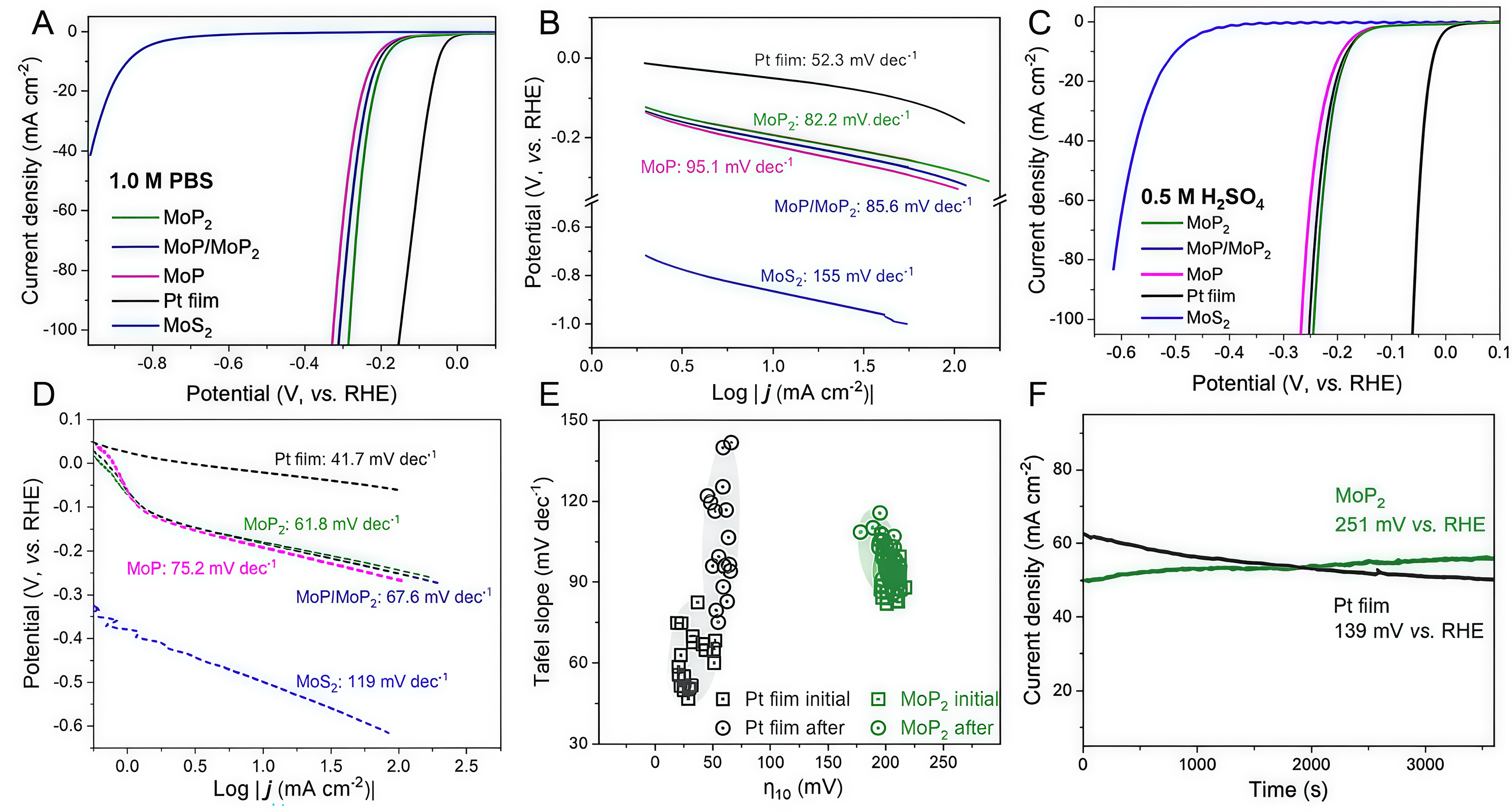
Figure 18. (A-D) Electrochemical HER measurements of MoP, MoP2, and Pt under (A and B) neutral and (C and D) acidic conditions. (E) Overpotential at 10 mA cm-2 (η10) and Tafel slope of multiple Pt films and MoP2 nanosheets before and after 5 HER cycling tests. (F) Stability tests of MoP2 and Pt, This figure is adapted with permission[135], Copyright © 2025 Wiley-VCH Verlag.
The studies on 2D DSMs reveal that these materials possess considerable advantages in electrocatalysis owing to their high electrical conductivity and flexible electronic structures. Various strategies, including phase engineering, defect regulation, and composition optimization, have been applied to improve catalytic activity, as observed in PtTe2, NiTe2, and MoP2 systems. However, current studies mainly focus on HER performance, while their application in overall water splitting and OER remains relatively limited. Future studies should expand the application range of DSMs by exploring multifunctional catalysts and rationally designing electrode architectures for efficient and durable water electrolysis.
2D WSMs as electrocatalysts
The edge states of 2D WSMs feature Fermi arcs that connect Weyl points in momentum space. These edge Fermi arcs expose additional active sites at the boundary. Moreover, the unique nature of edge Fermi arcs provides enhanced tunability of electronic structures and improved flexibility in material design[136,137].
Recent studies have shown that magnetic interactions significantly influence the HER rates[138,139]. Applying an external magnetic field can accelerate reaction kinetics by regulating charge transfer and spin-related effects. However, its practical implementation for improving electrocatalytic performance remains limited. Notably, when non-trivial band topology coexists with 2D magnetic materials, the resulting 2D magnetic topological materials exhibit unique properties[140,141]. The coexistence of intrinsic magnetism and non-trivial topological energy structures makes the resulting materials highly suitable for electrocatalysis applications.
Liu et al.[142] reported monolayer Fe₂Sn as a 2D ferromagnetic Weyl semimetal and systematically investigated the effect of spin polarization on HER activity through density functional theory (DFT) calculations. As shown in Figure 19A, the Fe2Sn monolayer with spin polarization exhibited a ΔGH* of -0.06 eV at the Fe-Fe bridge site, while the layer without spin polarization exhibited a ΔGH* of -1.27 eV. This difference indicates excessively strong hydrogen adsorption and poor activity in the absence of spin polarization. Spin polarization enhances the electron transfer into the antibonding orbital of the hydrogen atom, substantially filling the antibonding state. This effect weakens the Fe-H chemical bond, thereby moderating hydrogen adsorption strength and significantly improving HER activity [Figure 19B].
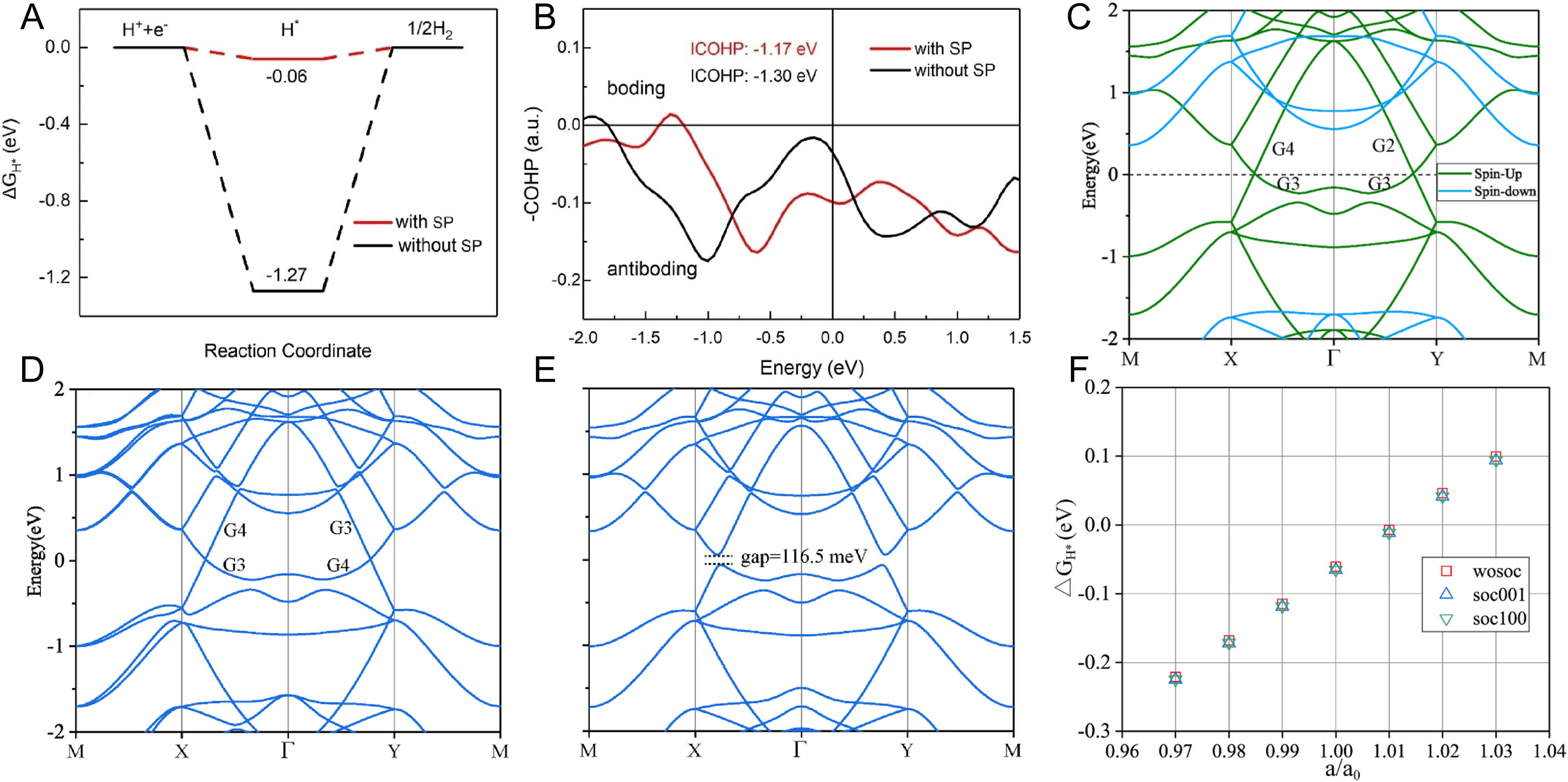
Figure 19. (A) Calculated ΔGH* values at the Fe-Fe bridge sites. (B) Crystal orbital Hamiltonian populations (COHPs) of the Fe2Sn monolayer with/without spin polarization (SP), (A and B) are adapted with permission[142], Copyright © 2024 Wiley-VCH Verlag. (C) Calculated band structure of the TiTe monolayer without spin-orbit coupling (SOC). (D and E) Considering SOC with the magnetization direction along (D) the x-axis and (E) the z-axis, respectively. (F) ΔGH* of TiTe monolayer under biaxial strain, (C-F) are adapted with permission[143], Copyright © 2025 IOP Publishing Ltd.
Wang et al.[143] investigated the effects of different magnetization directions on the topological states and HER catalytic performance of single-layer TiTe. As shown in Figure 19C-E, without SOC, the single-layer TiTe material exhibits Weyl semimetallic behavior. When SOC is considered, the material remains a Weyl semimetal with magnetization along the x-axis but transforms into a semi-Chern insulator with magnetization along the z-axis. They further investigated the effect of strain on the HER activity for the TiTe monolayer [Figure 19F]. Under -3% to 3% biaxial strain, ∆GH∗ varied almost linearly, indicating possible manipulation of HER activity through strain engineering. Moreover, the magnetization direction along the x or z axis slightly affects ∆GH∗, indicating the excellent HER performance of TiTe regardless of magnetization direction, although it can induce a topological phase transition in TiTe between semimetal and insulator states.
WTe2 is an important type II Weyl semimetal, but conventional preparation methods face challenges in scaling the growth of 2D WTe2 films. Li et al.[144] developed a combined hydrothermal and CVD method to prepare highly crystalline 1T'-WTe2 nanoribbons. Additionally, they investigated the HER catalytic performance of the prepared nanoribbons. As shown in Figure 20A and B, 1T'-WTe2 exhibits an overpotential of 430 mV and a Tafel slope of 57 mV/dec. As depicted in Figure 20C and D, the polarization curves of 1T'-WTe2 nanoribbons showed slight decay after 5,000 cyclic voltammetry cycles and a 20-h constant-current test, indicating exceptional stability.
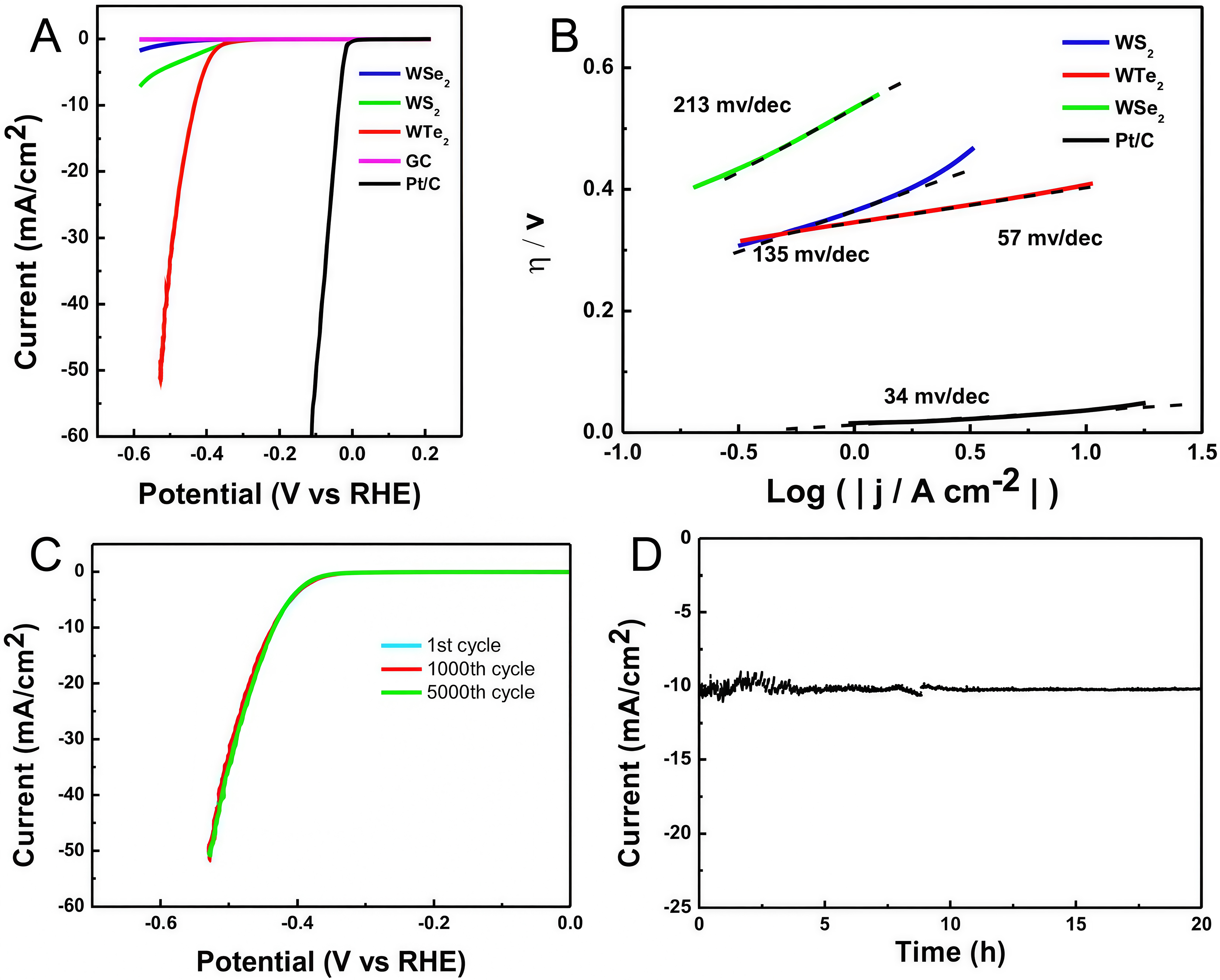
Figure 20. (A) Polarization curve and (B) Tafel slope of 1T'-WTe2. (C) Comparison of polarization curves after 1, 1,000, and 5,000 cyclic voltammetry tests. (D) Long-term current test, This figure is adapted with permission[144], Copyright © 2018 American Chemical Society.
Different synthesis strategies can induce distinct structural features and surface properties, thereby influencing the catalytic performance of WTe2. For example, CVD-prepared WTe2 films[67] generally exhibit high crystallinity, uniform thickness, and strong adhesion to substrates, thereby enhancing charge transfer and long-term structural stability during electrochemical processes. In contrast, WTe2 nanosheets prepared through electrochemical exfoliation[82] exhibit reduced thickness, larger specific surface area, and abundant exposed edge sites, providing more accessible catalytic sites for water-splitting reactions. However, their structural stability may be relatively limited. Furthermore, combining hydrothermal-assisted synthesis with CVD enables the fabrication of multilayer WTe2 with optimized morphology and enhanced electrode compatibility[144]. These results show that rational selection of synthesis methods is crucial for balancing active site exposure, charge-transfer capability, and operational stability, which ultimately determines the applicability of WTe2 in practical electrocatalytic water-splitting applications.
MoTe2 is a transition-metal dichalcogenide material with strongly phase-dependent electronic properties. 2H-MoTe2[145,146] exhibits semiconductor behavior, 1T′-MoTe2[147,148] exhibits Weyl semimetallic properties, and Td-MoTe2[149,150] exhibits superconductivity. In a recent study[151], various MoTe2 phases, including F-1T′-MoTe2, F-1T′/2H-MoTe2, P-1T′-MoTe2, SG-1T′-MoTe2, and LG-1T′-MoTe2, were grown on carbon cloth through CVD, and their electrocatalytic performance was compared [Figure 21A]. The results showed that 1T′-MoTe2 exhibited the lowest overpotential, the lowest Tafel slope, and the highest stability. As shown in Figure 21B and C, DFT calculations show that the hydrogen adsorption free energy of Mo atomic sites at the edges of the 1T′ phase is closer to zero than that in the 2H phase. Additionally, as illustrated in Figure 21D-F, the strain and defects increase the number of active sites, thereby improving the catalytic performance.
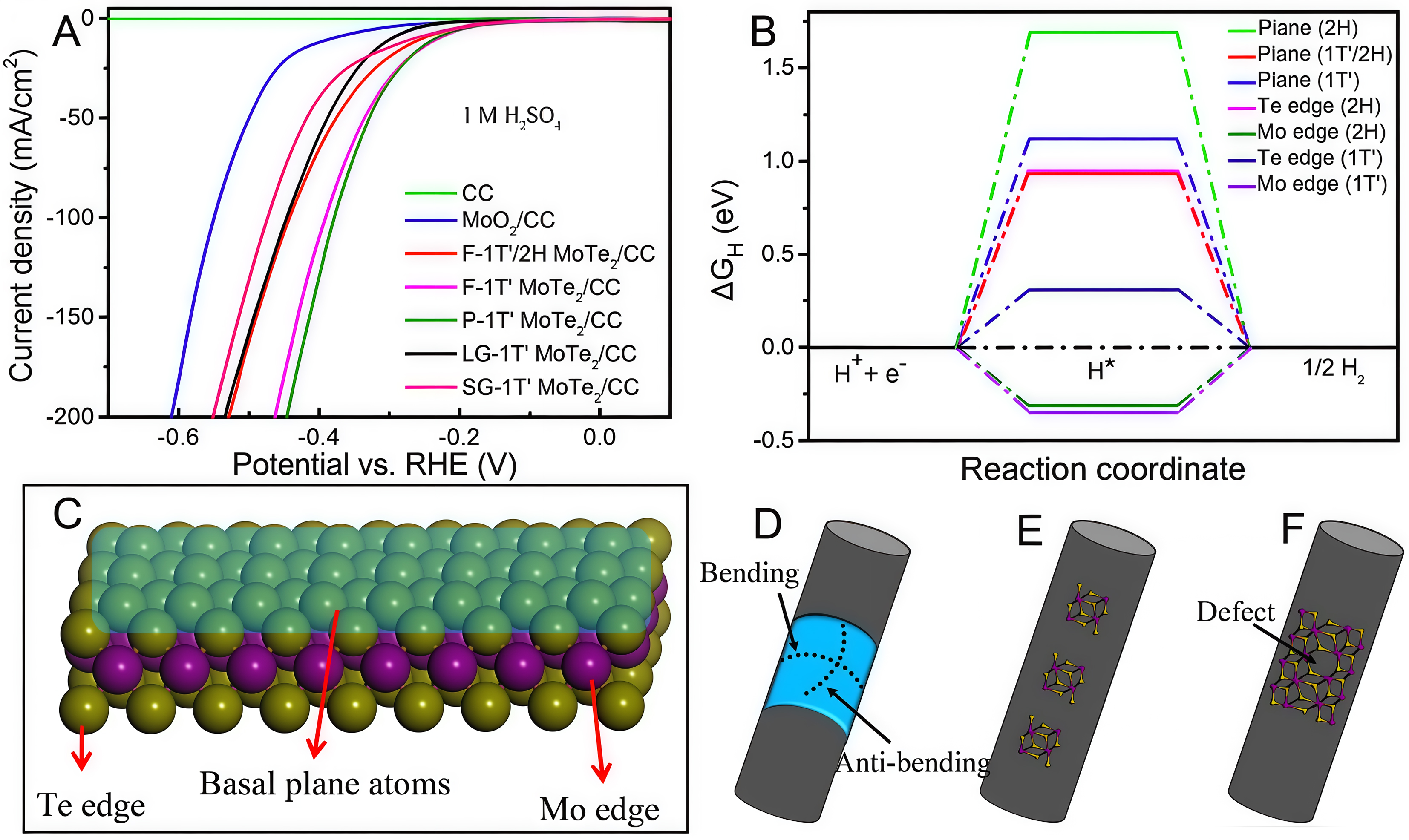
Figure 21. (A) Polarization curves of different forms of 1T′-MoTe2. (B) Free energy of hydrogen adsorption for 2H-MoTe2, 1T′/2H-MoTe2, and 1T′-MoTe2. (C) Schematic diagram of the catalytic active sites of F-1T′-MoTe2. (D-F) Schematic diagram for the morphology variation of F-1T′-MoTe2, This figure is adapted with permission[151], Copyright © 2020 American Chemical Society.
Compared with 2D TIs and 2D DSMs, the electrocatalytic research on 2D WSMs remains in an early stage. Existing studies mainly focus on representative materials, such as 1T′-WTe2 and 1T′-MoTe2[144,151], in which high carrier mobility and structural flexibility improve catalytic performance. However, the limited availability of experimentally realizable Weyl semimetal materials and the challenge of achieving high-quality thin-film growth restrict their further development. Future research should prioritize the exploration of new experimentally realizable Weyl systems, optimization of synthesis processes, and integration of WSMs into practical electrode configurations.
2D NLSMs as electrocatalysts
Electronic states near Dirac or Weyl points can exhibit approximately isotropic dispersion. In contrast, the closed nodal line structure exhibits anisotropic electron properties near the nodal lines, which are influenced by direction. This anisotropy may cause different crystal orientations or positions at the material edges to exhibit distinct catalytic activities, thereby enhancing catalytic performance[152,153]. Furthermore, this unique nodal line structure can provide the material with greater tunability[154,155].
Studies have shown a correlation between the position of the nodal line relative to the Fermi level (EF) and catalytic activity. Wang et al.[156] conducted DFT calculations to investigate the electrocatalytic properties of the 2D NLSM Cu2Si monolayer. The results showed that the ΔGH* value of the Cu2Si monolayer was 0.195 eV, and the difference between EF and the HER standard potential was approximately 0.33 eV
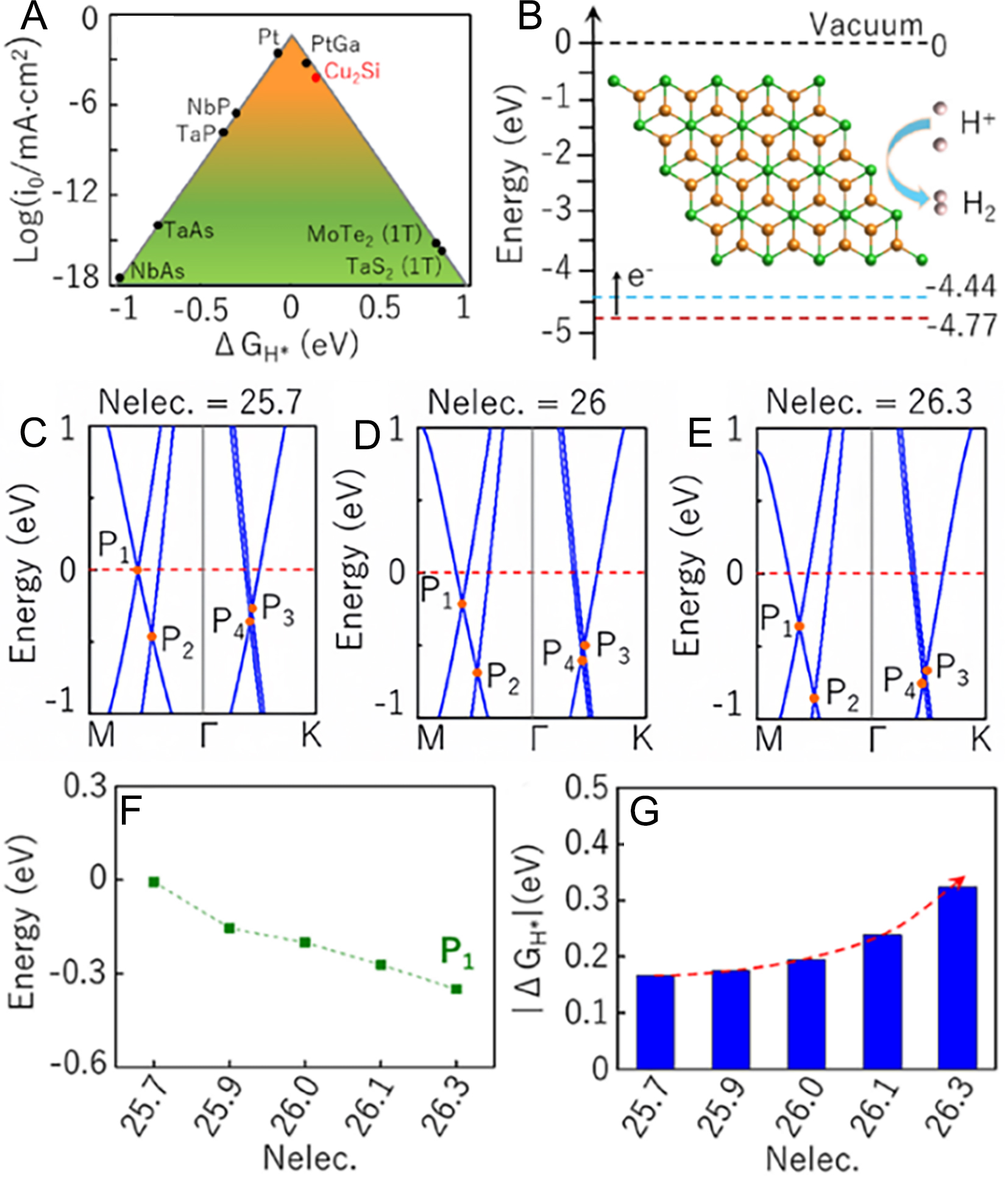
Figure 22. (A) ΔGH* of the Cu2Si monolayer compared with that of other materials. (B) Comparison of Fermi level and HER standard potential. (C-E) Band structures under different electron doping. (F and G) Relationship between the position of the nodal lines (relative to the Fermi level) and ΔGH*, This figure is adapted with permission[156], Copyright © 2023 American Chemical Society.
In another study, Gao et al.[159] investigated the theoretical performance of PtB2 monolayers as HER catalysts. The results showed that ΔGH* at the B site was as low as 0.057 eV in the unstrained pristine state
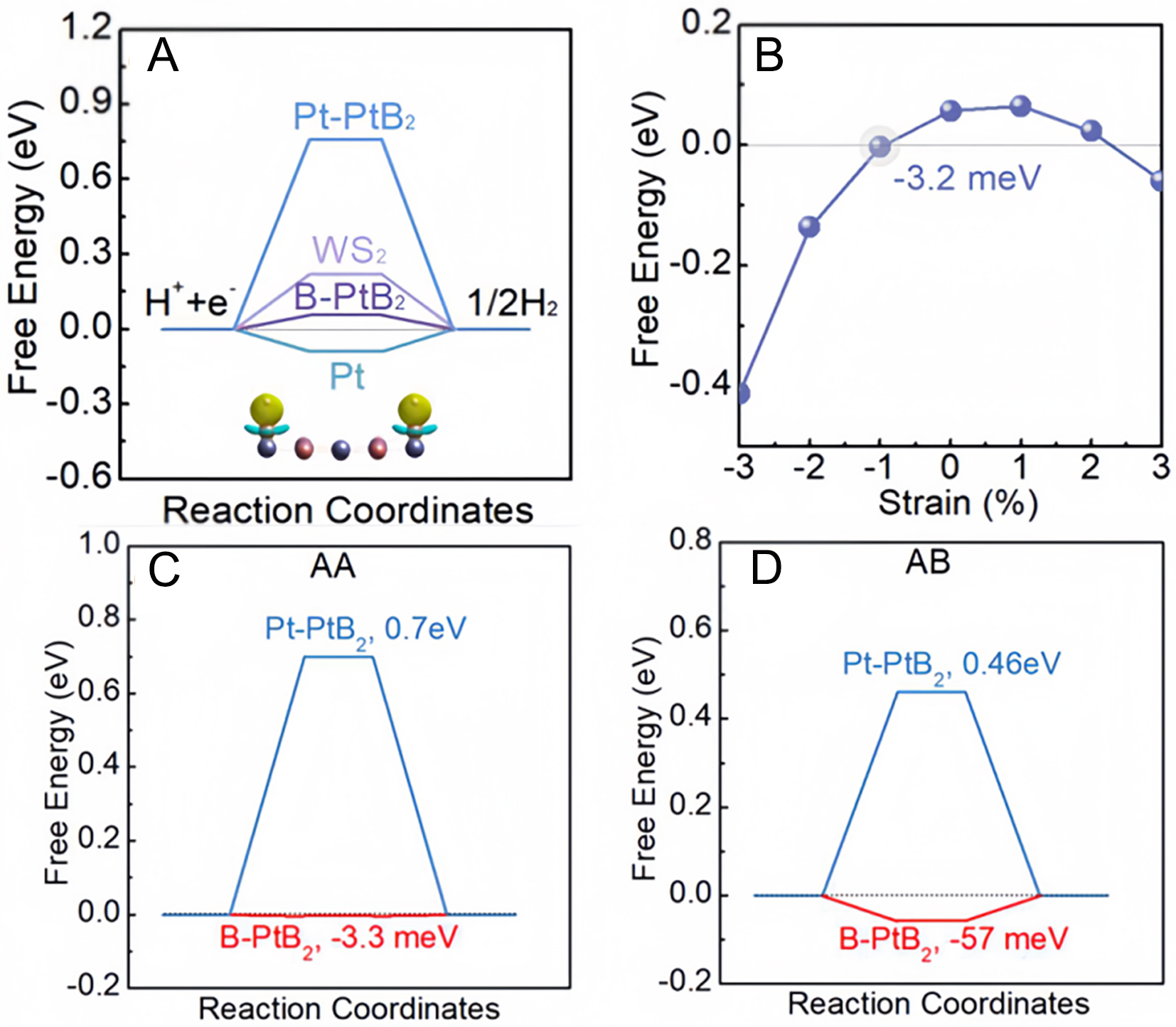
Figure 23. (A) Gibbs free energy of different adsorption sites. (B) Variation in Gibbs free energy at the B site with biaxial strain. (C and D) Gibbs free energy diagram for HER on (C) AA stacking and (D) AB stacking, This figure is adapted with permission[159], Copyright © 2024 Elsevier.
Nodal lines are confined within the 2D Brillouin zone, forming closed-loop structures. However, in certain materials, nodal lines extend along the Brillouin zone boundary, traversing the zone to form open loops[160,161]. Wang et al.[162] proposed a strategy for designing 2D materials with open nodal lines and identified a Cu2C2N4 monolayer that satisfied the design requirements. This strategy indicates that open nodal-line states extending across the Brillouin zone can generate extended Fermi arc states at the material boundaries, which may facilitate charge transfer and enhance HER catalytic performance. The Cu2C2N4 monolayer was confirmed to exhibit an open nodal line along the S-Y path of the Brillouin zone, and the theoretical location of its long Fermi arc along the edge is shown in Figure 24A and B. Additionally, the ΔGH* for the HER was 0.01 eV, indicating its high catalytic performance.
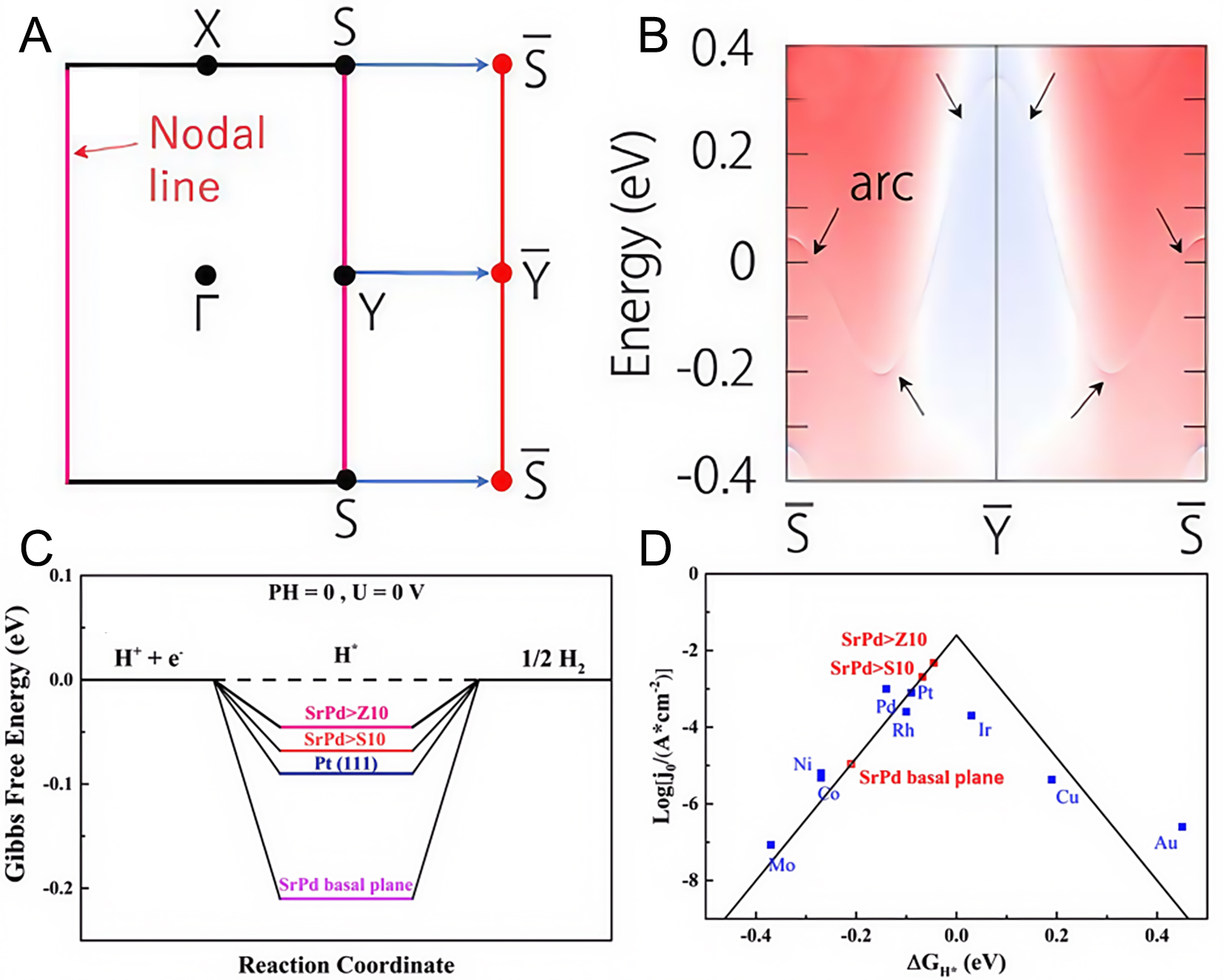
Figure 24. (A) Brillouin zone and (B) edge projection of Cu2C2N4 monolayer, (A and B) are adapted with permission[162], Copyright © 2021 Royal Society of Chemistry. (C) Gibbs free energy at different sites of the SrPd/BaPd monolayer. (D) HER volcano plot, (C and D) are adapted with permission[163], Copyright © 2023 American Chemical Society.
Although the topological properties of most topological materials are mainly determined by s or p orbitals, d orbital electrons typically play a central role in catalytic reactions. Consequently, topological materials whose properties are governed by d orbitals may exhibit superior catalytic performance. Kong et al. designed a 2D topological NLSM SrPd/BaPd monolayer material with topological properties derived from Pd’s d orbitals[163]. Calculations revealed that the d-origin TESs were partially unoccupied. These unoccupied d-orbital edge states act as catalytic active sites. As shown in Figure 24C and D, the results show extremely low hydrogen adsorption free energies at the edge Pd sites, indicating exceptional catalytic performance.
2D NLSMs represent an emerging class of 2D topological catalysts, and recent studies have highlighted their potential through unique structural designs, such as open nodal lines and d-orbital-derived catalytic sites. For example, studies on Cu2C2N4, SrPd, and BaPd monolayers have shown that rational regulation of electronic structures provides favorable reaction sites and optimizes adsorption behavior[162,163]. However, compared with other 2D topological materials, experimental verification and practical catalytic studies of 2D NLSMs remain scarce. Future studies should focus on expanding experimentally accessible nodal-line materials, developing reliable synthesis strategies, and establishing systematic relationships between structural characteristics and catalytic performance.
Advantages of different 2D topological materials as electrocatalysts
Although different classes of 2D topological materials have shown considerable potential for electrocatalytic water splitting, their performance is closely related to their intrinsic electronic structures and material characteristics. Therefore, no single class exhibits universally superior electrocatalytic performance; instead, different classes offer distinct advantages depending on the specific reaction mechanism and catalytic requirements. Materials for 2D TIs, such as Bi2Se3 and Bi2Te3, have attracted significant attention owing to their excellent surface states and tunable surface structures. For example, studies have shown that exfoliation, interface construction, and surface regulation enhance the catalytic activity of Bi2Se3 nanosheets and Bi2Te3-based heterostructures, making them promising for designing functional catalytic interfaces[105,106].
Representative 2D DSMs, including PtTe2, NiTe2, and MoP2[133-135] exhibit high carrier mobility, excellent electrical conductivity, and flexible electronic structures, accelerating charge transfer during electrocatalytic reactions. Notably, PtTe2 and NiTe2-based systems exhibit excellent HER performance, while MoP2 can regulate electronic structure and provide abundant active sites. These features make 2D DSMs particularly promising for constructing highly conductive electrocatalytic platforms.
2D WSMs, such as 1T′-WTe2 and 1T′-MoTe2, are characterized by their highly anisotropic electronic structures and excellent charge-transport capability. The successful growth of few-layer WTe2 and MoTe2 films through advanced synthesis methods has facilitated their exploration as efficient HER catalysts and flexible catalytic electrodes. However, compared with other material classes, the development of 2D WSMs remains limited by challenges in achieving large-scale synthesis and maintaining structural stability under electrochemical conditions.
2D NLSMs represent another promising class of topological materials with unique electronic structures and highly tunable properties. For example, theoretical studies on Cu2C2N4 and SrPd/BaPd monolayers have shown that rational structural design and regulation of electronic states can provide favorable catalytic sites and optimize reaction intermediates[162,163]. Although experimental studies on 2D NLSMs remain relatively limited, the structural diversity of the semimetals provides new opportunities for developing next-generation electrocatalysts.
Overall, 2D TIs, 2D DSMs, 2D WSMs, and 2D NLSMs each offer distinct advantages for electrocatalytic water splitting owing to their characteristic topological, electronic, and structural properties. Therefore, future studies should focus on selecting appropriate material systems according to specific catalytic requirements and integrating their intrinsic advantages with advanced structural engineering strategies to achieve efficient and durable water electrolysis. To comprehensively compare different 2D topological materials for electrocatalytic water splitting, Table 2 summarizes their synthesis methods, representative catalytic performances, advantages, and limitations.
Summary of synthesis methods, electrocatalytic performance, advantages, and limitations of different 2D topological materials
| Material | Category | Synthesis methods | Overpotential (mV) | Tafel slope (mV/dec) | Stability | Advantages | Limitations |
| Bi2Te3/bismuthene[105] | 2D topological insulator | Liquid phase exfoliation | 119 | 95.4 | High | Heterostructure promotes charge transfer | Limited active sites and scalability |
| PtTe2[133] | 2D Dirac semimetal | Chemical vapor deposition | 38.8 | 59.2 | Moderate | Abundant active sites | Insufficient stability |
| 1T-NiTe2[134] | 2D Dirac semimetal | Chemical vapor deposition | 353 | 41 | Very high | Extremely stable | Slow reaction rate |
| MoP2[135] | 2D Dirac semimetal | Gas-solid transformation | 193 | 82.2 | High | High controllability | Difficult to synthesize |
| 1T′-WTe2[144] | 2D Weyl semimetal | Hydrothermal synthesis and CVD growth | 430 | 57 | High | High carrier mobility | Experimental preparation remains challenging |
| 1T′-MoTe2[151] | 2D Weyl semimetal | Chemical vapor deposition | 230.7 | 127.1 | Moderate | High flexibility | Not stable enough |
CONCLUSION
In this review, we summarize the recent advances in the design, preparation, and electrocatalytic applications of 2D topological materials for water splitting. This review reveals that the unique topological electronic structures of 2D topological materials, including protected edge states, high carrier mobility, and tunable electronic properties, play a critical role in enhancing electrocatalytic performance. Different classes of 2D topological materials exhibit distinct catalytic advantages: TIs provide highly active edge states, whereas DSMs, WSMs, and NLSMs offer efficient charge transport pathways and flexible electronic regulation. Furthermore, this review highlights heterostructure construction, defect engineering, doping, strain engineering, and phase control as effective strategies for regulating active sites and intermediate adsorption, thereby improving HER/OER activity. However, challenges remain in the scalable synthesis of high-quality materials, experimental validation of the relationship between topological properties and catalytic mechanisms, and evaluation under practical operating conditions. Future studies should focus on rational material design, advanced characterization, and mechanism exploration to accelerate the development of high-performance 2D topological electrocatalysts for sustainable hydrogen production.
CURRENT CHALLENGES AND FUTURE PROSPECTS
Although significant progress has been made in the application of 2D topological materials for electrocatalytic water splitting, most studies have mainly focused on theoretical predictions and laboratory-scale demonstrations. To facilitate the transition from fundamental research to practical applications, several critical challenges must be addressed. The major challenges and corresponding future research directions are discussed below.
(1) Catalyst stability
Although topological states provide certain electronic robustness, the long-term stability of 2D topological catalysts under practical electrochemical conditions remains a challenge. Prolonged exposure to electrolytes, applied potentials, and reactive intermediates may induce surface oxidation, structural reconstruction, or phase degradation, resulting in catalytic performance decay during prolonged operation.
Future studies should combine in situ and operando characterization with theoretical simulations to reveal degradation mechanisms. Constructing stable heterostructures and protective interfaces and optimizing catalyst-substrate interactions may effectively preserve topological properties and enhance the durability of 2D topological electrocatalysts.
(2) Scalability of preparation
Although various methods, including MBE, CVD, and exfoliation techniques, have been developed, large-scale preparation of 2D topological materials remains challenging. Limited yield, complex procedures, strict growth conditions, and poor reproducibility hinder their transition from fundamental research to practical applications.
Future studies should focus on scalable and controllable synthesis strategies. Improving large-area CVD growth, optimizing liquid-phase and electrochemical exfoliation, and precisely controlling thickness, defects, and electronic structures are critical to achieving high-quality and large-scale production.
(3) Synthesis cost
The high synthesis cost of 2D topological catalysts limits their practical applications. Expensive precursors, complex fabrication processes, high energy consumption, and specialized equipment requirements significantly increase production costs. Furthermore, the reliance of some high-performance topological materials on scarce elements may increase material costs and constrain resource availability, thereby limiting their economic viability for large-scale hydrogen production.
Future studies should focus on developing earth-abundant and cost-effective topological materials. Simplifying synthesis processes, improving precursor utilization efficiency, reducing energy consumption, and designing environmentally friendly preparation routes will be important strategies for large-scale production. In addition, techno-economic analyses should be incorporated to evaluate the practical applicability of these materials.
(4) Integration into practical water electrolysis devices
Although 2D topological materials have exhibited excellent catalytic performance in laboratory-scale electrochemical studies, their integration into practical water electrolysis systems remains limited. Most studies are based on conventional three-electrode configurations, which do not fully represent industrial operating conditions. Key challenges include catalyst loading, electrode architecture, mass transport, high-current-density operation, and long-term stability.
Future research should transition from material-level investigations toward device-level applications. Developing self-supported electrodes, membrane electrode assemblies, and optimized catalyst-substrate interfaces will be crucial. Furthermore, standardized evaluation protocols under industrially relevant operating conditions are required to accurately assess the practical potential of 2D topological electrocatalysts.
DECLARATIONS
Authors’ contributions
Writing - original draft, visualization, formal analysis, data curation: Yu, Z.
Writing - review & editing, supervision, conceptualization, methodology, investigation, funding acquisition: Cheng, Z.
Investigation, formal analysis: Wang, Q.
Resources, formal analysis: Rao, J.
Writing - review & editing, conceptualization: Han, C.
Writing - review & editing, funding acquisition: Ma, X.
Availability of data and materials
Not applicable.
AI and AI-assisted tools statement
Not applicable.
Financial support and sponsorship
Project funded by the Opening Project of Hubei Key Laboratory of Photoelectric Materials and Devices, Hubei Normal University (PMD202507), the Key R&D Project of Hubei Provincial Technology Innovation Program (2025BAB043), and the Key Research and Development Program of Wuhan City (2024050702030134 and 2024050702030113).
Conflicts of interest
All authors declared that there are no conflicts of interest.
Ethical approval and consent to participate
Not applicable.
Consent for publication
Not applicable.
Copyright
© The Author(s) 2026.
REFERENCES
1. Majumdar, A.; Nguyen, H. T.; Raut, N.; et al. Recent key engineering strategies of 2D materials in AEM water splitting applications. Coord. Chem. Rev. 2026, 548, 217216.
2. Gupta, S. K.; Sen, S. K.; Singh, P. Topological materials: a roadmap for enhanced catalytic performance in hydrogen evolution reaction. Int. J. Hydrogen. Energy. 2025, 165, 148759.
3. Salman, M.; Zhou, H.; Ahmed, S.; et al. 2D metal-organic frameworks and their composites for water splitting: catalytic insights, synthesis pathways, and structural engineering strategies. Coord. Chem. Rev. 2025, 544, 216985.
4. Jeon, D.; Kim, D. Y.; Kim, H.; et al. Electrochemical evolution of Ru-based polyoxometalates into Si,W-codoped RuOx for acidic overall water splitting. Adv. Mater. 2023, 36, 2304468.
5. Zhang, C.; Xu, Z.; Han, N.; et al. Superaerophilic/superaerophobic cooperative electrode for efficient hydrogen evolution reaction via enhanced mass transfer. Sci. Adv. 2023, 9, eadd6978.
6. Tan, P.; Gao, R.; Zhang, Y.; et al. Electrostatically directed assembly of two-dimensional ultrathin Co2Ni-MOF/Ti3C2Tx nanosheets for electrocatalytic oxygen evolution. J. Colloid. Interface. Sci. 2023, 630, 363-71.
7. Mei, J.; Deng, Y.; Cheng, X.; Wu, Q. Facile and scalable synthesis of Ni3S2/Fe3O4 nanoblocks as an efficient and stable electrocatalyst for oxygen evolution reaction. J. Colloid. Interface. Sci. 2024, 660, 440-8.
8. Cheng, R.; Min, Y.; Li, H.; Fu, C. Electronic structure regulation in the design of low-cost efficient electrocatalysts: from theory to applications. Nano. Energy. 2023, 115, 108718.
9. Liu, Y.; Wang, L.; Hübner, R.; et al. Cobalt-based Co3Mo3N/Co4N/Co metallic heterostructure as a highly active electrocatalyst for alkaline overall water splitting. Angew. Chem. Int. Ed. 2024, 63, e202319239.
10. Liu, L.; Chen, L.; Zhang, H.; et al. Construction of Fe regulated NiMoN nanorods as an efficient electrocatalyst for overall water splitting and urea electrolysis. Nanoscale 2026, 18, 3813-27.
11. Hou, M.; Zheng, L.; Zhao, D.; et al. Microenvironment reconstitution of highly active Ni single atoms on oxygen-incorporated Mo2C for water splitting. Nat. Commun. 2024, 15, 1342.
12. Sharma, T. S. K.; Jana, J.; Babu, B. M.; et al. Exploring structural and electronic properties of transition metal carbides (T = Ti, V, Mo, & W) as efficient catalysts for overall water splitting with the DFT study. J. Mater. Chem. A. 2025, 13, 7488-502.
13. Zeb, Z.; Huang, Y.; Chen, L.; et al. Polyoxometalates metal-organic frameworks-derived transition metal sulfides with rich interfaces for efficient alkaline oxygen evolution reaction. J. Colloid. Interface. Sci. 2025, 686, 289-303.
14. Wu, Y.; Du, X.; Zhang, X. P doping transition metal sulfides as bifunctional electrocatalyst for overall seawater splitting. Int. J. Hydrogen. Energy. 2025, 103, 174-82.
15. Zhang, H.; Zhang, Z.; Li, Z.; An, Y. Revealing and tuning the catalytic structure-activity relationship for overall water splitting on a Cu2Ge topological nodal-line semimetal. J. Alloys. Compd. 2026, 1068, 188401.
16. Wang, L.; Yang, Y.; Wang, J.; et al. Excellent catalytic performance toward the hydrogen evolution reaction in topological semimetals. EcoMat 2022, 5, e12316.
17. Zhang, X.; Wang, L.; Li, M.; et al. Topological surface state: universal catalytic descriptor in topological catalysis. Mater. Today. 2023, 67, 23-32.
18. Zhan, J.; Cao, Y.; Lai, J.; et al. Design of high-efficiency hydrogen evolution catalysts in a chiral crystal. ACS. Catal. 2024, 14, 1030-6.
19. Xie, R.; Zhang, T.; Weng, H.; Chai, G. Progress, advantages, and challenges of topological material catalysts. Small. Sci. 2022, 2, 2100106.
20. Li, Y.; Yu, W.; Zhang, K.; et al. Two-dimensional topological semimetals: an emerging candidate for terahertz detectors and on-chip integration. Mater. Horiz. 2024, 11, 2572-602.
21. Que, Y.; Kumar, A.; Weber, B. Two-dimensional topological insulators: promises, challenges, and future perspectives. Adv. Mater. 2026, e00030.
22. Yu, H.; Zeng, H.; Zhang, Y.; et al. Two-dimensional layered topological semimetals for advanced electronics and optoelectronics. Adv. Funct. Mater. 2024, 35, 2412913.
23. Yin, Y.; Gao, Y.; Zhang, L.; Zhang, Y.; Du, S. Recent advances in 2D organic topological insulators: materials, properties, and realizations. J. Phys. Condens. Matter. 2025, 37, 473006.
24. Weber, B.; Fuhrer, M. S.; Sheng, X.; et al. 2024 roadmap on 2D topological insulators. J. Phys. Mater. 2024, 7, 022501.
25. Zhang, G.; Wu, H.; Zhang, L.; et al. Two-dimensional van der waals topological materials: preparation, properties, and device applications. Small 2022, 18, 2204380.
26. Qiao, C.; Hsu, C.; Zhang, T.; et al. Evolution of topological phases in atomically thin WTe2 films. Chin. Phys. Lett. 2026, 43, 050702.
27. Weng, G.; Alexandrova, A. N. Understanding the finite size and surface relaxation effects on the surface states of Bi2Se3 family topological insulators. J. Phys. Chem. C. 2024, 128, 20659-69.
28. Lygo, A. C.; Guo, B.; Rashidi, A.; Huang, V.; Cuadros-Romero, P.; Stemmer, S. Two-dimensional topological insulator state in cadmium arsenide thin films. Phys. Rev. Lett. 2023, 130, 046201.
29. Singh, B.; Lin, H.; Bansil, A. Topology and symmetry in quantum materials. Adv. Mater. 2022, 35, 2201058.
30. Wu, H.; Chen, A.; Zhang, P.; et al. Magnetic memory driven by topological insulators. Nat. Commun. 2021, 12, 6251.
31. Zarezad, A. N.; Barnaś, J.; Qaiumzadeh, A.; Dyrdał, A. Bilinear planar hall effect in topological insulators due to spin-momentum locking inhomogeneity. Phys. Status. Solidi. R. 2023, 18, 2200483.
32. Guo, Z.; Liu, Y.; Jiang, H.; et al. Magnetic high-order topological insulator in 2D layered CrOCl. Mater. Today. Phys. 2023, 36, 101153.
33. Xu, Y.; Cao, G.; Li, Q.; et al. Realization of monolayer ZrTe5 topological insulators with wide band gaps. Nat. Commun. 2024, 15, 4784.
34. Yalameha, S.; Nourbakhsh, Z.; Zahmatkesh, J. K2Be2P2 monolayer: a predicted strain-tunable two-dimensional topological insulator exhibiting multifunctional properties. J. Mater. Chem. C. 2025, 13, 19749-62.
35. Gupta, R.; Witteveen, C.; Das, D.; Von Rohr, F. O.; Khasanov, R. Type-II superconductivity in the Dirac semimetal PdTe2. Phys. Rev. B. 2024, 109, 134507.
36. Zhao, X.; Feng, P.; Gao, M.; Yan, X.; Ma, F.; Lu, Z. Two-dimensional antiferromagnetic Dirac semimetal: rhombic-MnN4. APL. Comput. Phys. 2025, 1, 016107.
37. Liang, Y.; Lin, X.; Wan, B.; et al. Two-dimensional Weyl and type-III Dirac semimetals in BaCu monolayer and twisted α/β-BaCu/BN systems. NPJ. Comput. Mater. 2025, 11, 220.
38. Wang, Y.; Gao, Q.; Hu, Z. A novel two-dimensional all-carbon Dirac node-line semimetal. Europhys. Lett. 2024, 145, 56003.
39. Meng, W.; Liu, Y.; Yu, W.; Zhang, X.; Liu, G. Spin-orbital robust Dirac points in two-dimensional systems. Mater. Today. Phys. 2022, 27, 100774.
40. Wang, H.; Xu, W.; Wei, Z.; et al. Twisted photonic Weyl meta-crystals and aperiodic Fermi arc scattering. Nat. Commun. 2024, 15, 2440.
41. Lu, Q.; Reddy, P. V. S.; Jeon, H.; et al. Realization of a two-dimensional Weyl semimetal and topological Fermi strings. Nat. Commun. 2024, 15, 6001.
42. Guo, B.; Miao, W.; Huang, V.; Lygo, A. C.; Dai, X.; Stemmer, S. Zeeman field-induced two-dimensional Weyl semimetal phase in cadmium arsenide. Phys. Rev. Lett. 2023, 131, 046601.
43. Xu, W.; Yi, J.; Huan, H.; Zhao, B.; Xue, Y.; Yang, Z. Two-dimensional half chern-Weyl semimetal with multiple screw axes. Phys. Rev. B. 2022, 106, 205108.
44. Wu, J.; Ke, S.; Guo, Y.; Zhang, H.; Lü, H. Two-dimensional Dirac nodal line state protected against spin-orbit coupling in MoTe monolayer. J. Alloys. Compd. 2022, 923, 166349.
45. Li, S.; Yu, Z.; Liu, Y.; et al. Type-II nodal loops: theory and material realization. Phys. Rev. B. 2017, 96, 081106.
46. Zhang, X.; Jin, L.; Dai, X.; Liu, G. Topological type-II nodal line semimetal and dirac semimetal state in stable kagome compound Mg3Bi2. J. Phys. Chem. Lett. 2017, 8, 4814-9.
47. Zhang, X.; Yu, Z.; Lu, Y.; Sheng, X.; Yang, H. Y.; Yang, S. A. Hybrid nodal loop metal: unconventional magnetoresponse and material realization. Phys. Rev. B. 2018, 97, 125143.
48. Zhang, X.; Jin, L.; Dai, X.; Chen, G.; Liu, G. Ideal inner nodal chain semimetals in Li2XY (X = Ca, Ba; Y = Si, Ge) materials. J. Phys. Chem. Lett. 2018, 9, 5358-63.
49. He, T.; Zhang, X.; Liu, Y.; et al. Ferromagnetic hybrid nodal loop and switchable type-I and type-II Weyl fermions in two dimensions. Phys. Rev. B. 2020, 102, 075133.
50. Chen, L.; Shi, J.; Zhang, J.; Fu, B. Engineering ideal two-dimensional type-II nodal line semimetals via stacking and intercalation of van der Waals layers. Phys. Rev. B. 2026, 113, 245142.
51. Kong, W.; Xiao, X.; Wei, J.; et al. C-Me-graphene: an ideal two-dimensional nodal line semimetal with ultrahigh Young's modulus. Phys. Chem. Chem. Phys. 2024, 26, 21739-45.
52. Tian, C.; Shi, J.; Wang, P.; et al. Ambient-pressure topological superconductivity in Ag4H up to 63 K by metallization of hydrogen. Phys. Rev. B. 2025, 111, 094521.
53. Wang, B.; Wang, L.; Jin, C.; Bai, H. High-temperature superconductivity with nontrivial electronic topology in monolayerh-V2N3. Phys. Rev. B. 2025, 111, 245431.
54. Ding, H.; Sui, C.; Qiao, S.; et al. Topological and superconducting properties of two-dimensional MXC3 [M:X = In:As, Se:As, In:Te and As:Te] by first-principles study. Phys. Chem. Chem. Phys. 2025, 27, 14288-95.
55. Hu, C.; Qian, T.; Ni, N. Recent progress in MnBi2nTe3n+1 intrinsic magnetic topological insulators: crystal growth, magnetism and chemical disorder. Natl. Sci. Rev. 2024, 11, nwad282.
56. Jiang, Y.; Wang, H.; Bao, K.; Wang, J. Intrinsic antiferromagnetic topological insulator and axion state in V2WS4. Phys. Rev. B. 2025, 111, 165109.
57. Yao, J.; Zhang, R.; Zhang, S.; et al. Axion insulator, Weyl points, quantum anomalous hall effect, and magnetic topological phase transition in Eu3In2As4. Phys. Rev. B. 2025, 111, L041117.
58. Liu, N.; Schreyeck, S.; Fijalkowski, K.; et al. Antiferromagnetic order in MnBi2Te4 films grown on Si(111) by molecular beam epitaxy. J. Cryst. Growth. 2022, 591, 126677.
59. He, Q.; Li, P.; Wu, Z.; et al. Molecular beam epitaxy scalable growth of wafer-scale continuous semiconducting monolayer MoTe2 on inert amorphous dielectrics. Adv. Mater. 2019, 31, 1901578.
60. Ip, C. I. J.; Gao, Q.; Nguyen, K. D.; et al. Preservation of topological surface states in millimeter-scale transferred membranes. Nano. Lett. 2024, 24, 7557-63.
61. Yánez-Parreño, W.; Huang, Y.; Ghosh, S.; et al. Thin film growth of the Weyl semimetal NbAs. Phys. Rev. Mater. 2024, 8, 034204.
62. Liu, W.; Endicott, L.; Stoica, V. A.; Chi, H.; Clarke, R.; Uher, C. High-quality ultra-flat BiSbTe3 films grown by MBE. J. Cryst. Growth. 2015, 410, 23-9.
63. Wickramasinghe, K. S.; Forrester, C.; Tamargo, M. C. Molecular beam epitaxy of twin-free Bi2Se3 and Sb2Te3 on In2Se3/InP(111)B virtual substrates. Crystals 2023, 13, 677.
64. Nelson, J. N.; Rice, A. D.; Kurleto, R.; et al. Thin-film TaAs: developing a platform for Weyl semimetal devices. Matter 2023, 6, 2886-99.
65. Tian, Y.; Yan, Z.; Jiang, L.; et al. Multiscale models of CVD process: review and prospective. Materials 2024, 17, 5131.
66. Germaine, I. M.; Mcelwee-White, L. Single-source precursors for the chemical vapor deposition of group 4-6 transition metal dichalcogenides. Cryst. Growth. Des. 2023, 24, 1-16.
67. Li, J.; Cheng, S.; Liu, Z.; Zhang, W.; Chang, H. Centimeter-scale, large-area, few-layer 1T′-WTe2 films by chemical vapor deposition and its long-term stability in ambient condition. J. Phys. Chem. C. 2018, 122, 7005-12.
68. Poplinger, M.; Kaltsas, D.; Stern, C.; et al. From monolayer to thin films: engineered bandgap in CVD grown Bi2SexSx topological insulator alloys. J. Mater. Chem. C. 2024, 12, 2723-9.
69. Yang, Y.; Zhang, K.; Zhang, L.; et al. Controllable growth of type-II Dirac semimetal PtTe2 atomic layer on Au substrate for sensitive room temperature terahertz photodetection. InfoMat 2021, 3, 705-15.
70. Hudie, S. M.; Lee, C. P.; Mathew, R. J.; et al. Phase-engineered Weyl semi-metallic MoxW1-xTe2 nanosheets as a highly efficient electrocatalyst for dye-sensitized solar cells. Solar. RRL. 2019, 3, 1800314.
71. Tu, N. H.; Tanabe, Y.; Satake, Y.; et al. Large-area and transferred high-quality three-dimensional topological insulator BixSbxTeySey ultrathin film by catalyst-free physical vapor deposition. Nano. Lett. 2017, 17, 2354-60.
72. Kong, D.; Chen, Y.; Cha, J. J.; et al. Ambipolar field effect in the ternary topological insulator (BixSb1-x)2Te3 by composition tuning. Nat. Nanotechnol. 2011, 6, 705-9.
73. Yang, L.; Wang, D.; Liu, M.; et al. Glue-assisted grinding exfoliation of large-size 2D materials for insulating thermal conduction and large-current-density hydrogen evolution. Mater. Today. 2021, 51, 145-54.
74. Huang, Y.; Pan, Y.; Yang, R.; et al. Universal mechanical exfoliation of large-area 2D crystals. Nat. Commun. 2020, 11, 2453.
75. Zheng, W.; Lee, L. Y. S. Beyond sonication: advanced exfoliation methods for scalable production of 2D materials. Matter 2022, 5, 515-45.
76. Yang, L.; Wu, H.; Zhang, G.; et al. Ultrahigh yield and large-scale fast growth of large-size high-quality van der Waals transition-metal telluride single crystals. Cell. Rep. Phys. Sci. 2022, 3, 100953.
77. Deng, Y.; Yu, Y.; Song, Y.; et al. Gate-tunable room-temperature ferromagnetism in two-dimensional Fe3GeTe2. Nature 2018, 563, 94-9.
78. Deng, Y.; Yu, Y.; Shi, M. Z.; et al. Quantum anomalous Hall effect in intrinsic magnetic topological insulator MnBi2Te4. Science 2020, 367, 895-900.
79. Sun, L.; Lin, Z.; Peng, J.; Weng, J.; Huang, Y.; Luo, Z. Preparation of few-layer bismuth selenide by liquid-phase-exfoliation and its optical absorption properties. Sci. Rep. 2014, 4, 4794.
80. Goswami, S.; De Oliveira, C. C.; Ipaves, B.; et al. Exceptionally high nonlinear optical response in two-dimensional type II dirac semimetal nickel Di-telluride (NiTe2). Laser. Photonics. Rev. 2025, 19, 2400999.
81. Yeon, C.; Yun, S. J.; Lee, K.; Lim, J. W. High-yield graphene exfoliation using sodium dodecyl sulfate accompanied by alcohols as surface-tension-reducing agents in aqueous solution. Carbon 2015, 83, 136-43.
82. Yang, H.; Synnatschke, K.; Yoon, J.; et al. Solution-processable electronic-grade 2D WTe2 enabled by synergistic dual ammonium intercalation. ACS. Nano. 2025, 19, 14309-17.
83. Ma, Y.; Shao, X.; Li, J.; et al. Electrochemically exfoliated platinum dichalcogenide atomic layers for high-performance air-stable infrared photodetectors. ACS. Appl. Mater. Interfaces. 2021, 13, 8518-27.
84. Yan, H.; Li, B.; Pan, J.; et al. Controlling the crystallinity and morphology of bismuth selenide via electrochemical exfoliation for tailored reverse saturable absorption and optical limiting. Nanomaterials 2024, 15, 52.
85. Ambrosi, A.; Sofer, Z.; Luxa, J.; Pumera, M. Exfoliation of layered topological insulators Bi2Se3 and Bi2Te3 via electrochemistry. ACS. Nano. 2016, 10, 11442-8.
86. Parvez, K.; Wu, Z.; Li, R.; et al. Exfoliation of graphite into graphene in aqueous solutions of inorganic salts. J. Am. Chem. Soc. 2014, 136, 6083-91.
87. Zhang, Z.; Xu, H.; Huang, C.; Shuai, T.; Zhan, Q.; Li, G. Recent advances in the synthesis of transition metal hydroxyl oxide catalysts and their application in electrocatalytic oxygen evolution reactions. Nanoscale 2024, 16, 19970-97.
88. Rong, C.; Huang, X.; Arandiyan, H.; Shao, Z.; Wang, Y.; Chen, Y. Advances in oxygen evolution reaction electrocatalysts via direct oxygen-oxygen radical coupling pathway. Adv. Mater. 2025, 37, 2416362.
89. Xu, Q.; Yang, Q.; Cao, Z.; et al. Modulation in crystal facets via Ta doping for stable acidic oxygen evolution reaction under lattice oxygen evolution mechanism. Electrochim. Acta. 2025, 543, 147551.
90. Song, W.; Duan, X.; Phyu Win, P. E.; Huang, X.; Wang, J. Tuning the electrochemical redox-mediated mechanism of oxygen evolution on cobalt sites by hydroxide ion coupling. Chem. Sci. 2025, 16, 8889-96.
91. Luo, Y.; Zhang, Y.; Zhu, J.; et al. Material engineering strategies for efficient hydrogen evolution reaction catalysts. Small. Methods. 2024, 8, 2400158.
92. Song, Q.; Gong, Z.; Liu, J.; et al. Boosting the hydrogen evolution activity of a low-coordinated Co-N-C catalyst via vacancy defect-mediated alteration of the intermediate adsorption configuration. Adv. Sci. 2025, 12, 2415665.
93. Yao, B.; Chen, Y.; Yan, Y.; et al. Iron-induced localized oxide path mechanism enables efficient and stable water oxidation. Angew. Chem. Int. Ed. 2024, 64, e202416141.
94. Zhang, Z.; Zhao, H.; Xi, S.; et al. Breaking linear scaling relationships in oxygen evolution via dynamic structural regulation of active sites. Nat. Commun. 2025, 16, 1301.
95. Zhu, T.; Gan, X.; Xiao, Z.; et al. Single-atom dispersed Cu or Co on 2H-MoS2 monolayer for improving electrocatalytic activity of overall water splitting. Surf. Interfaces. 2021, 27, 101538.
96. Marques, J. G.; Costa, A. L.; Pereira, C. Gibbs free energy (ΔG) analysis for the NaOH (sodium-oxygen-hydrogen) thermochemical water splitting cycle. Int. J. Hydrogen. Energy. 2019, 44, 14536-49.
97. Jin, M.; Li, J.; Gao, J.; et al. Atomic-level tungsten doping triggered low overpotential for electrocatalytic water splitting. J. Colloid. Interface. Sci. 2021, 587, 581-9.
98. Zheng, X.; Zhu, Y.; Ming, S.; Li, H.; Wang, Z. Ultralow-overpotential bifunctional water splitting using Ce-mediated CeOx/Ni3Fe/NiFe-LDH nanoheterojunction electrocatalysts. J. Mater. Sci. 2025, 60, 21097-110.
99. Singha Roy, S.; Madhu, R.; Karmakar, A.; Kundu, S. From theory to practice: a critical and comparative assessment of tafel slope analysis techniques in electrocatalytic water splitting. ACS. Mater. Lett. 2024, 6, 3112-23.
100. Anantharaj, S.; Noda, S. How properly are we interpreting the Tafel lines in energy conversion electrocatalysis? Mater. Today. Energy. 2022, 29, 101123.
101. Tang, J.; Xu, X.; Tang, T.; Zhong, Y.; Shao, Z. Perovskite-based electrocatalysts for cost-effective ultrahigh-current-density water splitting in anion exchange membrane electrolyzer cell. Small. Methods. 2022, 6, 2201099.
102. Ulyanova, E. S.; Shkerin, S. N.; Shalaeva, E. V.; et al. Novel testing procedure of area-specific exchange current density for photoactive powder: application in PEC water splitting. Int. J. Hydrogen. Energy. 2021, 46, 16888-98.
103. Xu, X.; Yu, X.; Chen, S.; et al. Heterostructured engineering of topological insulators/metal-organic frameworks for efficient electrocatalytic overall water splitting. Int. J. Hydrogen. Energy. 2025, 145, 786-94.
104. Rai, R. K.; Sarkar, B.; Ram, R.; Nanda, K. K.; Ravishankar, N. Designed synthesis of a hierarchical MoSe2@WSe2 hybrid nanostructure as a bifunctional electrocatalyst for total water-splitting. Sustain. Energy. Fuels. 2022, 6, 1708-18.
105. Sujita, P.; Vadivel, S.; Nasrin Banu, G.; Neppolian, B. Layered-bismuthene maximizes the active sites in Bi2Te3 towards electrocatalytic hydrogen evolution reactions. J. Alloys. Compd. 2024, 1003, 175483.
106. Yang, J.; Wang, C.; Ju, H.; et al. Integrated quasiplane heteronanostructures of MoSe2/Bi2Se3 hexagonal nanosheets: synergetic electrocatalytic water splitting and enhanced supercapacitor performance. Adv. Funct. Mater. 2017, 27, 1703864.
107. Bianchi, M.; Guan, D.; Bao, S.; et al. Coexistence of the topological state and a two-dimensional electron gas on the surface of Bi2Se3. Nat. Commun. 2010, 1, 128.
108. Zhang, H.; Liu, C.; Qi, X.; Dai, X.; Fang, Z.; Zhang, S. Topological insulators in Bi2Se3, Bi2Te3 and Sb2Te3 with a single Dirac cone on the surface. Nat. Phys. 2009, 5, 438-42.
109. Li, C.; Wang, Y.; Jiang, Y.; et al. Programmable higher-order topological phases in open-shell metal-organic frameworks. J. Am. Chem. Soc. 2025, 147, 39662-70.
110. Li, J.; Wu, R. Metal-organic frameworks: possible new two-dimensional magnetic and topological materials. Nanoscale 2020, 12, 23620-5.
111. Deng, T.; Shi, W.; Wong, Z. M.; et al. Designing intrinsic topological insulators in two-dimensional metal-organic frameworks. J. Phys. Chem. Lett. 2021, 12, 6934-40.
112. Huang, J.; Li, Y.; Huang, R. K.; et al. Electrochemical exfoliation of pillared-layer metal-organic framework to boost the oxygen evolution reaction. Angew. Chem. Int. Ed. 2018, 57, 4632-6.
113. Zhao, S.; Wang, Y.; Dong, J.; et al. Ultrathin metal-organic framework nanosheets for electrocatalytic oxygen evolution. Nat. Energy. 2016, 1, 16184.
114. Tao, L.; Lin, C.; Dou, S.; et al. Creating coordinatively unsaturated metal sites in metal-organic-frameworks as efficient electrocatalysts for the oxygen evolution reaction: insights into the active centers. Nano. Energy. 2017, 41, 417-25.
115. Cheng, W.; Zhao, X.; Su, H.; et al. Lattice-strained metal-organic-framework arrays for bifunctional oxygen electrocatalysis. Nat. Energy. 2019, 4, 115-22.
116. Zhao, X.; Pattengale, B.; Fan, D.; et al. Mixed-node metal-organic frameworks as efficient electrocatalysts for oxygen evolution reaction. ACS. Energy. Lett. 2018, 3, 2520-6.
117. Wang, X. L.; Dong, L. Z.; Qiao, M.; et al. Exploring the performance improvement of the oxygen evolution reaction in a stable bimetal-organic framework system. Angew. Chem. Int. Ed. 2018, 57, 9660-4.
118. Xue, Z.; Li, Y.; Zhang, Y.; et al. Modulating electronic structure of metal-organic framework for efficient electrocatalytic oxygen evolution. Adv. Energy. Mater. 2018, 8, 1801564.
119. Xue, Z.; Liu, K.; Liu, Q.; et al. Missing-linker metal-organic frameworks for oxygen evolution reaction. Nat. Commun. 2019, 10, 5048.
120. Sattigeri, R. M.; Jha, P. K.; Śpiewak, P.; Kurzydłowski, K. J. Two dimensional LiMgAs: a topological quantum catalyst for hydrogen evolution reaction. Appl. Phys. Lett. 2022, 121, 123101.
121. Wang, A.; Peng, J.; Ren, N.; Ding, L.; Yu, X.; Zhao, M. Serendipity for topological insulator as multifunctional electrocatalyst. ACS. Appl. Energy. Mater. 2020, 3, 8929-36.
122. Li, D.; Lao, J.; Jiang, C.; et al. Heterostructured MoS2@Bi2Se3 nanoflowers: a highly efficient electrocatalyst for hydrogen evolution. J. Catal. 2020, 381, 590-8.
123. Jayachitra, S.; Ravi, P.; Murugan, P.; Sathish, M. Supercritically exfoliated Bi2Se3 nanosheets for enhanced photocatalytic hydrogen production by topological surface states over TiO2. J. Colloid. Interface. Sci. 2022, 605, 871-80.
124. Wang, Z. F.; Chen, L.; Liu, F. Tuning topological edge states of Bi(111) bilayer film by edge adsorption. Nano. Lett. 2014, 14, 2879-83.
125. Jeong, S. W.; Kim, J. H.; Lee, S.; et al. Basal and edge plane activity of two-dimensional Dirac semimetal NiTe2 for hydrogen evolution reaction. Chem. Eng. J. 2025, 518, 164789.
126. Wu, H.; Meng, W.; Gao, Z.; Ma, F.; Jiao, Y. A two-dimensional topological quantum catalyst integrating Dirac points and nodal lines for high-efficiency hydrogen evolution. Int. J. Hydrogen. Energy. 2026, 240, 155511.
127. Li, Y.; Gong, J.; Wang, X. Multifold fermions boosted hydrogen evolution reaction catalysis in cubic palladium bronze LaPd3S4. Small. Struct. 2024, 5, 2400175.
128. Zhao, M.; Wang, S.; Li, H.; et al. Design of A series of high-performance topology catalyst APt3 (A = Dy, Nd, Sc, Sm, Y, Pr) materials. iScience 2025, 28, 113352.
129. Yang, Q.; Li, G.; Manna, K.; Fan, F.; Felser, C.; Sun, Y. Topological engineering of Pt-group-metal-based chiral crystals toward high-efficiency hydrogen evolution catalysts. Adv. Mater. 2020, 32, 1908518.
130. Wang, A.; Shen, L.; Zhao, M.; et al. Tungsten boride: a 2D multiple Dirac semimetal for the hydrogen evolution reaction. J. Mater. Chem. C. 2019, 7, 8868-73.
131. Peng, Y.; Zhu, L.; Li, C.; et al. Highly stable vertically oriented 2H-NbS2 nanosheets on carbon nanotube films toward superior electrocatalytic activity. Adv. Energy. Mater. 2023, 14, 2302510.
132. Chen, K.; Huan, Y.; Quan, W.; et al. Controllable growth and defect engineering of vertical PtSe2 nanosheets for electrocatalytic hydrogen evolution. ACS. Energy. Lett. 2022, 7, 3675-84.
133. Fu, J.; Peng, Y.; Zhou, L.; et al. Controllable growth of two dimensional stereoscopic PtTe2 nanosheets for efficient electrocatalytic hydrogen evolution. Chem. Commun. 2025, 61, 18360-3.
134. Shi, J.; Huan, Y.; Xiao, M.; et al. Two-dimensional metallic NiTe2 with ultrahigh environmental stability, conductivity, and electrocatalytic activity. ACS. Nano. 2020, 14, 9011-20.
135. Wang, W.; Wu, J.; Ma, C.; et al. Confined synthesis of 2D molybdenum diphosphide nanosheets via gas-solid transformation. Small 2024, 21, 2408782.
136. Han, N.; Chen, F.; Li, M.; et al. Boundary-induced topological chiral extended states in weyl metamaterial waveguides. Phys. Rev. Lett. 2025, 134, 196601.
137. Wang, L.; Jin, L.; Liu, G.; Liu, Y.; Dai, X.; Zhang, X. Theoretical realization of two-dimensional Dirac/Weyl line-node and traversing edge states in penta-X2Y monolayers. Appl. Mater. Today. 2021, 23, 101057.
138. Liu, J.; Zheng, J.; Li, L.; et al. Harnessing magnetic fields: temporal-spatial enabling in water-splitting electrocatalysis. Chem. Sci. 2025, 16, 18309-17.
139. Chandra, M.; Pandey, P.; Sahu, A.; Qureshi, M. Magnetic stimuli-guided multiple charge transfer pathways for boosted overall water splitting. ACS. Appl. Energy. Mater. 2025, 8, 5493-501.
140. Jiang, W.; Ni, X.; Liu, F. Exotic topological bands and quantum states in metal-organic and covalent-organic frameworks. Acc. Chem. Res. 2021, 54, 416-26.
141. Zhang, X.; Wang, X.; He, T.; et al. Magnetic topological materials in two-dimensional: theory, material realization and application prospects. Sci. Bull. 2023, 68, 2639-57.
142. Liu, D. X.; Hong, H.; Cao, Q.; Wang, D.; Du, Y. Spin polarization of 2D weyl semimetal Fe2Sn enabling high hydrogen evolution reaction activity. ChemPhysChem 2024, 25, e202300942.
143. Wang, G.; Liu, W.; Zhou, J.; Ding, C.; Kuang, M. Room temperature ferromagnetic TiTe monolayer: a topological material for efficient hydrogen evolution reaction. J. Phys. D. Appl. Phys. 2025, 58, 195502.
144. Li, J.; Hong, M.; Sun, L.; Zhang, W.; Shu, H.; Chang, H. Enhanced electrocatalytic hydrogen evolution from large-scale, facile-prepared, highly crystalline WTe2 nanoribbons with Weyl semimetallic phase. ACS. Appl. Mater. Interfaces. 2017, 10, 458-67.
145. Pan, Y.; Song, Y.; Wang, Q.; et al. Direct multitier synthesis of two-dimensional semiconductor 2H-MoTe2. ACS. Appl. Electron. Mater. 2022, 4, 5733-8.
146. Li, J.; Bing, D.; Wu, Z.; et al. Thickness-dependent excitonic properties of atomically thin 2H-MoTe2. Chin. Phys. B. 2020, 29, 017802.
147. Zhao, H.; Liu, Y.; Yang, S.; et al. Microscopic growth mechanism and edge states of monolayer 1T′-MoTe2. Chin. Phys. B. 2024, 33, 046801.
148. Chandran, Y.; Thakur, D.; Raju Naik, B.; Balakrishnan, V. Arresting the surface oxidation kinetics of bilayer 1T′-MoTe2 by sulphur passivation. Nanotechnology 2023, 34, 375702.
149. Li, X.; Qi, Z.; Wu, Q.; He, W. Topological superconductivity in monolayer Td-MoTe2. Commun. Phys. 2024, 7, 396.
150. Li, Z.; Jindal, A.; Strasser, A.; et al. Twofold anisotropic superconductivity in bilayer Td-MoTe2. Phys. Rev. Lett. 2024, 133, 216002.
151. Lu, D.; Ren, X.; Ren, L.; et al. Direct vapor deposition growth of 1T′ MoTe2 on carbon cloth for electrocatalytic hydrogen evolution. ACS. Appl. Energy. Mater. 2019, 3, 3212-9.
152. Zhang, R.; Zhang, Z.; Liu, C.; Yao, Y. Nodal line spin-gapless semimetals and high-quality candidate materials. Phys. Rev. Lett. 2020, 124, 016402.
153. Li, Z.; He, Z.; Wang, L.; et al. High-performance hydrogen evolution reaction in quadratic nodal line semimetal Na2CdSn. iScience 2024, 27, 110708.
154. Lu, Y.; Fan, X.; Ma, X.; Liu, J.; Li, Y.; Zhao, M. Tunable topological electronic states in the honeycomb-kagome lattices of nitrogen/oxygen-doped graphene nanomeshes. Nanoscale. Adv. 2022, 4, 2201-7.
155. Tian, Q.; Bagheri Tagani, M.; Izadi Vishkayi, S.; et al. Twist-angle tuning of electronic structure in two-dimensional dirac nodal line semimetal Au2Ge on Au(111). ACS. Nano. 2024, 18, 9011-8.
156. Wang, L.; Zhao, M.; Wang, J.; et al. High-performance hydrogen evolution reaction catalysts in two-dimensional nodal line semimetals. ACS. Appl. Mater. Interfaces. 2023, 15, 51225-30.
157. Wang, Y.; Qian, Y.; Yang, M.; et al. Spectroscopic evidence for the realization of a genuine topological nodal-line semimetal in LaSbTe. Phys. Rev. B. 2021, 103, 125131.
158. Chen, F.; Fei, Y.; Li, S.; et al. Temperature-induced lifshitz transition and possible excitonic instability in ZrSiSe. Phys. Rev. Lett. 2020, 124, 236601.
159. Gao, Z.; Ma, F.; Meng, W.; Jiao, Y. Two-dimensional platinum borides: a dirac nodal line quantum electrocatalyst for efficient hydrogen evolution reaction. Int. J. Hydrogen. Energy. 2024, 80, 507-15.
160. Shao, D.; Wang, H.; Chen, T.; et al. Composite topological nodal lines penetrating the Brillouin zone in orthorhombic AgF2. npj. Comput. Mater. 2019, 5, 53.
161. He, T.; Zhang, X.; Wang, L.; et al. Theoretical realization of fully spin-polarized nodal box with traversing Brillouin zone surface state. Phys. Rev. B. 2022, 106, 075155.
162. Wang, L.; Zhang, X.; Meng, W.; Liu, Y.; Dai, X.; Liu, G. A topological quantum catalyst: the case of two-dimensional traversing nodal line states associated with high catalytic performance for the hydrogen evolution reaction. J. Mater. Chem. A. 2021, 9, 22453-61.
Cite This Article
 Open Access
How to Cite
Download Citation
Export Citation File:
Type of Import
Tips on Downloading Citation
Citation Manager File Format
Type of Import
Direct Import: When the Direct Import option is selected (the default state), a dialogue box will give you the option to Save or Open the downloaded citation data. Choosing Open will either launch your citation manager or give you a choice of applications with which to use the metadata. The Save option saves the file locally for later use.
Indirect Import: When the Indirect Import option is selected, the metadata is displayed and may be copied and pasted as needed.
About This Article
Copyright

Data & Comments
Data
0











Comments
Comments must be written in English. Spam, offensive content, impersonation, and private information will not be permitted. If any comment is reported and identified as inappropriate content by OAE staff, the comment will be removed without notice. If you have any queries or need any help, please contact us at [email protected].