

Beyond iron: hepatic Smad4 orchestrates antibacterial host defense


 Download PDF
Key Points
• Hepatic Smad4 supports antibacterial defense through a program that is functionally separable from its established role in iron homeostasis.
• Smad4 cooperates with Stat3 and GR to induce Reg3b and Reg3g during bacterial infection.
• Under the tested conditions, Reg3 proteins promote host defense predominantly by organizing macrophage recruitment.
• The upstream trigger, Reg3 receptor, cellular specificity, and human relevance remain unresolved.
• Therapeutic translation will require pathway selectivity, human validation, and careful definition of benefit versus inflammatory risk.
STANDFIRST
The liver is classically viewed as a metabolic organ, and hepatic Smad4 is best known for regulating hepcidin and systemic iron homeostasis. Chen et al. provide experimental evidence for an antibacterial host-defense program in which hepatocyte Smad4 cooperates with Stat3 and the glucocorticoid receptor to induce Reg3b and Reg3g, thereby promoting macrophage recruitment and bacterial clearance[1]. The study broadens the immunological role of hepatocytes, while raising important questions about pathway activation, Reg3 sensing, cell specificity, human relevance, and the feasibility of therapeutic manipulation.
Beyond iron homeostasis
The liver sits at a strategic interface between metabolism and immunity. In addition to nutrient handling, detoxification, and plasma-protein synthesis, hepatocytes contribute to the innate immune defense by producing acute-phase proteins and other soluble mediators that influence systemic inflammation[2,3]. Smad4 is a particularly informative example of how a pathway assigned to metabolic homeostasis can acquire a different function during physiological stress. As the common mediator of canonical transforming growth factor beta (TGF-β)/bone morphogenetic protein (BMP) signaling, Smad4 integrates receptor-regulated SMAD signals with context-dependent transcriptional cofactors[4]. In hepatocytes, one of its best-established roles is to support hepcidin expression and systemic iron control[5,6].
This background makes infection an especially interesting setting. Iron availability shapes host-pathogen interactions, and infection-induced hepcidin responses can restrict extracellular iron and alter susceptibility to bacterial disease[7-10]. It was therefore reasonable to predict that impaired antibacterial resistance after hepatic Smad4 loss would be secondary to disturbed iron handling. Chen et al. challenge that explanation[1]. In hepatocyte-specific Smad4-deficient mice, Escherichia coli (E. coli) or Staphylococcus aureus (S. aureus) infection resulted in greater bacterial burden, liver injury, and mortality. Importantly, correcting the iron-overload phenotype did not restore antibacterial resistance, supporting a functional separation between the iron-regulatory and host-defense outputs of hepatic Smad4[1].
The conceptual advance is therefore not that iron becomes irrelevant to infection, but that hepatic Smad4 cannot be understood only through the BMP-Smad4-hepcidin axis. The same regulator can participate in at least two biologically separable programs: one maintaining iron homeostasis and another coordinating antibacterial defense. This distinction places hepatocytes more directly within the architecture of innate immunity and provides the basis for asking how an infection-specific Smad4 program is assembled. The core conceptual framework for this iron-independent antibacterial axis is summarized in Figure 1A.
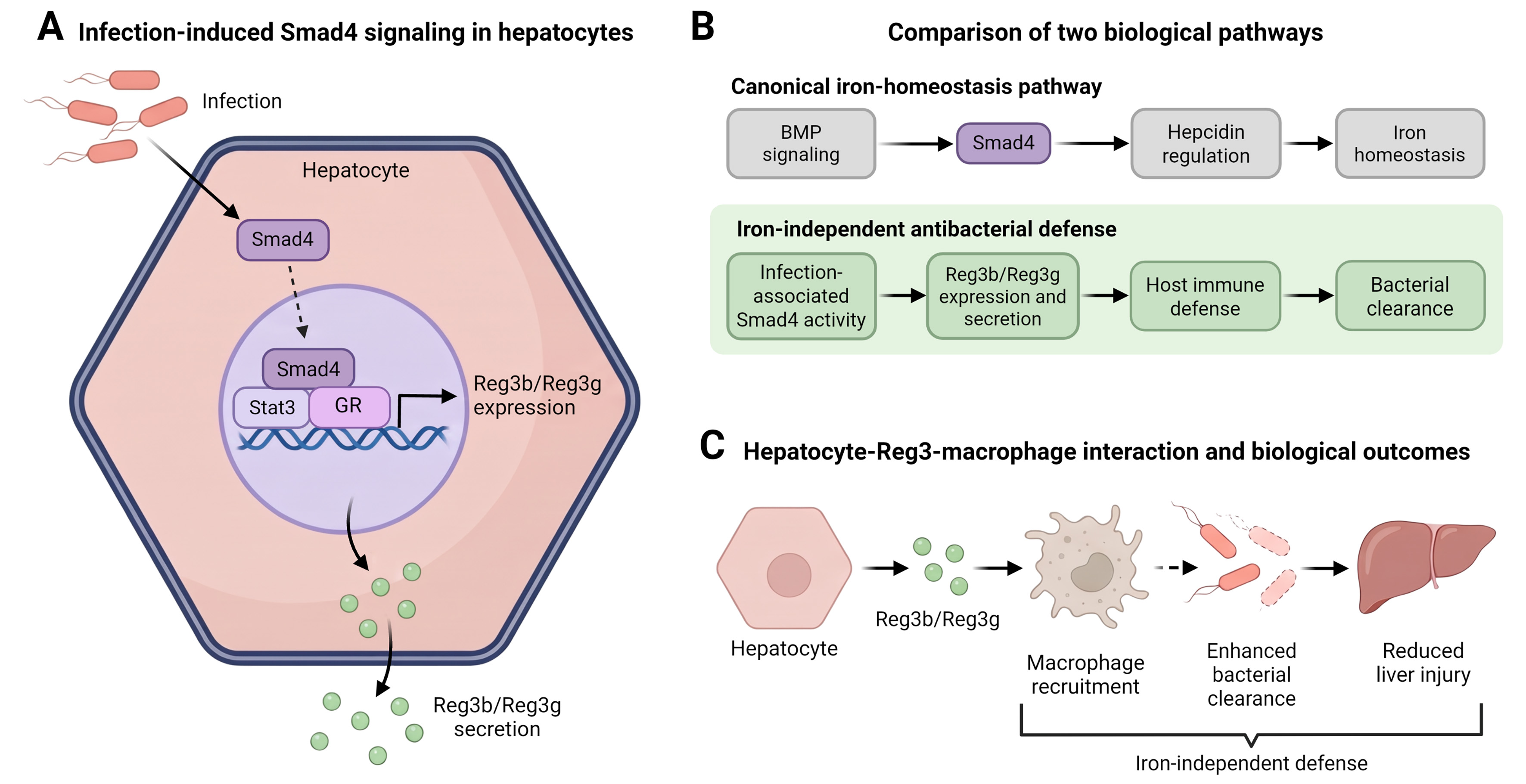
Figure 1. Dual transcriptional programs governed by hepatic Smad4 in iron homeostasis and antibacterial immunity.
(A) Graphic model depicting the iron-independent Smad4-Reg3-macrophage axis mediating hepatic antibacterial host defense. During bacterial infection, hepatocyte-resident Smad4 acts as a transcriptional co-activator together with Stat3 and GR to induce Reg3b and Reg3g expression and secretion. Secreted Reg3 proteins promote macrophage recruitment rather than direct bacterial killing, supporting bacterial clearance and limiting liver tissue injury; (B) Side-by-side comparison of two biologically distinct Smad4-dependent pathways. Upper: canonical BMP-Smad4-hepcidin signaling maintains systemic iron homeostasis. Lower: during bacterial infection, Smad4 cooperates with Stat3-GR complexes to upregulate Reg3b/Reg3g and initiate macrophage-dependent host defense; (C) Working model for the hepatic Smad4-dependent antibacterial response. In the proposed model, infection-associated signals engage hepatocyte Smad4 activity, followed by Reg3b/Reg3g secretion, macrophage recruitment, and bacterial elimination. The upstream signals that redirect Smad4 transcriptional output remain uncharacterized. Under the tested experimental conditions, Reg3-driven host protection is predominantly mediated by immune-cell recruitment, not direct bactericidal effects. Source: Original schematic prepared by the authors for this article. GR: Glucocorticoid receptor; BMP: bone morphogenetic protein.
A Reg3-centered immune-organizing circuit
Transcriptomic analysis identified Reg3b and Reg3g among the prominent genes suppressed by hepatic Smad4 deletion during infection. Treatment of Smad4-deficient animals with recombinant Reg3b and Reg3g improved bacterial clearance and reduced liver injury. Mechanistically, Smad4 functions in a non-canonical transcriptional configuration with Stat3 and the glucocorticoid receptor, facilitating activation of Reg3b and Reg3g rather than simply reproducing its homeostatic BMP-dependent program[1]. This side-by-side comparison of canonical homeostatic versus infection-rewired Smad4 function is illustrated in Figure 1B. This finding illustrates how a common transcriptional mediator can be redirected by inflammatory and stress-responsive partners to generate a context-specific output.
The downstream biology is equally important. Reg3 family proteins are widely recognized for antimicrobial functions at mucosal surfaces[11], but the current study indicates that hepatic Reg3b and Reg3g contribute to systemic antibacterial defense mainly by increasing macrophage accumulation at infected tissues. This interpretation is compatible with earlier evidence that Reg3β can regulate macrophage trafficking in tissue injury[12]. In the infection model, Reg3 proteins showed little direct bactericidal activity against E. coli under the tested conditions and did not substantially increase the intrinsic killing capacity of individual macrophages. Their major effect was organizational: increasing the number of phagocytes positioned where bacterial clearance was required[1].
The Smad4-Reg3 axis provides a mechanistic example of distributed tissue immunity, in which a parenchymal cell helps determine where innate effector cells accumulate. A proposed stepwise working model for this hepatic Smad4-dependent antibacterial cascade is presented in Figure 1C. Human liver single-cell and spatial studies provide a framework for mapping spatially organized interactions between hepatic cell populations and immune-cell states[13].
Unresolved questions and translational boundaries
The study provides evidence for a previously unrecognized pathway; its broader importance will depend on resolving what the pathway does not yet explain. The first question is upstream: what converts hepatic Smad4 from a homeostatic regulator into an infection-responsive co-activator? The study implicates IL-6/STAT3 and glucocorticoid signaling in Reg3 induction. However, how infection coordinates these inputs and how SMAD4 supports their transcriptional activity remain incompletely understood[1]. It will be important to determine whether infection changes Smad4 abundance, localization, complex formation, chromatin occupancy, or other regulatory states, and whether this response is driven by microbial products, inflammatory cytokines, endocrine stress signals, or combinations of these inputs. Clarifying this point is essential because “Smad4 activation” should not be assumed to represent the same molecular event as canonical receptor-SMAD signaling.
A second major gap is the identity of the Reg3-sensing mechanism. The current data place Reg3b and Reg3g upstream of macrophage accumulation, but they do not yet establish which receptor or responding cell converts extracellular Reg3 into a trafficking response. Direct macrophage chemotaxis, activation of endothelial or stromal cells, induction of secondary chemokines, or combinations of these mechanisms remain plausible. Defining the receptor would do more than complete the pathway diagram: it could identify a therapeutically more tractable node than Smad4 itself. It will also be necessary to determine which macrophage states are recruited and whether Reg3 affects monocytes, neutrophils, dendritic cells, or other innate populations. Macrophage accumulation is not intrinsically beneficial in every inflammatory setting, so the phenotype, timing, and tissue localization of recruited cells will matter as much as their number.
Third, the boundaries of the antibacterial phenotype remain to be mapped. Protection against both E. coli and S. aureus suggests that the pathway is not restricted to a single bacterial class, but two experimental pathogens cannot establish broad-spectrum host-defense activity. Studies across additional Gram-negative and Gram-positive organisms, distinct routes of infection, and polymicrobial sepsis models could reveal whether the pathway responds to conserved inflammatory cues or to pathogen-specific programs. Similarly, the observation that Reg3 proteins have little direct bactericidal activity against E. coli under the conditions tested should not be generalized to every Reg3 family member, microorganism, concentration, or tissue environment.
Fourth, “iron-independent” should be interpreted as functional separability rather than complete biological independence. Iron restriction remains an established component of nutritional immunity, and the new Reg3 pathway may interact with iron-dependent defense at other stages of infection. Double-perturbation experiments, temporal profiling, and rescue studies under iron deficiency, iron repletion, and iron overload could determine whether the two Smad4 outputs act in parallel, sequentially, or redundantly. Such work would sharpen the central conceptual claim by defining where the pathways separate and where they converge.
The fifth and most important translational question is whether the same circuit operates in humans. The current evidence is compelling but predominantly experimental. Human studies should test whether hepatic SMAD4 activity, expression of human REG3-family members, and macrophage localization are associated during bacterial infection or sepsis. Any biomarker role for REG3 proteins should also be distinguished from a causal immune function. Sepsis is characterized by simultaneous inflammatory activation and immune dysfunction[14], and a pathway that is protective in a controlled mouse infection may behave differently across human disease stages, comorbidities, microbial burdens, and treatment exposures.
Finally, therapeutic manipulation remains a distant but interesting possibility. Directly increasing Smad4 activity is unlikely to be a simple strategy because Smad4 participates broadly in development, tissue repair, fibrosis, tumor biology, and metabolic regulation. Manipulating STAT3 or glucocorticoid-receptor signaling would raise similarly broad concerns. Downstream intervention at the Reg3 receptor, once identified, or liver-targeted modulation of the infection-specific transcriptional complex may offer greater selectivity. Before host-directed therapy is considered, studies will need to establish dose-response relationships, treatment windows, reversibility, and the risk that excessive macrophage recruitment could amplify tissue injury rather than improve bacterial control.
OUTLOOK
The work by Chen et al. represents a significant contribution that expands the biological meaning of hepatic Smad4. Its established role in hepcidin regulation remains intact, but it is now complemented by evidence for an infection-associated program linking hepatocyte transcription to Reg3-dependent immune-cell recruitment[1]. These findings suggest that hepatocytes may participate more directly in the architecture of innate immunity. The broader lesson is that metabolic organs can participate in host defense not only by controlling nutrients available to pathogens, but also by organizing the location and behavior of immune cells. Collectively, these experimental findings identify a potentially important connection between liver immunometabolism and organ-level antibacterial defense. Defining the upstream signals, the Reg3-sensing mechanism, and the relevance in human infection will be essential to establish its broader biological and translational significance.
The next phase should therefore move from pathway discovery to boundary definition. Identifying the upstream infection signal, the Reg3 receptor, the responding immune-cell states, and the human counterpart of the pathway will determine whether the Smad4-Reg3 axis becomes primarily a conceptual advance, a biomarker framework, or a therapeutic opportunity. For now, the strongest conclusion is not that Smad4 or Reg3 should be targeted clinically, but that hepatocyte-directed immune coordination represents an underappreciated layer of antibacterial defense. By revealing that iron homeostasis and immune-cell recruitment can be functionally separated downstream of the same hepatic regulator, this study opens a productive and exciting set of questions at the intersection of metabolism, organ crosstalk, and innate immunity.
DECLARATIONS
Acknowledgments
Graphical abstract/Figure 1 was created with BioRender.com.
Authors’ contributions
Contributed equally to the conception and writing of this editorial: Vanden Berghe, T.; Muckenthaler, M.
Availability of data and materials
Not applicable.
AI and AI-assisted tools statement
During preparation of this editorial, the authors used ChatGPT (OpenAI) to assist with drafting and language editing. The authors critically reviewed and revised the generated material, verified the scientific statements and references. Both authors take full responsibility for the accuracy, integrity, and final content of the manuscript.
Financial support and sponsorship
None.
Conflicts of interest
Vanden Berghe, T. is a Deputy Editor of the journal Element. Muckenthaler, M. is an Associate Editor of the journal Element. Vanden Berghe, T. and Muckenthaler, M. were not involved in any steps of editorial processing, notably including reviewers’ selection, manuscript handling, and decision-making.
Ethical approval and consent to participate
Not applicable.
Consent for publication
Not applicable.
Copyright
© The Author(s) 2026.
REFERENCES
1. Chen, L. et al. Hepatic Smad4 mediates antibacterial defense via macrophage recruitment. Element. 1, 9 (2026).
2. Mantovani, A. ; Garlanda, C. Humoral innate immunity and acute-phase proteins. N. Engl. J. Med. 388, 439-52 (2023).
3. Zhang, W. J.; Li, K. Y.; Huang, B. H.; Wang, H.; Wan, S. G.; Zhou, S. C. The hepatocyte in the innate immunity. Virology 576, 111-6 (2022).
5. Wang, R. H. et al. A role of SMAD4 in iron metabolism through the positive regulation of hepcidin expression. Cell Metab. 2, 399-409 (2005).
6. Kowdley, K. V.; Gochanour, E. M.; Sundaram, V.; Shah, R. A.; Handa, P. Hepcidin signaling in health and disease: ironing out the details. Hepatol. Commun. 5, 723-35 (2021).
7. Girelli, D. ; Marchi, G.; Busti, F.; Vianello, A. Iron metabolism in infections: focus on COVID-19. Semin. Hematol. 58, 182-7 (2021).
8. Ni, S. ; Yuan, Y.; Kuang, Y.; Li, X. Iron metabolism and immune regulation. Front. Immunol. 13, 816282 (2022).
9. Pan, Y. et al. Hepcidin sustains Kupffer cell immune defense against bloodstream bacterial infection via gut-derived metabolites in mice. J. Clin. Invest. 135, e189607 (2025).
10. Stefanova, D. et al. Hepcidin protects against lethal Escherichia coli sepsis in mice inoculated with isolates from septic patients. Infect. Immun. 86, e00253-18 (2018).
11. Cash, H. L.; Whitham, C. V.; Behrendt, C. L.; Hooper, L. V. Symbiotic bacteria direct expression of an intestinal bactericidal lectin. Science 313, 1126-30 (2006).
12. Lörchner, H. et al. Myocardial healing requires Reg3β-dependent accumulation of macrophages in the ischemic heart. Nat. Med. 21, 353-62 (2015).
13. Andrews, T. S. et al. Single-cell, single-nucleus, and spatial transcriptomics characterization of the immunological landscape in the healthy and PSC human liver. J. Hepatol. 80, 730-43 (2024).
Cite This Article
 Open Access
How to Cite
Vanden Berghe, T.; Muckenthaler, M. Beyond iron: hepatic Smad4 orchestrates antibacterial host defense. Element 2026, 1, 16. https://dx.doi.org/10.20517/element.2026.34
Download Citation
If you have the appropriate software installed, you can download article citation data to the citation manager of your choice. Simply select your manager software from the list below and click on download.
Export Citation File
Type of Import
Tips on Downloading Citation
Citation Manager File Format
Type of Import
Direct Import: When the Direct Import option is selected (the default state), a dialogue box will give you the option to Save or Open the downloaded citation data. Choosing Open will either launch your citation manager or give you a choice of applications with which to use the metadata. The Save option saves the file locally for later use.
Indirect Import: When the Indirect Import option is selected, the metadata is displayed and may be copied and pasted as needed.
Article Notes
About This Article
Copyright




Data & Comments
Data
 0









Comments
Comments must be written in English. Spam, offensive content, impersonation, and private information will not be permitted. If any comment is reported and identified as inappropriate content by OAE staff, the comment will be removed without notice. If you have any queries or need any help, please contact us at [email protected].