


Multi-electron organic frameworks for ammonium storage
 0
0 
The development of sustainable, high-safety, and low-cost energy storage systems has recently stimulated growing interest in ammonium-ion batteries (AIBs) as a promising option[1]. Benefiting from their unique non-metal characteristic, appropriate hydrated ionic radius, rapid diffusion kinetics, and unique hydrogen-bond-mediated intercalation mechanism, the NH4+ charge carrier exhibits distinct advantages in aqueous environments for energy storage[2]. However, the rational design of anode host materials that simultaneously enable rapid ion transport and efficient electron transfer remains a critical challenge. In particular, most widely reported covalent organic frameworks (COFs) suffer from intrinsically low electrical conductivity, low electron delocalization, and less electron redox, which severely restrict the reversible capacity and cycling stability in AIBs[3,4].
In a recent work published in Science Advances, entitled “Rigid-flexible heptazine-biguanide frameworks enable fast electron delocalization and low-steric-hindrance ammonium-ion storage”, Prof. Liu and co-workers developed a novel rigid–flexible polymeric heptazine–biguanide framework (HBF) as a high-performance anode for NH4+ storage, as illustrated in Figure 1[5]. By integrating planar π-conjugated heptazine units with rotational biguanide linkers, the authors constructed a unique framework that synergistically combines fast electron delocalization with reduced steric hindrance. The rigid heptazine domains provide extended π-conjugation for rapid charge transport, while the flexible biguanide chains effectively expose redox-active C=N sites and facilitate ion coordination. This cooperative design overcomes the intrinsic trade-off between conductivity and active-site utilization in COFs.
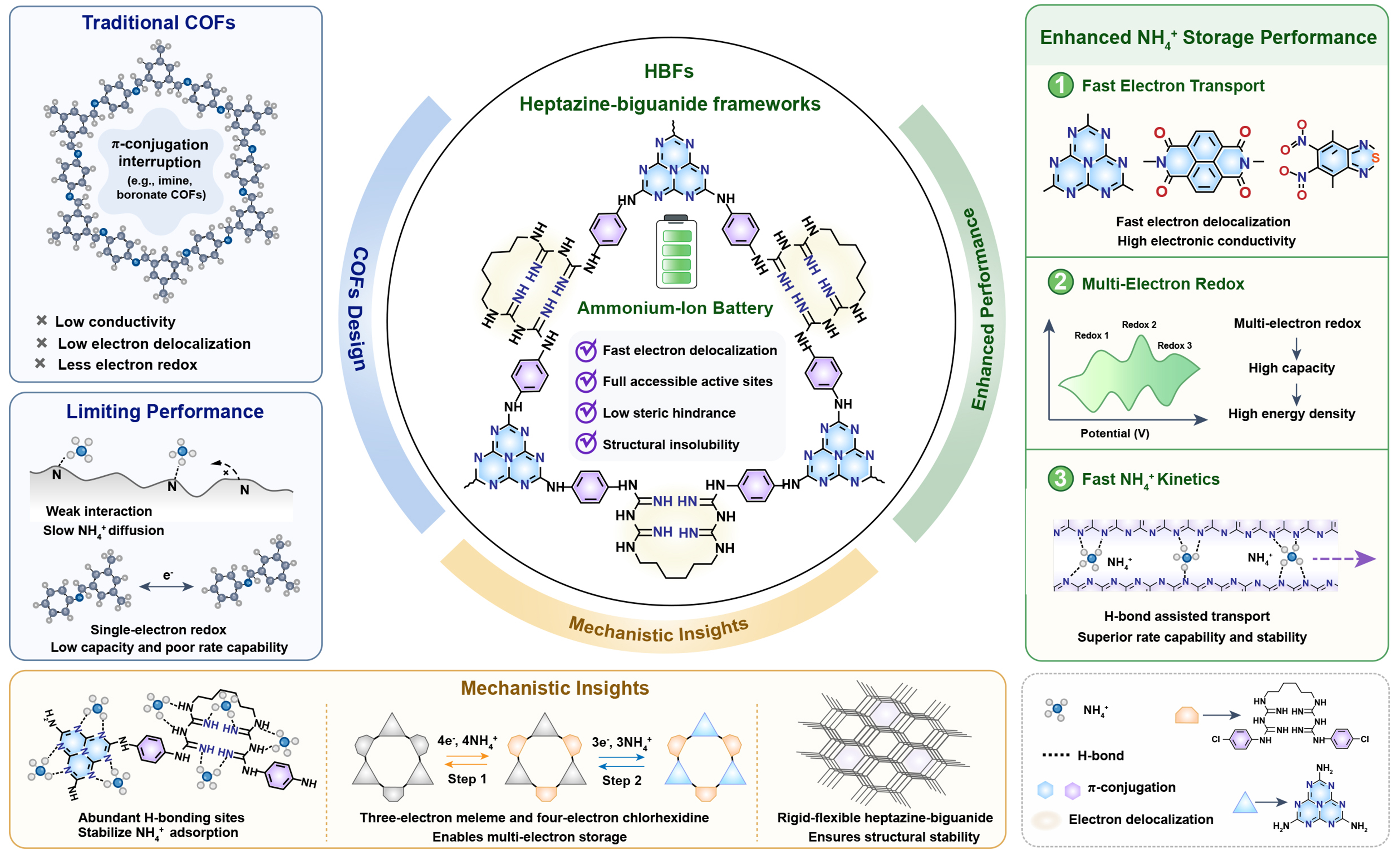
Figure 1. Mechanisms of multi-electron rigid-flexible HBFs for NH4+ storage and prospects for high-performance COFs in AIBs. The figure is adapted from[5]. Copyright © AAAS. HBFs: Heptazine–biguanide frameworks; COFs: covalent organic frameworks; AIBs: ammonium-ion batteries.
Beyond materials design, the research provides fundamental insights into the NH4+ storage mechanism in COFs. The electrochemical energy-storage process is governed by reversible NH4+ transport within the electrode, confirming NH4+ is the dominant charge carrier rather than H+. As presented in Figure 1, the HBFs architecture enables a highly reversible multi-electron storage process involving a seven-electron transfer, governed by synergistic hydrogen-bond interactions and coordination with imine sites. Specifically, NH4+ storage proceeds via a stepwise binding process, where four NH4+ ions are initially accommodated by the four C=N sites of the biguanide unit, followed by the binding of three additional NH4+ ions to the three C=N sites of the heptazine unit. The mechanism not only stabilizes NH4+ within the framework but also facilitates rapid ion transport through dynamic hydrogen-bond networks. Meanwhile, the extended π-conjugation significantly lowers the activation energy (0.15 eV) and ensures efficient electron delocalization[5], while the flexible molecular chains minimize steric hindrance and enable nearly complete utilization of redox-active sites (up to 99.6%). Consequently, the HBFs anode delivers an exceptional reversible capacity of 314 mAh·g-1, and ultralong cycling stability exceeding 120,000 cycles. More importantly, this work establishes a new design paradigm by integrating rigid π-conjugated units with flexible coordination motifs, providing a viable pathway toward high-performance organic electrode materials in COFs.
Overall, this work highlights a promising strategy for advancing AIBs through rational conjugation engineering in COFs. By simultaneously enabling multi-electron redox chemistry and efficient charge transport, such rigid-flexible architectures effectively bridge the gap between molecular-level design and device-level performance. Future efforts may focus on tailoring electronic structures, optimizing ion-framework interactions, and extending this design principle to other COF systems. These advances are expected to accelerate the development of next-generation sustainable energy storage technologies.
DECLARATIONS
Acknowledgments
The author (Zheng, R.) thanks the University of Namur for providing research facilities and technical support.
Authors’ contributions
Drafted the manuscript: Zheng, R.
Manuscript revision: Shu, J.; Li, Y.
Availability of data and materials
Not applicable.
AI and AI-assisted tools statement
Not applicable.
Financial support and sponsorship
This work was supported by the Wallonia Government in the frame of ‘Plan de Relance’ (2310153-BatFactory) and China Scholarship Council (No. 202008330309).
Conflict of interest
All authors declared that there are no conflicts of interest.
Ethical approval and consent to participate
Not applicable.
Consent for publication
Not applicable.
Copyright
© The Author(s) 2026.
REFERENCES
1. Kulkarni, A.; Padwal, C.; Macleod, J.; Sonar, P.; Kim, T.; Dubal, D. Toward safe and reliable aqueous ammonium ion energy storage systems. Adv. Energy. Mater. 2024, 14, 2400702.
2. Zheng, R.; Ding, Y.; Zhang, Y.; et al. Redox chemistry enables excellent capacity and ultra long life aqueous ammonium ion batteries. Angew. Chem. Int. Ed. Engl. 2026, e6628239.
3. Shi, M.; Zhang, X. Pioneering the future: principles, advances, and challenges in organic electrodes for aqueous ammonium-ion batteries. Adv. Mater. 2025, 37, e2415676.
4. Liu, J.; Guo, K.; Guo, W.; Chang, J.; Li, Y.; Bao, F. Superconjugated anthraquinone carbonyl‐based covalent organic framework as anode material for high‐performance aqueous ammonium‐ion batteries. Angew. Chem. Int. Ed. Engl. 2025, 64, e202424494.
Cite This Article
 Open Access
How to Cite
Download Citation
Export Citation File:
Type of Import
Tips on Downloading Citation
Citation Manager File Format
Type of Import
Direct Import: When the Direct Import option is selected (the default state), a dialogue box will give you the option to Save or Open the downloaded citation data. Choosing Open will either launch your citation manager or give you a choice of applications with which to use the metadata. The Save option saves the file locally for later use.
Indirect Import: When the Indirect Import option is selected, the metadata is displayed and may be copied and pasted as needed.
About This Article
Copyright

Data & Comments
Data
0











Comments
Comments must be written in English. Spam, offensive content, impersonation, and private information will not be permitted. If any comment is reported and identified as inappropriate content by OAE staff, the comment will be removed without notice. If you have any queries or need any help, please contact us at [email protected].