

Robotic bedside surgical assistants: a distinct class of surgical robotics
 0
Graphical Abstract
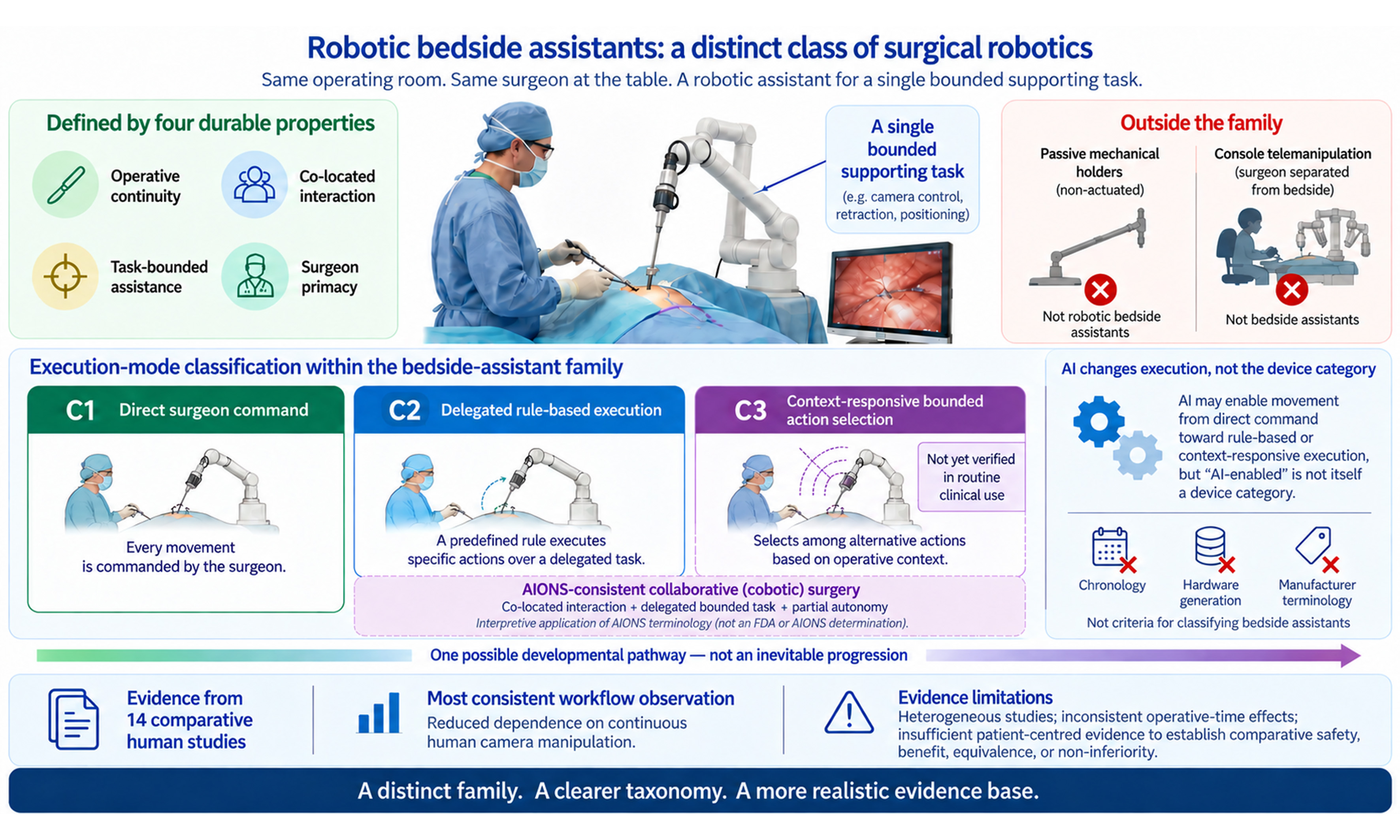
Abstract
Robotic bedside assistants - devices that perform a single bounded supporting task, such as endoscope control, while the surgeon operates from the table with conventional instruments - have been described for three decades without an agreed definition, taxonomy, or evaluation framework, and are increasingly characterized, often loosely, as collaborative or artificial intelligence (AI)-enabled. This review examined the technology landscape using primary regulatory and technical documentation rather than manufacturers’ characterizations, and reconstructed the comparative clinical evidence from the full text of fourteen primary studies rather than abstracts or prior pooled syntheses. Because devices, procedures, and study designs proved markedly heterogeneous, no quantitative pooled synthesis was undertaken; findings are reported narratively. We propose that control and task-execution mode - direct surgeon command (C1), delegated rule-based execution (C2), and context-responsive bounded action selection (C3) - provides a more informative classification than device generation or marketing terminology, and distinguishes bedside-assistant family membership, defined by operative continuity, co-located interaction, task-bounded assistance, and surgeon primacy, from the narrower designation of Artificial Intelligence Organization for the Next Generation of Surgeons (AIONS)-consistent collaborative (cobotic) surgery, which additionally requires delegated, partially autonomous execution. The clearest recurring finding is task reallocation - reduced dependence on continuous human camera manipulation - while operative-time results are inconsistent in direction and patient-centred outcomes remain too sparse to establish comparative safety, benefit, equivalence, or non-inferiority. AI, where verified, modifies execution rather than defining a new device category: documented functions remain predominantly C1 or C2, with context-responsive assistance remaining unverified in routine use. We propose a minimum reporting set, a three-tier outcome hierarchy, and a staged evaluation agenda.
Keywords


 Download PDF
INTRODUCTION
Minimally invasive surgery is now the default approach to a large share of abdominal and thoracic operations, valued for reduced access trauma, faster recovery, and improved convalescence relative to open surgery[1,2]. Yet conventional laparoscopy retains a structural dependency that has changed little in three decades: it requires a second pair of hands to hold and direct the endoscope. The quality of that assistance - its steadiness, its anticipation, its coordination with the operating surgeon - shapes visualization, operative rhythm, and cognitive load, and it varies with the assistant’s experience, fatigue, and communication.
Two very different robotic responses have emerged. The first, telemanipulation, removes the surgeon from the table altogether, relocating them to a console separated from the bedside workspace; it expands what is technically achievable and now dominates the discourse and economics of surgical robotics[3-7]. The second, quieter response keeps the surgeon at the table with conventional instruments in hand and instead assigns a single bounded supporting task - most often camera control, sometimes retraction or positioning - to a robotic assistant working alongside them. Devices of this kind have existed since the mid-1990s, evolving from voice- and head-controlled scope holders[8-15] through image-guided tracking systems[16,17] to contemporary co-manipulative platforms[18,19]. They have not yet coalesced into a consistently defined clinical and technological category.
This is the problem the present review addresses. Despite a literature spanning thirty years and dozens of devices, robotic bedside assistants lack an agreed definition, a coherent taxonomy, and an evaluation suited to what they actually do. They are described interchangeably as camera holders, scope manipulators, solo-surgery systems, and, increasingly and often loosely, as “Artificial intelligence (AI) - enabled” or “collaborative” robots. The evidence base is correspondingly fragmented and dominated by demonstrations of feasibility rather than tests of benefit. Two claims in particular are asserted more often than they are examined: that these systems constitute a distinct class of collaborative robotic surgery, and that they represent an early, low-risk step toward AI-enabled surgery.
The recent Artificial Intelligence Organization for the Next Generation of Surgeons (AIONS) consensus on definitions of AI surgery, robotics, and surgomics[20] has, for the first time, supplied ratified terminology for this space - including a definition of collaborative (cobotic) surgery grounded in the co-located presence of surgeon and robot and in shared, bounded task execution. That consensus deliberately stopped at definition. It did not test which existing devices meet its criteria, what the clinical evidence for them shows, why their adoption has remained limited, or whether the trajectory it implies toward AI-enabled surgery is real.
This review takes up exactly that task and positions itself as the clinical and translational extension of the AIONS taxonomy[20]: where the consensus defined the concept, we examine the class against it. A clarification is essential at the outset. “Bedside assistant” denotes a broad device family united by physical presence at the operating table; it is not a synonym for cobotic. Only a subset of these systems - those combining co-located interaction with genuine partial autonomy - satisfies the AIONS definition of collaborative surgery[20]. The legacy surgeon-commanded scope holders that make up most of the historical literature are not, by default, cobotic. Preserving that distinction is central to the argument that follows.
Three concrete examples make the relationship explicit. A voice-controlled Automated Endoscopic System for Optical Positioning (AESOP) holder is a bedside assistant but not cobotic: it is co-located but delegates no sustained, partially autonomous execution. AutoLap with its Follow Me function, and Maestro with ScoPilot, are bedside assistants that also satisfy the AIONS lower boundary for collaborative surgery on the interpretive reading proposed here, because they execute a delegated view-keeping task with rule-based partial autonomy under continuous surgeon supervision. A console telemanipulator such as the da Vinci system is not, because the surgeon is not co-located and the principal operative work is performed through proprietary articulated instruments under indirect control. The distinction therefore rests on system capability and control architecture - whether the system is designed to perform a bounded supporting task, which may be delegated with partial autonomy - rather than on intraoperative role alone: a telemanipulator used in an assisting role remains a telemanipulator, and a bedside assistant confined to camera work remains a bedside assistant even when a human performs the dissection. The overlap between the bedside-assistant family and the AIONS-consistent cobotic category is shown as the shaded zone in Figure 1.
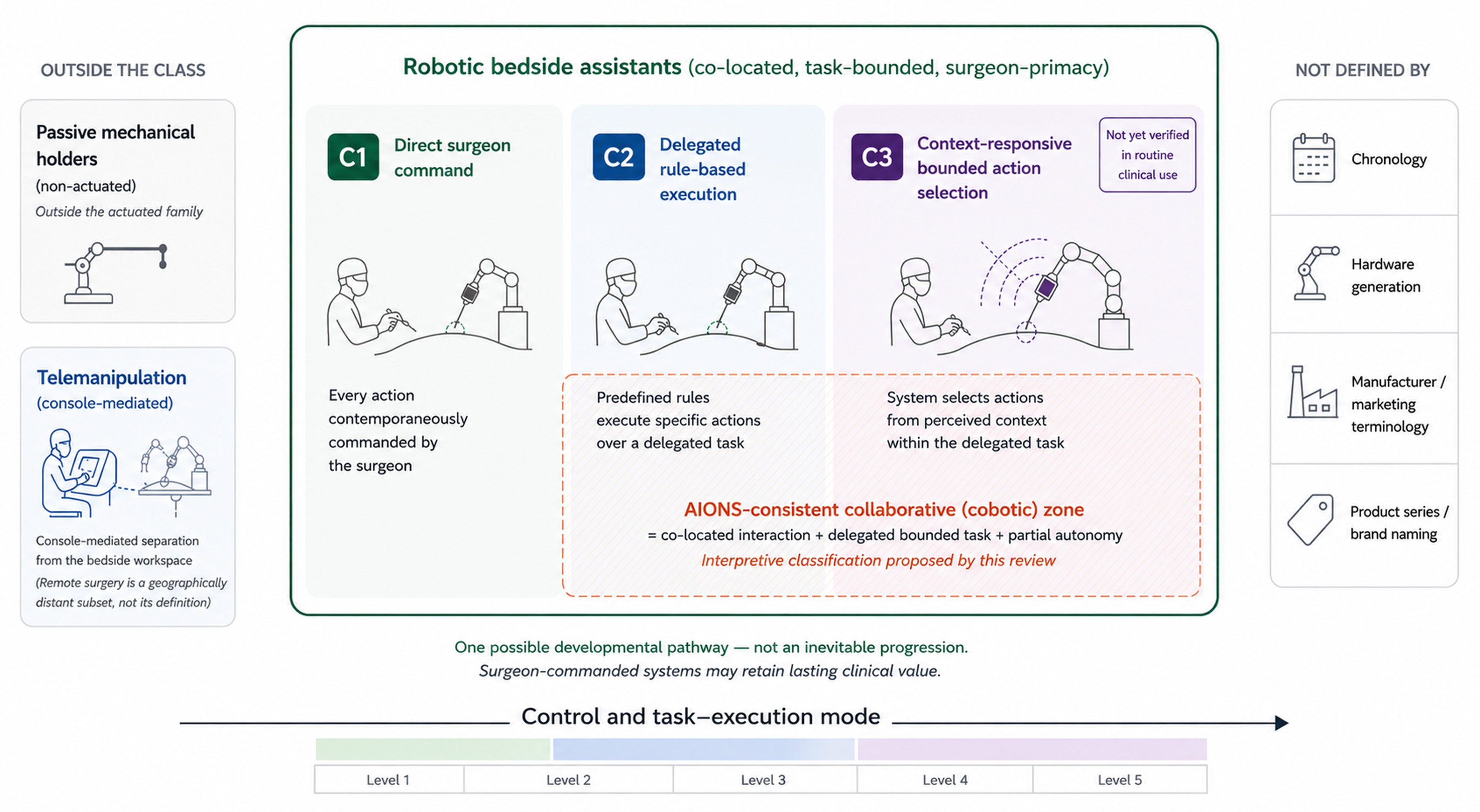
Figure 1. The robotic bedside-assistant class, organized by control and task-execution mode. Robotic bedside assistants constitute a distinct class of surgical robotics defined by operative continuity, co-located interaction, task-bounded assistance, and surgeon primacy. Within this class, systems are classified according to C1, C2, and C3. Passive mechanical holders and telemanipulation lie outside the class, while hardware generation, chronology, and manufacturer terminology are not classification criteria. The shaded overlay indicates the AIONS-consistent collaborative (cobotic) surgery zone as interpreted in this review. C3 represents the proposed future boundary of the framework and remains unverified in routine clinical practice. The developmental pathway illustrates one possible direction of evolution rather than an inevitable progression, and the LASR strip is shown only as an approximate reference. C1: Direct surgeon command; C2: Delegated rule-based execution; C3: context-responsive bounded action selection; LASR: Levels of Autonomy in Surgical Robotics.
We advance - and test against the available evidence - three propositions. First, that robotic bedside assistants are best understood not as automated camera holders but as a distinct modality of surgical robotics, organized more informatively by control architecture than by device generation. Second, that most legacy devices execute their task under direct surgeon command (C1), and that the class is now visibly crossing into partially delegated execution, exemplified by early regulator-cleared instrument-following camera functions [Supplementary Table 1]. Third, that this crossing makes these systems a plausible and testable substrate on which AI-enabled surgery might be developed and validated in a low-risk domain - a pathway to be examined rather than an inevitable progression.
We treat that final proposition with deliberate restraint. The evidence to date supports feasibility across a wide range of procedures[14,15,21-38]; it has not identified a consistent safety signal in either direction, and comparative safety and clinical benefit remain unproven. We are explicit throughout about where the argument rests on verified evidence, where it rests on this review’s interpretation, and where it rests on reasoned expectation about the future.
APPROACH TO EVIDENCE IDENTIFICATION AND VERIFICATION
This is a state-of-the-art Review, not a systematic review or meta-analysis, and no Preferred Reporting Items for Systematic Reviews and Meta-Analyses (PRISMA) workflow, formal risk-of-bias scoring, or pooled quantitative synthesis was undertaken. Device classifications were checked against United States Food and Drug Administration (FDA) decision summaries, notified-body and European Conformity (CE) documentation, instructions for use, and peer-reviewed technical descriptions where these were publicly available; where only manufacturer material could be located, this is stated explicitly rather than treated as independent confirmation of regulatory status. Comparative clinical claims were verified against the full text of primary studies rather than abstracts, and cross-checked for shared cohorts, institutions, or research programs to avoid double-counting related findings as independent confirmation; two studies identified during this process were subsequently excluded on full-text review (see “Clinical Evidence”). The underlying devices, procedures, and study designs proved markedly heterogeneous in control architecture, clinical context, and design; findings are therefore synthesized narratively rather than pooled, and no forest plot, pooled effect estimate, or Grading of Recommendations Assessment, Development and Evaluation (GRADE) certainty rating is presented. Where a regulatory date, clearance status, or technical claim could not be verified against a primary or peer-reviewed source, it is stated in the text as corroborated only by secondary or manufacturer material.
Candidate devices and studies were identified by searching PubMed/MEDLINE, Embase, Scopus, and Google Scholar from database inception to August 2026, combining terms for the device class (for example robotic camera holder, scope holder, laparoscope positioner, solo surgery, and named systems such as AESOP, EndoAssist, FreeHand, ViKY, SoloAssist, AutoLap, EMARO, and Maestro/ScoPilot) with terms for comparison (human assistant, comparative, randomized, operative time, outcomes), supplemented by backward and forward citation searching of retrieved articles and prior reviews and by querying regulatory databases [FDA 510(k) and De Novo; EU CE/EUDAMED]. For the comparative clinical evidence, a study was eligible if it compared a robotic bedside camera or positioning assistant with human assistance, or with a solo-surgery configuration, in human patients and reported at least one operative, workflow, ergonomic, or patient-centred outcome; simulator, cadaveric, and animal-model studies were excluded, as were single-arm feasibility reports lacking a human comparator. Where cohorts or institutional series overlapped, related reports were retained but flagged as non-independent rather than excluded. The literature search was updated through August 2026. This account is provided to make identification transparent and reproducible; it does not convert the article into a systematic review, and no PRISMA flow diagram, formal risk-of-bias scoring, or quantitative synthesis was undertaken. All regulatory clearances, commercial availability, and software functionality described in this review were last verified in August 2026 and are subject to change.
DEFINING THE CLASS
The bedside-assistant device family
Robotic bedside assistants are best defined first by what unites them as a family and only then by what divides them into meaningful sub-types. The unifying feature is deceptively simple: the device occupies the operative field alongside the surgeon and assumes a supporting task that would otherwise fall to a human assistant, while the surgeon continues to perform the operation. Four characteristics follow from this and together demarcate the family from adjacent technologies.
First, operative continuity: the surgeon continues to perform the principal operative manoeuvres directly, using conventional or substantially conventional minimally invasive instruments, while the system supports a bounded assistant task. This does not require identical ports or wholly standard equipment; it requires that the core operative work remain in the surgeon’s own hands rather than being transferred to proprietary articulated instruments under indirect control. Second, co-located interaction: the robot and the surgeon share a single physical workspace at the table, in contact with the patient - the surgeon is not relocated to a separate console. Third, task-bounded assistance: the device supports one delimited function - endoscope control, retraction, organ positioning - rather than mediating the whole procedure. Fourth, surgeon primacy: the operating surgeon remains the primary operator and decision-maker; the device executes or stabilizes a task within the limits the surgeon sets and can override at any moment.
These criteria draw a clean boundary against telemanipulation, which breaks operative continuity and co-located interaction at once. They also exclude passive mechanical holders with no actuation or control system: these assist positioning but do not participate in the operative task in any responsive sense, and are treated here as non-actuated assistance, outside the actuated family rather than as a zero-capability member of it. What remains inside the boundary is a large and heterogeneous family - three decades of scope holders, manipulators, solo-surgery systems, and co-manipulative assistants - and it is this heterogeneity that the remainder of this section resolves.
Three modes of bedside assistance
The family divides according to how the supporting task is controlled - specifically, where each intraoperative action originates. This is a more reproducible basis for classification than “autonomy”, a term that invites disagreement about thresholds. The operative question is concrete: for any given movement of the device, what determined it - a direct surgeon command, a predefined rule triggered by a set condition, or a selection the system made from its reading of the current context? Three modes follow, and we introduce the shorthand C1-C3 used throughout the remainder of this review.
C1 - surgeon-commanded bedside assistance. Every action of the device is directly and contemporaneously commanded by the surgeon, through a voice interface, head-tracking, a foot pedal, or a handle. The device supplies steadiness and eliminates a human assistant’s tremor and drift, but originates no action of its own. The great majority of the historical camera-holder literature describes systems of this kind.
Delegated rule-based execution (C2) - automation-assisted bedside collaboration. The device executes predefined, rule-based behaviours triggered by specified conditions: recentring the endoscope on a marked instrument, returning to a stored viewpoint, or maintaining a fixed spatial relationship to a tracked target. Action here is not contemporaneously commanded for each movement - distinguishing this mode from C1 - but neither is it independently chosen - distinguishing it from C3. Much of what is marketed as intelligent or AI-enabled camera control belongs here: instrument-following and automated recentring are rule executions over a tracked feature, not context-dependent decisions, unless it is demonstrated that the system is selecting among possible actions rather than applying a fixed mapping.
Context-responsive bounded action selection (C3) - partially autonomous robotic assistance. The device selects an action from its interpretation of the current operative context, rather than executing a single predefined rule. The surgeon supervises continuously and retains override, and the autonomy remains narrow and bounded to the assistant task.
These modes correspond closely to an autonomy-based reading - C1 maintaining a surgeon-set position or executing contemporaneous commands, C2 moving the endoscope or instrument automatically in response to a defined trigger, and C3 selecting an action from the system’s own interpretation of context - but they are defined here by the origin of each action rather than by autonomy level, because autonomy invites disagreement about thresholds whereas the origin of a given movement is comparatively concrete and recoverable from a device’s documentation.
The dividing line the field most often blurs runs between C2 and C3. The operative test is whether the system merely executes a predefined rule over a perceived feature, or independently selects an action from perceived context. Only the latter meets the C3 definition, and, as later sections establish, it is a test the current literature rarely reports enough information to perform.
Explicit decision rules make this classification reproducible. A system is classified as C1 when every device movement is contemporaneously commanded by the surgeon (by voice, head-tracking, foot pedal, or handle). It is classified as C2 when the device executes a fixed, predefined mapping triggered by a specified condition or a tracked feature - for example, recentring on a surgeon-tagged instrument - without contemporaneous command for each movement. It is classified as C3 only when published documentation demonstrates that the device selects among alternative actions on the basis of an interpretation of operative context rather than applying a fixed rule; where the available documentation is insufficient to demonstrate context-based selection, the system is classified conservatively as C2. On this last rule, no system in the present review met the evidentiary threshold for C3 in routine clinical use.
AIONS-consistent collaborative (cobotic) surgery: a separate classification
AIONS consistency is a separate classification from control mode, not a synonym for the highest mode. The consensus defines collaborative surgery by three conjoint requirements: co-located interaction, delegation of a bounded task, and partial autonomy in executing it - the device carries out the delegated task without continuous, action-by-action surgeon command[20]. These requirements cut across the three modes rather than mapping onto the highest one.
C1 does not meet them: nothing is delegated. C3 clearly meets them. The consequential case is C2. Some C2 systems meet the AIONS lower boundary for collaborative surgery: if a device executes a delegated task over a sustained interval without the surgeon commanding each movement, a bounded task has genuinely been handed over. Others do not: a system that repositions on a single triggered condition and reverts immediately to surgeon command has not been delegated a task in any sustained sense. Whether a given C2 device meets the AIONS lower boundary is an empirical question about how much bounded execution is actually delegated - one the published literature frequently does not provide enough detail to answer, and one on which this review’s own classifications, where offered, are its interpretive application of the AIONS criteria rather than determinations made by the consensus itself.
The core relationship, and a caution against teleology
Bedside assistance is the broad device family. Co-located interaction is necessary but not sufficient for collaborative surgery in the AIONS sense: a device can share the surgeon’s workspace and still be no more than C1. What collaborative surgery additionally requires is partial autonomy together with shared, bounded task execution.
It would be easy, and mistaken, to read C1→C2→C3 as a ladder every device is destined to climb. Partial autonomy is one emerging pathway for the family, visible in a small number of recent platforms; it is not a trajectory the whole family is bound to follow, nor a hierarchy of clinical value. A deliberately surgeon-commanded system may remain the right choice for a given procedure, team, or setting, and may retain clinical value indefinitely even as other devices acquire context-responsive capabilities. The modes classify how a device works, not how advanced or desirable it is.
Positioning the class: two axes
Locating the family requires two conceptual axes, because the two frameworks the field already possesses each capture only one. LASR (Levels of Autonomy in Surgical Robotics)[39] arranges surgical robots along a single dimension - task autonomy - from Level 1 to Level 5; it cannot distinguish a console-mediated telemanipulator from a co-located bedside assistant at the same nominal level, since interaction configuration is not one of its dimensions. AIONS[20] supplies that missing dimension - co-located interaction - but as a definitional criterion rather than a continuous scale.
Placed at right angles, the two ideas define the plane on which the class lives [Figure 1]. The horizontal axis is control and task-execution mode - referred to as execution mode throughout the remainder of this review - spanning C1 through C2 to C3, with LASR levels available beneath it as an approximate reference band rather than a one-to-one mapping. The vertical axis is interaction configuration - from console-mediated separation from the bedside workspace (of which geographically distant remote surgery is one case, not the definition) to a co-located, shared bedside workspace. Telemanipulation occupies the console-mediated band; non-actuated holders sit outside the plotted taxonomy; robotic bedside assistants occupy the co-located band across a range of execution-mode positions. The AIONS-consistent cobotic zone is drawn as an overlay enclosing the C3 region together with the portion of the C2 region where sustained bounded execution is genuinely delegated. A light annotation marks the pathway from C1 toward C2/C3 as one emerging direction, not an inevitable progression, noting that surgeon-commanded systems may retain lasting clinical value [Figure 1].
THE TECHNOLOGY LANDSCAPE
Organizing three decades of devices by control and task-execution mode, rather than by chronology or manufacturer, makes the field’s structure legible and exposes where its documentation is thinnest - precisely where classification is most consequential. Classifications below are assigned only from FDA decision summaries, notified-body/CE documentation, instructions for use, or peer-reviewed technical description; where only manufacturer material exists, this is stated explicitly rather than treated as verified [Tables 1 and 2].
Camera-control bedside assistants, by control and task-execution mode
| Device | Manufacturer | Mode | AIONS lower boundary | Regulatory status | Commercial status | Certainty |
| AESOP[9-12,35] | Computer Motion | C1 | No | Cleared 1994; discontinued ~2003 | Discontinued | Moderate |
| EndoSista/EndoAssist[8,15,40] | Armstrong Healthcare | C1 | No | Historical CE-era | Discontinued (→ FreeHand) | Moderate |
| FreeHand[23,26,41] | FreeHand Ltd/Prosurgics | C1 | No | CE-marked; FDA 510(k) K090340 22 May 2009 | Limited | Moderate |
| ViKY[16,22,42,43] | EndoControl | C1 | No | FDA 510(k) K082233 18 Dec 2008 | Active/uncertain availability | Moderate |
| SoloAssist II[24,27,29,31,34] | AKTORmed/Stryker | C1 | No | CE-marked; FDA 510(k) K171947 21 Sep 2018 | Active | Moderate |
| EMARO[36] | Riverfield/Hogy Medical | C1 | No | No FDA/CE/PMDA record identified | Active (Japan) | Low-Moderate |
| FIPS Endoarm[44] | Karlsruhe/Tübingen | C1 | No | Historical prototype | Discontinued | High |
| RoboLens[45] | Mirbagheri et al. | C1 | No | Academic prototype | Prototype | Moderate |
| EvoLap[46] | Herman et al. | C1 | No | Academic prototype | Prototype | Moderate |
| AVROS-P | Accrea | C1 | No | Technical configuration described by manufacturer; regulatory and commercial status not independently verified | Not independently verified | Low |
| Maestro (base)[18,19] | Moon Surgical | C1 | No | FDA 510(k) K221410, 2 Dec 2022; K240598, 3 Jun 2024 | Active | High |
| AutoLap + “Follow Me”[17,28,37] | MST/TransEnterix-Asensus | C2 | Potentially, per this review’s interpretive application of AIONS | FDA 510(k) K152848, 17 Nov 2015 | No longer independently marketed (technology absorbed into Asensus, 2018) | High |
| Maestro + ScoPilot[50] | Moon Surgical | C2 | Potentially, per this review’s interpretive application of AIONS | FDA 510(k) K242323, 14 Mar 2025; PCCP K250984, 27 Jun 2025 | Active | High |
Broader bounded-assistance platforms (Not directly comparable to Table 1)
| Device | Manufacturer | Bounded task | Mode | Regulatory status | Commercial status |
| Levita MARS/Magnetic Surgical System[47] | Levita Magnetics | Magnetic organ/tissue retraction and positioning | C1 | FDA De Novo DEN150007 (2016); 510(k) K223673 (4 Aug 2023) | Active |
C1 - surgeon-commanded devices account for the great majority of named systems. AESOP (Computer Motion; voice-controlled[9-12,35]) is widely and consistently reported across independent peer-reviewed and textbook sources to have received FDA clearance in 1994 as the first such device for intra-abdominal surgery, and to have been discontinued following Computer Motion’s 2003 merger with Intuitive Surgical. The Armstrong Healthcare head-tracking lineage (EndoSista, later EndoAssist[15,40], succeeded by FreeHand[23,26,41]) and EndoControl’s foot- and voice-driven ViKY[16,42,43] share this architecture; ViKY received FDA clearance in December 2008, corroborated by the manufacturer’s registered ClinicalTrials.gov record. AKTORmed’s SoloAssist II[24,27,29,31,34] is CE-marked and received FDA 510(k) clearance in 2018. Riverfield’s head-tracked pneumatic EMARO is used clinically in Japan[36]; no FDA, CE, or Pharmaceuticals and Medical Devices Agency - Japan (PMDA) regulatory record was identified. FreeHand is CE-marked and received FDA 510(k) clearance in 2009. The academic prototypes FIPS Endoarm[44], RoboLens[45], and EvoLap[46] were research systems, never commercialized.
Levita’s Magnetic-Assisted Robotic Surgery (MARS) belongs in the same control tier, though its bounded task is magnetic organ retraction and positioning, rather than camera control[47] - a distinct assistance category reported separately [Table 2]. The Levita Magnetic Surgical System received an FDA De Novo classification in 2016 (DEN150007) for magnetic surgical retraction, and the MARS robotic endoscope-holder arm received a 510(k) clearance in 2023 (K223673, 4 August 2023); these identifiers were checked against the FDA device databases (last verified August 2026).
The base Moon Surgical Maestro platform also belongs here: its FDA summary (510(k) K221410, cleared 2 December 2022; design-change 510(k) K240598, cleared 3 June 2024) states that conventional instruments are exclusively controlled by the surgeon, with the arms following direct movement and holding position once hand force is removed. Under the AIONS criteria[20], none of these devices is cobotic.
C2 - delegated rule-based devices form a much smaller tier. Medical Surgery Technologies (MST)’s AutoLap, with its “Follow Me” software [510(k) K152848, FDA decision 17 November 2015; first clinical experience reported by Wijsman et al.[17]], let the laparoscope follow a surgeon-tagged instrument under a fixed, static computer-vision model - a genuine handover of view-keeping, though the standalone product is no longer independently marketed, its technology having been incorporated into the TransEnterix/Asensus ecosystem following a 2018 acquisition. The contemporary instance is Maestro’s ScoPilot function [510(k) K242323, cleared 14 March 2025], whose summary describes the scope following a surgeon-chosen instrument tip when commanded, using a fixed, static instrument-identification model. A subsequent clearance [510(k) K250984, 27 June 2025] authorized fleet connectivity together with a predetermined change control plan covering pre-specified, bounded modifications only, not unrestricted or continuously self-learning adaptation.
On the criteria set out in the preceding section, both AutoLap+Follow Me and Maestro+ScoPilot are potentially consistent with the AIONS lower boundary for collaborative surgery - co-located interaction, a sustained delegated view-keeping task, and rule-based partial autonomy under continuous surgeon supervision and override - though this is the interpretive application of the consensus proposed by this review, not a determination made by AIONS itself or by the FDA.
C3 - context-responsive devices. Among bedside-assistant systems with sufficiently detailed public regulatory or technical documentation, no routine clinical function was confirmed to perform context-responsive selection among alternative actions. Systems marketed as “AI-enabled”, “intelligent”, or “autonomous” are, on inspection of their cleared descriptions, either C1 or fixed-model C2 followers. This absence of verification should not be read as evidence that context-responsive systems do not exist; it reflects the current absence of sufficiently detailed public documentation demonstrating their routine clinical deployment.
The pattern across tiers is itself a finding. C1 devices, easiest to classify, are the best documented; C2 and cobotic-boundary devices, where classification is consequential, are described in terms that rarely permit the C2/C3 or cobotic-consistency test to be applied without a primary regulatory document. Several devices in the historical record - EMARO regarding its regulatory status outside Japan, ViKY’s current availability, and the AVROS-P platform in its entirety - remain corroborated only by manufacturer material and are reported as such in Table 1. This reporting deficit motivates the standardized reporting proposal developed later in this review.
Concise summaries of the FDA decision documents supporting the classification of commercially available systems are provided in Supplementary Table 1.
CLINICAL EVIDENCE
Commercial and regulatory maturity have outpaced comparative clinical evidence by a wide margin. Several systems have been cleared and deployed - some across hundreds or thousands of manufacturer-reported cases - yet the comparative studies that would establish whether they help patients remain few, small, heterogeneous, and methodologically limited. This section returns to fourteen verified comparative human studies, extracted from primary full text rather than abstracts or a prior pooled synthesis, and reports their direction and limitations narratively; no pooled estimate is used, because devices of different control modes and procedures of differing difficulty do not aggregate into a single number.
Two additional studies identified during source verification were assessed for eligibility and excluded.
Clinical evidence - comparative human studies (n = 14)
| Study | Design | Device (mode) | Procedure/N | Comparator | Key finding | Limitation |
| den Boer et al., 2002[21] | Multicentre RCT | AESOP, active (C1); PASSIST is passive, non-actuated, and not classified | CCE; 78 (39/39) | Human assistant | OR time NS; repositionings fewer (49 vs. 114, P < 0.001); no conversions | Active robot only 10/78 |
| Kraft et al., 2004[35] | RCT | AESOP 3000 (C1) | CCE + TAPP; 240 | Human assistant | TAPP OR time longer (39 vs. 45, P = 0.02); 14 conversions to human assistance | Older AESOP; unblinded |
| Aiono et al., 2002[14] | RCT | EndoAssist (C1) | CCE; 86 | Human assistant | OR time 66 min vs. 74 min (P = 0.049), not clinically significant per authors | Device-maker co-author |
| Kalteis et al., 2007[30] | Case-control, matched | AESOP 2000, solo (C1) | CCE; 72 vs. 72 | Human-assisted | Time equivalent; complications/conversion “at least equal” (authors’ wording) | Selection bias (surgeon preference) |
| Ohmura et al., 2018[29] | Retrospective before/after | SoloAssist II (C1) | CCE; 382 | Human assistant | Fewer surgeons; OR time shorter | Era confounding; shares team with Ohmura et al. 2019’s series |
| Wijsman et al., 2019[37] | RCT, NCT03339960 | AutoLap (C2) | Mixed laparoscopy; 30 | Human camera control | Assistant RULA/workload improved; surgeon unchanged | n = 30; Manufacturer-linked authors |
| Wijsman et al., 2022[28] | RCT, NCT02934542 | AutoLap (C2) | Mixed laparoscopy; 100 | Human camera control | 1/50 conversion to human assistance; OR time NS (60 vs. 53, P = 0.122) | Single centre |
| Kim et al., 2019[27] | Retrospective, time-split | SoloAssist II (C1) | Colon cancer; 76 | Human assistant | OR time, LOS, conversion all NS | Retrospective; single surgeon |
| Ohmura et al., 2019[24] | Retrospective, PS-matched | SoloAssist II (C1) | Colorectal cancer; 273 | Human assistant | Fewer surgeons (P < 0.01); OR time NS overall | Era-based allocation; shares team with Ohmura et al. 2018[29] and Ohmura et al. 2019[31] |
| Proske et al., 2004[25] | Prospective vs. historical control | AESOP 3000 (C1) | CCE + colectomy; 94 | Human assistant (historical) | No difference in OR time, LOS, morbidity | Historical control |
| Samar et al., 2022[26] | Retrospective case-control | FreeHand (C1) | Fundoplication; 44 | Human-assisted | OR time shorter (129 vs. 165, P < 0.0001) | Underpowered |
| Cawich et al., 2024[23] | Prospective concurrent pilot | FreeHand (C1) | Colectomy; 23 | Human-assisted | OR time shorter (95 vs. 106, P = 0.045); 0 conversions to human assistance | Small pilot; selection bias |
| Ohmura et al., 2019[31] | Retrospective comparative | SoloAssist II (C1) | Inguinal hernia (TAPP); 182 | Human assistant | Fewer participating surgeons; operative time not significantly different | Retrospective; non-independent; shares team with Ohmura et al. 2019[24] and Ohmura et al. 2018[29] |
| Gillen et al., 2014[34] | Case-control | SoloAssist (C1) | Cholecystectomy (solo); 123 | Human-assisted | Solo surgery feasible; operative time and outcomes comparable | Independent case-control; selection bias |
Three features of this literature govern any honest reading. The endpoints are dominated by surrogate and process measures - operative time, camera-related process counts, ergonomic and workload scores, personnel numbers - rather than patient-centred outcomes. The studies are heterogeneous in device (AESOP, EndoAssist, SoloAssist, FreeHand, and the C2 system AutoLap), procedure, and design, with outcome definitions varying between reports. Most comparative data are retrospective single-centre series; the few randomized trials - den Boer et al. (2002)[21], Kraft et al. (2004)[35], Aiono et al. (2002)[14], and the two independent Wijsman et al. AutoLap trials (NCT03339960 - 2019[37] and NCT02934542 - 2022[28]) - are old, modest in size, and necessarily unblinded.
The clearest recurring finding is not a patient-outcome effect but a change in task allocation: these devices can reduce dependence on continuous human camera manipulation. Wijsman’s efficiency trial[28] completed 49 of 50 robotic procedures without a human camera operator, reducing the team from four members to three, with no significant difference in operative time (60 min vs. 53 min, P = 0.122). Ohmura’s propensity-matched colorectal study[24] found fewer participating surgeons with SoloAssist than with human assistance (2.5 vs. 3.3, P < 0.01), as did the same group’s cholecystectomy series[29] (2.8 vs. 2.3 overall; 2.7 vs. 2.0 in matched elective cases, human vs. robotic assistance, respectively - sharing institution and team with the colorectal series, and reported here as related rather than independent confirmation), and Kim et al. (2019)[27] reported one fewer assistant per case. Cawich et al.’s small pilot (2024)[23] completed all eight FreeHand-assisted colectomies without conversion to human camera control; as a small, non-randomized pilot, this is consistent with the wider task-reallocation finding.
Findings on visualization are weaker and largely subjective, and are attributed here to their specific sources rather than generalized. Aiono et al. (2002)[14] and Proske et al. (2004)[25] reported that surgeons judged the robotic image stable and equivalent to or better than a human-held view, but these were subjective assessments; the one objective process measure, den Boer et al. (2002)[21], found the laparoscope repositioned far less often with a positioner than with an assistant (49 times vs. 114 times, P < 0.001), though that trial’s intervention arm combined a small number of active AESOP cases (n = 10) with a passive mechanical holder and so cannot isolate a robotic effect. Ergonomic benefit, where measured, accrued to the assistant rather than the surgeon: Wijsman et al.’s ergonomics trial (2019)[37] found better posture and lower subjective workload for the first assistant on validated instruments [Rapid Upper Limb Assessment (RULA) 2.55 vs. 3.69, P = 0.001], with the surgeon’s own scores unchanged.
Camera-specific process measures were reported unevenly. Laparoscope-cleaning counts were identical in Wijsman et al.’s efficiency trial[28] (2.0 vs. 2.0), whereas Ohmura et al.’s cholecystectomy series[29] reported fewer cleanings with robotic assistance than with human assistance (0.9 vs. 3.2). Both comparisons were descriptive and were not accompanied by statistical testing. Image-centering did not differ according to den Boer et al.[21] (43% vs. 42%); and Kraft et al.[35] recorded, if anything, more manual camera corrections with the robot than with the assistant during hernia repair.
Operative time points in three directions, and the direction appears to depend on procedure, device, team, and learning curve rather than on any intrinsic property of the class. Some studies reported shorter times: Aiono et al. 2002[14] (66 min vs. 74 min, P = 0.049, though the authors themselves judged this not clinically significant), Ohmura’s cholecystectomy series[29] in elective and emergency cases, Samar et al. 2022[26] (a 36-minute reduction confounded by procedure-mix imbalance and acknowledged underpowering), and Cawich et al. 2024[23] (95 min vs. 106 min, P = 0.045, a small non-randomized, surgeon-selected pilot). Several found no significant difference: den Boer et al. 2002[21], Kalteis et al. 2007[30], Wijsman et al.’s efficiency trial[28], Kim et al. 2019[27], Proske et al. 2004[25], and Ohmura et al.’s colorectal study overall[24]. Kraft et al.’s 240-patient randomized trial[35] - the largest randomized trial in the reviewed evidence base - found the robot required significantly longer times for hernia repair (45 min vs. 39 min, robotic vs. human assistance, respectively; P = 0.02, with longer preparation time as well) alongside device-specific technical problems in roughly a fifth of cases and fourteen conversions from robotic to human assistance. Kraft is the clearest counter-evidence in this literature and is presented with corresponding emphasis here rather than treated as an outlier.
Patient-centred outcomes are sparse and rest on few events. Complications, conversion, and length of stay were most often not significantly different (Kim et al. 2019[27], Proske et al. 2004[25], Ohmura et al.’s colorectal series[24], Cawich et al. 2024[23] - the last also finding no difference in nodal harvest or resection margins), and conversion events were uncommon and inconsistently reported, leaving the available studies unable to exclude clinically relevant benefit or harm. Where shorter length of stay was reported (Kalteis et al. 2007[30]; Ohmura et al.’s cholecystectomy series[29]), a selection-based or before/after design leaves the finding confounded. Although these two retrospective studies described their devices as “not inferior” or “equivalent” in the original authors’ own wording, neither was designed or powered as a formal equivalence or non-inferiority trial, and the evidence base as a whole cannot establish comparative safety, equivalence, non-inferiority, benefit, or harm. Across a reported experience of many hundreds of procedures, no consistent safety signal has emerged in either direction, and no device-specific complication pattern was observed beyond the older AESOP generation in Kraft et al. 2004[35].
The newer C2 function has, to date, been evaluated almost entirely through feasibility and Idea, Development, Exploration, Assessment and Long-term study (IDEAL) - stage development work[17-19,50] rather than through comparative trials with patient-centred endpoints. These establish that a delegated automated camera-control function can be used in real procedures; they do not establish that it changes outcomes.
The most defensible summary is a careful one. Robotic bedside assistants are technically feasible across a wide range of procedures and can reproduce the camera-holding function of a human assistant while reducing dependence on continuous human camera manipulation. Beyond that workflow effect, the literature offers subjective and process-level signals of stable visualization and improved assistant ergonomics, inconsistent effects on operative time, including the largest randomized trial in the reviewed evidence base showing them longer, and no demonstrated improvement in patient-centred outcomes. That a technology intended to influence visualization, workflow, and outcomes has been evaluated so largely through process surrogates, three decades after its introduction, is itself a central finding of this review and motivates the evaluation framework developed later in this review.
THE ADOPTION PARADOX
Three decades after the first robotic camera holder was introduced into clinical use, bedside assistants remain a marginal presence in most operating rooms - but “poorly adopted” is too blunt a description. The field’s history is one of discontinued legacy systems (AESOP[9-12,35], withdrawn after Computer Motion’s 2003 merger with Intuitive Surgical; the EndoSista/EndoAssist lineage[15,40], superseded by FreeHand[23,26,41]; AutoLap[17,28,37], no longer independently marketed), confined regional uptake (SoloAssist[24,29,31] across a handful of German and Japanese centres, EMARO[36] chiefly within Japan, FreeHand and ViKY[16,22,42,43] in scattered institutions), and, more recently, expanding contemporary deployment of a small number of co-manipulative platforms acquiring regulator-cleared software functions. Adoption has been discontinuous and platform-specific, not absent; what has been scarce across all three phases is evidence that any of these systems improves patient or health-system outcomes.
That is the central tension examined here: commercial deployment has consistently advanced faster than proof of value. As established above, the comparative literature’s clearest positive finding is a reduction in the personnel needed at the table, not a patient benefit. Understanding why uptake has nonetheless stalled or fluctuated requires separating several distinct barriers, because they call for different remedies.
Evidence barriers. A surgeon or hospital weighing adoption encounters a literature that can demonstrate feasibility and reduced staffing but cannot answer whether patients do better, or even equally well, in a way that would justify changing an established workflow. Kraft et al.’s randomized finding[35] that an older device could be slower and less reliable than a human assistant in one procedure is precisely the kind of result that hardens institutional scepticism; weak and ambiguous evidence actively licenses resistance rather than remaining a neutral state.
Workflow and staffing barriers. Realising the task-reallocation effect requires reorganising the operating team and physical setup - repositioning ports to avoid instrument-arm collision, accommodating a floor-standing or rail-mounted unit in a crowded field, and redistributing the freed assistant’s other tasks (retraction, specimen handling, instrument exchange) that the device does not perform. Where a device interferes with instruments or restricts camera reach, the workflow cost can outweigh the staffing saving. Adoption is easiest where the staffing constraint is most acute - the Trinidad and Tobago colectomy pilot[23] was undertaken because camera-person shortages were impairing laparoscopic access at all - and hardest where a capable human assistant is already integrated. This pattern is suggested by individual reports rather than established across the evidence base.
Economic and procurement barriers. No study in the verified evidence base includes a formal economic evaluation. The economic case that is made rests on substituting device and disposable costs for personnel costs, but the inputs are institution- and system-specific. Procurement is complicated further by the field’s own instability: a purchaser must weigh the risk that a platform will be discontinued or absorbed, as several have been. In lower-resource settings the calculus differs again: the same colectomy pilot[23] framed a single-arm holder as an affordable alternative to full telemanipulation precisely because the latter was unattainable.
Training and trust barriers. Device-specific reports suggest relatively short familiarisation curves for some systems, on the order of a few cases for AESOP[12] and FreeHand[41], although formal learning-curve evidence remains sparse. The relative importance of training, trust, workflow, and other barriers to adoption has not been established comparatively. Documented resistance to adoption has been framed by established surgeons around anticipated harms that the small existing studies do not bear out but also cannot decisively refute. This tracks the evidence gap rather than reflecting simple conservatism: a device asks a surgeon to accept a change on the promise of stability and workflow benefit, while the literature offers mostly subjective visualization assessments and no outcome guarantee. Until the evidence is stronger, adoption depends substantially on individual surgeon preference - a pattern the studies reveal directly, with single-surgeon-preference allocation recurring as both a driver of uptake and a source of selection bias.
Regulatory and implementation barriers. Regulatory clearance has not been the historical bottleneck for the established camera-holding function; these devices have been cleared for decades under existing pathways. The emerging regulatory challenge instead attaches to the newer software functions, whose iterative-update model raises evaluation questions that neither the older clearance model nor the existing clinical literature was designed to answer. Implementation barriers are more mundane but persistent: integration with existing towers, tables, and instrument sets; sterilization and turnover logistics; and the absence of standardized reporting that would let one institution learn from another’s experience.
These barriers share a structure that points to this section’s central conclusion: the adoption problem cannot be solved simply by adding more automation or intelligence to the devices. More autonomy does not by itself supply what adoption lacks. It does not generate the comparative outcome evidence surgeons and purchasers require - a continuously updating function complicates evaluation further, if anything. It does not resolve the workflow reorganisation and physical-integration costs, which are properties of the operating room, not the algorithm. It does not answer the human-factors questions of trust, takeover, and how a supervising surgeon should relate to a device that now originates some of its own motion - questions that, as the next section argues, become more acute as autonomy increases, not less. And it does not produce the economic evaluation that would let a hospital justify the expenditure. Automation may raise the ceiling on what these devices can offer, but adoption has been limited by the floor: unproven value, unintegrated workflow, unaddressed human factors, and unquantified economics. Raising that floor requires evidence generation, deliberate workflow integration, human-factors design, and credible economic evaluation - the agenda the remainder of this review sets out.
AI, SHARED AUTONOMY, AND THE EXECUTION OF THE DELEGATED TASK
Why AI changes execution, not classification
That agenda begins with the technology often presented, including by manufacturers, as its own solution to the adoption problem: AI. The introduction of AI into bedside assistance is easily misread as the arrival of a new device category. This review treats that reading as a category error. A bedside assistant is defined by the four family properties established above. None of these is a statement about how the device’s movements are computed. AI acts one level down, on control architecture - on what originates each action within the same bounded task. A C2 device that follows a surgeon-marked instrument by a machine-learned image model is holding and moving the laparoscope for the surgeon exactly as a C1 voice-controlled holder did; what has changed is the mechanism of execution, not the identity of the thing doing it.
This review interprets AI’s effect, accordingly, as movement along the horizontal axis of the taxonomy rather than relocation to a new plane. It can convert C1 into C2. And it is the technology through which C2 may, in some future systems, evolve toward C3 - one possible developmental pathway, not an expected trajectory. In both cases, the device remains a bedside assistant performing a single bounded supporting task under a supervising surgeon; only the origin of the action shifts.
Current state
As established above, almost every commercially available bedside assistant with adequate documentation operates as C1 or C2; no verified C3 function exists in routine clinical use, for the reasons of documentation rather than existence set out in the Technology Landscape section. Where C2 capabilities have reached patients, they have done so in early-phase feasibility and development studies rather than comparative trials, establishing that a delegated automated camera-control function can be used in real procedures - not that it selects contextually, or improves outcomes. The honest characterisation of the current frontier is a system at the C2/C3 boundary, cleared and used as a rule-based follower, with context-responsive selection remaining a described aspiration rather than a documented clinical reality.
Shared autonomy
The concept that governs this frontier is shared autonomy, and it must be distinguished from adjacent terms with which it is often conflated. Automation is the execution of a predefined rule, predictable in principle from the rule and its inputs. Full autonomy is the opposite pole: the system pursues a goal and selects and executes the actions required without a human in the control loop. Shared autonomy occupies neither pole - it denotes an arrangement in which a bounded portion of a task is delegated to the device to execute with some independence, while the surgeon remains continuously in supervisory control, able to direct, correct, or resume the task at any moment. C3 is the form shared autonomy takes when the device’s independence extends to selecting actions from its reading of the scene; it is a species of shared autonomy, not a synonym for it, and not yet verified in routine clinical use.
Shared autonomy maps onto the AIONS definition of collaborative surgery set out earlier in this review[20], and this review reads that mapping as clarifying why the definition is constructed as it is: shared autonomy is the operational content of its partial-autonomy requirement, bounded by the co-location and delegation requirements defined there. This is why, on the interpretive application of the AIONS consensus proposed in this review, a C2 follower can satisfy the AIONS lower boundary for collaborative surgery while remaining well short of context-responsive selection - an interpretive application, not a classification made by AIONS itself. The framework thus treats autonomy not as a single ascending scale but as a bounded region. Confined to bedside assistance, where the delegated task is visualization or positioning rather than tissue manipulation or operative decision-making, shared autonomy is a comparatively contained proposition - one reason this class is a plausible setting in which to develop it, a point the clinical evidence’s findings on safety and feasibility support rather than establish.
Human factors
It is tempting to assume that as a device assumes more of its task, the demands on the surgeon diminish. The opposite is true: increasing a device’s autonomy increases, rather than reduces, the importance of human-factors engineering. Once execution is delegated, the surgeon must maintain an accurate model of a system that now acts partly on its own, and every property governing the quality of that model becomes safety-relevant.
Trust must be calibrated rather than maximal: a surgeon who trusts a follower too little will override it constantly and lose the benefit, while one who trusts it too much may cease to monitor the field it is responsible for keeping in view. Calibrated trust depends on transparency and predictability. A fixed-model C2 follower is predictable in a way a C3 system would not automatically be, which is one reason the C2→C3 transition raises the human-factors stakes rather than settling them.
Two further properties become critical as autonomy grows. Takeover - the surgeon’s ability to resume manual control smoothly and immediately - is the mechanism that keeps shared autonomy shared. Situational awareness must be actively preserved, because delegation carries a characteristic risk: a surgeon relieved of controlling the view may attend to it less, precisely when continued attention is what makes the delegation safe. Cognitive workload is better understood as redistributed than reduced - the surgeon exchanges manual effort for supervisory load, and whether the net effect helps or harms depends on interaction design. Underlying all of this is responsibility, framed here strictly as a matter of supervisory control and system design: the surgeon remains the responsible operator, which is coherent only if the surgeon retains genuine, exercisable supervisory control. These are conditions of the technology’s safe use, not refinements to be added once it matures, and the verified literature’s near-total silence on them is a gap this review’s agenda addresses directly.
Evaluation challenges
The movement of bedside assistants along the execution axis also unsettles the assumptions on which their clinical evaluation has rested. A mechanical holder is a fixed artefact: the device evaluated in a trial is the device deployed afterward. A software-enabled function is not fixed in this way - its behaviour is determined by an algorithm that can be revised, and a device whose behaviour can change is a device whose evidence can expire. As documented above, ScoPilot was cleared alongside a predetermined change control plan permitting pre-specified modifications, an arrangement that explicitly anticipates change within bounds. Such mechanisms are a reasonable response to the reality of software, but they relocate part of the evaluative burden from before deployment to during it - toward ongoing algorithm validation, post-market surveillance, and reproducibility, since a result obtained with one model version may not hold for another.
For the surgeon and the institution, knowing a function was cleared is no longer sufficient to know how it will behave in their operating room. This places a premium on reporting the current literature does not provide: not merely that a device was used and with what outcome, but what function was engaged, in which mode, under which model version, and with what provision for change. The evaluation problem is not primarily regulatory; it is a problem of describing clearly enough what was done that another surgeon could understand and reproduce it. The resulting challenge is therefore not simply to evaluate a device but to evaluate a software-enabled clinical function whose behaviour may evolve over time.
Transition
Bedside assistants are in the middle of a transition in kind of object, even as their class remains constant: from purely mechanical holders, whose evaluation a single study could settle, toward software-enabled collaborative systems whose behaviour is delegated, partly autonomous, and revisable. The taxonomy accommodates this transition without strain, but the methods used to evaluate, report, and adopt these devices have not kept pace with it.
The measurement gap as the field’s central methodological problem
The preceding sections converge on a single diagnosis: a mismatch between the outcomes these devices are intended to influence and the outcomes that studies have measured. Bedside assistants are justified in terms of visualization stability, workflow, ergonomics, staffing, and the safe delegation of a task to software, yet the verified literature measures operative time, and little else, with any consistency. This review interprets that mismatch as the field’s central methodological problem: it explains why three decades of devices have produced so little actionable evidence, and it defines what an adequate evaluation framework must capture.
Workflow and the reallocation of tasks
The most consistently reported observation in the evidence base - reduced dependence on continuous human camera manipulation - is a workflow effect, and yet workflow is among the least rigorously measured dimensions of these devices. Camera control is only one of the bedside assistant’s functions, and delegating it redistributes rather than eliminates the remainder: retraction, exposure, instrument exchange, specimen handling. A device that keeps the view stable but cannot retract has changed what a second person does, not removed the need for one. Workflow evaluation for this class must measure the reorganisation of the whole operative team - flow and disruption, transitions between delegated and manual control, setup demands, and points of physical interference. The verified literature documents such friction only anecdotally; that absence is a defining weakness of the field rather than an incidental one.
Ergonomics, cognitive workload, and situational awareness
Ergonomic effect is one of the few dimensions assessed with validated instruments, and the finding is specific: where measured, it accrued to the assistant rather than the operating surgeon, whose own posture and workload were largely unchanged[37]. This review reads that result as a caution against assuming that relieving the surgeon of manual camera control necessarily lightens the surgeon’s load. Whether the exchange from manual to supervisory effort is favourable is an empirical question that has not been asked of these systems, because workload has been measured, when at all, as the assistant’s subjective burden rather than the surgeon’s supervisory load, and situational awareness has not been measured at all. Their absence means that the properties on which the safety of shared autonomy depends - trust calibration, predictability, takeover quality, preserved situational awareness - are at present unquantified for every device in this class, and an adequate evaluation framework must treat them as explicitly specified, prospectively measured outcomes rather than secondary refinements.
Economic and health-system value
No study in the verified evidence base includes a formal economic evaluation, and this review regards that as a decisive limitation rather than a minor omission, since the case for these devices is frequently economic. The claim that a device pays for itself by freeing personnel is testable but untested; it rests on assumptions about redeployment, local staffing and wage structures, and disposable and capital costs that vary by institution. The setting in which the economic logic has been made most explicit[23] - a single-arm holder introduced where camera-person shortages were impairing surgical access - illustrates that health-system value is context-dependent. Credible economic evaluation must specify the staffing model against which savings are claimed, account for setup and turnover time, incorporate the capital risk of platform discontinuation, and relate cost to a measured outcome rather than to time alone.
Toward a framework that measures what these devices are for
Workflow reorganisation, the surgeon’s supervisory workload and situational awareness, the human-factors properties that make delegation safe, and context-specified economic value are precisely the outcomes that would tell a surgeon, an institution, or a regulator whether a bedside assistant is worth adopting - and precisely the outcomes the existing literature has not captured. This review interprets the findings of the preceding sections as establishing that the class cannot be adequately evaluated by perioperative endpoints alone, and that this deficiency becomes more acute as devices acquire behaviour that may itself evolve over time. What follows is a positive obligation: to specify an evaluation pathway, a minimum reporting standard, and a prioritised research agenda - the subject of the next section.
REPORTING STANDARDS AND A RESEARCH AGENDA
A minimum reporting set
This review proposes that any clinical report of a bedside assistant record, at minimum: the exact device and generation; the software version where a function is software-enabled; the execution mode engaged (C1/C2/C3), specified per operative phase; the bounded supporting task; the operating team’s composition and the surgeon’s experience with the specific system; the setup and port workflow; and a structured account of conversions to open surgery, conversions to human camera control, device failures, instrument-arm collisions, repositioning frequency, and human takeover events.
Each variable earns its place by reference to a demonstrated failure of the current literature. Execution mode and bounded supporting task are required because a device’s C1/C2/C3 status cannot otherwise be recovered and is routinely obscured by marketing language. Software version is required because a machine-learned function can change, and the same product name may denote different behaviour over time. Team composition, surgeon experience, and setup workflow are required because operative-time findings proved procedure-, team-, and learning-curve-dependent. And the record of conversions, failures, collisions, and takeovers is required because these events determine whether delegation was safe and workable, and were documented only anecdotally where at all.
An outcome hierarchy
This review proposes organizing evaluation into three tiers. The primary tier is patient outcomes and safety - complications, conversions, oncologic adequacy, and other patient-centred endpoints. The secondary tier comprises workflow disruption, staffing and task reallocation, ergonomics, supervisory cognitive workload, and situational awareness. The exploratory tier gathers trust calibration, takeover quality, transparency and predictability, economic value, and implementation metrics. Operative time cannot anchor this hierarchy because it pointed in three directions across the reviewed studies and, in the largest randomized trial in the reviewed evidence base, ran against the device; it captures neither primary-tier safety nor secondary-tier workflow and human-factors value.
Maturing the evidence through staged design
Evaluation should progress, following the IDEAL framework for surgical innovation[51,52], from feasibility and early development[17-19,50], through comparative cohorts assessed against the outcome hierarchy, to adequately powered multicentre trials with patient-centred endpoints, and onward into implementation studies. The verified literature sits almost entirely at the first stage; the comparative tier consists of fourteen small, heterogeneous, mostly single-centre studies underpowered for patient outcomes. The field’s task is to move deliberately up this ladder, stratifying comparison by execution mode so a C2 function is not pooled with a C1 holder as though they were the same intervention. For software-enabled functions this progression extends into post-market surveillance - a clinical necessity, not a regulatory formality.
Evaluating a function that can change
This review recommends that studies of software-enabled functions report algorithm identity, the software version under study, its update status, and explicitly whether behaviour changed during the study, alongside execution mode. ScoPilot’s authorized predetermined change control plan gives this concrete form: a study conducted before and after such an authorized modification may be studying two different functions under one product name, and recording version and change status is what allows a later reader to know which function a given result describes.
Research priorities
Ten specific priorities follow, each emerging from a demonstrated gap: validated metrics of workflow disruption and operative flow; measurement of the operating surgeon’s supervisory cognitive workload under delegation; measurement of situational awareness under delegation; systematic study of takeover behaviour and its quality; investigation of trust calibration and its determinants in transparency and predictability; context-specified cost-effectiveness analysis tied to a measured outcome; multicentre registries built on the minimum reporting set; adequately powered comparative trials with patient-centred endpoints, stratified by execution mode; comparative evaluation of C2 camera control specifically, the frontier where contemporary evidence is thinnest and clinical claims strongest; and longitudinal post-deployment surveillance linking software versions to outcomes.
Toward the discussion
Bedside assistants have evolved faster than the methods used to evaluate them. A class that began as fixed mechanical holders and is moving, in a small but real vanguard, toward delegated and potentially context-responsive execution has outrun a body of evidence still built around operative time and single-centre feasibility. The remedy is not, in the first instance, better devices, but better evidence: standardized in its reporting, hierarchical in its outcomes, staged in its design, honest about the mutability of software, and directed at the priorities above.
DISCUSSION
Principal findings
This review asked whether robotic bedside assistants constitute a distinct, clinically meaningful class, and whether the evidence supports their positioning as a step toward AI-enabled surgery. The answer is qualified rather than sweeping. Bedside assistants are best defined by physical relationship and task structure rather than hardware generation. Control and task-execution mode, not device generation or marketing description, is the principal framework by which this class should be classified.
Interpretation: why the field has struggled to see this clearly
The field has generally treated bedside assistants as a single, comparatively simple thing - a camera holder, distinguished from its predecessors mainly by interface - rather than as a family differing in what matters clinically: what the device does with the task once delegated. Kraft’s finding[35] that an early voice-controlled system was slower and less reliable than a human assistant, and ScoPilot’s clearance as a function executing a bounded task without continuous command, are not two points on a single continuum of “robotic camera assistance”; they describe devices with materially different relationships to the surgeon’s control, and any synthesis that does not first separate them by that relationship will tend to wash out the distinctions on which clinical and regulatory judgment should turn.
Existing frameworks capture complementary but incomplete dimensions of the problem. AIONS[20] defines collaborative surgery by co-location and partial autonomy; the LASR literature[39] scales devices by decision-making independence. What was missing was a framework holding the interaction-configuration dimension and the execution-mode dimension together, so that co-location did not have to stand in, by default, for collaboration in the fuller sense the field increasingly cares about. Organizing the evidence this way is what allowed task reallocation to emerge as the field’s best-supported finding and operative time as its least reliable one - a conclusion available in the primary literature all along, but obscured while devices of different execution modes were read as one undifferentiated group.
Clinical implications
For surgeons, a device’s execution mode, not its marketing description, should govern expectations. A C1 holder will do exactly what it is told and no more; a C2 follower will sustain a designated view without further command but will not adapt to context it was not built to recognise. This review’s account of takeover, trust calibration, and situational awareness offers a practical vocabulary for that judgment.
For hospitals and procurement decision-makers, the economic and staffing case for these devices, while plausible, has not been demonstrated in a form that transfers reliably between institutions. The most consistently reported workflow effect - a reduction in the personnel required for camera control - is, on current evidence, modest and incompletely characterised; it does not account for the workflow reorganisation and redistributed tasks that accompany it.
For researchers, the implication is architectural before it is empirical: future comparative work should stratify by execution mode as routinely as trials stratify by disease stage or surgical approach, since pooling across modes reproduces the interpretive difficulty this review set out to resolve.
For regulators, the implication concerns the durability of evidence rather than the adequacy of any particular clearance pathway. As noted above, a predetermined change control plan is a sensible response to software that can change after clearance, but it sharpens rather than resolves the question of how performance is tracked once a function has been modified in the field.
For industry, regulatory clearance of a control architecture, however clearly documented, is not evidence of clinical benefit, and the two claims should not be conflated in how a cleared function is described to clinicians.
For surgical training, delegating camera control to a device has consequences the evidence has not yet addressed. The scopist and bedside-assistant roles have traditionally given trainees early operative exposure and an understanding of exposure and visualization; replacing them with a robotic holder may reduce these opportunities, while potentially offering offsetting benefits such as a more standardized visual field and greater scope for supervised independent operating. Whether the net educational effect is favourable is unknown, and prospective study of the training implications of bedside assistance belongs on the research agenda alongside its clinical evaluation.
AI and the likely evolution of the class
The verified record supports C2: a bounded task, handed over for sustained performance, executed according to a fixed mapping. It does not support a demonstrated, routinely deployed instance of C3. That distinction is not a matter of degree awaiting more capable versions of the same thing; it is a distinction in kind between executing a rule and selecting a response, and the field’s vocabulary should track it precisely rather than allow “AI-enabled” to blur the two. Future development should be evaluated by demonstrated function, not by the label attached to it - a discipline for recognising context-responsive assistance accurately if and when it arrives, and for resisting its premature attribution to systems that have not yet demonstrated it.
Strengths of this review
The review’s principal strength is methodological: every device classification rests on primary regulatory documentation or peer-reviewed technical description rather than manufacturer characterisation where such documentation was available, and every clinical claim was rebuilt from the full text of the underlying studies rather than inherited from prior syntheses. This process surfaced eligibility errors - two studies (Uchal et al.[48] and Kondraske et al.[49]) initially identified as candidate clinical evidence but excluded on full-text review as, respectively, a simulator study and an animal study; a comparative arm found to combine active and passive devices[21] - that a less granular approach would have carried forward silently. The organisation of the technology and evidence around execution mode is this review’s central conceptual contribution.
Limitations
The field is changing quickly, and any account of the technology landscape risks being overtaken by subsequent clearances or discontinuations. The comparative clinical evidence, even rebuilt from primary sources, remains limited to a small number of heterogeneous, mostly single-centre studies, several confounded by non-random allocation, insufficient for quantitative synthesis and reported here in narrative form only. Device classification depended on publicly available regulatory summaries, which for several systems proved unavailable in sufficient detail, so a number of classifications are explicitly marked as unverified rather than assigned by inference. And the heterogeneity that motivated this review’s organizing framework is also, unavoidably, a limitation of the review itself: it precludes any pooled estimate of effect.
Concluding perspective
The trajectory traced across this review - from C1 holders, through C2 execution, toward a still-unverified prospect of C3 assistance - describes a class of devices whose engineering has, in places, moved ahead of the evidence and methods used to understand it. The challenge that now defines the field is accordingly less about building more capable bedside assistants than about learning to evaluate, report, compare, and safely integrate the software-enabled collaborative functions already emerging.
This review’s lasting contribution is not a verdict on any single device or platform. It is the demonstration that control and task-execution mode - not hardware generation, not marketing language, not autonomy level alone - is the framework by which this class should be classified, evaluated, and reported, together with an evidence base rebuilt from primary sources and a reporting and research agenda specified in enough detail to be followed. If bedside assistants are indeed the substrate on which shared autonomy and AI-enabled surgery will first be validated, the execution-mode framework proposed here is offered as the discipline that translation will need: a way of ensuring that what gets called collaborative, or intelligent, or autonomous, has actually earned that description.
CONCLUSION
Robotic bedside assistants form a distinct device family, defined not by any single generation of hardware but by four durable properties: operative continuity (the surgeon performs the principal operative manoeuvres directly), co-located interaction with the surgeon, a bounded supporting task such as visualization or positioning, and surgeon primacy over the operation as a whole. Within that family, this review has argued that control and task-execution mode - C1, C2, and C3 - is the most informative framework for classifying and evaluating individual devices, more so than device generation, manufacturer, or marketing description.
Against that framework, the verified evidence supports a specific and limited claim. These systems are feasible across a wide range of procedures and can, in the available comparative studies, reduce reliance on a continuously present human camera operator, although this rests on a small and heterogeneous evidence base. They do not, on current evidence, establish comparative safety, patient benefit, equivalence, non-inferiority, or health-system value.
The practical contribution of this review follows from that finding. Future studies should evaluate what a function demonstrably does, not what it is called; reporting should specify execution mode, bounded supporting task, software version, takeover events, workflow disruption, human factors, and patient outcomes. Progress in this field will not come from more capable devices alone. It will come from evidence built to match them.
DECLARATIONS
Authors’ contributions
Conceptualization, methodology, and taxonomy development: Messaoudi N, Gemini A Investigation - technology-landscape and regulatory-document verification: Gemini A, Darsif N, Belhaj A
Investigation - clinical-evidence extraction and verification: Gemini A, Collin L, Turayev J, Rouani N
Formal analysis and data curation: Vanlander A
Writing - original draft: Gemini A, Messaoudi N
Writing - review and editing: Gemini A, Darsif N, Collin L, Turayev J, Belhaj A, Rouani N, Vanlander A, Messaoudi N
Supervision and project administration: Messaoudi N
All authors read and approved the final manuscript.
Availability of data and materials
Not applicable.
AI and AI-assisted tools statement
During the preparation of this manuscript, the AI tool ChatGPT (OpenAI, version GPT-5.6, released 2026-07-09) was used to assist in the preparation of Figure 1 and the Graphical Abstract. The tool did not influence the study design, data collection, analysis, interpretation, or the scientific content of the work. All authors take full responsibility for the accuracy, integrity, and final content of the manuscript.
Financial support and sponsorship
None.
Conflicts of interest
Messaoudi N is a journal Editorial Board Member of Artificial Intelligence Surgery. Messaoudi N was not involved in any stage of the editorial process, including reviewer selection, manuscript handling, or decision-making. The other authors declared that there are no conflicts of interest.
Ethical approval and consent to participate
Not applicable.
Consent for publication
Not applicable.
Copyright
© The Author(s) 2026.
Supplementary Materials
REFERENCES
1. Coelho FDS, Barros DE, Santos FA, et al. Minimally invasive esophagectomy versus open esophagectomy: a systematic review and meta-analysis. Eur J Surg Oncol. 2021;47:2742-8.
2. Walshaw J, Huo B, Mcclean A, et al. Innovation in gastrointestinal surgery: the evolution of minimally invasive surgery - a narrative review. Front Surg. 2023;10:1193486.
3. D’Hondt M, Devooght A, Willems E, et al. Transition from laparoscopic to robotic liver surgery: clinical outcomes, learning curve effect, and cost-effectiveness. J Robot Surg. 2023;17:1405.
4. Burghgraef TA, Sikkenk DJ, Crolla RMPH, et al. Assessing the learning curve of robot-assisted total mesorectal excision: a multicenter study considering procedural safety, pathological safety, and efficiency. Int J Colorectal Dis. 2023;38:9.
5. Liu R, Abu Hilal M, Besselink MG, et al. International consensus guidelines on robotic pancreatic surgery in 2023. Hepatobiliary Surg Nutr. 2024;13:89-104.
6. Janjua H, Cousin-Peterson E, Barry TM, Kuo MC, Baker MS, Kuo PC. The paradox of the robotic approach to inguinal hernia repair in the inpatient setting. Am J Surg. 2020;219:497-501.
7. Solaini L, Cavaliere D, Avanzolini A, Rocco G, Ercolani G. Robotic versus laparoscopic inguinal hernia repair: an updated systematic review and meta-analysis. J Robot Surg. 2022;16:775-81.
8. Yavuz Y, Ystgaard B, Skogvoll E, Mårvik R. A comparative experimental study evaluating the performance of surgical robots aesop and endosista. Surg Laparosc Endosc Percutan Tech. 2000;10:163-7.
9. Kunisaki C, Hatori S, Imada T, et al. Video-assisted thoracoscopic esophagectomy with a voice-controlled robot: the AESOP system. Surg Laparosc Endosc Percutan Tech. 2004;14:323-7.
10. Mettler L, Ibrahim M, Jonat W. One year of experience working with the aid of a robotic assistant (the voice-controlled optic holder AESOP) in gynaecological endoscopic surgery. Hum Reprod. 1998;13:2748-50.
11. Allaf ME, Jackman SV, Schulam PG, et al. Laparoscopic visual field. Voice vs foot pedal interfaces for control of the AESOP robot. Surg Endosc. 1998;12:1415-8.
12. Jacobs LK, Shayani V, Sackier JM. Determination of the learning curve of the AESOP robot. Surg Endosc. 1997;11:54-5.
13. Long JA, Cinquin P, Troccaz J, et al. Development of miniaturized light endoscope-holder robot for laparoscopic surgery. J Endourol. 2007;21:911-4.
14. Aiono S, Gilbert JM, Soin B, Finlay PA, Gordan A. Controlled trial of the introduction of a robotic camera assistant (EndoAssist) for laparoscopic cholecystectomy. Surg Endosc. 2002;16:1267-70.
15. Kommu SS, Rimington P, Anderson C, Rané A. Initial experience with the EndoAssist camera-holding robot in laparoscopic urological surgery. J Robotic Surg. 2007;1:133-7.
16. Voros S, Haber GP, Menudet JF, Long JA, Cinquin P. ViKY robotic scope holder: initial clinical experience and preliminary results using instrument tracking. IEEE/ASME Trans. Mechatron. 2010;15:879-86.
17. Wijsman PJM, Broeders IAMJ, Brenkman HJ, et al. First experience with THE AUTOLAPTM SYSTEM: an image-based robotic camera steering device. Surg Endosc. 2018;32:2560-6.
18. Cadière GB, Himpens J, Poras M, Pau L, Boyer N, Cadière B. First human surgery using a surgical assistance robotics device for laparoscopic cholecystectomies. Surg Endosc. 2023;37:7812-8.
19. Cadière GB, Himpens J, Poras M, Boyer N, Cadière B. Feasibility and safety study of the use of a new robot (MaestroTM) for laparoscopic surgery. Obes Surg. 2024;34:3561-8.
20. Gumbs A, Diana M, Rawicz-Prusyński K, et al. AIONS Consensus Conference on Definitions of Artificial Intelligence Surgery, Surgomics and Robotics. Art Int Surg. 2026;6:98-113.
21. den Boer KT, Bruijn M, Jaspers J, et al. Time-action analysis of instrument positioners in laparoscopic cholecystectomy. Surg Endosc. 2002;16:142-7.
22. Takahashi M, Takahashi M, Nishinari N, et al. Clinical evaluation of complete solo surgery with the “ViKY®” robotic laparoscope manipulator. Surg Endosc. 2017;31:981-6.
23. Cawich SO, Plummer JM, Griffith S, Naraynsingh V. Colorectal resections for malignancy: a pilot study comparing conventional vs freehand robot-assisted laparoscopic colectomy. World J Clin Cases. 2024;12:488-94.
24. Ohmura Y, Suzuki H, Kotani K, Teramoto A. Comparative effectiveness of human scope assistant versus robotic scope holder in laparoscopic resection for colorectal cancer. Surg Endosc. 2019;33:2206-16.
25. Proske JM, Dagher I, Franco D. Comparative study of human and robotic camera control in laparoscopic biliary and colon surgery. J Laparoendosc Adv Surg Tech A. 2004;14:345-8.
26. Samar AM, Bond A, Ranaboldo C. Comparison of FreeHand® robot-assisted with human-assisted laparoscopic fundoplication. Minim Invasive Ther Allied Technol. 2022;31:24-7.
27. Kim JS, Park WC, Lee JH. Comparison of short-term outcomes of laparoscopic-assisted colon cancer surgery using a joystick-guided endoscope holder (Soloassist II) or a human assistant. Ann Coloproctol. 2019;35:181-6.
28. Wijsman PJM, Voskens FJ, Molenaar L, et al. Efficiency in image-guided robotic and conventional camera steering: a prospective randomized controlled trial. Surg Endosc. 2022;36:2334-40.
29. Ohmura Y, Nakagawa M, Suzuki H, Kotani K, Teramoto A. Feasibility and usefulness of a joystick-guided robotic scope holder (soloassist) in laparoscopic surgery. Visc Med. 2018;34:37-44.
30. Kalteis M, Pistrich R, Schimetta W, Pölz W. Laparoscopic cholecystectomy as solo surgery with the aid of a robotic camera holder: a case-control study. Surg Laparosc Endosc Percutan Tech. 2007;17:277-82.
31. Ohmura Y, Suzuki H, Kotani K, Teramoto A. Laparoscopic inguinal hernia repair with a joystick-guided robotic scope holder (Soloassist II®): retrospective comparative study with human assistant. Langenbeck Arch Surg. 2019;404:495-503.
32. Kania P, Salagierski M. Preliminary results of using a voice-controlled robotic camera driver during 3D laparoscopic radical prostatectomy. Cent European J Urol. 2018;71:394-8.
34. Gillen S, Pletzer B, Heiligensetzer A, et al. Solo-surgical laparoscopic cholecystectomy with a joystick-guided camera device: a case-control study. Surg Endosc. 2014;28:164-70.
35. Kraft BM, Jäger C, Kraft K, Leibl BJ, Bittner R. The AESOP robot system in laparoscopic surgery: increased risk or advantage for surgeon and patient? Surg Endosc. 2004;18:1216-23.
36. Furukawa S, Wakiyama K, Okamura K, Noshiro H. Usefulness of laparoscopic inguinal hernia repair using the Endoscope Manipulator Robot (EMARO). Hernia. 2024;28:1461-5.
37. Wijsman PJM, Molenaar L, Van’t Hullenaar CDP, et al. Ergonomics in handheld and robot-assisted camera control: a randomized controlled trial. Surg Endosc. 2019;33:3919-25.
38. Tchartchian G, Dietzel J, Bojahr B, Hackethal A, De Wilde R. Decreasing strain on the surgeon in gynecologic minimally invasive surgery by using semi‐active robotics. Int J Gynecol Obstet. 2011;112:72-5.
39. Lee A, Baker TS, Bederson JB, Rapoport BI. Levels of autonomy in FDA-cleared surgical robots: a systematic review. NPJ Digit Med. 2024;7:103.
40. Gilbert JM. The EndoAssistTM robotic camera holder as an aid to the introduction of laparoscopic colorectal surgery. Ann R Coll Surg Engl. 2009;91:389-93.
41. Sbaih M, Arulampalam THA, Motson RW. Rate of skill acquisition in the use of a robotic laparoscope holder (FreeHand®). Minim Invasive Ther Allied Technol. 2016;25:196-202.
42. Maheshwari M, Ind T. Concurrent use of a robotic uterine manipulator and a robotic laparoscope holder to achieve assistant-less solo laparoscopy: the double ViKY. J Robot Surg. 2015;9:211-3.
43. Akrivos N, Barton-Smith P. A pilot study of robotic uterine and vaginal vault manipulation: the ViKY Uterine PositionerTM. J Robot Surg. 2013;7:371-5.
44. Buess GF, Arezzo A, Schurr MO, et al. A new remote-controlled endoscope positioning system for endoscopic solo surgery: the FIPS endoarm. Surg Endosc. 2000;14:395-9.
45. Mirbagheri A, Farahmand F, Meghdari A, Karimian F. Design and development of an effective low-cost robotic cameraman for laparoscopic surgery: RoboLens. Sci Iran. 2011;18:105-14.
46. Herman B, Duy KT, Dehez B, et al. Development and first in vivo trial of EvoLap, an active laparoscope positioner. J Minim Invasive Gynecol. 2009;16:344-9.
47. Gonzalez AN, Eilender BM, Cadeddu JA. Dual robotic surgery: Da Vinci SP® and Levita® MARS (magnetic-assisted robotic surgery) platforms. J Robot Surg. 2025;19:70.
48. Uchal M, Haughn C, Raftopoulos Y, et al. Robotic camera holder as good as expert camera holder: a randomized crossover trial. Surg Laparosc Endosc Percutan Tech. 2009;19:272-5.
49. Kondraske GV, Hamilton EC, Scott DJ, et al. Surgeon workload and motion efficiency with robot and human laparoscopic camera control. Surg Endosc. 2002;16:1523-7.
50. Mercoli H, Tzedakis S, Cadière B, et al. Safety and feasibility of solo surgery using a novel robotic platform: an IDEAL 2a development study. Surg Endosc. 2026;40:300-6.
51. McCulloch P, Altman DG, Campbell WB, et al. No surgical innovation without evaluation: the IDEAL recommendations. Lancet. 2009;374:1105-12.
Cite This Article
 Open Access
How to Cite
Gemini A, Darsif N, Collin L, Turayev J, Belhaj A, Rouani N, Vanlander A, Messaoudi N. Robotic bedside surgical assistants: a distinct class of surgical robotics. Art Int Surg. 2026;6:598-621. https://dx.doi.org/10.20517/ais.2026.81
Download Citation
If you have the appropriate software installed, you can download article citation data to the citation manager of your choice. Simply select your manager software from the list below and click on download.
Export Citation File
Type of Import
Tips on Downloading Citation
Citation Manager File Format
Type of Import
Direct Import: When the Direct Import option is selected (the default state), a dialogue box will give you the option to Save or Open the downloaded citation data. Choosing Open will either launch your citation manager or give you a choice of applications with which to use the metadata. The Save option saves the file locally for later use.
Indirect Import: When the Indirect Import option is selected, the metadata is displayed and may be copied and pasted as needed.
About This Article
Copyright

Data & Comments
Data
0









Comments
Comments must be written in English. Spam, offensive content, impersonation, and private information will not be permitted. If any comment is reported and identified as inappropriate content by OAE staff, the comment will be removed without notice. If you have any queries or need any help, please contact us at [email protected].