

DigMethpy: an AI-empowered digital catalysis platform for methane pyrolysis molten catalyst design
 0
0 
Abstract
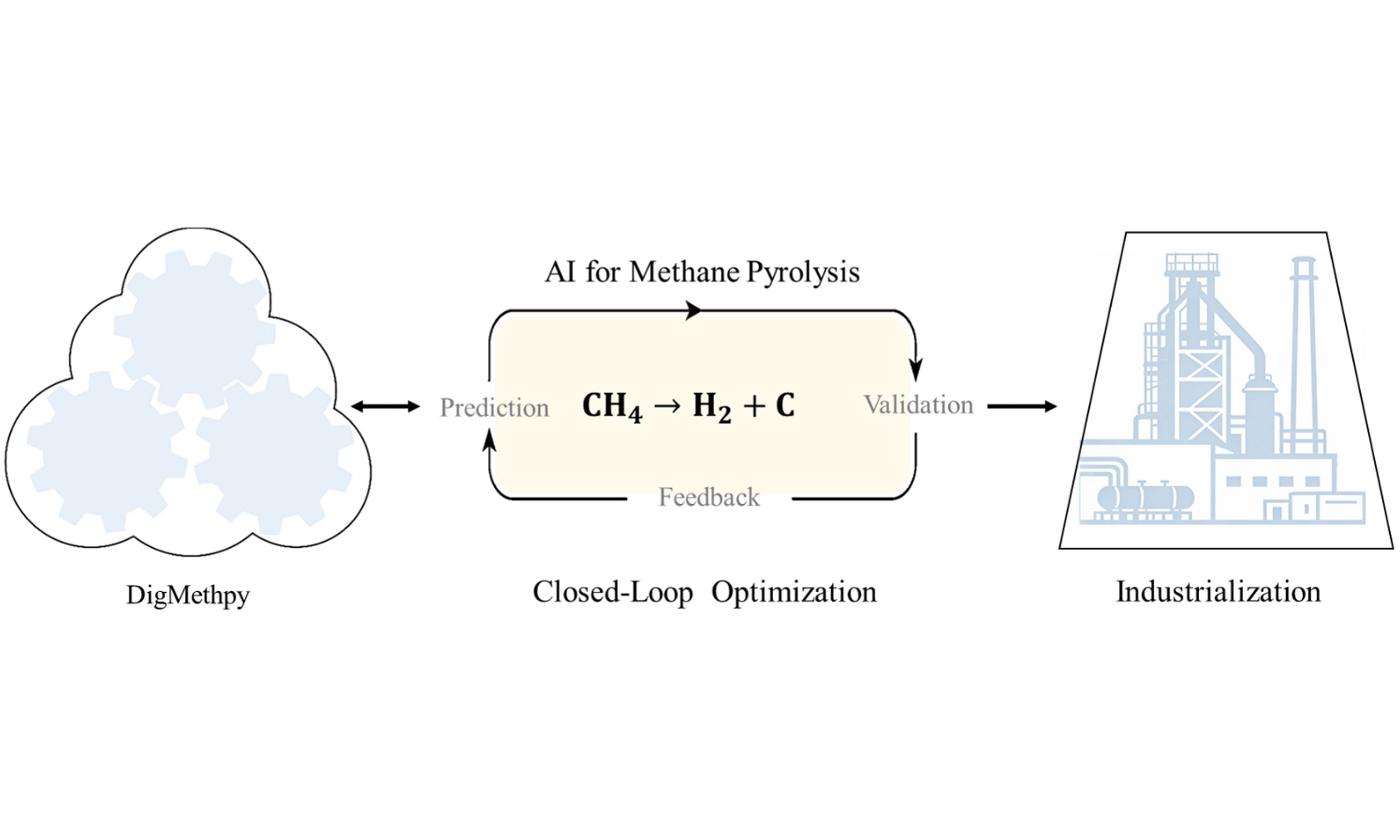
Methane pyrolysis via molten catalysts offers a transformative route for coke-free hydrogen production and high-value carbon capture. However, the development of molten catalysts is hindered by a vast compositional space and the disordered atomic structure of the molten state, which makes traditional trial-and-error experimentation inefficient. Here, we introduce an artificial intelligence-empowered digital catalysis platform (DigMethpy) to accelerate the development of molten catalysts. This platform integrates experimental and computational data with machine learning models, literature-based knowledge bases, and large language models, forming a closed-loop workflow of “data → model → prediction → validation”. It provides a data-centric framework for intelligent catalyst design by iteratively refining prediction models and intelligent agents through data feedback. The platform is poised to evolve from a single-agent workflow toward multi-agent collaboration and a self-driving system, offering a scalable digital infrastructure to connect the research community and accelerate the industrialization of methane pyrolysis.
Keywords
INTRODUCTION
In recent years, molten media-catalyzed methane pyrolysis has emerged as a transformative, coke-free pathway for carbon-neutral hydrogen production and high-value carbon capture[1-3]. This molten cracking method has emerged as a promising approach by introducing molten media (metals, alloys, and salts; Figure 1A) to form liquid reaction interfaces, enabling dynamic separation of carbon products and efficient heat transfer. These features effectively circumvent coking-induced catalyst deactivation commonly encountered in solid catalysts[4]. This strategy not only offers high catalytic efficiency and facile product separation but also facilitates the production of high-value carbon materials (e.g., graphene[5] and diamond[6]), providing a promising pathway toward the industrialization of methane pyrolysis.
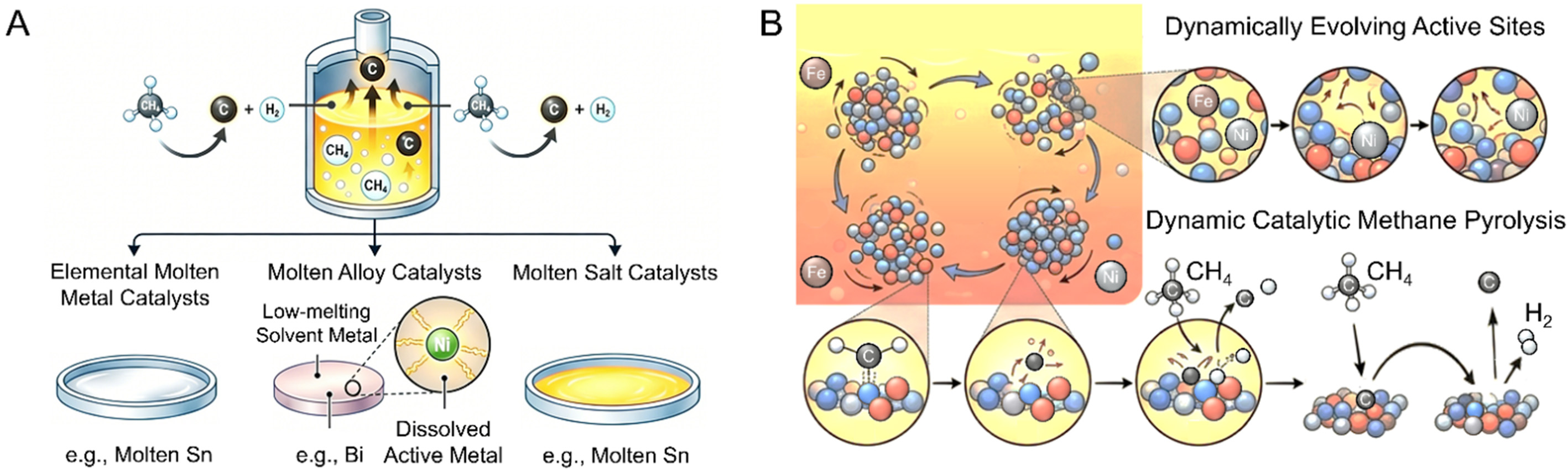
Figure 1. Classification and design challenges of molten catalysts for methane pyrolysis. (A) Overview of molten media classifications for methane pyrolysis; (B) Illustration of the disordered atomic structure and dynamically evolving active sites in molten catalysts, taking the Ni-Fe-based molten alloy system as an example.
Despite its considerable potential, the development of molten media as molten catalysts for methane pyrolysis remains in its infancy. To date, reported studies have been confined to a limited set of elemental compositions explored through experimental means[7], primarily due to two major challenges: (1) the vast combinatorial space of elemental compositions in molten systems renders the traditional trial-and-error experimental approach inefficient. Moreover, the energy-intensive conditions required for molten state experiments further hinder high-throughput screening; (2) the disordered atomic structure of molten catalysts leads to dynamically evolving active sites, making it challenging to elucidate underlying microscopic mechanisms and thereby limiting the theoretical design of such catalysts [Figure 1B][8,9].
With the rapid advancement of artificial intelligence (AI)-driven, data-centric technologies in recent years[10-12], a new design paradigm has emerged in catalysis research, surpassing traditional experimental and theoretical approaches. These technologies have evolved from auxiliary tools into scientific partners capable of generating hypotheses, designing experiments, and even facilitating new knowledge discovery. In particular, large language models (LLMs) are opening new opportunities in catalysis research, especially in literature understanding, knowledge extraction, and workflow orchestration[13,14]. By integrating knowledge from literature, experimental records, and computational data, LLMs extend catalyst design beyond coordinate-based representations by providing a text-centered layer that organizes heterogeneous information into actionable workflows[15]. Within this framework, domain-specialized LLMs have demonstrated strong agentic capabilities in catalytic applications. For example, several digital pyrolysis platforms (e.g., DigCat[16] and DigHyd[17]), which connect databases and LLMs, have been developed with agentic catalysis workflows and have already enabled multiple innovative outcomes[18,19]. To advance the integration of AI, data, and LLMs for agent development, we recently delineated an executable and iterative research roadmap: AI → Database → Universal Machine Learning Interatomic Potentials (MLIPs)/LLMs → Experimental Feedback[20]. This roadmap prioritizes establishing a robust data foundation, then expanding physical modeling capabilities, followed by introducing LLMs as a knowledge and workflow orchestration layer. Through iterative optimization informed by experimental validation and feedback, the system ultimately evolves into an agent. This direction is also consistent with recent discussions on digital materials ecosystems and AI agents, which emphasize that autonomous discovery depends not only on powerful models, but also on reliable databases, executable workflows, and structured feedback loops[21-23].
In this work, we present DigMethpy (https://www.digmethpy.org), an AI-enabled digital catalysis platform for methane pyrolysis. DigMethpy integrates high-quality datasets, machine learning (ML) predictive models, and LLMs within a unified framework. It incorporates structured experimental feedback and enables intelligent orchestration for catalyst design guidance. By covering the comprehensive workflow from data mining to validation, the system establishes an AI-driven, data-centric paradigm for autonomous catalyst discovery. Our preliminary data mining results confirm its effectiveness in applications such as the design of high-activity molten alloy catalysts for methane pyrolysis. Ongoing development aims to further expand its physical modeling capabilities by introducing large-scale simulations and agent automation to enhance overall system performance.
METHODS
In the workflow of DigMethpy, the dataset was constructed by extracting content using Gemini 2.5 Flash[24], where the conversion of PDF files into text and image formats was accomplished using MinerU[25]. All subsequent steps in the workflow were developed using the LangGraph package, enabling modular and robust pipeline construction for literature mining and data extraction. Ab initio molecular dynamics (MD) simulations[26] and first-principles calculations were performed using the projector augmented wave (PAW) method[27], as implemented in the Vienna ab initio simulation package (VASP)[28], to simulate the structural evolution and calculate the catalytic data of the molten media. To accurately account for long-range interactions between molten metal atoms, the dispersion correction method was incorporated[29], effectively compensating for the deficiencies of conventional GGA-PBE[30] in describing van der Waals forces, thus ensuring the accuracy of calculations involving weak adsorption and surface reaction barriers. To facilitate effective model training and evaluation for predicting Bader charge, we adopted a regression model as the backbone architecture and randomly shuffled the dataset and partitioned it into training and testing subsets using a 9:1 split ratio. During model training, cross-validation was employed as the primary evaluation method to ensure statistical robustness. This approach ensured that a substantial portion of the data was available for model learning while reserving a dedicated portion for rigorous performance validation, thereby enabling assessment of the generalization capability of the ML model. In the development of the AI agent, we chose Gemini as the integrated LLM and the Model Context Protocol (MCP)[31] as the method for exchanging contextual information between applications and the AI model. For experimental verification, molten catalytic methane pyrolysis was carried out using a molten bubble chemical vapor deposition (CVD) method[5], followed by treatment in a bubble column reactor under high-temperature reduction conditions.
RESULTS AND DISCUSSION
Figure 2 illustrates the architecture of the DigMethpy platform. Built upon a robust foundation of high-quality experimental and computational data, the platform integrates ML predictive models, literature-derived knowledge bases, and LLMs. The architecture is structured around three core modules: data extraction, data modeling, and language processing. The data extraction branch aggregates information from empirical experiments, computational simulations, and existing literature. The curated data are subsequently processed by ML models to generate predictive models. Ultimately, these models are combined and fed into the LLM to produce an autonomous catalyst discovery agent. To drive data scaling and iterative model optimization, DigMethpy employs a comprehensive workflow: data mining model construction catalyst prediction validation feedback. Currently, MLIP-enabled large-scale simulations for molten catalysis, agent evolution, and fully autonomous discovery remain under active development as future extensions rather than fully implemented capabilities.
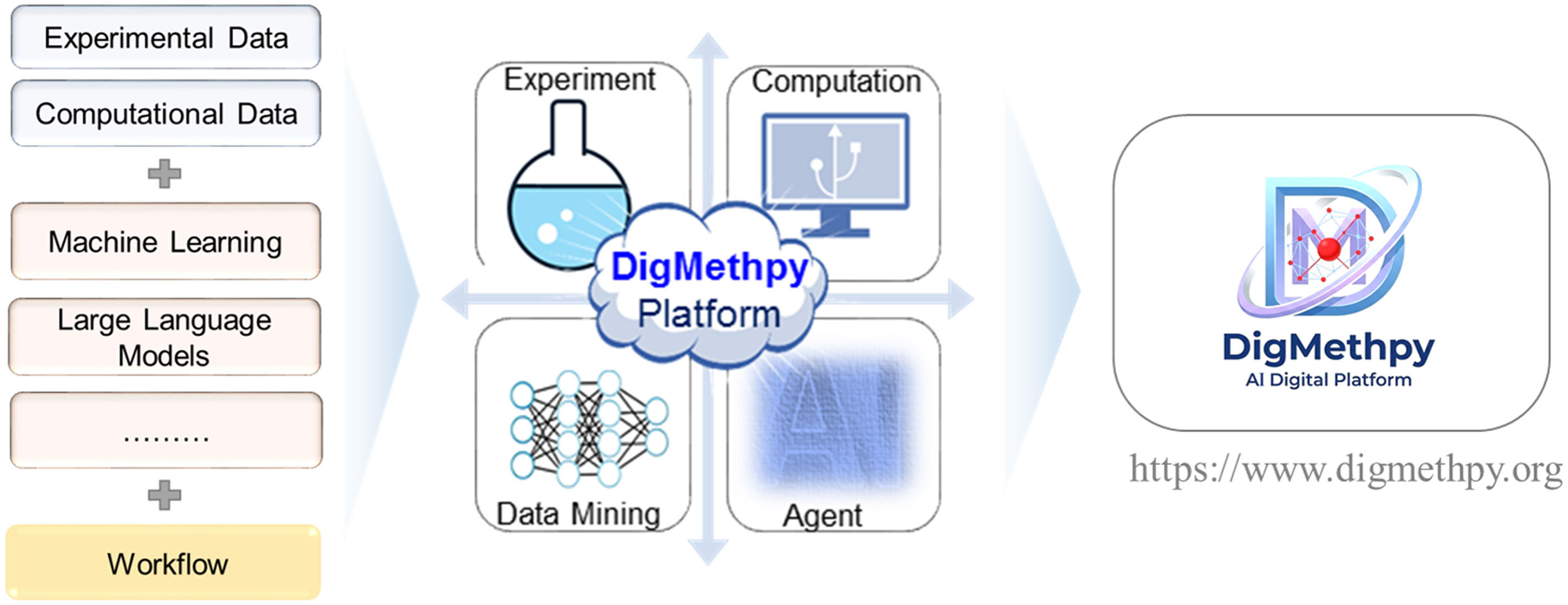
Figure 2. Overview of the evolving architecture and technical framework of the DigMethpy platform. The platform integrates databases, machine learning, LLMs, and related modules. LLMs: Large language models; AI: artificial intelligence.
The catalyst design process in DigMethpy follows a closed-loop strategy involving three key interconnected steps: data construction, data mining, and experimental verification, as illustrated in Figure 3.
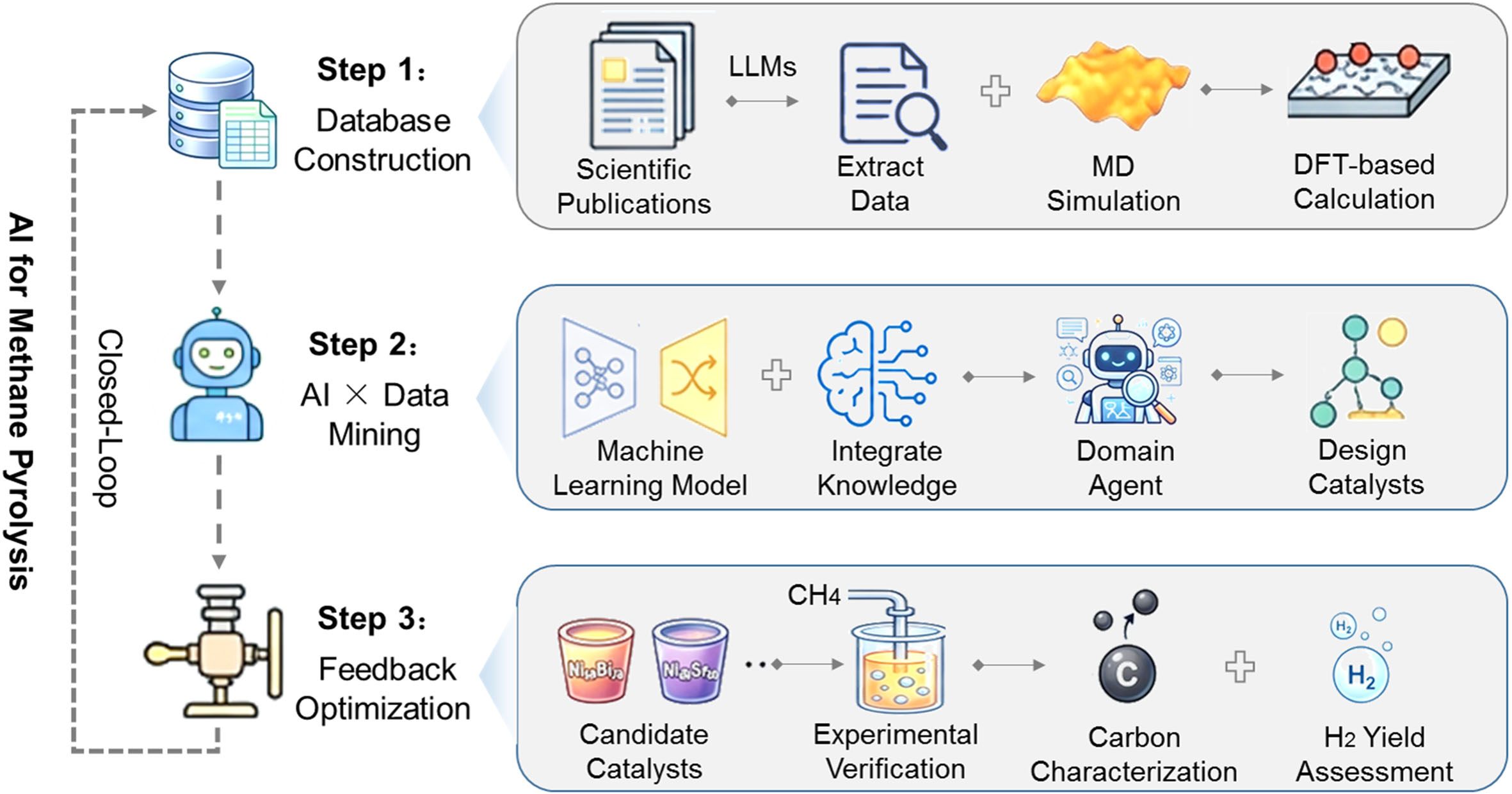
Figure 3. Three key steps within the closed-loop molten catalyst design workflow of the DigMethpy platform. The evolutionary pathway, associated technologies, and corresponding models are presented for each interconnected step. AI: Artificial intelligence; LLMs: large language models; MD: molecular dynamics; DFT: density functional theory.
Step 1 - Database Construction: The first step is database construction, in which experimental and computational data are integrated into the DigMethpy platform to establish the database infrastructure. DigMethpy mainly utilizes LLMs to extract text-/table-based data from methane pyrolysis publications. In addition to LLM-extracted data, the platform collects data from computational tools and pyrolysis experiments to compensate for the limited availability of methane pyrolysis literature. To improve data reliability, LLM-extracted text-/table-based records undergo an additional quality-control curation step before integration into the working database, including screening for consistency in composition, units, and experimental metadata. At the computational level, first-principles calculations can be performed through a workflow involving the generation of an amorphous “molten” surface by MD, adsorption of reactants, and calculation of catalytic properties based on density functional theory (DFT)[32]. The database includes correlated data on elements, alloys, catalytic activity, and melting points, including detailed feature vectors that describe molten element information (metal diffusivity, radial pair distribution function, charge distribution, and melting point) and catalytic performance (i.e., conversion efficiency, activation energy, and hydrogen adsorption energy). These complementary data extraction routes can process multiple data modalities and provide a more comprehensive basis for the next data-mining step.
Step 2 - AI Data Mining: This step involves AI-empowered approaches for molten catalyst design, primarily through ML- and LLM-based modeling to explore unknown compositional design spaces via feature engineering of the existing database[33]. The ML model contains two key components: an encoder and a decoder. The encoder learns features from the database inputs, and the decoder generates plausible media compositions from the learned latent representations. This framework enables the targeted generation of promising new catalyst compositions. In addition, by adopting LLMs, the platform integrates knowledge derived from the methane pyrolysis literature, thereby extending catalyst design through a text-centered layer that translates methane pyrolysis knowledge into actionable workflows. Within this framework, further integration with ML models could enable the development of a methane pyrolysis-specialized agent that serves as an expert-facing assistant for knowledge synthesis and hypothesis generation.
Step 3 - Feedback Optimization: In the last step, the most promising compositions are selected using a ranking-based policy. The top-ranked candidates then undergo thorough experimental verification for methane pyrolysis. If the experimental results align with the AI predictions, the candidate is validated as a successful discovery. Otherwise, the discrepancies are analyzed, and the resulting key data and findings are fed back into the DigMethpy database, forming a closed-loop data chain that updates the models and agent to improve the accuracy of subsequent predictions. Through repeated iterations, the workflow can ultimately identify ideal molten catalysts for methane pyrolysis. This iterative process not only refines the compositions of molten catalysts but also enhances the understanding of their properties and behaviors.
The current version of DigMethpy can be operationalized through AI-enabled tools to assist researchers in identifying optimized catalyst compositions and stoichiometric ratios worthy of experimental validation. At present, the DigMethpy database contains more than 40,000 curated data points from over 500 literature sources, together with computationally generated records, spanning molten metals, alloys, salts, and their multicomponent mixed systems relevant to methane pyrolysis, and covering descriptors and performance metrics such as composition, melting behavior, charge-related features, diffusivity, adsorption energetics, activation barriers, and methane conversion data. To gain insights into the activity of molten alloy catalysts, we analyzed the key performance metrics within the DigMethpy database. As a result, atomic charge was identified as an activity descriptor for methane pyrolysis: the lower the Bader charge of the active atoms in the alloy, the higher the catalytic activity[34,35]. To enable physically interpretable modeling, we compiled a dataset containing all known compositions and their primary elemental features, performed ML training, and obtained an optimal regression model for predicting Bader charge, as shown in Figure 4A. Based on this descriptor-driven data mining approach, together with two additional activity descriptors of the solute-metal diffusion coefficient and hydrogen adsorption energy, we designed the highly active quaternary molten alloy catalyst Bi70Ni18Cu6Co6 [Figure 4B]. Through experimental validation [Figure 4C], we further confirmed its high activity, achieving a methane conversion of 40.3% at 1,000 °C. More details can be found in our recent work[36].

Figure 4. (A) Machine learning regression model for Bader charge in the Bi-based alloy system; (B) Descriptor-based screening of molten alloy catalysts for CH4 pyrolysis; (C) Schematic illustration of the experimental validation of Bi70Ni18Cu6Co6 for CH4 pyrolysis; (D) Homepage of the DigMethpy platform. RMSE: Root mean square error; MAE: mean absolute error; R2: coefficient of determination; AI: artificial intelligence.
Within the DigMethpy platform (as shown in Figure 4, several integrated modules such as ML modeling and intelligent agents are being refined. This platform aims to establish a closed-loop digital design route for molten catalysts used in methane pyrolysis, featuring a “data + model + prediction + feedback” framework that enables automated data extraction, composition-property relationship mining, and intelligent agent design. It should be emphasized that the prescriptive analytics enabled by the synergy of data, machine intelligence, and expert knowledge constitute an iterative process that may not yield immediate results.
Looking ahead, the DigMethpy platform will be deeply integrated into the entire workflow of methane pyrolysis catalysis research, from AI-empowered design to experimental testing. Meanwhile, it will also draw on other materials-data domains, such as high-entropy alloys[37], significantly broadening the scope of catalyst prediction and facilitating adaptation to previously unexplored systems. These integrations will drive AI-empowered, data-informed rational design of molten catalysts and provide innovative solutions to the major scientific challenge of developing highly efficient, low-consumption catalysts for the industrialization of methane pyrolysis. We believe that catalyst design for methane pyrolysis will be propelled by the integration of DigMethpy, multimodal LLMs, and automation-driven data-mining systems, fostering an era in which molten catalyst discovery and methane pyrolysis applications reach unprecedented heights.
CONCLUSION
At the forefront of innovation, DigMethpy is built around the core principles of ML and LLMs, enabling a transformative approach to catalyst development for methane pyrolysis. The power of this digital platform lies in its efficient exploration of vast compositional spaces while maintaining scientific rigor. Looking to the future, DigMethpy aims to expand its capabilities through the development of MLIPs capable of enabling large-scale atomistic MD simulations to generate high-quality data and expand database capacity. Achieving this goal will likely require augmentation through multi-fidelity or delta learning to correct the limitations of baseline DFT, as well as knowledge distillation to reduce the cost of long MD runs. Meanwhile, through architectural innovation, DigMethpy aims to develop smarter systems that evolve from single-agent tool use to multi-agent collaboration. These systems would combine the logical reasoning and strategic planning capabilities of LLMs with multimodal data integration, automated physical MD simulations enabled by MLIPs, and image analysis capabilities, thereby significantly accelerating the research and development of new molten catalysts and further advancing the industrial development of methane pyrolysis.
Despite the promise of DigMethpy, several bottlenecks still limit fully predictive molten catalyst discovery, including sparse and heterogeneous literature data, incomplete coverage of multicomponent compositional spaces, the difficulty of representing dynamic liquid-phase active environments, and the current lack of broadly validated MLIP models for molten methane pyrolysis. Addressing these issues will be essential for advancing from descriptor-assisted ranking to robust closed-loop autonomous discovery. At present, DigMethpy is viewed as a practical first step toward an agentic infrastructure for molten catalyst design rather than a fully realized self-driving platform.
If these challenges can be overcome, the AI-powered DigMethpy platform and framework introduced here will not only address the slow pace of traditional experimental design and the challenges associated with the theoretical design of molten catalysts, but can also be extended to other areas of molten catalysis, such as NH3 pyrolysis, thereby opening new pathways for research and development in renewable energy-related industries.
DECLARATIONS
Authors’ contributions
Data collection, processing, and manuscript writing: Cheng, Z.
Database platform construction: Huang, X.; Liu, H.
Data analysis: Du, J.
Platform development: Ma, P.; Yin, H.
Data post-processing, platform construction guidance, and technical support: Zhang, D.; Li, H.; Chen Y.
Availability of data and materials
The data supporting this study are available from the corresponding author upon reasonable request. DigMethpy is available at https://www.digmethpy.org.
AI and AI-assisted tools statement
Not applicable.
Financial support and sponsorship
This work was supported by Akashic Technology Co., Ltd. (Chengdu, China) and Suzhou MatSource Technology Co., Ltd. (Suzhou, China). This work was also funded by the Science and Technology Project of PetroChina Southwest Oil & Gasfield Company (Chengdu, China) (No. 2024D112-03), JSPS KAKENHI (Tokyo, Japan) (Nos. JP25H01508, JP25K01737, JP25K17991, JP24K23068, and JP24K23069), and the Gusu Laboratory of Materials (Suzhou, China) (No. Y2501).
Conflicts of interest
Ma, P. is an Editorial Board Member of the journal AI Agent, and Li, H. is Editor-in-Chief of AI Agent. They were not involved in any stage of the editorial process, including reviewer selection, manuscript handling, or decision making. Yin, H. is affiliated with Akashic Technology Co., Ltd., and has declared no conflicts of interest. The other authors declared that there are no conflicts of interest.
Ethical approval and consent to participate
Not applicable.
Consent for publication
Not applicable.
Copyright
© The Author(s) 2026.
REFERENCES
1. Upham, D. C.; Agarwal, V.; Khechfe, A.; et al. Catalytic molten metals for the direct conversion of methane to hydrogen and separable carbon. Science 2017, 358, 917-21.
2. Son, J. H.; Park, G.; Lee, D.; et al. Selenium-promoted molten metal catalysts for methane pyrolysis: Modulating surface tension and catalytic activity. Appl. Catal. B. Environ. Energy. 2025, 366, 125009.
3. Sun, Z.; Wang, B.; Dummer, N. F.; et al. Modulating the interfacial energy of Ni-Bi molten alloys for enhanced methane decomposition to hydrogen. ACS. Catal. 2025, 15, 17333-46.
4. Msheik, M.; Rodat, S.; Abanades, S. Methane cracking for hydrogen production: a review of catalytic and molten media pyrolysis. Energies 2021, 14, 3107.
5. Tang, Y.; Peng, P.; Wang, S.; Liu, Z.; Zu, X.; Yu, Q. Continuous production of graphite nanosheets by bubbling chemical vapor deposition using molten copper. Chem. Mater. 2017, 29, 8404-11.
6. Gong, Y.; Luo, D.; Choe, M.; et al. Growth of diamond in liquid metal at 1 atm pressure. Nature 2024, 629, 348-54.
7. Moghaddam, A. L.; Hejazi, S.; Fattahi, M.; et al. Methane pyrolysis for hydrogen production: navigating the path to a net zero future. Energy. Environ. Sci. 2025, 18, 2747-90.
8. Zhang, X.; Chen, J.; Gao, G.; et al. The activity origin of C-N-Cu electrocatalysts for ethanol formation in the CO2 reduction reaction under working conditions. J. Mater. Chem. A. 2024, 12, 3580-8.
9. Zhang, X.; Chen, J.; Wang, H.; et al. Dynamic structural evolution of single-atom catalysts at the catalyst-electrolyte interface: insights from electrochemical coupled field. Nano. Lett. 2025, 25, 6332-9.
10. Huang, W.; Martin, P.; Zhuang, H. L. Machine-learning phase prediction of high-entropy alloys. Acta. Mater. 2019, 169, 225-36.
11. Liu, X.; Zhang, J.; Pei, Z. Machine learning for high-entropy alloys: progress, challenges and opportunities. Prog. Mater. Sci. 2023, 131, 101018.
12. Toyao, T.; Maeno, Z.; Takakusagi, S.; Kamachi, T.; Takigawa, I.; Shimizu, K. Machine learning for catalysis informatics: recent applications and prospects. ACS. Catal. 2019, 10, 2260-97.
13. Suvarna, M.; Pérez-ramírez, J. Embracing data science in catalysis research. Nat. Catal. 2024, 7, 624-35.
14. Jia, X.; Wang, T.; Zhang, D.; et al. Advancing electrocatalyst discovery through the lens of data science: state of the art and perspectives. J. Catal. 2025, 447, 116162.
15. Zhang, D.; Li, H. The hidden engine of AI in electrocatalysis: databases and knowledge graphs at work. MCE 2025, 1, 100003.
16. Zhang, D.; Li, H. Digital catalysis platform (DigCat): a gateway to big data and AI-powered innovations in catalysis. ChemRxiv 2026. Available online: https://doi.org/10.26434/chemrxiv-2024-9lpb9/v3 (accessed 11 May 2026).
17. Zhang, D.; Jia, X.; Tran, H. B.; et al. “DIVE” into hydrogen storage materials discovery with AI agents. Chem. Sci. 2026, 17, 3031-42.
18. Wang, X.; Li, Z.; Zhang, D.; Li, H.; Xu, H.; Cheng, D. Catalysis AI agent guides discovering the universal design principle of Cu‐based single‐atom alloy catalysts for CO2 electroreduction. Angew. Chem. Int. Ed. 2026, e24612.
19. Chen, Y.; Huang, X.; He, Y.; et al. Data-driven strategies for designing multicomponent molten catalysts to accelerate the industrialization of methane pyrolysis. ACS. Catal. 2025, 15, 11003-12.
20. Zhang, D.; Chen, Y.; Liu, C.; et al. Accelerating catalyst materials discovery with large artificial intelligence models. Angew. Chem. Int. Ed. 2026, 65, e26150.
21. Zhang, D.; Jia, X.; Wang, Y.; et al. Digital materials ecosystem: from databases to AI agents for autonomous discovery. Chem. Sci. 2026, 17, 5782-804.
22. Zhuang, Y.; Yang, X.; Zhang, C.; et al. Materials databases: foundations of modern digital materials. Precis. Chem. 2026.
24. Comanici, G.; Bieber, E.; Schaekermann, M.; et al. Gemini 2.5: pushing the frontier with advanced reasoning, multimodality, long context, and next generation agentic capabilities. arXiv 2025, arXiv:2507.06261. Available online: https://doi.org/10.48550/arXiv.2507.06261 (accessed 11 May 2026).
25. Wang, B.; Xu, C.; Zhao, X.; et al. MinerU: an open-source solution for precise document content extraction. arXiv 2024, arXiv:2409.18839. Available online: https://doi.org/10.48550/arXiv.2409.18839 (accessed 11 May 2026).
26. Kresse, G.; Hafner, J. Ab initiomolecular-dynamics simulation of the liquid-metal-amorphous-semiconductor transition in germanium. Phys. Rev. B.. Condens. Matter. 1994, 49, 14251-69.
27. Blöchl, P. E. Projector augmented-wave method. Phys. Rev. B.. Condens. Matter. 1994, 50, 17953-79.
28. Kresse, G.; Furthmüller, J. Efficient iterative schemes for ab initio total-energy calculations using a plane-wave basis set. Phys. Rev. B.. Condens. Matter. 1996, 54, 11169-86.
29. Grimme, S.; Antony, J.; Ehrlich, S.; Krieg, H. A consistent and accurate ab initio parametrization of density functional dispersion correction (DFT-D) for the 94 elements H-Pu. J. Chem. Phys. 2010, 132, 154104.
30. Perdew, J. P.; Burke, K.; Ernzerhof, M. Generalized Gradient Approximation Made Simple. Phys. Rev. Lett. 1996, 77, 3865-8.
31. Hou, X.; Zhao, Y.; Wang, S.; Wang, H. Model context protocol (MCP): landscape, security threats, and future research directions. ACM. Trans. Softw. Eng. Methodol. 2026, 3796519.
32. Palmer, C.; Tarazkar, M.; Kristoffersen, H. H.; et al. Methane pyrolysis with a molten Cu-Bi alloy catalyst. ACS. Catal. 2019, 9, 8337-45.
33. Du, J.; Yan, Y.; Li, X.; et al. A mechanism-guided descriptor for the hydrogen evolution reaction in 2D ordered double transition-metal carbide MXenes. Chem. Sci. 2025, 16, 9424-35.
34. Kim, T.; Lee, J.; Ko, Y.; Chong, G.; Kang, D.; Kwon, H. Catalytic molten Zn-Bi alloys for methane pyrolysis. Chem. Eng. J. 2025, 509, 161304.
35. Chen, L.; Song, Z.; Zhang, S.; et al. Ternary NiMo-Bi liquid alloy catalyst for efficient hydrogen production from methane pyrolysis. Science 2023, 381, 857-61.
36. Liu, H.; Cheng, Z.; Huang, X.; et al. Closed-loop framework for descriptor-empowered exploring high-activity co-based quaternary molten alloys catalysts for methane pyrolysis. ChemRxiv 2026. Available online: https://doi.org/10.26434/chemrxiv.15002240/v3 (accessed 11 May 2026).
Cite This Article
 Open Access
How to Cite
Download Citation
Export Citation File:
Type of Import
Tips on Downloading Citation
Citation Manager File Format
Type of Import
Direct Import: When the Direct Import option is selected (the default state), a dialogue box will give you the option to Save or Open the downloaded citation data. Choosing Open will either launch your citation manager or give you a choice of applications with which to use the metadata. The Save option saves the file locally for later use.
Indirect Import: When the Indirect Import option is selected, the metadata is displayed and may be copied and pasted as needed.
About This Article
Copyright

Data & Comments
Data
0





Comments
Comments must be written in English. Spam, offensive content, impersonation, and private information will not be permitted. If any comment is reported and identified as inappropriate content by OAE staff, the comment will be removed without notice. If you have any queries or need any help, please contact us at [email protected].